Email Popups Are Dying. Shoppers Are Still Talking.
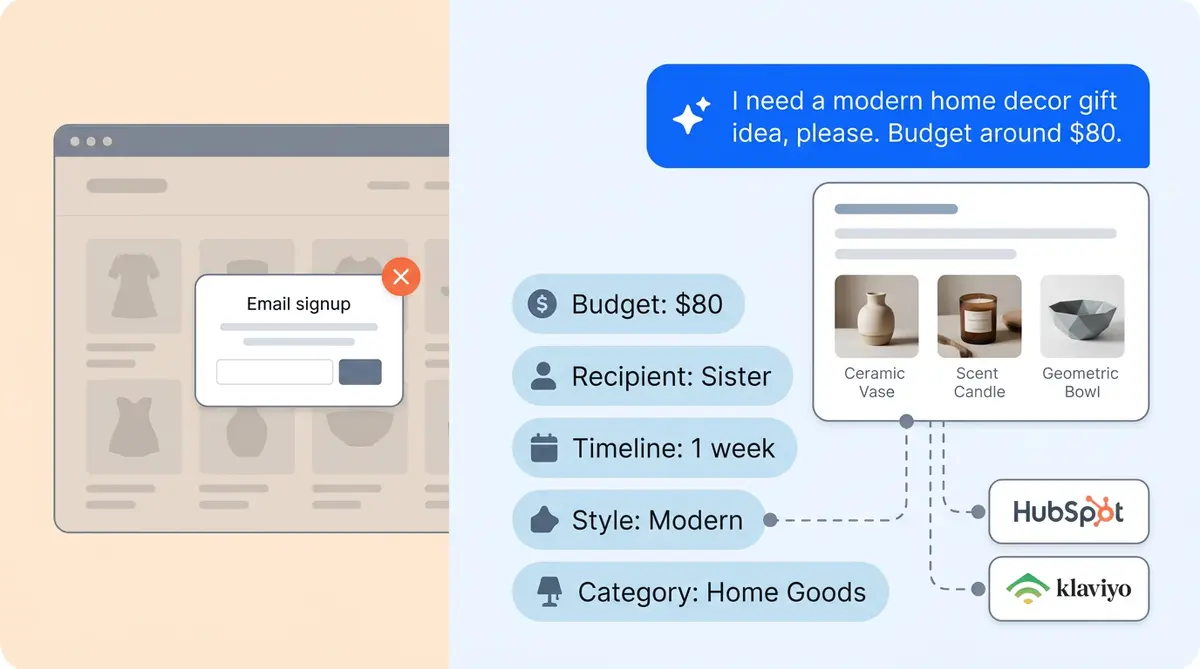
Email popup conversion rates have dropped below 2%. Shoppers close modals without reading them. Customer banner blindness now extends to every form-based capture method on your site, from embedded forms to exit-intent overlays. GDPR and cookie consent requirements have made behavioral tracking harder and more expensive. Traditional lead generation is costing more and delivering less. For ecommerce businesses, organizations, and DTC brands, the generation process and related processes need a reset.
But those same shoppers who ignore every popup willingly share their skin type, size preference, budget range, and purchase timeline when talking to an AI shopping assistant. They aren't filling out a form. They're shopping. And every answer is a lead signal that no popup or form software could ever capture.
This post breaks down how conversational AI turns natural shopping exchanges into qualified leads, what information it captures across verticals, and how to measure whether it outperforms your current lead gen strategy, generate leads more efficiently, and outperform your existing stack. Whether you sell beauty products, home furnishing, fashion, or services, this approach ensures your target audience targeting improves with every interaction.
What Is Zero-Form Conversational Lead Capture?
When a shopper tells the AI "I'm looking for a gift for my wife's birthday next week, she likes minimalist jewelry, budget around $200," that single sentence contains five data points: purchase timeline, relationship context, style preference, product category, and budget. The AI answers the shopping question and simultaneously captures all five as CRM attributes, without asking the shopper to fill out anything.
This is zero-party data at its richest. The customer volunteered it naturally in pursuit of their own goal. No incentive bribe, no "10% off for your email" tradeoff. The data is richer because it actually reflects real, verified purchase intent, not a generic newsletter signup. Retail organizations and DTC brands are built to benefit from this shift.
Alhena AI's Lead Generation Agent is purpose-built for this. It runs alongside the Shopping Assistant and Support Concierge, so the shopper gets expert product guidance while your CRM gets enriched. Every AI interaction becomes both a shopping experience and a lead qualification event.
Five Scenarios: What AI Extracts From Natural Conversations
AI powered lead capture works across every ecommerce vertical and use cases and business cases. In 2026, smarter, smart AI-powered targeting with smart segmentation and smart routing is making this generation process faster and more effective than legacy methods. Here's what AI lead generation looks like in practice.
Beauty
"What's good for acne-prone oily skin?" The AI captures skin type and skin concern, recommends specific products, and routes the contact to a free skincare regimen email sequence in HubSpot or Klaviyo. A popup would have captured an email address. The conversation captured two attributes that make the follow-up email actually relevant.
Fashion
"Do you have this in medium? I usually fall between M and L." The AI captures size range and fit uncertainty, answers the sizing question, and routes the contact to a size-guide follow-up sequence, triggering targeted sequences automatically. That fit hesitation signal is invisible to any form.
Home Goods
"Will this couch fit in a 12 by 14 living room?" The AI captures room dimensions and product interest, provides a helpful answer, and routes the contact to a design consultation workflow. No popup asks for room measurements. Traditional tools can’t capture this level of detail.
Gift Shopping
"I need something for my partner who loves gardening, under $80." The AI analyzes recipient relationships, interests, and budget to deliver curated gift suggestions. Three attributes from one sentence, all volunteered naturally.
Subscription
"Can I try this for a month before committing?" The AI captures subscription hesitation and routes to a trial offer automation sequence that can automate follow-up. That hesitation signal tells your marketing team and sales team exactly which objection to address.
In every case, the shopper gets a helpful answer. The CRM gets enriched. No friction was added to the shopping experience.
Hidden Lead Qualification Signals That Forms Can't Capture
Beyond explicit preferences, AI exchanges reveal intent signals that traditional lead capture methods miss entirely.
Purchase urgency. "Can I get this by Friday?" signals a hot customer lead ready to buy now. A form captures the same email whether the shopper needs something today or is browsing for next year.
Product specificity. Asking about a specific SKU versus general category discovery and browsing signals high purchase intent. The AI can identify the difference instantly. Your popup doesn't.
Price sensitivity. "Do you have something similar but cheaper?" signals a price-conscious buyer who responds to discount-based nurture campaign sequences, not aspirational brand emails.
Comparison behavior. "How does this compare to the gel version?" helps identify a late-stage evaluator weighing final options. This contact needs a product comparison email, not a welcome series.
Repeat interest. Multiple sessions asking about the same category signals a nurture candidate who hasn't converted yet. First-party data intelligence identifies and tracks these patterns over time, helping your team identify high-value prospects and identify the right follow-up for each lead.
Each signal triggers a different workflow in your CRM. Alhena AI's Lead Generation system maps these signals to HubSpot contact properties or feeds behavioral data to Klaviyo for email segmentation, turning raw chat data into actionable, predictive lead scoring and lead management insights that traditional lead scoring methods can’t match.
How Alhena AI's Lead Generation Agent Works
Alhena AI includes a purpose-built Lead Generation Agent, one of several specialized AI agents, that extracts configured attributes from natural shopping interactions automatically. Here's the technical architecture.
Default attributes (email, first name, last name) are pre-configured out of the box. The AI captures these when shoppers share them naturally during conversation, or prompts for email when contextually appropriate.
Custom attributes map to any CRM property. You define the attribute name (matching your HubSpot or Klaviyo internal property name), add a description that guides the AI on what to extract, and optionally include value examples. Skin type, size preference, budget range, room dimensions: if your CRM has a property for it, Alhena's Lead Generation Agent can populate it from conversation.
Every extracted attribute creates or updates the contact record in HubSpot, or feeds profile data to Klaviyo for segmentation. The Klaviyo integration also captures conversation context automatically: page URL, visitor location, and UTM parameters. When a shopper provides consent, they're subscribed to your email marketing list. With consent and a phone number, SMS too.
The Lead Generation Agent works alongside the Product Expert Agent and Order Management Agent. There's no tradeoff. Your lead capture processes and shopping experience run in parallel. Both happen in the same session.
Measuring Conversational Lead Capture vs. Traditional Forms
Three metrics tell you whether AI-powered lead generation engine outperforms your current approach.
Leads captured per 1,000 sessions. Compare chat-sourced leads per 1,000 chat sessions against popup leads per 1,000 pageviews. This normalizes for traffic differences and gives you a direct capture rate comparison.
CRM enrichment rate. Measure the percentage of contacts with three or more attributes populated from chat. A popup gives you an email. Alhena AI gives you an email plus skin type plus purchase timeline. Richer profiles (based on verified chat data, not guesswork) mean better segmentation, deeper personalization and higher email conversion rates and customer satisfaction.
Chat-sourced lead-to-purchase conversion rate. Track how chat-captured leads convert compared to popup-captured leads. Brands using Alhena AI's AI shopping assistant see 3x higher conversion rates and 38% AOV uplift because the AI qualifies and guides buyers in the same session that captures their data.
Use your ROI calculator to model the revenue impact before you start. Most brands see results within minutes of the AI engaging website visitors, not weeks of waiting for form submissions to trickle in.
Lead Generation That Doesn't Feel Like Lead Generation
The best lead generation doesn't feel like lead generation to the shopper. It feels like getting help. Information flows naturally in both directions. The shopper asks about sizing, shares their skin concerns, describes their living room, or explains who they're shopping for. They get a useful answer. Your CRM gets a qualified, enriched contact record.
The brands that replace popup friction with AI-powered intelligence will capture richer data, qualify leads faster, qualify buyers more accurately, grow your sales pipeline, build a stronger pipeline of qualified buyers, and convert at higher rates. Not because they found a better form design, but because the shopper never had to stop shopping to become a lead.
Ready to turn your AI chats into qualified leads? Book a demo with Alhena AI today. Ready to see it in action? Book a demo now or start for free with 25 conversations.
AI-Powered Lead Scoring From Chat Conversations
Traditional lead scoring assigns points based on page views, email opens, and form fills. AI powered lead scoring goes deeper. When a customer tells the AI they need a product by Friday, that urgency signal is worth more than ten page views. When they ask about a specific SKU and compare it to alternatives, that buying intent outscores any number of newsletter clicks.
Alhena AI's Lead Generation Agent builds a real-time lead score from conversation signals. Each interaction updates the customer profile with behavioral data that traditional marketing automation software can't capture. The AI tools within the platform assign weight to different signals automatically:
- High urgency (delivery deadline mentioned): qualifies leads as sales-ready immediately
- Product-specific inquiry (asked about a named SKU): high-intent lead, route to personalization workflow
- Price comparison (asked for cheaper options): qualify leads for discount campaign sequences
- Repeat category interest (multiple sessions, same category): nurture candidate for targeted outreach
- Subscription hesitation (asked about trial options): route to trial offer automation strategy
This AI model for lead scoring turns every conversation into a qualify leads event. Instead of guessing which inbound visitors are ready to buy based on pageview patterns, you know exactly where each customer stands because they told the AI directly. The lead scoring data syncs to HubSpot and Klaviyo in real time, so your sales team and marketing automation workflows act on live intent signals, not stale form data.
How AI Lead Generation Compares to Traditional Lead Gen Software
Most AI tools for lead generation were built for B2B outbound sales. Platforms like LinkedIn Sales Navigator, Leadfeeder, and Zoho SalesIQ are designed to identify prospects from website visits or professional networks. They score leads based on company size, job title, and website behavior. These tools work well for B2B software sales where the goal is to book a meeting.
Ecommerce lead generation is fundamentally different. Your customers aren't filling out demo request forms or downloading whitepapers. They're browsing product pages, asking about sizing, and comparing options. The AI tools that work for B2B outreach and cold email campaigns don't capture the preference data that ecommerce brands need for personalization and segmentation.
Alhena AI is purpose-built as ecommerce lead generation software. Where Sales Navigator helps B2B sales reps find prospects by job title, Alhena's AI powered chatbot finds buyer intent from product conversations. Where Leadfeeder and similar lead generation tools identify anonymous website visitors by company, Alhena identifies individual customer preferences by what they say. Where SalesIQ tracks pageview sequences, Alhena captures stated needs, budgets, and timelines.
The strategy is different because the customer journey is different. Ecommerce AI lead generation doesn't need outbound prospecting or cold email automation to automate outbound sequences. It needs inbound conversation intelligence that qualifies leads while helping them shop. That's why Alhena's approach generates richer data and higher conversion rates and high quality leads than repurposing B2B lead gen tools for an ecommerce use case.
Why Ecommerce Lead Generation Tools Need a Different Approach
Traditional lead generation tools were designed for a sales funnel that starts with a landing page, captures contact information through a lead magnet (discount code, free guide, quiz), and pushes potential customers into an email marketing drip campaign. This sales process works when your target audience is willing to trade their details for something valuable. The problem is that modern website visitors increasingly aren't willing. They skip the landing page popup, ignore the lead magnet, and leave without entering the sales funnel at all.
Ecommerce lead generation tools need to generate leads differently. Instead of interrupting the shopping experience with forms, the best AI-powered approach uses natural language processing, machine learning, and AI model intelligence to extract lead data from the conversations website visitors are already having. Your potential customers don't stop to fill out a form. They ask questions about products, and the AI captures their preferences, intent signals, and contact information as part of the answer.
This shift from form-based to conversation-based lead management means you can automate lead capture at every touchpoint: web chat, social media DMs, email replies, and even voice calls. You can automate the entire lead qualification and lead management workflow without adding friction. The AI handles the natural language understanding, scores intent signals in real time, and routes high quality leads to the right campaign or sales team member automatically.
Content marketing and social media still drive traffic to your store. Landing pages still convert some visitors. But the majority of your website visitors won't fill out a form. Conversational AI lead generation tools capture the visitors that every other lead generation tool misses, turning shopping questions into qualified leads and business growth into a predictable, automated process.
Frequently Asked Questions
How does AI capture leads without forms or popups?
Alhena AI's Lead Generation Agent listens to natural shopping conversations and extracts configured attributes (email, preferences, budget, sizing) as shoppers ask product questions. The shopper never fills out a form. They're getting product help, and the AI captures lead data from what they share during the conversation. Default attributes like email, first name, and last name are pre-configured, and you can add unlimited custom attributes mapped to your CRM properties.
What zero-party data can AI chatbots collect from shopping conversations?
Alhena AI can capture any attribute you configure: skin type, size preference, budget range, room dimensions, gift recipient details, purchase timeline, product interests, and subscription intent. These are zero-party data points the shopper volunteers while shopping, not inferred from cookies or browsing behavior. Each attribute maps directly to a HubSpot contact property or Klaviyo profile field for immediate segmentation.
Does AI-driven lead capture replace email popups entirely?
For many brands, yes. Conversational lead capture through Alhena AI generates richer contact records than popups because it captures multiple attributes per interaction, not just an email address. A popup converts below 2% and gives you a single data point. An AI conversation captures 3 to 5 attributes while helping the shopper discover what they need. Some brands keep a minimal popup as a fallback but find that AI-sourced leads actually convert at significantly higher rates due to richer profile data.
What CRM properties can Alhena AI extract from chat automatically?
Any property in your CRM. Alhena AI's Lead Generation tool lets you define custom attributes by specifying the internal property name from HubSpot or Klaviyo, adding a description that guides the AI on what to extract, and providing optional value examples. If your CRM has a field for it (skin concern, preferred size, budget range, room dimensions), the AI can populate it from conversation. The Klaviyo integration also captures page URL, visitor location, and UTM parameters automatically.
How do you measure AI lead generation ROI versus traditional forms?
Track three metrics: leads captured per 1,000 chat sessions versus popup leads per 1,000 pageviews, CRM enrichment rate (percentage of contacts with three or more attributes from chat), and chat-sourced lead-to-purchase conversion rate. Alhena AI's built-in analytics dashboard with built-in attribution tracks these automatically, and the ROI calculator at alhena.ai/roi-calculator lets you model revenue impact before deployment.
Can one AI conversation feed both CRM and email platforms simultaneously?
Yes. Alhena AI's Lead Generation Agent syncs extracted attributes to HubSpot for CRM management and Klaviyo for email marketing and SMS marketing in real time. A single chat session where a shopper asks about acne-prone skincare creates a HubSpot contact with skin type and concern properties while simultaneously adding a Klaviyo profile subscribed to your skincare segment. Both platforms receive the data from one interaction, with no duplicate entry or manual import needed.
How quickly can ecommerce brands deploy AI lead generation with Alhena?
Alhena AI deploys in under 48 hours with no developer resources required. The Lead Generation Agent activates when you connect your HubSpot or Klaviyo account, connect your product catalog or Klaviyo integration, configure your custom attributes, and define extraction descriptions. Most brands are capturing enriched leads from AI chat within two days of starting setup, and the AI improves extraction accuracy as it handles more traffic on your store.