Why Health and Wellness Shoppers Struggle Online
Walk into a health food store and a knowledgeable associate will ask about your goals, dietary restrictions, and existing supplements before pointing you to a shelf. Online, that experience vanishes. You're left with a search bar for online shopping, 300 product listings, and the hope that the third-party reviews aren't fake.
The numbers confirm this frustration across the global wellness business. According to Accenture's research across 19,000 consumers, 73% feel overwhelmed by too much choice online, and 74% have abandoned a purchase because of it. In health and wellness specifically, cart abandonment sits at 69%, climbing to nearly 81% for beauty and personal care.
Health products come with extra complexity that other categories don't. The management of ingredient lists, dosage processes, and compliance details overwhelms most shoppers. Shoppers need to check ingredient lists for allergens, compare dosage forms, verify third-party certifications, and figure out whether a supplement interacts with medications they already take. A Constructor study found that 42% of online shoppers rate product discovery experiences as "C" grade or below. For health-conscious buyers, that poor discovery experience doesn't just cost a sale. It erodes trust in the brand itself.
Three pain points stand out:
- Choice overload: A typical supplement brand carries dozens of SKUs across vitamins, minerals, adaptogens, and blends. Without expert guidance, shoppers freeze.
- Trust deficit: More than 70% of wellness consumers prefer brands that clearly list ingredients and their origins, according to Coherent Market Insights. When that transparency is missing, buyers leave.
- Decision anxiety: Health purchases carry personal consequences. Choosing the wrong protein powder is annoying; choosing the wrong supplement when you have a medical condition can be harmful.
What Guided Shopping Actually Means for Health Brands
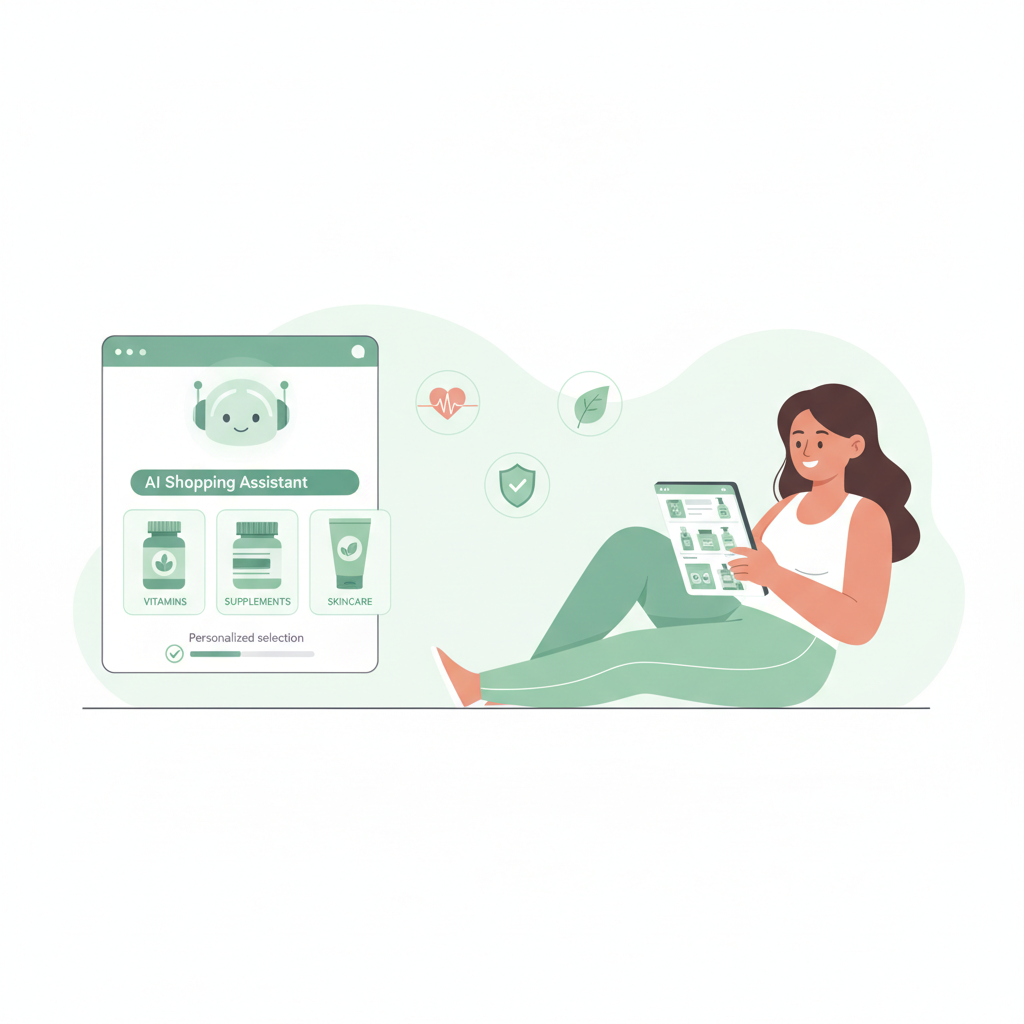
Guided shopping technology replaces the traditional "browse and hope" model with an AI-led conversation that narrows thousands of options to the right product in minutes. Think of it as the digital version of that health store associate, except it's available 24/7 and remembers every product detail across your entire catalog.
Here's how it works in practice. A first-time visitor lands on a wellness brand's site looking for sleep support. Instead of scrolling through 40 products, they interact with an AI shopping assistant that asks targeted questions: "Are you looking for a supplement, a topical product, or a sleep device?" "Do you have any dietary restrictions like vegan or gluten-free?" "Are you currently taking any other supplements?"
Based on the answers, the AI surfaces two or three products that match. It explains why each one fits, highlights relevant certifications (NSF, USP, third-party tested), and answers follow-up questions about dosage and timing. The shopper goes from overwhelmed to confident in under two minutes.
This isn't the same as a basic product quiz or old-school chatbots. Generative AI shopping assistants are different. Static quizzes follow predetermined paths and can't handle unexpected questions. AI guided shopping adapts in real time, using artificial intelligence to read context and respond dynamically. If the shopper mentions they're pregnant, the AI immediately filters out products with contraindicated ingredients. If they ask about combining two supplements, it provides guidance based on the brand's verified product data.
The conversion impact is significant. According to industry data, shoppers who engage with AI chat convert at 12.3%, compared to 3.1% for those who don't. That's a 4x improvement. They also complete purchases 47% faster and are more likely to add complementary products to their cart.
How AI Improves Product Discovery in Health Ecommerce
Traditional site search fails health shoppers in a specific way: it matches keywords, not intent. A customer searching "energy supplement without caffeine" on most ecommerce sites gets results stuffed with caffeine-heavy pre-workouts because "caffeine" appears in the listing. AI-powered product discovery understands the "without" qualifier and filters accordingly.
Natural language processing, one of the most practical AI applications on ecommerce platforms, lets shoppers describe what they need in their own words. "Something for joint pain that won't upset my stomach" is a perfectly valid query for an AI shopping assistant. So is "vegan collagen alternative under $40." The AI parses these multi-layered requests and matches them against product attributes, ingredient lists, and customer reviews to surface the best options.
For health and wellness brands invested in growth and business development, this kind of discovery is worth real revenue. McKinsey reports that companies leading in personalization generate 40% more revenue than average performers. AI product recommendations drive 15 to 22% higher average order values, according to Envive's analysis.
The health category benefits disproportionately from better discovery because of how products relate to each other. Someone buying magnesium glycinate for sleep often benefits from adding vitamin B6, which supports magnesium absorption. An AI that understands these relationships can suggest evidence-based bundles that help the customer and increase basket size at the same time.
Brands like Hims and Hers have proven this model at scale. By investing in AI-driven personalization, 70% of their Q3 2025 online revenue came from personalized offerings, up from 50% the prior year, contributing to $1.5 billion in 2024 revenue.
Building Customer Trust with AI That Gets It Right
Trust is the single biggest conversion driver in health ecommerce. Shoppers aren't just buying a product; they're putting something in their body. If the AI recommends a supplement that contradicts their doctor's advice or makes an unsubstantiated health claim, the brand's credibility takes a hit that no discount code can fix.
This is where the distinction between generic chatbot tools and purpose-built ecommerce AI technologies matters. A general-purpose chatbot trained on internet data might tell a customer that ashwagandha "cures anxiety," which violates FDA guidelines on structure/function claims. A hallucination-free AI shopping assistant grounded in the brand's verified product data will say the supplement "supports stress response," because that's the approved claim on the label.
The regulatory stakes are real. The FTC has filed over 120 cases against supplement companies for misleading health claims in the last decade, and their Operation AI Comply initiative specifically targets deceptive claims generated by AI. Brands need AI that enforces compliance guardrails automatically, not one that creates liability.
Trust-building AI goes beyond avoiding bad claims. While the technology can't replace treatment advice from healthcare providers or patients' relationships with doctors, it can surface clinical trials data and verified certifications that build confidence. It actively builds confidence by surfacing the right information at the right moment: third-party test results when a shopper asks about purity, clinical study references when they question efficacy, and clear ingredient sourcing details when they care about origin. When the AI encounters a question it can't answer safely (like a medical interaction query), it escalates to a human agent with full conversation context rather than guessing.
Brands like Victoria Beckham have seen a 20% increase in average order value after implementing AI that provides accurate, brand-aligned product guidance. When customers trust the recommendations, they buy more. It's that straightforward.
From Discovery to Checkout: The AI-Powered Customer Journey
The gap between "I found what I want" and "I actually bought it" is where health brands lose the most revenue. A shopper might spend ten minutes getting a great recommendation from the AI, add the product to their cart, and then abandon at checkout because they have a last-minute question about returns, shipping speed, or subscription options.
A complete AI solution with real-time capabilities can deliver quality services across the entire journey, not just the product discovery phase. Here's what that looks like for a health and wellness brand:
- Arrival and engagement: The AI greets the visitor with a relevant prompt based on their behavior. A returning customer sees "Welcome back! Ready to reorder your vitamin D?" A new visitor on the supplements category page sees "Looking for something specific? I can help you find the right fit."
- Guided discovery: Through conversational questions, the AI narrows the catalog to two or three products matched to the shopper's health goals, dietary needs, and budget.
- Objection handling: When hesitation creeps in, the AI detects it. Maybe the shopper has been on the product page for three minutes without adding to cart. The AI offers a contextual nudge, perhaps a comparison with a similar product, a quick summary of verified reviews, or a reminder about the money-back guarantee.
- Cart and checkout: The AI can populate the cart directly and pre-fill checkout fields, reducing friction at the critical moment. For subscription products (common in wellness), it explains billing cycles and cancellation policies upfront.
- Post-purchase support: After the sale, the AI Support Concierge uses ai agents to automate order tracking, subscription changes, and returns without routing to a human agent.
This end-to-end approach recovers revenue that would otherwise disappear. AI-driven proactive chats recover 35% of abandoned carts, and 93% of customer questions get resolved without human intervention. For health brands running lean support teams, that's a massive operational gain on top of the revenue lift.
The impact on shopper hesitation is particularly notable in health ecommerce, where buyers need more reassurance before clicking "buy."
How Alhena AI Powers Health and Wellness Shopping
Alhena AI was built as an agentic commerce platform for ecommerce revenue, not just ticket deflection. That distinction matters for health and wellness brands because the goal isn't simply to answer questions faster. It's to guide shoppers from "I'm not sure what I need" to "This is exactly right for me" and then through checkout.
Alhena's Product Expert Agent learns every SKU in your product catalog through deep personalization, including ingredients, dosage details, certifications, usage instructions, and customer reviews. When a shopper asks "What's the best magnesium for sleep that's also vegan?", the agent doesn't return a keyword-matched list. It evaluates your magnesium products against the specific criteria and recommends the best match with a clear explanation of why.
For health brands, the hallucination-free architecture is non-negotiable. Alhena grounds every response in your verified product data, help center content, and approved marketing claims. It won't fabricate ingredient information or make disease claims. If a question falls outside the AI's verified knowledge, it flags it and routes to your support team with full context.
The guided discovery flow asks strategic questions to identify customer needs, then surfaces the best-fit products with contextual explanations. Smart FAQs handle the high-volume health questions (ingredient sourcing, allergen info, dosage guidance) instantly, reducing support tickets while accelerating purchase decisions.
When Alhena detects hesitation, its conversion nudges respond with contextual prompts. These aren't generic popups. They're personalized responses based on the shopper's conversation history and browsing behavior. A shopper comparing two probiotic formulas might see a side-by-side breakdown of CFU counts and strain profiles, while someone hovering on the price gets a reminder about the subscription discount.
Alhena operates across every channel your customers use: web chat, email, Instagram DMs, WhatsApp, and voice. A customer who starts a conversation on Instagram can pick it up on your website without repeating themselves.
The results from brands in adjacent verticals tell the story. Tatcha achieved a 3x conversion rate, 38% AOV uplift, and 11.4% of total site revenue attributed to AI conversations. Puffy reached 63% automated inquiry resolution with 90% customer satisfaction. These aren't support metrics. They're sales results.
Built-in analytics track every conversation's revenue potential, so you can measure the future impact of AI on your business. As wellness trends become part of everyday lifestyle decisions, this data gets more valuable over time. Setup takes less than 48 hours with no dev resources required. Alhena integrates with Shopify, WooCommerce, Magento, and Salesforce Commerce Cloud, along with helpdesks like Zendesk, Freshdesk, and Gorgias. You can see projected ROI before committing using the ROI calculator.
Key Takeaways
- Health shoppers face unique barriers online: 73% feel overwhelmed by choice, and cart abandonment in wellness hits 69%. The complexity of health products (ingredients, interactions, certifications) makes guided assistance essential.
- AI shopping assistant guided shopping converts 4x better: Shoppers who engage with AI assistants convert at 12.3% vs. 3.1% for unassisted visitors, and they complete purchases 47% faster.
- Accuracy builds trust, trust drives sales: Health brands need hallucination-free AI that sticks to verified product data and approved claims. Inaccurate recommendations don't just lose sales. They create regulatory risk.
- The full journey matters: AI should cover discovery, objection handling, checkout, and post-purchase support. Proactive engagement recovers 35% of abandoned carts.
- Personalization pays off: Companies that lead in personalization generate 40% more revenue than average performers. AI-driven product recommendations lift AOV by 15 to 22%.
- Alhena AI is purpose-built for ecommerce: With hallucination-free architecture, guided discovery, conversion nudges, and omnichannel support, Alhena turns health shoppers into confident buyers.
Ready to give your health and wellness customers the guided shopping experience they deserve? Book a demo with Alhena AI or start for free with 25 conversations to see the impact on your store.
Frequently Asked Questions
How does AI guided shopping work for health and wellness brands?
AI guided shopping uses conversational AI to ask shoppers about their health goals, dietary restrictions, and preferences, then recommends the best-matching products from your catalog. Instead of browsing hundreds of options, customers get two or three targeted recommendations in under two minutes. Shoppers who engage with AI assistants convert at 12.3% compared to 3.1% for unassisted visitors.
What is the difference between an AI shopping assistant and a product quiz?
A product quiz follows a fixed path with predetermined outcomes. An AI shopping assistant adapts in real time based on the conversation. If a shopper mentions a new constraint (like a medication interaction or allergy), the AI adjusts recommendations instantly. It can also handle follow-up questions about ingredients, dosage, and certifications that a static quiz cannot.
Can AI make health claims about supplements or wellness products?
A properly built AI shopping assistant only makes claims that match your approved product labels and marketing materials. Alhena AI is hallucination-free, meaning it grounds every response in your verified product data. It will use structure/function claims (like "supports joint health") but will never make disease claims that could violate FDA or FTC regulations.
How does Alhena AI improve product discovery for health ecommerce?
Alhena's Product Expert Agent understands natural language queries like "vegan collagen alternative under 0" and matches them against your full catalog including ingredients, certifications, and reviews. It also suggests evidence-based product bundles (like pairing magnesium with vitamin B6) that increase average order value by 15 to 22%.
What results have brands seen with AI shopping assistants?
Tatcha achieved a 3x conversion rate and 38% AOV uplift using Alhena AI, with 11.4% of total site revenue from AI conversations. Victoria Beckham saw a 20% AOV increase. Puffy reached 63% automated inquiry resolution with 90% customer satisfaction. Across the industry, AI-assisted shoppers complete purchases 47% faster.
How long does it take to set up Alhena AI for a health and wellness store?
Alhena deploys in under 48 hours with no developer resources required. It integrates with Shopify, WooCommerce, Magento, and Salesforce Commerce Cloud, and connects to helpdesks like Zendesk, Freshdesk, and Gorgias. The AI automatically learns your product catalog, ingredients, certifications, and FAQ content during setup.
Does AI guided shopping work across social media and other channels?
Yes. Alhena AI operates across web chat, email, Instagram DMs, WhatsApp, and voice. A customer can start a conversation on Instagram asking about a supplement and continue it on your website without repeating their questions. This omnichannel approach is important for health brands, where 84% of consumers rate wellness as a top life priority.
How does AI handle sensitive health questions from shoppers?
Alhena AI answers product-specific questions using your verified data (ingredients, dosage, allergen info, certifications). When a question requires medical expertise, like drug interaction concerns or pregnancy safety, the AI flags it and routes the conversation to a human agent with full context. This approach builds trust while keeping your brand compliant with health product regulations.