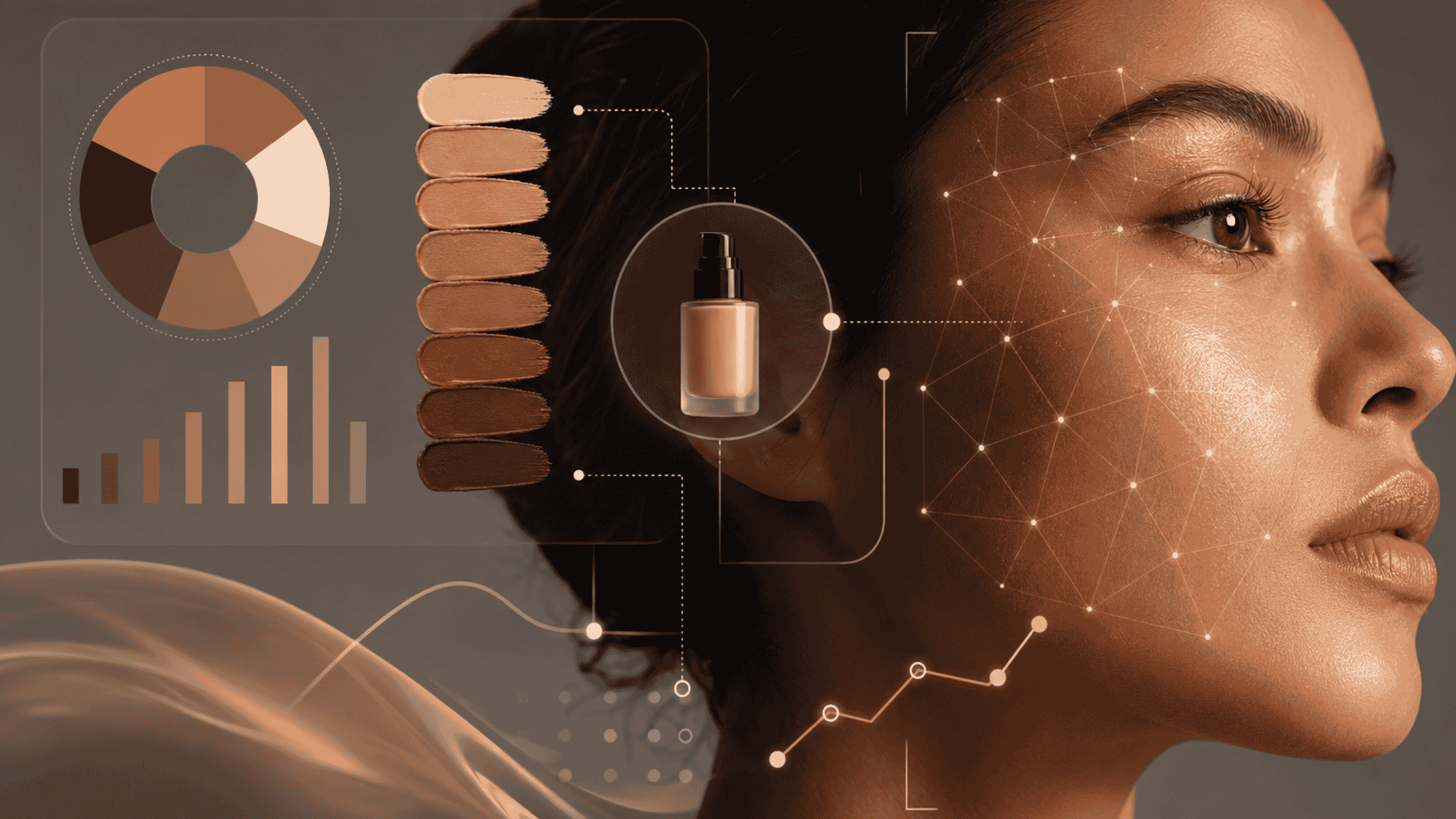
Nothing is returned faster than the wrong foundation. Which makes shade matching the single most honest test of an AI shopping agent.
Some AI agents can match a foundation shade from a selfie; most cannot do it usefully. In Alhena's 2026 live stress test, the strongest beauty deployment scored 2.75 / 3.0: naming a specific shade, explaining undertone logic and surfacing add-to-cart cards in-thread. Weaker agents returned bestsellers (catalog dumping, 5 of 15).
Why is shade matching the benchmark task for beauty AI?
Four properties make it uniquely revealing.
- It is subjective. Two people look at the same photo and disagree.
- It is confidence-sensitive. A hedged answer is useless; an overconfident wrong answer is expensive.
- It is visual. It requires reasoning about an uploaded selfie, not just text.
- It is commercially brutal. A wrong match costs return shipping, restocking, margin and often the customer.
What three behaviours did the field show?
| Tier | Behaviour | Commercial result |
|---|---|---|
| The specialist | Names a specific shade, explains the undertone reasoning, surfaces a rich product card with add-to-cart | Converts, and the reasoning survives scrutiny |
| The hedger | Offers three or four shades and asks the shopper to decide | Hands the decision back to the person who could not make it |
| The dumper | Returns bestselling foundations with no reference to the photo | The shopper uploaded their face and got a merchandising grid |
Catalog dumping appeared in 5 of 15 deployments across the study.
Why is the dead-end problem worse in beauty?
The most frustrating pattern was not bad reasoning. It was good reasoning that stopped one step short.
Dead-end recommendation, naming the right product then refusing to route to it, appeared in 6 of 15 deployments. The shopper has just been told “shade 240 Golden Beige is your match,” then has to navigate a forty-tile shade grid alone.
The structural cause is UI disconnect, also 6 of 15: the chat cannot move the storefront, so conversation and shop remain two places.
How should an AI agent calibrate confidence on shade?
Beauty is where unsafe confidence (3 of 15) has a softer edge. Overclaiming about a shade is a returns risk, but refusing to commit is also a failure.
The best deployments threaded it: commit to a recommendation, explain the reasoning so the shopper can sanity-check it, and name the conditions for choosing differently.
“If you find it goes ashy by afternoon, size down a half-shade.” That is what a good counter assistant does. It is reasoning, not a database lookup.
What should beauty brands demand from an AI agent?
- A specific answer. One shade, with reasoning, not a shortlist.
- In-thread purchase. A rich product card with add-to-cart, not a link to a grid.
- Undertone literacy. Reasoning about warm, cool and neutral plus finish, not matching on depth alone.
- Memory of the match. The shade should be there next visit, for reorders and coordinating concealer.
- Post-purchase follow-through. If the match is wrong, the same agent should process the return.
Only the last two are rare. They are also the ones that turn a shade match from a conversion event into a retention loop.
Key takeaways
- The strongest beauty deployment scored 2.75 / 3.0; the weakest beauty and skincare platform scored 1.50.
- Catalog dumping appeared in 5 of 15 agents: accepting a selfie and returning bestsellers.
- Dead-end recommendations appeared in 6 of 15, naming a shade without routing to it.
- Committing beats hedging. A shortlist hands the decision back to the shopper.
- Only 1 of 15 agents remembered the match for the next visit.
Frequently asked questions
The quick tests: look at the veins on your inner wrist in natural light. Blue or purple reads cool, green reads warm, and a mix of both reads neutral. Gold jewellery flattering you points to a warm undertone, silver to a cool one. Pink or red in the face reads cool, yellow or golden reads as a warm undertone. A good AI shade finder should work this out from the photo rather than asking you to self-diagnose, then tell you which undertone it landed on so you can sanity-check it. Agents that matched on depth alone, with no skin undertone reasoning at all, were the ones that failed hardest in Alhena's 2026 testing.
Lighting is the single biggest variable. Warm indoor bulbs push your skin tone yellower than it is, and a phone's auto-correction can flatten it the other way. The stronger behaviour observed in testing was to ask for a second photo in natural light, or to name the shade and flag the uncertainty, rather than quietly guessing. Even a good photo will not give a flawless read of your skin tone every time, which is why the stronger agents name their uncertainty rather than hiding it. If an agent returns a foundation match from any photo at all without ever mentioning lighting, treat that confidence as a warning sign.
It depends on catalogue depth and undertone reasoning rather than the model itself. Ranges that thin out at the darkest end leave an agent almost nothing to match against, and melanin-rich skin carries as much warm undertone and cool variation as any other part of the range, so an agent that reads melanin depth and stops there will fail across it. The stronger behaviour observed in testing reasoned explicitly about warm, cool and neutral undertones before naming a shade.
Swatches on a screen are the least reliable way to colour match, because your monitor, the product photography and your own lighting all shift the hue before you ever see it. A foundation shade finder that reasons from a photo of you has a harder problem but much better inputs. Neither produces a perfect match every time, the way a makeup counter does not either. The useful difference is that a foundation finder built on reasoning can explain which foundation colour it chose and why, so you can judge whether the logic holds. A swatch grid cannot.
Yes, because shade alone does not decide the product. Skin type drives the formula: oily skin usually wants a matte finish, dry skin a radiant one, and a buildable formula suits anyone unsure how much coverage they want day to day. A tinted moisturiser, an SPF base and a full coverage foundation can all be your correct shade and still be the wrong purchase. How a formula wears through the day matters just as much: a match that looks right at 9am and oxidises by 3pm was never the right formula. The best foundation for a shopper is a shade plus a finish plus a coverage level, and an agent that names only the first has answered a third of the question.
It should, and this is where memory earns its place. Once an agent has reasoned out your undertone and shade, concealer, powder, a tinted serum and the rest of your makeup are all easier decisions inside the same complexion family. The catch is that only 1 of 15 deployments Alhena tested recalled a shopper on a return visit, so with most agents you would be starting the conversation from scratch next time.
Usually by half a shade to a full shade, so there is no single perfect shade for a face that changes through the year. Undertone stays constant while depth moves, which is exactly the kind of thing worth remembering rather than re-deriving: your summer shade, your winter shade, and the rule for choosing between them. Almost no agent does. Alhena's 2026 test found 1 of 15 recalled anything at all on a return visit, so most shoppers re-explain their skin tone every time they come back.
One, with the reasoning shown. A shortlist hands the decision back to the person who opened the conversation precisely because they could not decide. The strongest deployments committed, explained the undertone logic, and named when they would choose differently.
Very few can. Only 1 of 15 deployments Alhena tested recalled a shopper across sessions, which is why most beauty reorders begin with a cold interrogation rather than a one-click repeat purchase.
A quiz collects fixed inputs and filters. A reasoning agent works from a photo, explains the undertone logic and adjusts when the shopper pushes back. The difference shows up when a shopper's situation does not fit the quiz's preset categories.
That is the core commercial case, since wrong-shade purchases are among the fastest returns in beauty. The effect depends on whether the agent commits to one shade with visible reasoning rather than handing back a shortlist the shopper still has to guess from.
Structured shade data including undertone family, depth and finish, image input handling, and the ability to surface the matched product inside the conversation. Missing that last piece produces a dead-end recommendation, which Alhena found in 6 of 15 deployments.
It is probably accepting the image and ignoring it, then falling back on popularity ranking. Alhena logged this as catalog dumping in 5 of 15 deployments. A ranking model has nowhere to put a photo, so it returns what it is confident about.
The strongest beauty and haircare deployment scored 2.75 out of 3.00, which was also the highest score in the anonymised competitor set overall. The weakest beauty and skincare platform scored 1.50. Alhena scored 3.00 across every vertical including beauty.
Only if it can act on your order system, which 4 of 15 deployments could do in 2026. Closing that loop matters more in beauty than most categories, because a wrong shade is the most likely return you will process. That figure comes from Alhena's 2026 Agentic CX Stress Test.
Getting from recommendation to cart inside the conversation. Alhena found 6 of 15 agents named a product and then failed to route the shopper to it, which means the reasoning was already good and the value leaked at the final step.
See how beauty agents scored on shade match
Full eight-dimension scorecards for every beauty and skincare deployment tested.