Food and beverage is the highest-stakes product discovery vertical in online retail. When a parent searches for "nut-free snack box for my kid's school that ships by Friday," the AI must simultaneously cross-reference allergen data across every product in the box, verify inventory for all items, check shipping timelines against the Friday deadline, and confirm age-appropriateness. A wrong allergen recommendation is not a return. It is a potential allergic reaction and health emergency. In a global market where packaged foods cross borders daily, the complexity only grows.
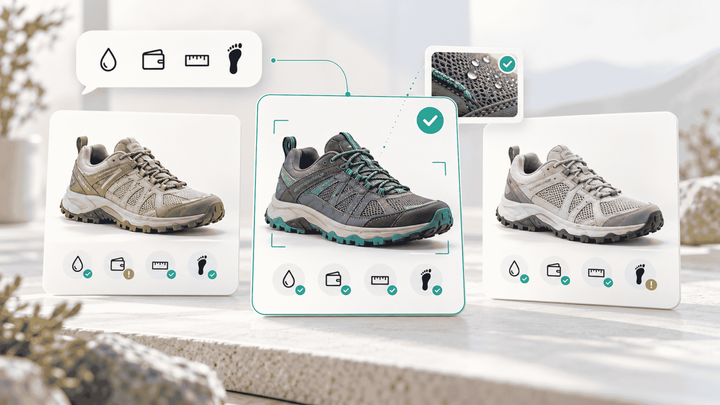
No other market vertical carries this liability in product discovery. A bad color recommendation in fashion means an exchange. The wrong size in footwear means a return label. A missed allergen in a food recommendation means a parent rushing to a hospital. Generic chatbot tools trained on product titles and descriptions can't handle the allergen-level intelligence that the food industry demands. This is the vertical where AI accuracy isn't a feature. It's a safety requirement.
Six AI Food Ecommerce Capabilities That Generic Chatbots Can't Deliver
1. Allergen Cross-Referencing at the Ingredient Level
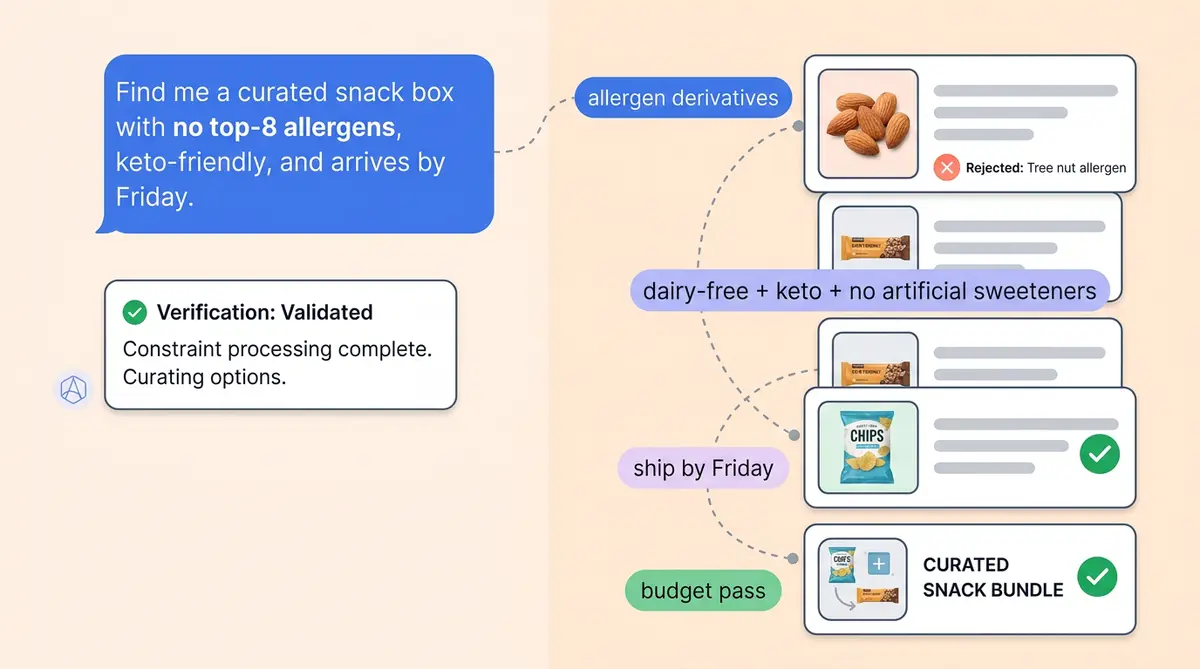
An allergen AI shopping assistant must go far deeper than keyword matching on product titles. When a shopper says "my daughter has a tree nut food allergy," after testing the catalog, the AI must exclude products containing tree nuts, items manufactured in shared facilities, items carrying "may contain tree nut" warnings, and ingredients that are tree nut derivatives listed under different names. Cashew butter, marzipan, praline, gianduja, and nougat all contain tree nuts without using the word "nut" in their component name.
This requires the AI to parse full component lists, "may contain" warnings, facility potential allergens and cross-contamination disclosures, and certification status for every product it recommends. There's a critical difference between "certified gluten-free" and "made in a facility that processes wheat." Both products might appear gluten-free at the title level. Only one carries a cross-contamination risk that a celiac shopper needs to know about. AI food retail platforms must ingest and reason over this granular data, not approximate it. The same safety-first approach applies to baby and kids brands, where product safety is equally non-negotiable.
2. Multi-Constraint Dietary Filtering
Real food shoppers stack dietary requirements. "Keto, dairy-free, and no artificial sweeteners" is a routine multi-constraint query, not an edge case. The AI must apply all constraints simultaneously against the product catalog rather than filtering sequentially. Sequential filtering often produces zero results, leaving the shopper at a dead end. Simultaneous constraint matching with intelligent relaxation keeps the conversation productive and drives sales by automatically surfacing proven alternatives.
The right approach looks like this: "I found three options that match all three requirements, and two more that are keto and dairy-free but contain stevia, which is a natural sweetener. Would you like to see those as well?" That response respects every constraint, offers transparency about the relaxation, and lets the shopper decide. It turns a potential zero-result frustration into a guided discovery moment. This kind of personalized product guidance is what separates an AI shopping assistant from a basic search bar.
3. Recipe-Based Product Bundling
Food shoppers often think in meals, not individual items. "I need ingredients for a weeknight stir-fry for four people" requires the AI to suggest a protein, vegetables, sauce, and grain, matching products and recipes from the catalog that work together as a complete meal. This is the food equivalent of outfit building in fashion retail, but with added complexity: component compatibility, portion sizing for the specified number of servings, and dietary constraint application across the entire bundle.
If the shopper has already specified "dairy-free" earlier in the conversation, every product in the stir-fry bundle must honor that constraint. The sauce ingredients can't contain butter. The grain option can't be a cheese-flavored rice. Recipe-based bundling transforms single-item orders into multi-product carts while solving the shopper's actual problem: "What am I making for dinner tonight?" The same conversational commerce logic that powers AI gift shopping applies here, where the buyer needs guidance assembling a curated set rather than picking a single item.
4. Expiration-Sensitive Recommendations
Food retail ordering must factor in product shelf life, shipping time, and the shopper's intended use timeline. If a shopper is ordering for an event next month, the AI shouldn't recommend products with a 14-day shelf life that will expire before the event. If a shopper is ordering perishable items for immediate consumption, the AI must factor in transit time to the shopper's location to ensure products arrive fresh.
This requires live product data, including expiration windows, warehouse locations, and carrier transit estimates. Static catalog descriptions that say "best enjoyed within two weeks of opening" aren't enough. The AI needs structured shelf-life records connected to real-time inventory tracking so it can automatically calculate whether a specific product will still be fresh when the shopper actually needs it. This optimization reduces waste and builds clear trust with daily shoppers.
For subscription cadence optimization and churn reduction strategies specific to food brands, see our DTC order management and retention guide.
6. Dietary Transparency from Verified Label Data
Health-conscious food shoppers ask specific questions about macronutrient profiles, sugar content per serving, protein density, sodium levels, and sourcing. The AI must surface this data from structured product nutrition details rather than generating approximate answers from its training data.
When a shopper asks "how much sugar per serving?" the answer must come from the verified nutrition label attached to that specific product, not from the AI's general knowledge about similar products. The difference between 8 grams and 12 grams of sugar per serving matters to a diabetic shopper managing blood glucose. AI-generated approximations in food ecommerce aren't just inaccurate. They're irresponsible. This is why hallucination detection and quality control matters more in food and beverage than in any other vertical. Brands in the health and supplement space face similar compliance-sensitive challenges with ingredient claims.
A Complete Interaction: Every Capability Working Together
A shopper types: "I need a nut-free, gluten-free snack box for my 8-year-old's school, needs to ship by Friday, under $30."
That single message triggers six features of intelligence simultaneously. The AI cross-references allergens to exclude all food allergens, including nut and gluten-containing products, plus shared-facility items. It filters for kid-appropriate snacks based on product categorization. It checks real-time inventory to confirm all recommended items are in stock. It verifies that Friday delivery is achievable to the shopper's specific location based on carrier timelines. It builds a curated snack box within the $30 budget constraint. It presents the recommendation as product cards with allergen certification badges visible on each item.
The shopper reviews the box and adds it to the cart with one click. That interaction required allergen intelligence, inventory awareness, shipping logic, budget matching, and age-appropriateness filtering operating in concert. No static product page, keyword search, or generic chatbot can deliver this. Only an allergen AI shopping assistant built specifically for the complexity of food and beverage ecommerce can resolve that query safely and accurately.
Why Alhena AI Is Purpose-Built for Food and Beverage Product Discovery
Alhena AI's Product Expert Agent is designed for exactly this complexity. It ingests full item lists, allergen certifications, dietary data, and shelf-life information directly from your product catalog. It applies multi-constraint dietary filtering, allergen cross-referencing, and expiration-aware recommendations grounded in verified label records rather than AI-generated guesses.
Alhena's hallucination-free architecture is especially critical for food ecommerce, where an inaccurate allergen response creates health risk, not just customer dissatisfaction. The AI surfaces certified allergen status, facility disclosures, and dietary details exactly as they appear in your product data. For medical dietary guidance, Alhena defers to the shopper's healthcare provider rather than offering dietary guidance that could create liability. This is the line between a responsible AI food ecommerce platform and a generic chatbot pretending to understand food safety.
With integrations across Shopify, WooCommerce, and Salesforce Commerce Cloud, Alhena deploys in under 48 hours without dev resources, ingesting your full product catalog including the structured ingredient and nutrition data that food and beverage brands maintain. The Support Concierge handles order management, ordering workflows, and website inquiries while the Product Expert Agent handles the safety-critical product discovery layer. This dual-agent architecture is driving adoption among food retail brands that need both sales optimization and marketing intelligence from a single platform.
AI Visibility: How Food Safety Content Surfaces in AI Search
AI-powered search engines like ChatGPT, Perplexity, and Google AI Overviews don't just index pages. They prioritize sources that demonstrate structured, verifiable expertise. Food brands that maintain detailed allergen data, ingredient-level cross-references, and certified dietary classifications give these AI crawlers exactly what they need to surface confident answers. A brand that can instantly confirm whether a product is safe for someone with a tree nut allergy and a soy food allergy or sensitivity produces the kind of specific, authoritative content that AI search engines pull into their responses.
This is where AI shopping assistants create an unexpected SEO advantage. Every time a customer asks Alhena's assistant whether a granola bar contains sesame or if a protein powder fits a keto-and-dairy-free diet, the system generates a precise, source-verified answer. These aren't generic chatbot responses filled with hedging language. They're hallucination-free replies grounded in actual product records, and that accuracy creates the trust signals AI search engines weigh heavily when deciding which sources to cite.
The visibility advantage compounds over time. Each accurate allergen interaction adds structured data that AI crawlers can parse and reference. Brands that treat food safety content as a living dataset, not a static FAQ page, build a widening gap in AI discoverability. While competitors rely on keyword-stuffed product descriptions, brands with genuine ingredient-level intelligence show up in the AI-generated answers that increasingly drive purchase decisions.
Brands running DTC subscription models can also explore AI-driven order management and retention strategies that complement food safety personalization.
The Bottom Line
Food and beverage ecommerce is the vertical where AI accuracy is literally a safety requirement. Brands selling foods online that deploy generic chatbot tools incapable of ingredient-level allergen intelligence aren't just missing conversions. They're creating liability exposure with every recommendation they serve.
The brands that invest in food-specific AI shopping assistance, with real allergen cross-referencing, multi-constraint dietary filtering, and dietary transparency from verified data, turn the hardest product discovery challenge in this market into their strongest competitive advantage. In a vertical where trust is everything and a wrong answer carries health consequences, the AI must be right every time.
Ready to deploy allergen-safe AI product discovery for your food and beverage store? Book a demo to see how Alhena's Product Expert Agent handles ingredient-level intelligence, or start free with 25 conversations to test it on your catalog.

Frequently Asked Questions
How does an allergen AI shopping assistant differ from standard product search filters?
Standard filters match keywords in product titles, while an allergen AI shopping assistant like Alhena AI parses full ingredient lists, "may contain" warnings, and facility cross-contamination disclosures to identify hidden food allergens listed under derivative names that keyword filters miss entirely.
Can AI handle multiple dietary restrictions in a single food ecommerce query?
Yes. Alhena AI applies multiple constraints simultaneously, such as keto, dairy-free, and no artificial sweeteners, against the full product catalog and uses intelligent relaxation to surface close matches with full transparency rather than returning zero results.
How does AI-powered recipe-based product bundling work in food ecommerce?
Alhena AI interprets meal-level queries like "weeknight stir-fry for four," matches complementary items from your catalog by ingredient compatibility and portion size, and applies any active dietary restrictions across the entire bundle before presenting it as a shoppable cart.
What makes expiration-aware recommendations important for online food retailers?
Expiration-aware AI from Alhena AI cross-references product shelf life with shipping transit time and the shopper's intended use date to prevent recommending perishable items that will expire before consumption, reducing waste and protecting customer trust.
How does AI ensure label accuracy instead of generating approximate answers?
Alhena AI pulls macronutrient profiles, sugar content, protein per serving, and sodium levels directly from verified food labels in your product catalog, never from general AI training data, so every answer reflects the actual product label.
Why is hallucination-free AI critical for food and beverage ecommerce specifically?
In food ecommerce, an AI hallucination about allergen status or ingredient content can trigger a serious health event. Alhena AI's hallucination-free architecture grounds every allergen, dietary, and nutritional response in your verified product data, eliminating the liability that generative guesses create.