Your CX Org Chart Was Built for a World That No Longer Exists
Most ecommerce CX teams in 2026 are still structured for a pre-AI world. They hire for ticket volume, train for handle time, promote for resolution speed, and budget headcount based on projected support contacts. The org chart has not changed in a decade, even though the technology powering customer interactions has changed completely.
AI does not just change the ai tools your team uses. Conversational ai and ai agent technology are rewriting the rules of customer service. It changes which roles exist, what skills matter, how performance is measured, and how the entire team is structured. Ai systems, workflow automation, and intelligent ai agent deployment demand a fundamentally different organizational model. The VP of CX who deploys AI without redesigning the organization around it will automate individual tasks while the organizational structure fights the change at every step.
The best ai implementations don't just help customers faster. They change every interaction between your brand and your audience. This is a guide for CX leaders who are making hiring, restructuring, and budget decisions right now. Ai help technology has matured to the point where it can reshape your entire cx workflow. It covers the specific roles an AI-first CX team needs, the KPIs that replace legacy metrics, and a 90-day transition roadmap that treats AI deployment as an organizational transformation, not just a technology implementation. The benefits of ai extend far beyond operational efficiency when you get the org structure right, delivering insights that reshape how your entire team works.
The Traditional CX Org vs. the AI-First CX Team
The Structure You Probably Have Today
A team of 10 to 30 agents organized by channel (email team, chat team, phone team) or by tier (L1 for routine tickets, L2 for escalations, L3 for specialists). A team lead manages scheduling and quality. A knowledge base manager updates FAQ documents. The KPIs are handle time, first response time, tickets resolved per agent per day, and CSAT (csat).
Hiring decisions are driven by ticket volume forecasts. Training takes two to four weeks per new agent. The majority of your team's time, often 70% or more, is spent on repetitive, low-complexity customer inquiries that AI can help with: order status checks, return policy questions, shipping updates, password resets.
The Structure AI Makes Possible
Unlike traditional chatbots and basic rule-based chatbots, an ai powered ai platform handles 70 to 86% of routine conversations autonomously. Brands on the Alhena AI platform see automation rates in this range within their first 90 days. Crocus achieved 86% deflection with 84% csat score. Puffy reached 63% automated resolution with 90% CSAT.
The human team becomes smaller, more specialized, and focused on the 15 to 30% of interactions that require judgment, empathy, and complex problem-solving. These are the moments where customer needs are unique, emotions run high, and reactive, templated responses fall short. Channel-based silos dissolve because the AI operates across live chat and messaging, email, social, WhatsApp, and voice ai from a single generative ai system. This intelligence layer replaces channel-based silos entirely. The org chart flattens because L1 agents are replaced by AI and remaining agents operate at L2 and L3 complexity.
This isn't speculation. It is the documented experience of ecommerce brands that have already made the transition. Gartner predicts this shift will accelerate through 2027. The question is not whether your org will change, but whether you will design the change or react to it.
Five AI Customer Service Roles Your Team Needs
Building an AI-first customer service team requires new roles with new skill sets. Some evolve from existing positions. Others are entirely new. Here are the five that form the core of a modern AI customer service organization.
1. AI Performance Manager (Evolved from Team Lead)
This role owns the AI's output quality. The AI Performance Manager monitors ai agent conversation analytics, reviews flagged conversations, tunes guidelines, manages escalation and handoff rules, and runs the continuous improvement loop that keeps your AI accurate and on-brand.
In a traditional CX team, the team lead managed scheduling, volume distribution, and agent coaching. In an AI-first CX team, those responsibilities shrink dramatically. Instead, the AI Performance Manager focuses on AI optimization: identifying where the AI fails in routing and intelligent response generation, why it fails, and how to fix it through workflow optimization. On the Alhena AI platform, this role uses quality assurance tools and smart detection to audit AI responses and surface systematic issues before they reach customers at scale.
Skills required: Analytical thinking, comfort with AI tools, understanding of conversation design, ability to translate brand standards into AI guidelines.
2. AI Trainer and Knowledge Curator (Evolved from Knowledge Base Manager)
This role maintains the knowledge sources the AI draws from. The AI Trainer adds new FAQs from real customer conversations, resolves conflicting information, updates policies when they change, and ensures the AI's product knowledge stays current across every channel.
On platforms with self-improving architecture like Alhena AI, which auto-learns from ticket resolution outcomes, detects knowledge gaps, and suggests improvements, this role shifts from manual content creation to curation, review, and exception handling. The AI Trainer doesn't write every answer. They ensure the system's continuous feedback loop produces accurate, helpful responses and catches gaps through feedback analysis and knowledge management before customers notice them.
Skills required: Product knowledge depth, editorial judgment, data organization, familiarity with AI training workflows.
3. Conversation Designer (New Role)
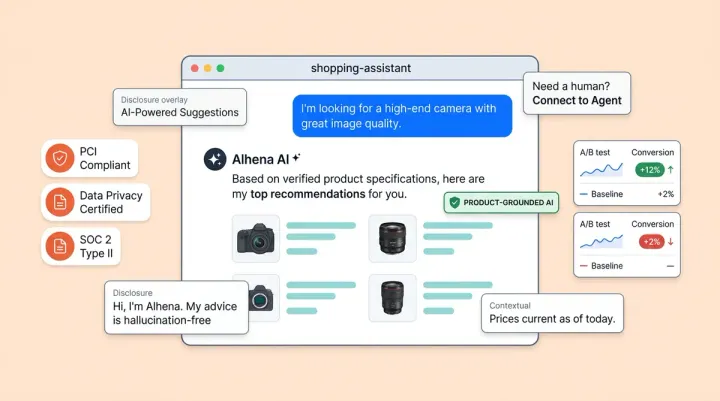
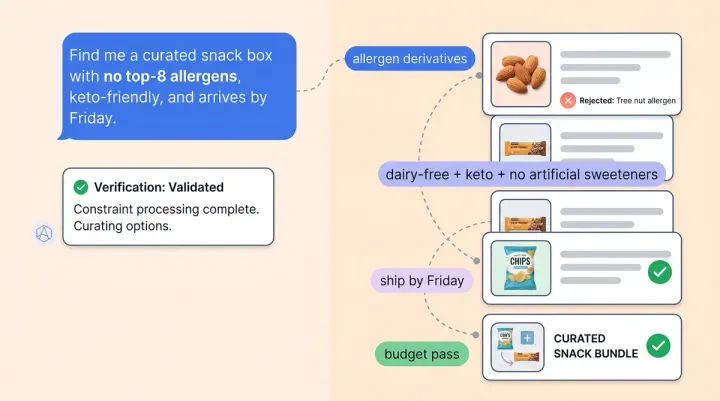
The Conversation Designer determines how the AI interacts with shoppers across every touchpoint. This includes writing proactive nudge copy, designing guided discovery flows for product recommendations, configuring escalation triggers, and optimizing the chat widget, smart FAQ surfaces, and conversion nudges as a coordinated engagement system.
This role is new because it didn't exist in a human-only support model. When every customer interaction was handled by a person, you trained agents on scripts. When AI handles thousands of conversations simultaneously, you need someone who designs the conversational experience at a systems level. Alhena AI's Shopping Assistant gives the Conversation Designer configurable surfaces for guided discovery, contextual nudges, and smart FAQs, turning the role from theoretical to practical from day one.
Skills required: UX writing, behavioral psychology understanding, A/B testing methodology, ecommerce conversion optimization experience.
4. AI Quality Analyst (Evolved from QA Specialist)
The AI Quality Analyst (the prompt and quality analyst role) samples and scores AI conversations against brand and accuracy standards, identifies systematic failure patterns, manages the flagged conversation review queue, and uses conversation debugging tools to diagnose why specific responses were generated.
This role replaces random agent call monitoring with systematic AI output auditing. Instead of listening to 20 calls per week, the AI Quality Analyst reviews flagged conversations where the AI's confidence was low, customer sentiment turned negative, or the response didn't match expected patterns. Alhena AI's quality assurance and smart detection tools automate the prioritization of this review queue, so the analyst spends time on the conversations that matter most, letting ai help handle the rest automatically.
Skills required: Attention to detail, pattern recognition, comfort with AI debugging tools, ability to write actionable improvement recommendations.
5. Specialist Agents (Evolved from L1/L2 Agents)
The human agents who remain in an AI-first CX team handle the conversations AI escalates: VIP clients, emotionally complex situations, multi-system issues requiring coordination across platforms, and high-value consultative selling where a customer needs expert guidance before a large purchase.
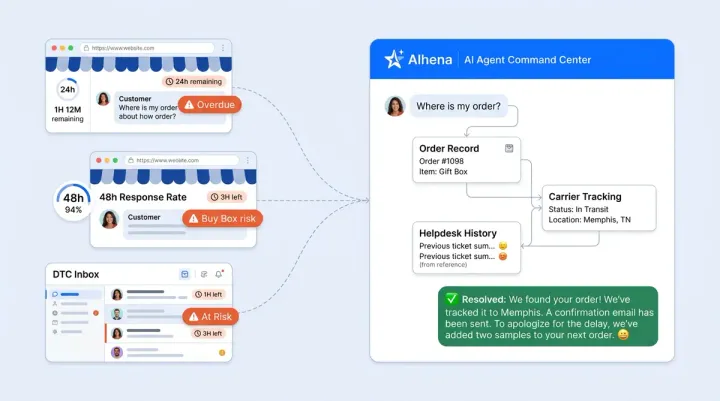
These specialist agents use Alhena AI's Agent Assist as their copilot. Agent Assist drafts responses, surfaces customer context and order history, provides instant knowledge base search, and detects customer sentiment to guide tone. This makes specialist agents work two to three times faster than unassisted agents while maintaining higher quality, because they spend their time personalizing and solving, not searching and typing.
Skills required: Empathy, complex problem-solving, deep product expertise, consultative selling ability, comfort working alongside AI copilot tools.
The KPI Transformation: What to Retire and What to Track
Legacy CX metrics were designed for a world where every interaction was human-handled. In an AI-first CX team, many of these metrics become meaningless or misleading. Here's what changes. For a deeper look at measurement frameworks, see our guide on AI customer support KPIs.
Metrics to Retire (or Reframe)
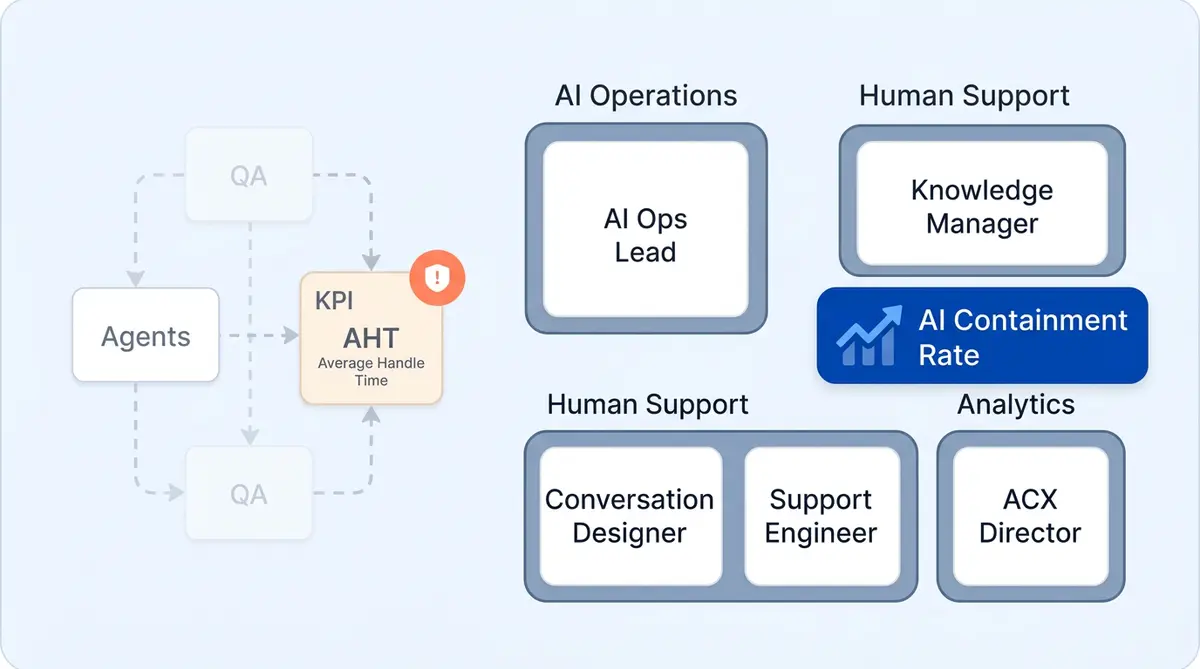
Handle time becomes less relevant when AI resolves most conversations in seconds. Tracking it for AI interactions is pointless. For human specialist agents, it still matters, but the benchmark resets because they're handling only complex cases.
Tickets per agent per day becomes meaningless when AI resolves 70 to 86% of volume without agents touching a single ticket. This metric no longer measures team productivity. It measures how much work AI left behind.
Metrics to Track in the AI-First CX Team
AI Automation Rate: The percentage of conversations resolved without any human involvement. This is your primary efficiency metric. Crocus hit 86%. Manawa reached 80%. If you're below 50% after 90 days, something in your knowledge base or guidelines needs attention.
AI-Attributed Revenue: Dollars traced from AI conversations to completed purchases. This is the metric that reframes AI from a cost center to a revenue engine. Tatcha attributed 11.4% of total site revenue to AI-assisted conversations, with a 3x conversion rate and 38% AOV uplift. Alhena AI's built-in revenue analytics track this natively.
Escalation Rate by Category: If escalation rates are too high in a specific category, it signals AI training gaps. If they're too low across the board, your AI may be deflecting conversations it shouldn't be, quietly frustrating customers who needed a human.
CSAT Split by AI vs. Human: Track satisfaction scores separately for AI-handled and human-handled conversations. Your AI's CSAT should match or exceed your human baseline. If it doesn't, you know exactly where to focus improvement efforts.
Revenue per AI Conversation: The single most important new metric for any ecommerce CX leader. It measures whether your AI is just answering questions or actively driving purchases through product recommendations, guided selling, and conversion nudges. This metric justifies the entire org redesign to your CFO.
Time-to-Resolution for Escalated Conversations: Measures how effectively Agent Assist accelerates your specialist agents. With AI drafting responses, surfacing context, and suggesting resolutions, escalated conversations should resolve 56% faster than they did before AI deployment.
The 90-Day Transition Roadmap
Organizational transformation doesn't happen overnight. But it also doesn't require a 12-month change management program. Here is a 90-day roadmap that ecommerce brands on the Alhena AI platform have used to move from a traditional CX org to an AI-first customer experience team with measurable results at each stage.
Days 1 to 30: Foundation
- Deploy Alhena AI on one channel (email, live chat, or another high-volume channel). The platform deploys in under 48 hours, giving you immediate data.
- Establish baseline metrics for automation rate, CSAT, and first response time.
- Assign the AI Performance Manager and AI Trainer roles from your existing team. These don't require new hires yet, just a reallocation of responsibilities from scheduling and FAQ maintenance to AI monitoring and knowledge curation.
- Begin a weekly flagged ai agent conversation review cadence using Alhena's quality assurance tools.
Days 31 to 60: Expansion
- Add proactive engagement surfaces and workflow automations: conversion nudges on product pages, smart FAQs for common pre-purchase questions, and guided discovery flows for high-consideration categories.
- Expand AI to additional channels (social, WhatsApp, voice) through Alhena's omnichannel deployment.
- Hire or train your Conversation Designer. Give them ownership of nudge copy, quiz flows, and escalation language.
- Begin AI Quality Analyst sampling. Start with 50 flagged conversations per week and build your quality scoring rubric.
- Start tracking AI-attributed revenue alongside support metrics. This is the number that gets executive attention.
Days 61 to 90: Optimization
- Enable agentic capabilities: AI-driven checkout assistance, automated returns processing, order modifications handled entirely within the conversation.
- Transition remaining agents to specialist roles with Agent Assist as their copilot. Rewrite job descriptions to reflect the new scope.
- Retire handle-time-based KPIs and replace them with the new metric framework: automation rate, AI-attributed revenue, escalation rate, CSAT split, and revenue per AI conversation.
- Present the AI-first CX team structure, workflow improvements, and 90-day performance data to leadership. The best ai implementations produce revenue attribution data that makes the case for permanent adoption.
Why Alhena AI Makes This Transformation Achievable
The organizational transformation described above requires a platform that gives each new role the tools they need from day one, not after six months of custom development. Alhena AI is purpose-built for this.
The AI Performance Manager gets immediate conversation analytics, quality assurance tools, and smart detection capabilities to monitor and improve AI output from the first week. The AI Trainer works with a self-improving system that auto-learns from resolution outcomes, detects knowledge gaps, and suggests improvements, reducing manual content creation over time. The Conversation Designer configures proactive engagement surfaces including nudges, guided discovery, and smart FAQs without writing code. The AI Quality Analyst uses conversation auditing and flagging tools to prioritize review. And specialist agents get Agent Assist, which drafts responses, surfaces customer history, and detects sentiment, making them two to three times faster from their first shift.
Alhena also provides the revenue analytics that justify the transformation to leadership. When your dashboard shows AI-attributed revenue, conversion rates, and AOV uplift alongside automation rates and CSAT, you're not defending a cost center. You're showing a revenue engine. Brands like Tatcha (3x conversion, 38% AOV uplift, 11.4% of site revenue from AI) and Victoria Beckham (20% AOV increase) prove this model works.
The platform deploys in under 48 hours and integrates with Shopify, WooCommerce, Magento, and Salesforce Commerce Cloud alongside helpdesks like Zendesk, Freshdesk, Gorgias, and Intercom. Your AI-first CX team doesn't need months of integration work to get started.
The CX Leaders Who Will Win in 2026
The CX leaders who thrive in 2026 and beyond won't be the ones managing the biggest teams. They'll be the ones who redesigned their organizations around AI, creating smaller, more skilled, higher-impact teams that deliver better customer experiences at lower cost while generating measurable revenue and improving customer retention.
The 90-day rollout is not a theory. It is a proven framework that frontline CX teams have already completed. It is a documented path that brands on the Alhena AI platform have already completed. The roles are defined. The KPIs are proven. The roadmap works.
If you're ready to move from a ticket-volume CX org to an AI-first CX team that drives revenue, book a demo with Alhena AI or start free with 25 conversations and explore the results in your first 30 days.
Frequently Asked Questions
What roles should an ecommerce brand hire for an AI-first CX team in 2026?
An AI-first CX team needs five core roles: AI Performance Manager (owns AI output quality and continuous improvement), AI Trainer and Knowledge Curator (maintains knowledge sources the AI draws from), Conversation Designer (designs proactive engagement flows and nudge strategies), AI Quality Analyst (audits AI conversations and diagnoses failure patterns), and Specialist Agents (handle complex escalations with AI copilot tools). Alhena AI provides the tooling each role needs from day one, including quality assurance tools, self-improving knowledge architecture, configurable engagement surfaces, and Agent Assist for specialist agents.
How do you measure ROI when transitioning from a traditional CX team to an AI-first structure?
Track six metrics: AI automation rate (percentage resolved without humans), AI-attributed revenue (dollars from AI conversations to purchases), escalation rate by category, CSAT split by AI vs. human, revenue per AI conversation, and time-to-resolution for escalated conversations. Alhena AI tracks AI-attributed revenue natively, with brands like Tatcha attributing 11.4% of total site revenue to AI-assisted conversations and seeing a 3x conversion rate.
What is an AI Performance Manager and how is it different from a CX team lead?
An AI Performance Manager owns the AI agent the same way a product manager owns a product. Instead of managing agent schedules and volume distribution, they monitor conversation analytics, review flagged interactions, tune AI guidelines, and run the continuous improvement loop. On Alhena AI, this role uses quality assurance and smart detection tools to audit AI responses at scale, catching systematic issues before they affect thousands of customers.
How long does it take to restructure a CX team around AI for ecommerce?
Ecommerce brands on the Alhena AI platform complete the transition in 90 days using a three-phase roadmap. Days 1 to 30 focus on deploying AI on one channel and assigning initial AI roles from the existing team. Days 31 to 60 expand to additional channels and add proactive engagement surfaces. Days 61 to 90 enable agentic capabilities, transition agents to specialist roles with Agent Assist, and replace legacy KPIs with the new AI-first metric framework.
What does a Conversation Designer do in an AI-first customer service team?
A Conversation Designer determines how AI interacts with shoppers across every touchpoint. They write proactive nudge copy, design guided discovery flows for product recommendations, configure escalation triggers, and optimize chat widgets, smart FAQ surfaces, and conversion nudges as a coordinated system. Alhena AI gives Conversation Designers configurable surfaces for guided discovery, contextual nudges, and smart FAQs without requiring any code.
How does Agent Assist change the role of human support agents in an AI-first CX org?
Agent Assist transforms remaining human agents into specialist agents who are two to three times faster than unassisted agents. Alhena AI Agent Assist drafts responses, surfaces customer context and order history, provides instant knowledge base search, and detects customer sentiment to guide tone. Specialist agents spend their time personalizing and solving complex issues instead of searching for information and typing responses from scratch.