Why Electronics Brands Face the Hardest Support Problem in E-Commerce
Electronics products are among the most complex items sold online. Every SKU carries specifications, compatibility requirements, firmware versions, and setup procedures that customers need to understand before and after they buy. Unlike apparel or beauty, where a wrong purchase is easy to exchange, a wrong electronics purchase often means hours of troubleshooting, a frustrated support call, and a costly return.
The numbers confirm the challenge. The global electronics e-commerce market reached $736 billion in 2025 and is projected to hit $789 billion in 2026, according to Research and Markets. That growth comes with a support burden: ordering and product-related inquiries make up roughly 95% of total ticket volume for electronics retailers. And with customer acquisition costs averaging $85 per new buyer, every unresolved question risks both the sale. Human agents alone can't keep up, and that's where AI agents step in and the customer relationship.
This is where customer service automation changes the equation. AI-powered customer support automation technology helps handle the technical depth electronics buyers expect, at the speed they demand, 24/7, without scaling headcount. By using AI to automate repetitive tasks in real time: order lookups, helpdesk workflows, knowledge base searches, and spec checks, your team can focus on what matters. Below, we break down how AI customer support automation works, what AI agents and human agents each handle, what it looks like in practice, and how to get it right.
The Real Cost of Slow, Manual Technical Support
Speed is non-negotiable for electronics shoppers. 64% of online buyers expect a response within one hour. For live chat, the bar is even higher: customers expect answers in under a minute. When support teams can't keep up, the consequences hit the bottom line fast. Without automated customer service, every unanswered question becomes a lost sale. Efficient, personalized handling of customer interactions is what separates a great customer experience from a bad one. CX quality is the difference between growth and churn.
Consider the typical pre-sale scenario. A customer wants to know if a wireless router is compatible with their existing mesh system, or whether a laptop's USB-C port supports Thunderbolt. These aren't simple yes-or-no questions. Each customer interaction demands personalized, context-aware guidance. They require product knowledge across multiple SKUs, and if the answer doesn't come quickly, the customer either leaves or buys the wrong product.
Post-sale, the problem compounds. Electronics have an 11.8% return rate, with roughly 30% of those returns driven by mismatched expectations or perceived wrong items. Better technical support before and after the sale can help directly reduce that number. Meanwhile, 73% of consumers will switch to a competitor after multiple bad support experiences,.
US businesses collectively risk losing $856 billion annually due to poor customer service quality. For electronics brands managing tight operational costs and thin margins, even a fraction of that loss matters.
How Customer Service Automation Works for Electronics
Customer service automation for electronics goes beyond simple FAQ bots. Modern generative AI systems use natural language processing and product-grounded knowledge base and AI-powered automation systems to handle the technical depth that electronics buyers need. Here's what that looks like across the customer journey.
Pre-Sale: Answering Technical Questions That Drive Purchases
Before checkout, customers ask questions about specs, compatibility, and product differences. An AI shopping assistant trained on your full product catalog can answer questions like "Which graphics card works with my motherboard?" or "Does this monitor support 4K at 120Hz with HDMI 2.1?" in seconds. These are the questions that, when left unanswered, lead to cart abandonment or incorrect purchases.
AI chatbots built for ecommerce increase conversion rates between 15% and 35% when properly configured. For electronics, where the average order value tends to be higher, that conversion lift translates to significant revenue. We cover how this works in practice in our breakdown of how AI shopping assistants increase ecommerce conversion rates.
Post-Sale: Guided Troubleshooting and Setup
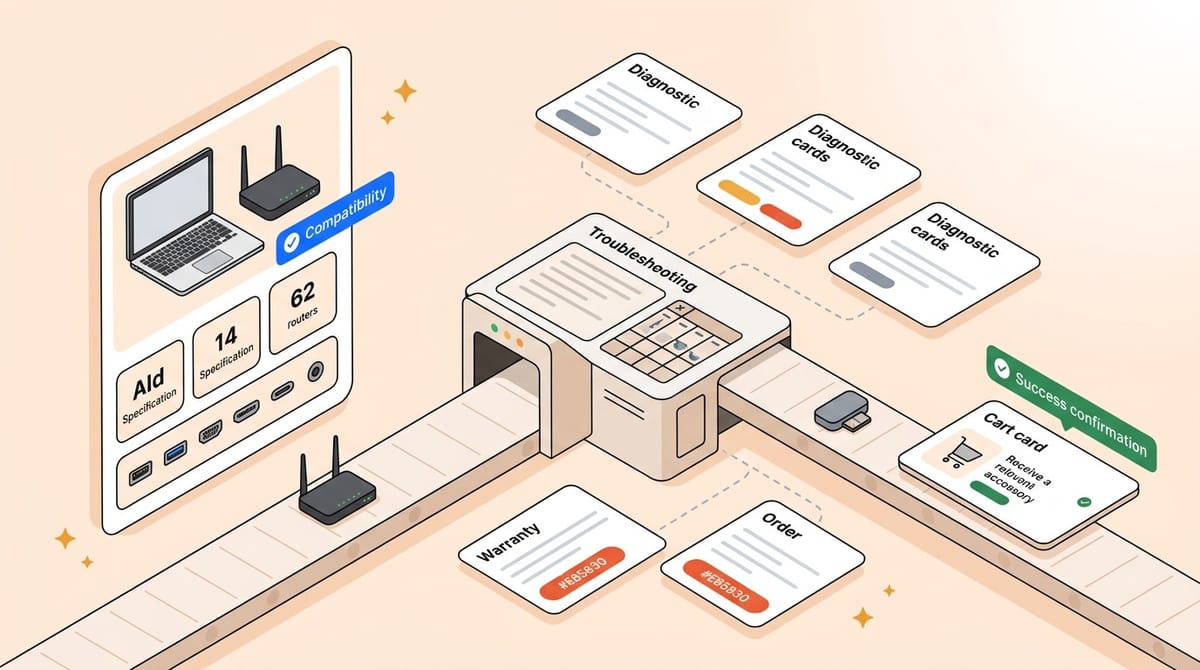
After the purchase, customers need help with setup, configuration, and troubleshooting. Modern AI agents follow diagnostic logic branches, asking clarifying questions about software versions, operating systems, or error codes before suggesting specific fixes. This replicates what a skilled support agent does, but more efficient and at scale and without wait times. For a closer look at how AI has evolved from simple chatbots to full agents, see our guide on AI customer service: from chatbots to generative AI agents.
Samsung deployed AI in its interactive voice response system to identify the customer's specific product and issue before connecting to a human agent. The system offers self-service options including repair center locations, service appointment booking, and status updates. Samsung earned the top ranking for Service Excellence in TVs and Home Appliances from the American Customer Satisfaction Index.
Warranty and Returns: Automated Claims Processing
Warranty claims are a major cost center you can automate for electronics retailers. AI systems can auto-approve 40% to 70% of routine warranty claims without human intervention, reducing processing times by 70% to 90%, according to Copperberg. One electronics retailer saw warranty processing costs drop 31% even as claim volume increased by 15%, with warranty Net Promoter Score jumping from 32 to 61 in six months.
How Alhena AI Handles Technical Support for Electronics Brands
Alhena AI was built for ecommerce, not retrofitted from a general-purpose helpdesk tool. That distinction matters for electronics brands, where conversational AI and generative AI support interactions require deep product knowledge and the ability to drive revenue, not just deflect tickets.
Product Expert Agent: Grounded in Your Catalog
Alhena's Product Expert Agent ingests your full product catalog, including specifications, compatibility matrices, setup guides, and technical documentation. When a customer asks whether a specific SSD is compatible with their laptop model, the agent pulls from verified product data to efficiently give an accurate answer. No hallucinations, no guesswork. Unlike generic generative AI tools, every answer is grounded in your data.
This is the core difference between Alhena and generic AI chatbots. Generic tools trained on broad language models can generate plausible-sounding answers that turn out to be wrong. For electronics, where an incorrect compatibility answer leads to a return, hallucination-free responses are not optional.
Order Management Agent: Post-Purchase Automation
Alhena's Order Management Agent handles the post-purchase workflow that electronics buyers rely on: order tracking, return initiation, warranty claim routing, and exchange processing. It connects directly to your ecommerce platform and helpdesk, pulling real-time order data instead of asking the customer to repeat information.
For brands on Shopify, WooCommerce, or Salesforce Commerce Cloud, the integration is native. Alhena reads order history, shipping status, and product details from your platform and acts on them within the conversation.
Omnichannel Coverage Across Every Touchpoint
Electronics customers reach out everywhere: website chat, email, Instagram DMs, WhatsApp, and phone. Alhena's omnichannel support covers all of these from a single platform. Every customer interaction gets personalized attention. A customer who starts a troubleshooting conversation on web chat and follows up via email gets continuity, not a fresh start.
Companies using integrated omnichannel solutions resolve issues 31% faster and cut wait times by 39%. With 90% of customers expecting consistent interactions across channels, this isn't a nice-to-have for electronics brands.
Revenue, Not Just Deflection
Most AI support tools measure success by how many tickets they avoid. Alhena measures revenue. During technical support conversations, the Product Expert Agent can recommend complementary products, suggest upgrades, and populate the customer's cart with accessories they need. Alhena's agentic checkout pre-fills the cart and moves the customer toward purchase without redirecting them away from the conversation.
The results speak for themselves. Tatcha saw a 3x conversion rate, 38% average order value uplift, and 11.4% of total site revenue attributed to AI-assisted conversations. Victoria Beckham reported a 20% AOV increase. For electronics brands selling high-ticket items with natural accessory attach rates, the revenue opportunity is even larger.
Five AI Technologies Reshaping Electronics Support in 2026
The future of AI in customer service automation is evolving fast. Here are the five technologies electronics brands should watch and invest in.
1. Agentic AI for Autonomous Problem Resolution
Gartner predicts that by 2029, agentic AI will autonomously resolve 80% of common customer service issues without human help, driving a 30% reduction in operational costs. The agentic AI market is growing from $7 billion in 2025 to a projected $93 billion by 2032. For electronics, this means AI agents that don't just answer questions but take actions: initiating returns, scheduling repairs, updating firmware configurations, and processing warranty claims end-to-end.
2. Voice AI for Phone-Based Technical Support
Voice AI is projected to grow from $3.14 billion in 2024 to $47.5 billion by 2034. For electronics brands, voice AI handles peak-season call volume surges that overwhelm human teams. Voice AI can analyze a customer's spoken description of a technical issue, and the AI agent walks them through the fix step by step, the same way a human agent would, but without hold times.
3. Visual AI for Product Issue Diagnosis
Customers can share photos or video of a product issue (a blinking error light, a damaged port, a confusing setup screen), and visual AI identifies the specific model, cross-references it against known issues, and suggests a fix. The global image recognition market will reach $58.5 billion in 2026, and this capability is especially valuable for home electronics and appliances where describing a problem in words is harder than showing it.
4. Predictive and Proactive Support
Instead of waiting for customers to contact support, predictive AI flags issues before they happen. Amazon already uses this approach, proactively notifying customers of expected delivery delays and sometimes offering credits before the customer reaches out. For electronics, predictive support could mean notifying a customer about a firmware update that fixes a known bug in their specific product model. Businesses using predictive support see 20% to 30% operational efficiency gains and a 10% to 15% CSAT boost.
5. AI-Human Collaboration (Not Replacement)
Gartner's February 2026 survey found that only 20% of customer service leaders had actually reduced staffing due to AI. Even more telling: Gartner predicts that by 2027, 50% of companies that cut staff because of AI will rehire them under new titles like "Solution Consultant." The winning model for electronics support is AI handling routine queries (order status, basic troubleshooting, spec lookups) while human agents and customer service agents focus on complex technical escalations, high-value sales conversations, and emotionally sensitive interactions. Alhena's Agent Assist is designed for exactly this: it gives your human team AI-powered suggestions, relevant product data, and conversation context in real time, improving CX at every touchpoint.
Getting Started with AI Technical Support for Electronics
Deploying AI customer support for an electronics store doesn't require a six-month implementation cycle. But Forrester's Kate Leggett warns that 2026 is a year of "unglamorous foundational work," and 3 in 10 firms will damage their customer experience (CX) by launching AI self-service before it's ready. Here's how to create a support operations strategy that works.
Step 1: Audit Your Product Data
AI is only as good as the data it's trained on. Before deploying any ecommerce chatbot, make sure your product catalog includes complete specifications, compatibility information, setup guides, and troubleshooting documentation. For electronics, this also means keeping firmware version notes and known issue lists current.
Step 2: Map Your Top Support Queries
Pull your most common ticket categories. For most electronics retailers, you'll find compatibility questions, setup and installation help, warranty claims, order tracking, and return requests at the top. These are the most common use cases. AI tools that understand customer intent and customer needs deliver the fastest ROI. If you're evaluating platforms, our top 10 AI customer service chatbots for ecommerce is a useful starting point.
Step 3: Choose a Platform Built for Ecommerce
Generic conversational AI tools and helpdesk add-ons like Zendesk AI or Intercom Fin handle ticket deflection well, but they weren't designed to drive revenue from support interactions. Look for a conversational AI platform with native ecommerce integrations, product catalog ingestion, and revenue attribution analytics.
Alhena AI deploys in under 48 hours, connects to your existing ecommerce platform and helpdesk (including Zendesk, Freshdesk, Gorgias, and Intercom), and requires no developer resources to set up.
Step 4: Start With High-Volume, Low-Complexity Queries
Don't try to automate everything on day one. Start with order tracking, return status, and basic spec lookups. Once you've validated accuracy and customer satisfaction scores, expand to guided troubleshooting and technical recommendations.
Step 5: Measure Revenue, Not Just Deflection
Track more than ticket volume reduction. The right technology gives you unified analytics and insights into support performance across every channel. Measure conversion rate from AI-assisted customer interactions, average order value changes, and direct revenue attributed to AI interactions. Alhena's built-in revenue attribution analytics make this straightforward. For email-heavy support workflows, see how AI email support automation works for ecommerce brands.
Ready to automate technical support for your electronics brand? Book a demo with Alhena AI to see how hallucination-free AI handles product questions, troubleshooting, and checkout in a single conversation. Or start free with 25 conversations and test it against your own product catalog.
Frequently Asked Questions
How does AI customer service automation work for electronics brands?
AI customer service automation uses natural language processing and product-grounded knowledge bases to handle technical queries at scale. For electronics, the AI ingests your full product catalog (specs, compatibility data, setup guides) and uses that information to answer customer questions accurately. It can handle pre-sale compatibility checks, post-purchase troubleshooting, warranty claims, and order tracking without human intervention for routine queries.
What types of electronics support queries can AI handle automatically?
AI handles the most common electronics support categories: product specification lookups, compatibility questions, setup and installation guidance, order tracking and status updates, return and exchange initiation, and basic troubleshooting with step-by-step diagnostic flows. Best-in-class AI implementations deflect up to 85% of incoming queries automatically.
Can AI chatbots answer complex technical compatibility questions accurately?
Yes, but only if the AI is grounded in verified product data rather than general language models. Platforms like Alhena AI ingest your full product catalog, including compatibility matrices and technical specifications, to give hallucination-free answers. Generic AI chatbots trained on broad data can generate plausible-sounding but incorrect answers, which for electronics leads to returns and lost trust.
What ROI can electronics retailers expect from AI customer support?
On average, companies see $3.50 in returns for every $1 invested in AI customer service, with top performers hitting 8x ROI. AI cuts first response times by 37% and resolves tickets 52% faster. Gartner projects $80 billion in contact center labor cost savings from AI by 2026. Brands currently on Zendesk, Freshdesk, or other helpdesk platforms are already seeing these savings. Beyond cost savings, AI-driven support conversations can increase conversion rates by 15% to 35% and lift average order values.
How does Alhena AI differ from Zendesk AI or Intercom Fin for electronics support?
Zendesk AI and Intercom Fin are support-first tools designed primarily for ticket deflection. Alhena AI is purpose-built for ecommerce, combining technical support with revenue generation. During a troubleshooting conversation, Alhena can recommend compatible accessories, suggest upgrades, and populate the customer's cart. It also provides built-in revenue attribution analytics so you can measure the direct sales impact of every AI interaction.
How long does it take to set up AI technical support for an electronics store?
With platforms like Alhena AI, deployment takes under 48 hours. The setup connects to your existing ecommerce platform (Shopify, WooCommerce, Salesforce Commerce Cloud) and helpdesk (Zendesk, Freshdesk, Gorgias, Intercom) without requiring developer resources. The AI ingests your product catalog automatically. Start with high-volume, low-complexity queries first, then expand to guided troubleshooting.
Will AI replace human support agents for electronics brands?
No. Gartner's 2026 survey found that only 20% of customer service leaders actually reduced staffing due to AI, and Gartner predicts 50% of companies that cut staff will rehire by 2027. The winning model is AI handling routine queries (order status, spec lookups, basic troubleshooting) while human agents focus on complex technical escalations and high-value sales conversations.
How does AI reduce electronics return rates?
Electronics have an 11.8% return rate, with about 30% of returns driven by mismatched expectations. AI reduces returns by answering detailed compatibility and specification questions before purchase, guiding customers to the right product through conversational recommendations, and providing step-by-step setup support after purchase. AI also auto-processes 40% to 70% of warranty claims, reducing resolution friction.
What is agentic AI and how does it apply to electronics customer support?
Agentic AI refers to AI systems that don't just answer questions but take autonomous actions. For electronics support, this means AI that can initiate a return, schedule a repair appointment, process a warranty claim, or update an order without handing off to a human agent. Gartner predicts agentic AI will autonomously resolve 80% of common customer service issues by 2029, driving a 30% reduction in operational costs and transforming support operations across the business.