Customer service volume can spike 300 to 500 percent during peak periods. Black Friday alone has driven inquiry surges of up to 800 percent for some retailers. The traditional response, scrambling for seasonal hires, means weeks of recruiting, onboarding, and training, only to watch customer satisfaction drop once temporary reps hit the floor. Wait times climb, human agents burn out, and every interaction suffers as support teams struggle to meet rising customer needs.
AI for customer support offers a smarter path. AI-powered chatbots and conversational AI tools built on generative AI scale instantly, cost a fraction of temporary labor, and maintain a consistent customer experience whether the queue holds fifty tickets or five thousand. These AI tools use natural language processing (NLP) and machine learning to analyze customer queries in real time, personalize every response, and resolve issues without a human agent transfer. With built-in sentiment analysis, an AI bot can prioritize urgent requests, reduce response time, and proactively address customer needs before they escalate.
This guide breaks down how AI customer service handles peak-season demand, what it costs compared to seasonal staffing, and how to use AI to automate and streamline service operations before your next big selling event. From self-service portals powered by a centralized knowledge base to predictive analytics that use data to anticipate surges, artificial intelligence is transforming the way brands deliver customer service at scale.
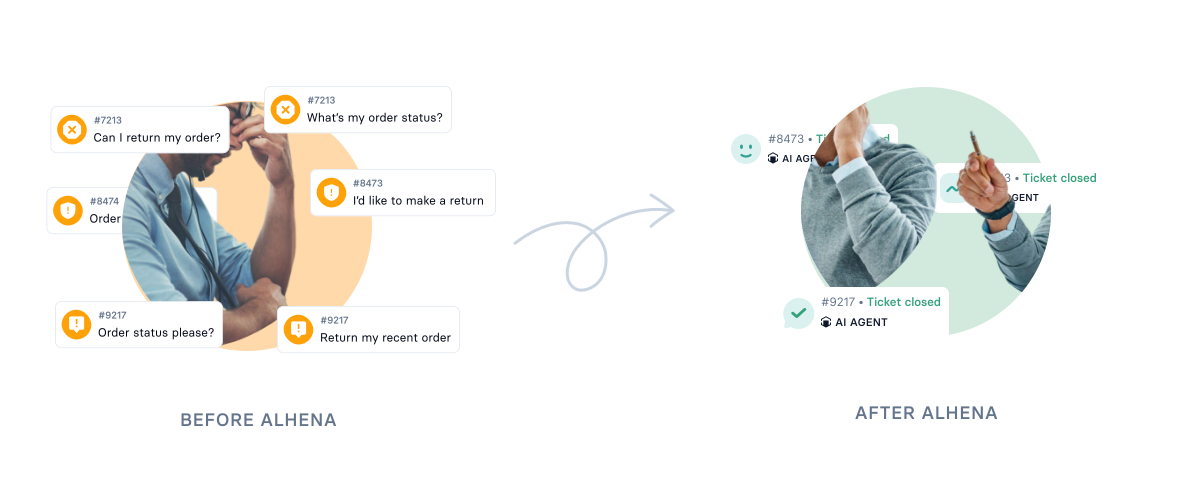
Why Peak Season Breaks Traditional Customer Service Teams
Peak season does not arrive gradually. Flash sales, product launches, and holiday shopping create abrupt walls of demand that support teams cannot absorb without costly preparation.
Hiring Takes Too Long
The average cost per hire in the United States sits at roughly $4,700, according to SHRM. For seasonal customer service roles, even streamlined hiring runs $480 per head once you factor in job postings, screening, and manager time, and that excludes wages, benefits, or the productivity lag while new hires learn your product catalog. Longer wait times during onboarding further erode customer satisfaction.
Training Never Catches Up
A seasonal rep joining two weeks before Black Friday cannot absorb the product knowledge a tenured agent holds. Average training costs run $1,105 per employee, and small companies spend even more manager time coaching arrivals. The result: a support team staffed by people who flag tickets unnecessarily and deliver inconsistent answers that damage the customer experience.
Quality Drops When It Matters Most
During the 2025 peak season, support volume increased 22 percent per agent beyond planned capacity, driving higher transfer rates and repeat contacts. This is the window when customer experience shapes lifetime value. A shopper whose question goes unanswered for hours is unlikely to return in January.
How AI for Customer Support Scales Automatically
AI-powered customer support removes the linear relationship between ticket volume and headcount. Instead of hiring one more person for every batch of queries, AI customer service agents handle concurrent conversations with zero marginal cost per interaction. When you use AI to automate responses, support teams efficiently manage surges without adding staff. Here is how the core AI tools work together.
AI Chatbots for Customer Support
Modern AI chatbots go far beyond scripted decision trees. These generative AI agents use natural language processing (NLP) and machine learning to understand customer queries in real time, pull data from order management systems, and resolve issues end to end. During the 2024 holiday season, chatbots cut support transfers by 35 percent and resolved 65 percent of inquiries without a human agent transfer. Unlike a seasonal hire, a chatbot, or conversational AI bot, does not need a lunch break, a desk, or two weeks of product training.
Automated Ticket Routing and Prioritization
When a customer writes about a lost package, AI instantly classifies the intent, checks the order status, and either resolves the issue or routes it to the right human agent. Built-in sentiment analysis flags emotionally charged messages for priority handling, while AI tools resolve routine queries instantly. This eliminates the manual triage bottleneck during surges. First response time drops from over six hours to under four minutes with AI-powered routing.
Self-Service Portals Powered by AI
AI-driven self-service lets customers track orders, initiate returns, and answer their own product questions without ever opening a ticket. These AI tools draw from a centralized knowledge base to deliver personalized, accurate responses in real time, boosting customer satisfaction without adding staff. Forrester predicts that one in four brands will see a 10 percent increase in successful self-service interactions by end of 2026, translating directly into fewer tickets reaching your live queue.
Predictive Analytics for Proactive Support
AI does not just react to incoming tickets, it anticipates customer needs. By using machine learning to analyze historical data, artificial intelligence platforms predict which products will generate the most questions, identify shipping delays before customers notice, and trigger proactive outreach. This shifts the model from reactive firefighting to preventive care, reducing overall ticket volume before the peak hits.
How Alhena AI Powers Peak Season Support for E-Commerce
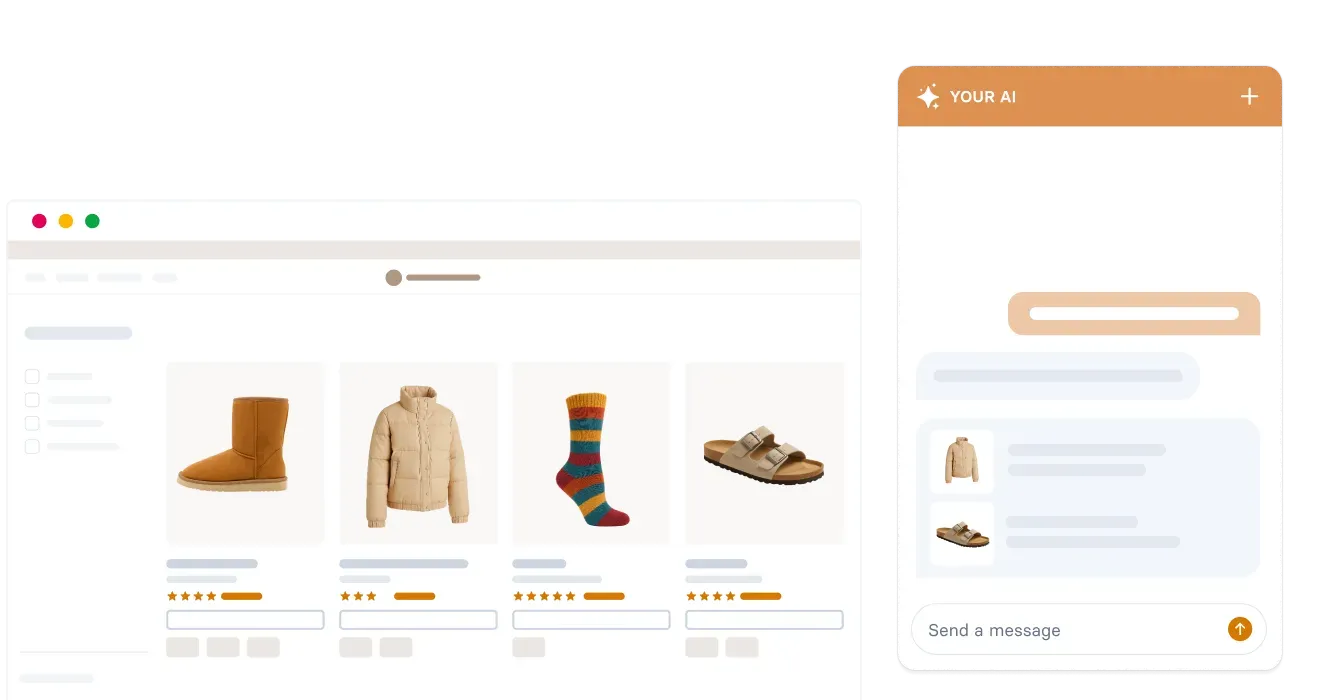
Alhena AI is purpose-built for e-commerce brands that need to scale customer service and drive revenue simultaneously, without seasonal hiring. Unlike general-purpose chatbots or support-first tools like Zendesk or Intercom Fin, Alhena combines an AI Shopping Assistant with an AI Support Concierge to handle both sides of the customer conversation.
Instant Scalability, Zero Ramp-Up
Alhena deploys in under 48 hours with no developer resources required. It integrates directly with Shopify, WooCommerce, Magento, and Salesforce Commerce Cloud, pulling live product data, inventory levels, and order details so the AI assistant can resolve inquiries accurately from day one. When Black Friday traffic spikes, Alhena scales with it, no overtime, no temp agencies, no quality drop.
Hallucination-Free AI Grounded in Your Data
Peak season is the worst time for AI to invent answers. Alhena’s responses are grounded in verified product data, eliminating the hallucination risk that plagues generic large language models. By combining NLP with your knowledge base, this AI bot delivers answers you can trust, no generative AI hallucinations. Every recommendation, order status update, and return policy answer comes directly from your catalog and business rules.
Revenue Beyond Ticket Deflection
Most AI support tools stop at deflection. Alhena goes further with agentic checkout capabilities, it can populate carts, pre-fill checkout fields, and guide shoppers through purchase decisions. The results: Tatcha achieved a 3x conversion rate, 38 percent AOV uplift, and 11.4 percent of total site revenue attributed to Alhena AI. Victoria Beckham saw a 20 percent AOV increase. Crocus reached an 86 percent deflection rate with 84 percent CSAT.
Omnichannel Coverage for Every Customer Touchpoint
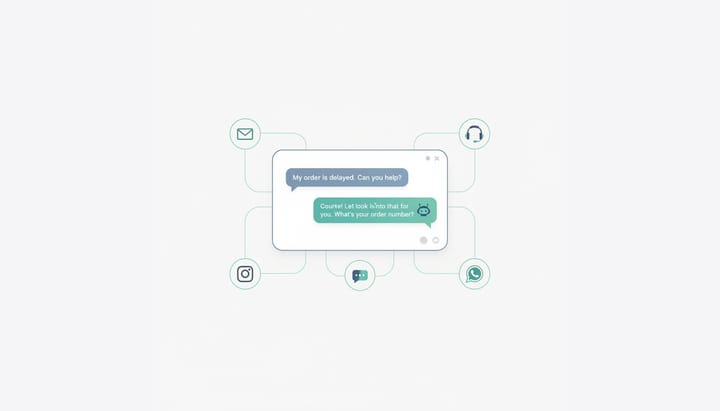
Peak-season requests do not come from a single channel. Alhena provides AI customer service across web chat, email, Instagram DMs, WhatsApp, and voice, all from a unified platform that streamlines every customer interaction. Combined with the Agent Assist tool for human agents, your team has full visibility and AI-powered suggestions regardless of where the customer reaches out. This tailored, omnichannel approach ensures every customer need is met efficiently.
Built-In Revenue Attribution
Alhena includes built-in analytics that analyze which AI conversations lead to purchases, making it easy to measure the direct revenue impact of your peak-season investment in AI customer service. You can see exactly how much revenue your AI-powered e-commerce support generates, not just how many tickets it deflects. Use the ROI Calculator to estimate your savings before deployment.
Best Practices for Deploying AI Before Peak Season
Deploying AI for customer support is not a last-minute decision. The brands that perform best during peak season follow a structured preparation timeline to efficiently integrate AI into their existing customer service workflows, whether built on Zendesk, Freshdesk, or Gorgias, and automate as much as possible.
Start 8 to 12 Weeks Before Peak
Give yourself at least two months to integrate your AI platform with your e-commerce stack, train it on your product catalog and support policies, and run a parallel period where AI handles live traffic alongside your human team. This timeline lets you fine-tune handoff thresholds and response accuracy before volume spikes.
Connect to Your Single Source of Truth
Your automation system must have access to real-time inventory, CRM data, payment systems, logistics APIs, and your refund and return policies to deliver tailored, personalized responses. Disconnected data leads to wrong answers. Alhena’s integrations with platforms like Shopify, WooCommerce, and helpdesks like Zendesk, Freshdesk, and Gorgias ensure every response reflects live data and meets each customer need precisely.
Define Clear Escalation Rules
Not every question should stay with AI. Define escalation triggers: order value above a threshold, negative sentiment detected through sentiment analysis, repeat contacts from the same customer, or questions outside the AI's knowledge base. When the bot needs to escalate, it should hand off with full context so human agents can resolve issues without asking the customer to repeat themselves. A well-designed escalation path is what separates a good AI deployment from a frustrating one.
Run a Post-Peak Review
After the season, analyze which intents had the highest AI resolution rate, where customers dropped off, and what new question types emerged. Feed this data back into your AI to make it smarter for the next cycle. Brands that use AI for customer support as a continuous improvement loop, using analytics to review performance, outperform those that deploy and forget. The benefits of AI compound over time when you commit to this process.
Key Takeaways
- Peak-season customer support volume can spike 300 to 500 percent, overwhelming teams that rely on seasonal hires alone.
- AI customer service scales instantly with no hiring, training, or ramp-up time, and costs 85 to 90 percent less per interaction than human agents.
- AI chatbots for customer support resolved 65 percent of holiday inquiries without human transfer during the 2024 season.
- The hybrid model, AI handling routine volume, humans handling complexity, delivers the best outcomes, with CSAT around 80 percent and cost reductions of 40 to 80 percent.
- Alhena AI is built specifically for e-commerce, combining support automation with revenue-driving capabilities like agentic checkout and personalized product recommendations.
- Brands like Tatcha (3x conversion), Crocus (86 percent deflection), and Puffy (90 percent CSAT) prove the benefits of AI for customer support at scale.
- Start deployment 8 to 12 weeks before peak season for the best results.
Ready to handle your next peak season without scrambling for seasonal hires? Book a demo with Alhena AI or start for free with 25 conversations to see how AI for customer support can scale your operation and drive revenue at the same time.
Frequently Asked Questions
How does AI for customer support handle peak season volume spikes?
AI for customer support scales horizontally with no lead time. When ticket volume surges during Black Friday, holiday sales, or product launches, AI agents handle thousands of concurrent interactions simultaneously. During the 2024 holiday season, AI chatbots resolved 65 percent of queries without any human transfer, keeping response times under seconds while human teams would need weeks of hiring and training to match that capacity.
Can AI customer support work alongside human agents during peak periods?
Yes, and the hybrid model is the most effective approach. Use AI to automate routine, high-volume interactions like order tracking, return initiation, and product queries, while human agents focus on complex issues, emotionally sensitive conversations, and high-value retention opportunities. Organizations using this model report customer satisfaction scores around 80 percent and cost reductions of 40 to 80 percent.
How quickly can Alhena AI be deployed before a peak season event?
Alhena AI deploys in under 48 hours with no developer resources required. It integrates directly with Shopify, WooCommerce, Magento, and Salesforce Commerce Cloud, along with helpdesks like Zendesk, Freshdesk, and Gorgias. For best results, start 8 to 12 weeks before your peak period to fine-tune escalation rules and run parallel testing.
Does AI customer support reduce quality during high-volume periods?
AI actually maintains more consistent quality than seasonal hires during peak periods. Human teams see customer experience dip as volume exceeds capacity, with the 2025 peak season showing a 22 percent overload per agent. Generative AI agents deliver the same response accuracy on ticket number 5,000 as on ticket number 5. Alhena AI specifically uses hallucination-free responses grounded in verified product data and its knowledge base, ensuring every answer is accurate regardless of volume.
What types of customer inquiries can AI resolve without human intervention?
AI excels at order tracking and status updates, return and exchange processing, product queries about sizing and compatibility, account management tasks like password resets, shipping and delivery inquiries, and basic troubleshooting. These categories typically account for 60 to 80 percent of total customer service volume during peak seasons, and AI tools can resolve them efficiently without human involvement.