Gartner reports that 91% of customer service leaders face direct executive pressure to implement AI in 2026. That number was 85% just a year ago. The message is clear: AI customer service is no longer a pilot project or a nice-to-have. It's a core function.
But here's the thing. While 88% of contact centers use some form of AI, only 25% have fully integrated it. And 75% of consumers say they've been frustrated by AI-driven customer service in the past year. The gap between "using AI" and "using AI well" is enormous.
This guide breaks down how AI customer service actually works, which tools are worth considering in 2026, and how to get started without frustrating your customers or blowing your budget.
What Is AI Customer Service?
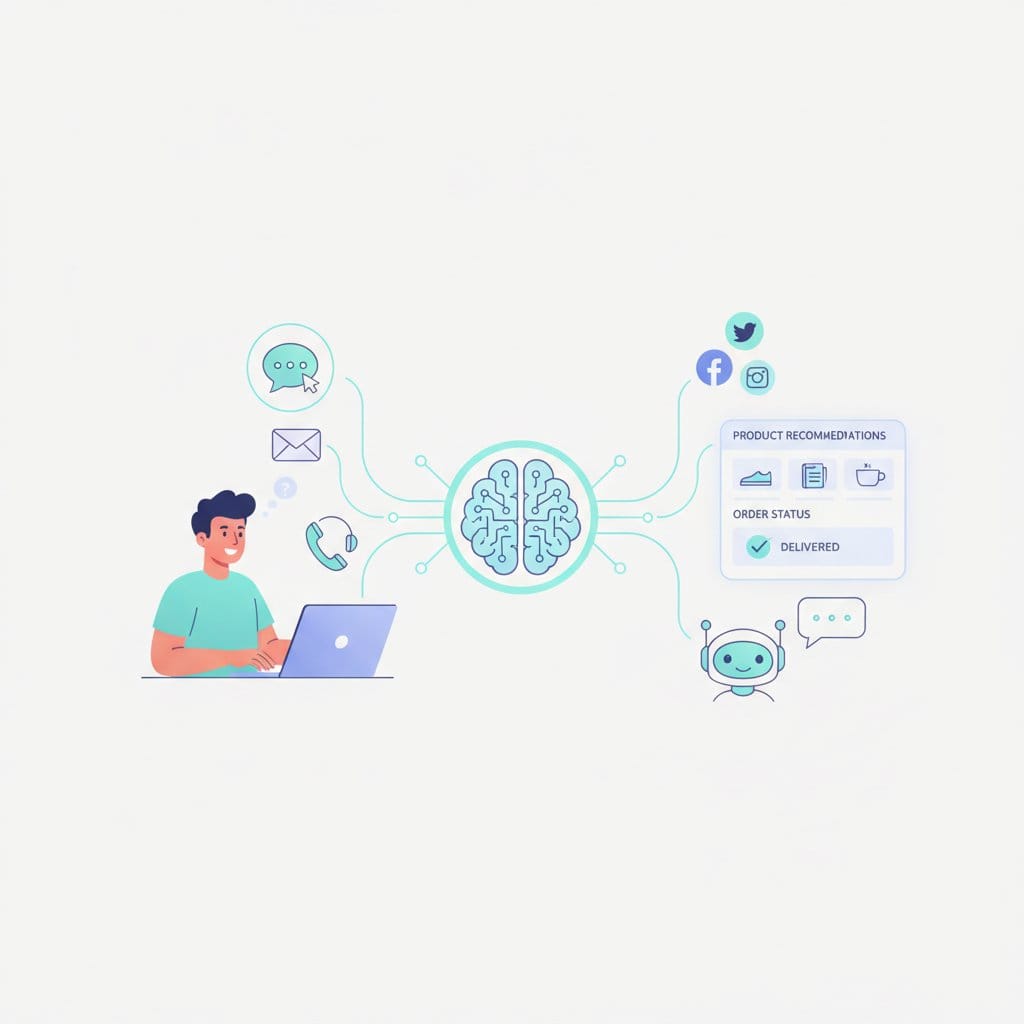
AI customer service uses artificial intelligence to handle, route, or assist with customer interactions across channels like chat, email, phone, and social media. In practice, that means everything from chatbots that answer FAQs to AI agents that process returns, modify orders, and recommend products.
The technology has evolved fast. Five years ago, "AI support" meant a keyword-matching chatbot that sent customers in circles. Today, the best platforms use large language models (LLMs), generative AI, retrieval augmented generation (RAG), and agentic workflows to resolve complex queries without human involvement.
There are three main categories of AI customer service tools:
- AI agents handle customer conversations autonomously, resolving queries from start to finish
- AI copilots sit alongside human agents, suggesting replies, summarizing tickets, and pulling relevant knowledge
- AI triage systems classify, prioritize, and route incoming requests to the right team or workflow
Most modern platforms combine all three. The best ones, like Alhena AI's Shopping Assistant, go further by turning support conversations into revenue opportunities.
How AI Customer Service Works Under the Hood
Understanding the technology behind AI customer support helps you evaluate tools and set realistic expectations. Here's what happens when a customer sends a message to an AI-powered support system.
Step 1: Understanding the Query
Natural language processing (NLP) and natural language understanding (NLU) parse the message to identify three things: intent (what the customer wants), entities (specific details like order numbers or product names), and sentiment (whether they're calm, confused, or frustrated). This is the foundation of every interaction.
Step 2: Retrieving Accurate Information
Here's where modern AI customer service separates from the old chatbot era. Retrieval augmented generation (RAG) connects the AI to your company's knowledge base, product catalog, order management system, and help center. Instead of generating answers from general training data (which causes hallucinations), the AI retrieves verified information, learns from your catalog, and uses it to craft accurate, personalized, brand-specific responses.
Alhena AI takes this a step further with a hallucination-free architecture. Every response is grounded in your actual product data and policies, so customers get trusted, accurate information. You can read more about this approach in our breakdown of how RAG powers agentic AI in customer support.
Step 3: Generating a Response
The LLM takes the retrieved context, the customer's query, and conversation history to generate a natural, helpful response. Good systems deliver responses that match your brand's tone of voice, whether that's casual and friendly or premium and polished.
Step 4: Taking Action
This is what separates AI agents from AI chatbots. Modern agentic AI doesn't just answer questions. It executes tasks: processing returns, updating shipping addresses, applying discount codes, or populating a customer's cart with recommended products. These intelligent, action-capable agents connect to your backend systems through APIs and complete workflows that used to require a human.
Step 5: Escalating When Needed
Not every issue should be handled by AI. Real-time sentiment analysis lets the system analyze frustration signals, and the system effectively routes complex, emotional, or high-value interactions to human agents with full context. The customer doesn't have to repeat themselves. Tools like Alhena AI's Agent Assist then help the human agent resolve the issue faster by suggesting replies and surfacing relevant information.
The Business Case: Why AI Customer Service Pays for Itself
The ROI numbers show that AI can improve customer support operations and are hard to ignore. According to industry research, companies using AI for customer service see:
- 68% lower cost per interaction, dropping from $4.60 to $1.45 on average
- 74% faster first response times, from 8.2 minutes down to 2.1 minutes
- 56% reduction in average handle time
- $3.50 return for every $1 invested, with measurable efficiency gains in AI customer service
Gartner projects $80 billion in contact center labor cost savings by the end of 2026. And the Salesforce State of Service 2025 report found that companies expect a 20% decrease in service costs and resolution times with AI agents.
But cost savings are only half the story. The real shift is AI customer service as a revenue driver. Alhena AI's work with Tatcha shows what's possible: 11.4% of total site revenue now comes from AI-assisted conversations, with a 38% average order value uplift. That's not deflection. That's selling.
For a deeper look at measuring these results, see our practical framework for measuring AI customer service ROI.
Best AI Customer Service Tools in 2026
The market for AI customer support software has matured rapidly. Here are the tools worth evaluating, organized by what they do best.
Alhena AI: Best for Ecommerce Revenue and Support
Alhena AI is purpose-built for ecommerce. It runs two specialized agents: a Product Expert Agent that handles pre-sale questions and drives conversions, and an Order Management Agent that resolves post-purchase queries like order tracking, returns, and subscription changes.
What sets it apart from general-purpose AI customer service tools is the revenue angle. Alhena doesn't just deflect tickets. It guides shoppers to products, populates carts, and pre-fills checkout. Victoria Beckham saw a 20% AOV increase. Puffy achieved 63% automated resolution with 90% CSAT. Crocus hit an 86% deflection rate while maintaining 84% CSAT.
Alhena deploys in under 48 hours with no engineering resources. It works across web chat, email, Instagram DMs, WhatsApp, and voice, and integrates with Shopify, WooCommerce, Magento, Zendesk, Freshdesk, Gorgias, Intercom, and more.
Zendesk AI: Best for Enterprise Helpdesk Teams
Zendesk's AI layer adds automated replies, ticket triage by intent and sentiment, and an agent copilot to its established helpdesk platform. It's a solid choice for large support teams already invested in the Zendesk ecosystem.
The catch: AI features require add-ons that push costs to $200-500 per agent per month at scale. And while Zendesk handles ticket deflection well, it wasn't designed to drive revenue from support conversations. For a side-by-side comparison, check out Alhena AI vs Zendesk AI.
Intercom Fin: Best for SaaS and Tech Companies
Intercom's Fin AI Agent charges $0.99 per resolution, only when the AI actually solves the problem. It supports chat, email, WhatsApp, and Messenger, and uses Procedures to handle multi-step workflows like refunds and subscription changes.
Fin is strong for SaaS companies, but its ecommerce features are limited. There's no product recommendation engine, no cart population, and no revenue attribution. We cover the full comparison in our Alhena AI vs Intercom Fin analysis.
Freshdesk Freddy AI: Best for Budget-Conscious SMBs
Freshworks offers Freddy AI as part of its Freshdesk platform. The per-session pricing (roughly $0.12 per session after the free tier) makes it one of the most affordable options. Freddy handles automated answers, agent suggestions, and ticket summaries across web, email, and WhatsApp.
The limitation: AI features are locked behind Pro and Enterprise plans, and ecommerce-specific capabilities like product recommendations or checkout assistance are missing. See how it stacks up in our Freshdesk Freddy alternatives guide.
Gorgias: Best for Shopify-Only Brands
Gorgias is ecommerce-native and Shopify-first. Its AI agent can issue refunds, edit subscriptions, and recommend products at roughly $1 per resolution. If your entire stack is Shopify and you want a helpdesk with AI built in, Gorgias is a strong contender.
The downside: it only works within the Gorgias helpdesk and is primarily Shopify-focused. Brands on WooCommerce, Magento, or Salesforce Commerce Cloud need to look elsewhere. For a broader comparison, see our best Gorgias alternatives for ecommerce.
Ada: Best for Enterprise Compliance
Ada handles complex, multi-step workflows with HIPAA, SOC2, and GDPR compliance built in. Its AI Voice product and email resolution capabilities (70% automated) are strong for large enterprises in regulated industries like fintech and healthcare.
Pricing is opaque. Enterprise deals range from $100K to $300K+ per year, making Ada cost-prohibitive for most ecommerce brands.
Tidio (Lyro AI): Best for Small Stores
Tidio's Lyro AI starts with a free plan and offers paid tiers from $39 per month for 100 AI conversations. It's the lowest barrier to entry for small Shopify and WordPress stores that want basic AI customer support without a big investment.
At higher volumes, costs add up quickly since Lyro and the chatbot builder are billed separately. Read our full Alhena AI vs Tidio comparison for details.
How to Get Started with AI Customer Service
The biggest mistake brands make with AI customer support is trying to automate everything at once. A poor rollout can damage the customer experience you worked hard to build. Here's a practical, phased approach that works.
1. Audit Your Support Operations First
Before you pick a tool, know your numbers. Map your most common ticket types and their volumes. Calculate your current cost per ticket, average resolution time, and CSAT baseline. Most ecommerce businesses find that 40-60% of their support volume is repetitive queries like order status, shipping updates, and return policies. Those are your automation candidates.
2. Set Clear, Measurable Goals
Avoid "implement AI" as a goal. Instead, define specific targets: "Reduce after-hours response time from 4 hours to under 5 minutes" or "Automate 50% of order status queries within 90 days." Tie every goal to a metric you can track. For guidance on which metrics matter most, our guide on AI customer support KPIs covers AHT, FCR, containment rate, and CSAT benchmarks.
3. Choose the Right Tool for Your Stack
Match the platform to your business. Ecommerce brands need tools built for product catalogs, order management, and checkout flows. Alhena AI deploys in under 48 hours and connects to your existing ecommerce platform and helpdesk through native integration, without dev resources. General-purpose tools like Zendesk AI or Intercom Fin work better for SaaS and tech companies where the support use case is different.
4. Prepare Your Knowledge Base
AI is only as good as the data it pulls from. Audit and update your help center articles, FAQs, product descriptions, and return policies before launch. Clean customer data is what separates good AI from bad. Fill gaps in your documentation. This is the single most impactful step you can take, and 58% of service leaders are now upskilling agents to manage knowledge bases for exactly this reason.
5. Start Small, Then Expand
Launch AI on your highest-volume, lowest-complexity queries first. Order status, shipping tracking, and return eligibility checks are ideal starting points. Monitor accuracy, customer satisfaction, and resolution rates for 2-4 weeks. Then expand to product recommendations, pre-sale questions, and more complex post-purchase flows.
6. Design the Human Handoff
Never bury the option to talk to a person. Define clear escalation triggers: frustrated sentiment, VIP customers, complex technical issues, or high-value orders. The AI should pass the full conversation context to the human agent so the customer doesn't repeat themselves. Manawa does this well, cutting response time from 40 minutes to 1 minute while keeping 80% of interactions automated.
AI Customer Service Trends Shaping 2026
The AI customer support landscape is shifting fast. Here are the trends that will define how brands operate this year and beyond.
Agentic AI Replaces Simple Chatbots
The industry is moving from chatbots that answer questions to AI agents that complete tasks. Gartner predicts agentic AI will resolve 80% of common customer service issues without human intervention by 2029. Cisco's data shows 56% of customer support interactions will involve agentic AI by mid-2026. The implication: if your "AI" is still a decision-tree chatbot, you're already behind.
Voice AI Goes Mainstream
Conversational voice agents are replacing traditional IVR menus. Voice AI demonstrates 35% faster call handling, and 44% of CS leaders are actively exploring voice bots. Alhena AI's Voice AI lets customers speak naturally instead of pressing buttons, with full context carryover from other channels.
AI Transparency Becomes Table Stakes
Customers want to know when they're talking to AI, and they want to understand its reasoning. Zendesk's CX Trends 2026 report found that 79% of consumers want plain-language explanations from AI, and 95% expect explanations for AI-driven decisions. Black-box AI is losing trust.
Omnichannel Memory Becomes the Baseline
Customers expect the AI to remember them, whether they reach out via chat, email, Instagram, or phone. 81% of consumers want agents to continue conversations without starting over. Alhena AI's Social Commerce agent carries context across all channels, so a customer who starts on Instagram DMs and follows up via email gets a connected experience.
Support Becomes a Revenue Channel
The biggest mindset shift in 2026: AI customer service isn't just a cost center. It's a revenue channel. Salesforce projects agentic AI will boost upsell revenue by 15%. Alhena AI is already proving this with real results: brands like Tatcha generate 11.4% of total site revenue through AI-guided conversations. The tools that treat every support interaction as a potential sale will win.
What Separates Good AI Customer Service from Bad
Forrester predicts that one-third of brands will erode customer trust through premature AI deployment in 2026. The difference between the brands that succeed and those that fail comes down to a few key factors.
Accuracy matters more than speed. An AI that responds in 2 seconds with wrong information does more damage than one that takes 10 seconds to give the right answer. Hallucination-free architectures like Alhena AI's, which ground every response in verified product data, solve this problem at the foundation level.
Escalation should feel natural, not like a punishment. When the AI can't help, the transition to a human should be smooth and fast. The customer should never have to re-explain their issue. The best implementations pass the full conversation summary, customer history, and recommended actions to the agent.
The knowledge base needs ongoing maintenance. AI can't give accurate answers from outdated documentation. Treat your knowledge base as a living product. Assign ownership, review content monthly, and track which queries the AI can't answer to identify gaps.
Measure what matters. Track performance insights like deflection rate, CSAT, resolution time, cost per ticket, and (for ecommerce) revenue from AI conversations. If your AI is deflecting tickets but tanking satisfaction, that's not a win. Alhena's ROI calculator can help you model the expected impact before you commit.
Key Takeaways
- AI customer service has moved from experimental to essential, with 91% of CS leaders under pressure to implement in 2026
- Modern AI uses RAG and agentic workflows to resolve issues accurately and take real action, not just deflect
- The ROI is proven: 68% lower cost per interaction, 74% faster response times, $3.50 return per $1 invested
- For ecommerce, choose tools built for product catalogs and checkout flows. Alhena AI leads in turning support into revenue
- Start small with high-volume queries, prepare your knowledge base, and design clear human handoff protocols
- The brands that win will treat AI customer support as a revenue channel, not just a cost-cutting tool
Ready to see how AI customer service can work for your ecommerce brand? Book a demo with Alhena AI or start free with 25 conversations to experience the difference yourself.
Frequently Asked Questions
How does AI customer service work?
AI customer service uses natural language processing to understand customer queries, retrieval augmented generation (RAG) to pull verified information from your knowledge base, and large language models to generate accurate responses. Modern AI agents can also execute actions like processing returns, updating orders, and recommending products through API connections to your backend systems.
What is the difference between AI chatbots and AI agents for customer support?
AI chatbots follow scripted decision trees and can only answer predefined questions. AI agents use LLMs and agentic workflows to understand context, reason through complex queries, and take real actions like issuing refunds or modifying subscriptions. Gartner predicts AI agents will resolve 80% of common service issues without human help by 2029.
How much does AI customer service software cost?
Pricing varies widely. Tidio starts with a free plan, Freshdesk Freddy charges about $0.12 per session, Intercom Fin charges $0.99 per resolution, and enterprise tools like Ada start at $30,000 per year. Alhena AI offers a free tier with 25 conversations and scales based on volume. Most companies see $3.50 ROI for every $1 invested.
Which AI customer service tool is best for ecommerce?
Alhena AI is purpose-built for ecommerce with two specialized agents: a Product Expert for pre-sale guidance and an Order Management Agent for post-purchase support. It integrates with Shopify, WooCommerce, Magento, and Salesforce Commerce Cloud. Tatcha saw 11.4% of total revenue from AI conversations, and Crocus achieved 86% deflection with 84% CSAT.
How long does it take to set up AI customer support?
Setup time ranges from hours to months depending on the platform. Alhena AI deploys in under 48 hours with no engineering resources needed. Tidio and Intercom Fin also offer self-serve setup in days. Enterprise platforms like Ada and Zendesk with full customization typically take 4-12 weeks.
Can AI customer service handle complex issues or just simple FAQs?
Modern AI agents handle multi-step workflows including returns processing, subscription changes, order modifications, and product recommendations with checkout assistance. For truly complex or emotionally sensitive issues, the AI escalates to a human agent with full conversation context so the customer doesn't need to repeat themselves.
Does AI customer service improve or hurt customer satisfaction?
It depends entirely on implementation quality. Well-deployed AI support improves CSAT by reducing wait times and providing accurate answers 24/7. Puffy achieved 90% CSAT with 63% automated resolution using Alhena AI. But poorly implemented AI frustrates customers, with 75% of consumers reporting negative experiences with bad AI deployment.
What channels does AI customer service support?
Most AI customer service platforms support web chat and email. Leading tools like Alhena AI also cover Instagram DMs, WhatsApp, voice calls, and SMS. Omnichannel AI carries context across channels, so a customer who starts on Instagram and follows up via email gets a connected experience without repeating themselves.
How do I measure the ROI of AI customer service?
Track five core metrics: deflection rate (percentage of queries resolved without human help), cost per ticket (before and after AI), average response time, CSAT score, and for ecommerce, revenue attributed to AI conversations. Alhena AI includes built-in revenue attribution analytics. Use the ROI calculator at alhena.ai/roi-calculator to model expected returns.