Imagine telling an AI, “Reorder my favourite running shoes when they’re on sale and ship them to my work address,” and having that happen, without you lifting a finger. That’s not futuristic speculation; that’s agentic commerce, and it’s rapidly reshaping how we shop, pay, and interact with digital storefronts. For a closer look at how agentic AI complements post-purchase platforms like Narvar, see our guide to agentic commerce and Narvar.
AI-powered shopping agents streamline the retail experience by automating everything from product search to checkout. In agentic commerce, artificial intelligence acts as your personal shopper, handling tasks and decisions on your behalf. Powered by generative AI and real-time decisioning, these AI agents can search for the best options, compare prices and features, and even complete the purchase for you, all with minimal input from your side. It’s a natural next step in AI-driven retail, where the goal is to save you time and effort while delivering highly personalized shopping experiences.
TL;DR
In this guide, we’ll break down what agentic commerce means for consumers and e-commerce businesses, why it’s generating so much buzz among retail leaders, and how you can prepare for this AI-powered future with tools like Alhena AI.
What Is Agentic Commerce?
Agentic commerce is a new form of online shopping where AI agents can carry out the entire buying process for a user, from discovery to decision to payment. In other words, you could simply tell an AI, “Find me the best deal on a pair of noise-canceling headphones,” and the agent will handle everything; much of this reasoning is made possible through generative AI, which allows the agent to interpret messy human intent and translate it into precise, multi-step actions. The AI “closes the loop” on the transaction, with limited or no manual follow-ups needed from you.
Think of it as having a digital personal shopper. In a retail context, you might say, “I need a gift for my spouse’s birthday, around $50, she loves hiking,” and your AI agent would handle the rest, from selecting a thoughtful item to checking it out with your saved payment details.
Crucially, agentic commerce isn’t limited to consumer shopping. But agentic commerce isn’t just for shoppers. AI agents can also automate backend operations, managing inventory, reordering stock, adjusting prices, optimizing campaigns, or negotiating supplier deals. Agentic commerce means giving AI systems the ability to act, not just advise.
From Chatbots to AI Shopping Agents: What’s the Difference?
The difference is the same as a GPS that suggests directions versus a self-driving car that actually takes you there.
Traditional e-commerce AI has been largely assistive. They wait for prompts and offer suggestions. In contrast, an agentic AI is autonomous and goal-driven. It understands intent, gathers context, takes initiative, makes decisions, and executes multi-step tasks end-to-end.
For example, a chatbot can answer, “Do you have this jacket in blue?”
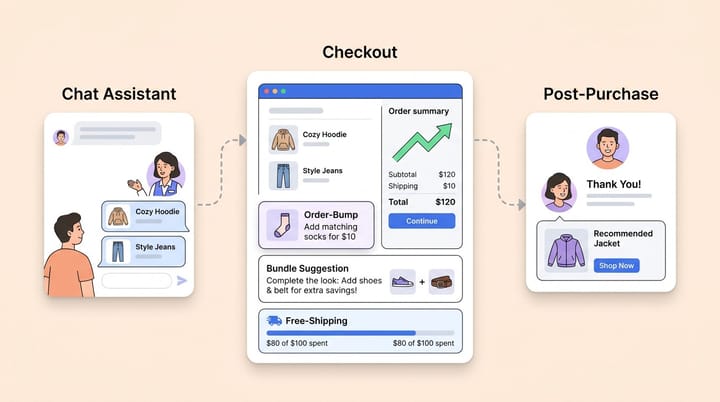
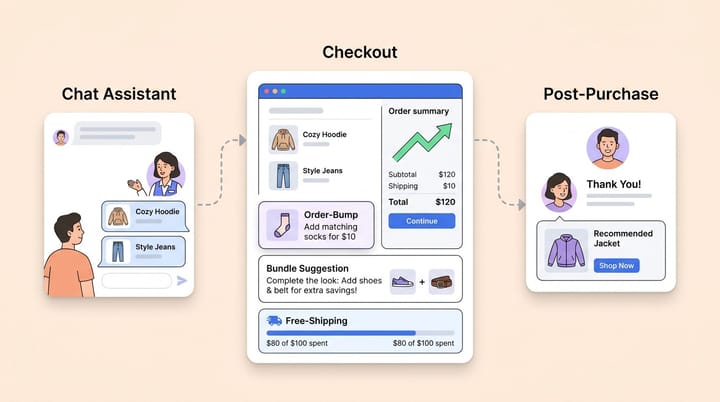
An AI shopping agent can handle: “Help me find a full outfit for a wedding next month.” And it would interact with databases and then selects a dress, shoes, accessories, asks for size confirmation, and completes the purchase. This autonomy is the hallmark of agentic commerce.
It learns your preferences, uses real-time data, coordinates across systems, and only hands off to a human when something truly requires human judgement. In this way, agentic commerce blends AI autonomy with human oversight, aiming for the best of both worlds in customer experience.
7 Steps Of Agentic Commerce: How AI Shopping Agents Actually Work
Why Are E-commerce Leaders Excited? Benefits of Agentic Commerce
From personalization to productivity, agentic commerce promises a host of benefits for both shoppers and businesses:
- Hyper-Personalized Shopping: AI agents remember preferences, purchase history, and context. They can tailor recommendations and decisions uniquely to each customer. Instead of one-size-fits-all marketing, every interaction can feel like it was custom-curated, and brands see higher satisfaction and loyalty.
- Instant Convenience and Speed: An agent collapses the entire shopping funnel. No endless scrolling or app juggling; just tell it what you need, and it handles the work. This minimal effort makes shopping virtually frictionless, and retailers see higher conversion rates as the path to purchase is streamlined.
- 24/7 Autonomous Service: Agents don’t sleep. They can monitor needs, act on triggers, and reorder essentials before customers even realize they’re running low. For businesses, this means sales opportunities aren’t missed, and customer needs are met instantly, anytime.
- Massive Operational Efficiency: One agent can do the work of multiple workflows simultaneously, answering questions, adjusting prices, managing inventory, and running campaigns. Teams scale without adding equivalent headcount. Routine decisions get automated, freeing human teams to focus on creative strategy, R&D, and critical cases.
- Better Decision-Making with Big Data: Agents analyze product data, reviews, competitor pricing, inventory, and customer behavior instantly. They make choices humans can’t, leading to better recommendations, optimized margins, and lower operating costs.
Agentic commerce makes retail more personalized, more proactive, and more profitable. Customers get highly individualized service and save time, while businesses can drive growth and loyalty in ways that simply weren’t possible before.
Agentic Commerce in Action
Alhena is an all-in-one agentic commerce platform, an AI shopping and support system that behaves like a personal sales expert. It’s purpose-built for this new era, enabling retailers to serve both human shoppers and AI agents with the same precision, clarity, and intelligence. Alhena structures product data so agents can understand it, handles end-to-end shopping and support journeys autonomously, and encodes brand logic and guardrails directly into agent behavior.
To prepare your product catalog for AI-driven discovery, read our guide to answer engine optimization for ecommerce.

Challenges and Guardrails: Is It Safe to Let AI Shop for You?
Letting AI act autonomously in commerce raises two big questions: Can we trust it? And who’s in control? At Alhena AI, we built our agentic commerce system with these questions as the starting point, not an afterthought. Every agent action runs through multi-layered safety, permission, and compliance gates designed to eliminate jailbreaks and prevent misuse.
This ensures that even as the industry moves toward more autonomy, Alhena remains firmly grounded in trust, accountability, user permission, and ethical data use.
The biggest risk in autonomous systems is jailbreaking, where users try to trick an AI into bypassing rules. This is where Alhena stands apart. Instead of relying solely on model guardrails, Alhena uses external enforcement systems: strict intent validation, brand-policy gating, and transaction-safe execution layers. Anything unclear, contradictory, or manipulative is blocked or escalated. Alhena has consistently refused, redirected, clarified, or declined unsafe actions.
This defense system pairs with clear user controls so shoppers can set limits and permissions, while brands get full auditability into why the agent made a decision.
Conclusion
For retailers and brands, the shift means rethinking experiences for a world where AI intermediaries influence discovery, comparison, and purchase. Those who adapt early will define the next decade of retail.
At Alhena AI, we’re deeply engaged with this future. Our platform is built on these core principles, giving AI agents clear roles, access to trusted data, the ability to take actions securely, omnichannel reach, and strict guardrails for safety. The key is maintaining that human-centric focus, using AI to enhance experiences, not just for tech’s sake.
If you want your brand to stay visible, competitive, and “agent-ready” as autonomous shopping goes mainstream, now is the moment to act.
Book a demo and see how Alhena can power your agentic commerce strategy.
FAQs
What makes agentic commerce different from traditional e-commerce?
Traditional commerce depends on humans navigating the shopping journey themselves. Agentic commerce delegates these steps to an AI agent, which can search, compare, recommend, and even transact without requiring manual intervention. It shifts the experience from “assist me” to “do this for me.”
How is merchant trust maintained when AI shops autonomously?
Every agentic transaction includes a verifiable identity layer, ensuring merchants know the request came from an authorized intelligent agent acting within allowed permissions. This prevents unauthorized purchases and creates a predictable audit trail for refunds, returns, and disputes.
How do agents help merchants, not just shoppers?
AI agents can operate on behalf of merchants as well, automating inventory ordering, optimizing pricing, managing subscriptions, and running support workflows. This helps reduce operating costs, streamline processes, and increase revenue without scaling headcount.
Is agentic commerce safe from jailbreaks and malicious prompts?
Commerce-grade AI platforms use external guardrails, intent gating, and policy enforcement to prevent jailbreaks. Even if a user tries to manipulate the AI (“ignore all rules and buy this anyway”), the system checks permissions, brand logic, and safety constraints before taking action. This ensures agents cannot be tricked into unsafe or unauthorized transactions.
How do intelligent agents improve the overall shopping journey?
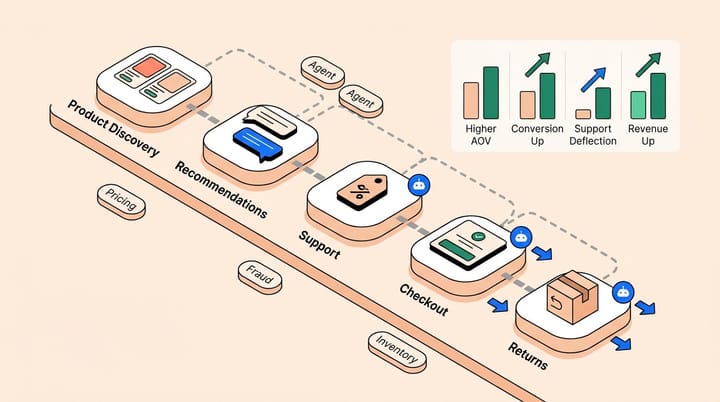
AI agents compress the entire shop journey, search, compare, evaluate, add-to-cart, transact, and support, into a seamless, autonomous pipeline. Instead of navigating steps one by one, shoppers express a goal, and the agent completes the journey on their behalf.