69% of Searches End Without a Click. Your Commerce Model Wasn't Built for That.
Nearly seven out of ten Google searches now end without the user clicking a single result. That stat alone should alarm every ecommerce leader and decision-maker reading this. But the real shift isn't just about search behavior. AI platforms are autonomously building full purchase journeys that let shoppers discover, evaluate, and buy products without ever visiting your website. The traffic-dependent online commerce model most brands rely on is breaking, and the replacement is already taking shape.
This is zero-click commerce in ecommerce, and it fundamentally changes what it means to "win" online. If your revenue strategy depends on driving visitors to your site and converting them there, you're competing in a game that's shrinking fast. Here's what's happening, how this consumption shift affects your business, and what you need to do about it right now.
What Zero-Click Commerce Actually Means
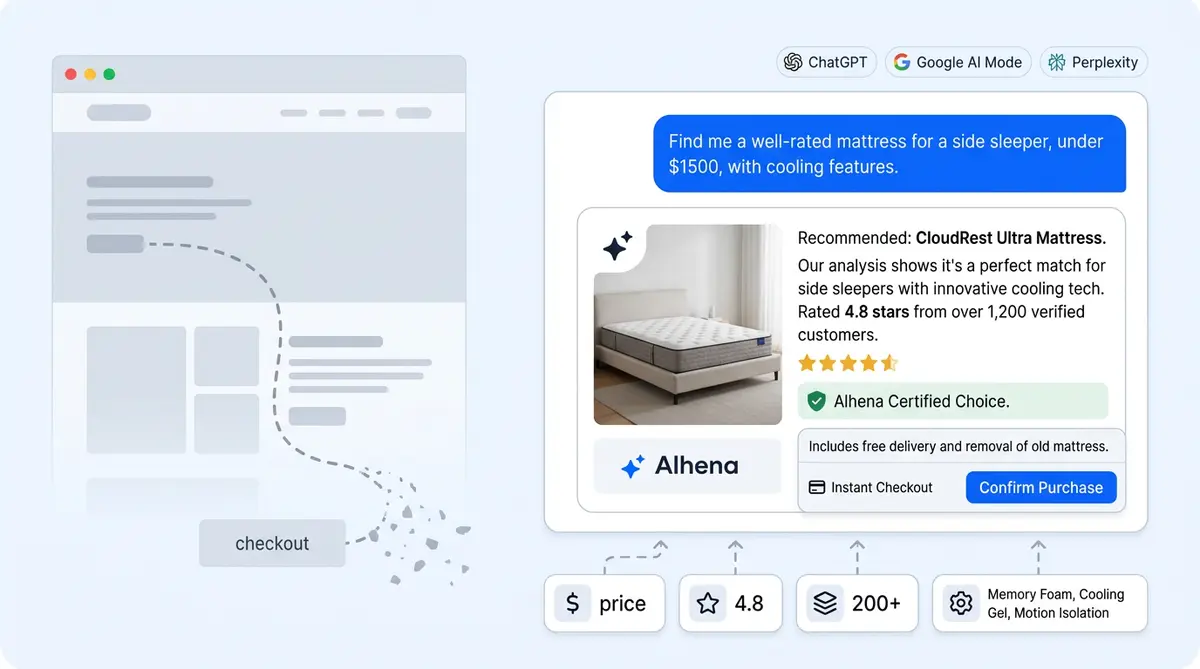
Zero-click commerce describes a buying experience where the entire shopping journey and transaction happens inside an AI interface. The shopper never leaves the platform. They don't visit your product page. They don't land on your homepage. They ask an AI assistant or shopping agent a question, get a product recommendation, and complete checkout without a single redirect.
This isn't a theoretical model. OpenAI's ChatGPT now offers Instant Checkout, letting users buy products from merchants and retailers like Etsy sellers, Shopify brands, and major retailers directly inside the chat. Google's AI Mode is building similar capabilities through its Universal Commerce Protocol, backed by major retailers including Walmart, Target, and Shopify. Walmart is already seeing results. Perplexity expanded its Buy with Pro checkout to all U.S. users and integrated PayPal for payments. Our <a href="https://alhena.ai/blog/perplexity-shopping-merchants-setup-guide/" title="Perplexity Shopping merchants guide">Perplexity Shopping merchant setup guide</a> walks through how to get your products into this channel.
The pattern is consistent across every major AI platform: combine conversational product discovery with embedded payment processing, creating an interaction model, and you get a complete AI shopping experience. The entire user journey never touches the merchant's website. That's zero-click commerce, and it's growing fast.
Two Protocols Competing for the Future
Two competing standards are racing to define how AI agents handle instant checkout at scale. OpenAI and Stripe launched the Agentic Commerce Protocol (ACP), which powers ChatGPT's checkout flow. Google responded with the Universal Commerce Protocol (UCP), announced in early 2026 with more than 20 retail partners. Both protocols represent a major innovation in active development to make purchasing inside AI interfaces as frictionless as buying on Amazon, and both are live today.
For brands, this means the infrastructure for zero-click commerce isn't coming. It's here. The question is whether your products are ready to be sold through it.
Why This Shift Is Accelerating Now
Three forces are converging to push zero-click commerce from experiment to mainstream.
AI Answers Are Replacing Browsing
When a shopper asks ChatGPT "what's the best moisturizer for dry skin under $50," the AI returns a curated recommendation with reviews, pricing, and a buy button. The shopper never needed to browse and compare across five websites, compare ingredients, or read landing page copy. The AI did that work in seconds, replacing human browsing behavior entirely. Research shows that 18% of adults already use ChatGPT for discretionary shopping, and that number is climbing month over month as adoption accelerates.
Embedded Checkout Removes the Last Reason to Visit
Product discovery alone wouldn't kill website traffic. But when you add native checkout inside the AI interface, the shopper has no reason to leave. Walmart customers using AI shopping assistants already show 35% larger basket sizes compared to non-AI shoppers. The transaction is faster, simpler, and increasingly frictionless inside the AI platform, redefining the customer experience.
Industry Projections Point to Rapid Growth
AI-driven commerce sales are projected to account for 1.5% of all online shopping in 2026. That sounds small until you consider the total addressable market: analysts project this channel will drive trillions in global transaction volume by the end of the decade. More telling, 92% of U.S. B2C marketing executives are already building AI agents and agentic commerce strategies. The acceleration curve over the next 12 to 24 months will be steep.
Why This Is Existential for Traffic-Dependent Brands
Most ecommerce brands have spent years perfecting a single funnel: drive traffic to the website, then convert that traffic on-site. SEO rankings, page speed, landing page design, A/B tested CTAs, retargeting pixels, marketing attribution. Every dollar of investment in e-commerce technology assumes the shopper will visit your site before buying.
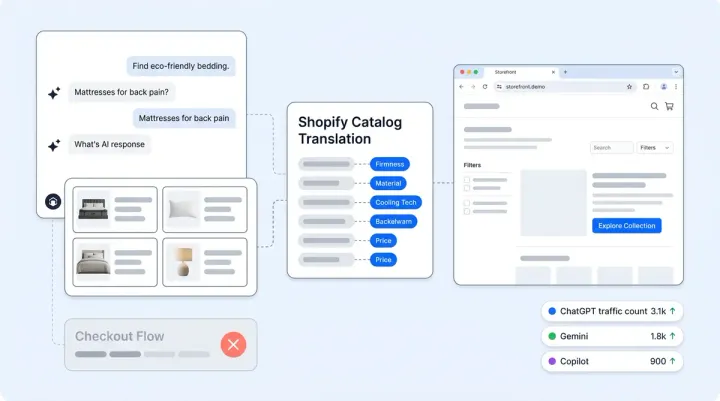
Zero-click commerce breaks that assumption. If the transaction happens inside an AI platform, your beautiful product page doesn't matter. Traditional commerce relied on that page. Your carefully optimized checkout flow never loads. Your retargeting pixel never fires. The shopper bought your product and you may not even know how they found it.
One DTC brand founder described the challenge bluntly: tracking how often your products show up in AI recommendations when purchase intent is present is like looking into "a black box." You can't measure what you can't see, and your brand becomes invisible to AI-driven buyers. And 70% of B2C marketing executives say they would shift spending from traditional retail media to answer engines like ChatGPT and Perplexity if they could. The attention is moving. The budgets will follow.
Brands that keep pouring resources exclusively into on-site conversion optimization are investing in a shrinking slice of the purchase journey. Traditional models of traffic and conversion are giving way to data-driven AI commerce. The brands winning in zero-click commerce are the ones preparing for a world where the point of sale is no longer their own website.
What Brands Need to Do Now
Winning in zero-click commerce doesn't mean abandoning your website. It means treating your product data as a revenue asset you optimize that works across every surface and touchpoint where purchases happen, including surfaces you don't own.
Product Feed Optimization for AI Checkout Platforms
AI models and platforms can only sell what they can understand. Your product feeds need to be complete, accurate, and rich enough for an AI to confidently recommend your product over a competitor's. That means detailed titles, thorough descriptions, correct pricing, real-time inventory status, fulfillment availability, and high-quality images. Every missing field is a reason for the AI to recommend a competing business instead.
Structured Data Completeness
Schema markup tells AI platforms exactly what your product is, what it costs, whether it's in stock, and what customers think of it. Brands with complete structured data across every product SKU give AI recommendation systems the confidence to include those products in purchase recommendations. Incomplete structured data means the AI has to guess, and it won't risk a bad recommendation when a competitor's data is cleaner.
Review Signal Strategy
AI platforms weight review signals heavily when deciding which products to recommend. Volume matters, but so does recency and sentiment distribution. A product with 2,000 reviews from three years ago loses to a product with 400 recent customer reviews from the last six months. Build a systematic approach to generating fresh, authentic reviews, and make sure those reviews are accessible to AI crawlers through proper markup.
Pricing Transparency
AI instant checkout works best when the platform can display accurate, real-time pricing. Hidden fees, complex discount structures, or pricing that requires a site visit to reveal will cause AI platforms to deprioritize your products. Keep pricing clean, consistent, and machine-readable across every feed and data source.
Data Confidence Is the New Conversion Rate
In traditional ecommerce, your conversion rate depended on how well your site persuaded visitors. In zero-click commerce, your "conversion rate" depends on how much confidence AI platforms have in your product data. If the AI trusts your data enough to recommend your product and drive conversion without sending the shopper without sending the shopper to verify on your site, you win the sale. If it doesn't, your competitor does.
How Alhena AI Helps Brands Win in Zero-Click Commerce
The biggest challenge with zero-click commerce is visibility. When purchases happen inside AI interfaces, brands lose sight of where and how their products appear. Alhena AI solves this with purpose-built intelligence for the AI commerce era.
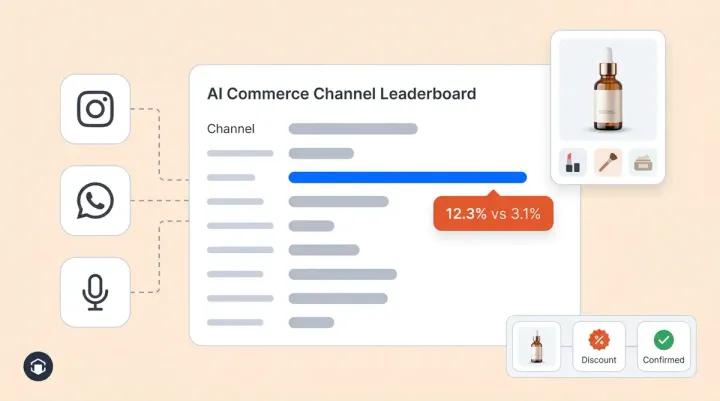
AI visibility tracking across shopping surfaces. Through automation and real-time tracking, Alhena monitors how and where your products appear across AI shopping platforms, from ChatGPT Shopping to Google AI Mode to Perplexity and voice assistants. You see exactly which products get recommended, which get skipped, and why. Instead of guessing at your AI visibility, you measure it at the SKU level.
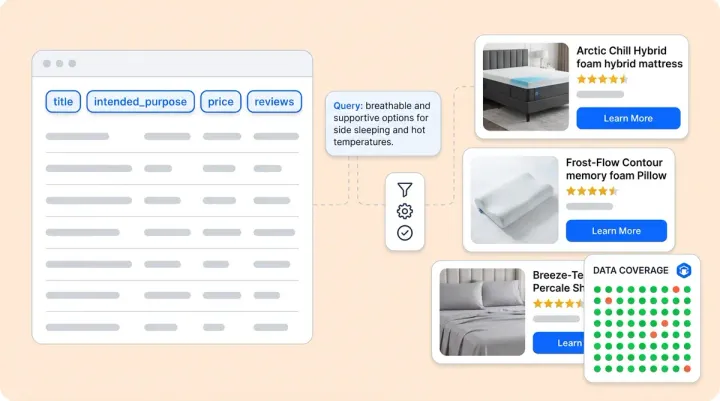
Product data gap identification. Alhena analyzes your product catalog against what AI checkout platforms need for confident recommendations. Missing attributes, weak descriptions, outdated pricing, and incomplete schema markup all get flagged with specific fixes. When every SKU is optimized, AI platforms have the data they need to sell your products without the shopper needing to visit your site.
Revenue intelligence for off-site sales. When transactions happen inside AI interfaces, traditional analytics can't attribute that revenue. Alhena's analytics layer connects AI-driven purchases back to your product data strategy, so you can see the revenue impact of your zero-click commerce readiness. Brands using Alhena have seen conversion rate increases of 3x and AOV lifts of up to 38% by ensuring their product data is discoverable and complete across AI surfaces.
Competitive intelligence. Alhena shows you how your products stack up against competitors in AI recommendations. If a competing product consistently appears above yours in ChatGPT Shopping results, you see exactly which data gaps are causing it and what to fix. This is the GEO advantage that forward-thinking brands are building right now.
The Brands That Win Are Not the Ones With the Best Websites
Zero-click commerce is not a future trend. It is happening today across every major AI platform. The brands that will capture revenue in this environment are not the ones with the fastest load times or the prettiest product pages. They're the ones whose product data is so complete, so well-structured, and so well-distributed that AI platforms choose to sell for them.
Every day you operate without visibility into how your products perform across AI shopping surfaces is a day you're losing revenue you can't even measure. The 69% zero-click rate isn't going back down. AI checkout capabilities are expanding every quarter. The window to actively build your zero-click commerce strategy is open now, but it's closing as competitors move first.
Ready to see where your products stand across AI shopping platforms? Book a demo with Alhena AI to get AI visibility tracking for your catalog, or start free with 25 conversations to see the platform in action.
Frequently Asked Questions
What is zero-click commerce and how does it affect ecommerce brands?
Zero-click commerce is when a shopper discovers, evaluates, and purchases a product entirely inside an AI interface like ChatGPT or Google AI Mode, never visiting the brand's website. It affects ecommerce brands by shifting the point of sale off their site, making product data quality more important than on-site conversion optimization for e-commerce businesses. Alhena AI helps brands track their visibility across these AI shopping surfaces so they can compete effectively.
How does AI instant checkout work on platforms like ChatGPT?
AI instant checkout lets shoppers complete purchases directly inside an AI chat interface. The shopper asks a question, receives a product recommendation, and checks out with saved payment details, all without leaving the platform. Alhena AI monitors how your products appear in these checkout-enabled AI surfaces and identifies data gaps that prevent your products from being recommended.
Why does the 69% zero-click search rate matter for ecommerce?
When 69% of searches end without a click, fewer shoppers are reaching brand websites through organic search. For ecommerce brands, this means the traditional funnel of driving traffic and converting on-site is shrinking. Alhena AI gives brands visibility into where their products appear across AI platforms, so they can capture revenue even when shoppers never visit their site.
What product data do AI shopping platforms need for zero-click commerce?
AI shopping platforms need complete product titles, detailed descriptions, accurate real-time pricing, inventory status, high-quality images, and structured schema markup. Review signals, including aggregate rating, volume, recency, and sentiment, also factor heavily into recommendations. Alhena AI analyzes your catalog against these requirements and flags specific gaps to fix at the SKU level.
How can brands measure their visibility in AI shopping recommendations?
Traditional analytics tools can't track how often your products appear in AI-generated recommendations. Alhena AI provides SKU-level AI visibility tracking across ChatGPT Shopping, Google AI Mode, and Perplexity, showing which products get recommended, which get skipped, and what data improvements would change the outcome.
What is the difference between AEO, GEO, and traditional SEO for ecommerce?
Traditional SEO focuses on ranking in search results. AEO (Answer Engine Optimization) focuses on getting your content cited in AI-generated answers. GEO (Generative Engine Optimization) focuses on influencing what AI platforms recommend in shopping contexts. Alhena AI helps ecommerce brands build strategies across all three, with particular focus on the product data signals that drive AI purchase recommendations.
How does zero-click commerce readiness affect revenue attribution?
When purchases happen inside AI interfaces, the transaction often doesn't show up in your standard analytics as an attributed sale. Brands lose visibility into which products are selling through AI channels and why. Alhena AI's revenue intelligence layer connects off-site AI purchases back to your product data strategy, giving you clear attribution for zero-click commerce revenue.
What should DTC brands prioritize first for zero-click commerce?
Start with product feed completeness and structured data markup, since AI platforms can't recommend what they can't parse. Next, build a fresh review signal strategy and ensure pricing is transparent and machine-readable. Alhena AI can audit your entire catalog in days and deliver a prioritized action plan for zero-click commerce readiness, ranked by revenue impact per SKU.