WISMO queries cost ecommerce brands between $5 and $22 per ticket, and they make up 30 to 40% of all support volume. For a brand processing thousands of orders per month, that's tens of thousands of dollars spent answering one question: "Where is my order?" AI changes the economics entirely, resolving these queries in under 10 seconds at a fraction of the cost. This guide breaks down what WISMO means for your business, why the problem keeps growing, and how AI-powered automation handles it at scale while turning order inquiries into revenue opportunities.
What Is WISMO and Why Does It Matter?
WISMO stands for "Where Is My Order?" and it's the single most common customer inquiry ecommerce support teams face. According to Shopify, WISMO queries account for 30 to 40% of all support tickets during normal periods. During peak seasons like Black Friday and the holidays, that number climbs to 50% or higher, according to 1point1 research.
The WISMO meaning is simple, but the business impact isn't. Every WISMO ticket that reaches a human agent costs between $5 and $22, depending on the channel. A mid-size brand processing 1,000 orders per month might handle 300 to 400 WISMO inquiries, translating to $1,500 to $8,800 in monthly support costs for a single question type.
Customers check their order status an average of 4.6 times per shipment, according to AfterShip. That's not a support problem. It's an information gap. And as Crisp puts it: "WISMO isn't a support problem, it's an information problem."
Why WISMO Queries Keep Growing
Between clicking "Buy" and receiving a package, customers experience what the industry calls a "black hole." Generic carrier tracking pages are confusing, tracking numbers get buried in email inboxes, and many retailers send only a single notification, and customers receive no further updates until the package "your order has shipped" notification. This lack of visibility drives repeated check-ins.
The anxiety intensifies during gift-giving seasons, when timely delivery carries emotional stakes. It also spikes during sale events, when shipping and logistics networks are strained and delays become more likely. A project44 study found that 69.7% of shoppers are less likely to shop with a retailer again if a package is delayed without notification.
For growing ecommerce brands, this creates a scaling problem. WISMO volume, and your customer support workload, grows linearly with order volume. If you're processing 10,000 orders per month during peak season, you could face thousands of WISMO tickets daily, each requiring a human to look up the order, check tracking with the carrier, and relay the status back. That doesn't scale.
The Real Cost of WISMO Calls
The math is straightforward. A brand handling 3,000 WISMO tickets per month at an average cost of $12 per ticket spends $36,000 monthly on order uncertainty alone. Human agents handle 10 to 15 WISMO calls per hour at a fully loaded cost of $15 to $25 per hour. During peak periods, brands either hire seasonal staff (expensive and slow to train) or let response times balloon (damaging customer satisfaction).
The downstream effects go beyond direct costs. ShippyPro reports that 70% of customers won't repurchase after a poor delivery experience, while 98% consider delivery experience a key loyalty factor. Poor WISMO handling doesn't just cost money today. It costs customers tomorrow.
How AI Resolves WISMO Queries in Seconds
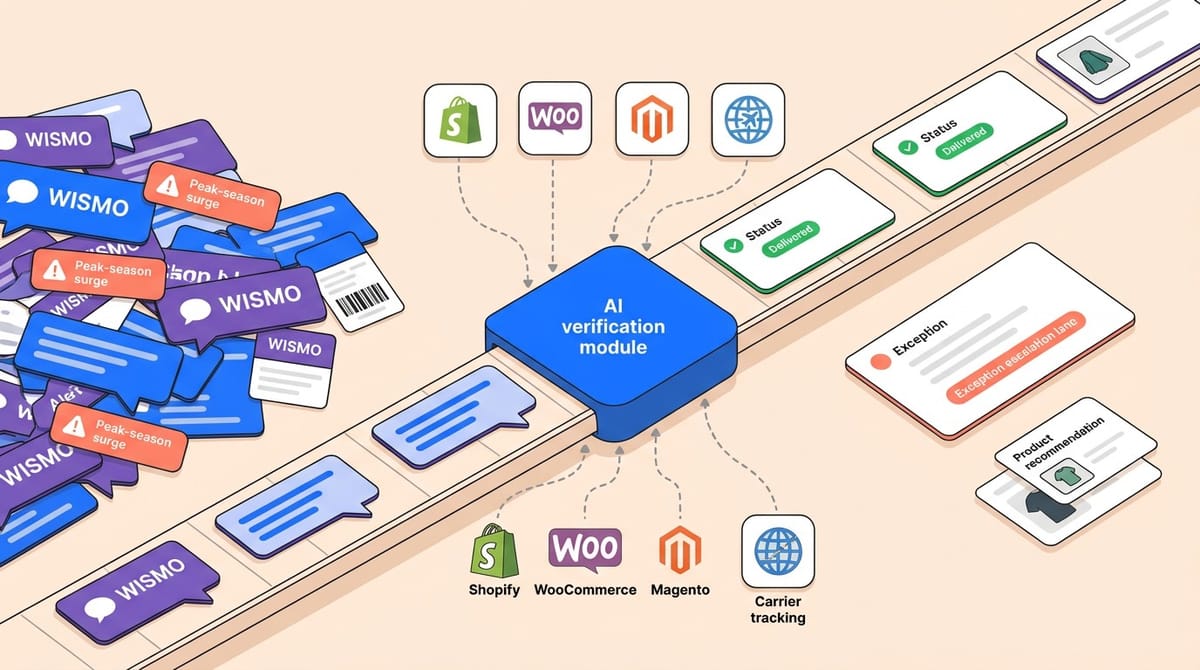
AI-powered WISMO solutions work by connecting directly to your ecommerce platform systems and shipping carriers through APIs, then using natural language understanding to answer order status questions in real time. Instead of a customer waiting 2 to 4 hours for an email response or sitting in a chat queue, they get an answer in under 10 seconds.
Here's what that looks like in practice. A customer messages your chat widget: "Hey, where's my order #4521?" The AI agent pulls the order from Shopify (or WooCommerce, or Magento), retrieves the latest tracking data from FedEx or USPS, and responds: "Your order shipped on March 14 and is currently in transit. It's estimated delivery date is March 19. Here's your tracking link."
No queue. No hold time. No agent involvement. AI chatbots resolve order tracking inquiries in under 10 seconds compared to 8 to 12 minutes for human agents. The cost? Roughly $1 per automated resolution versus $5 to $22 for a human-handled ticket.
Handling Complex WISMO Scenarios
Straightforward "where's my package?" lookups make up about 70 to 80% of WISMO volume, and AI handles these easily. But what about the harder cases? Delayed shipments, lost packages, multi-item orders where one item shipped and another didn't, or international orders stuck in customs?
Modern AI agents handle these scenarios by reading carrier exception codes and matching them to appropriate responses. If a shipment shows a delivery exception, the AI can explain the delay, provide an updated estimate, and offer options like reshipping or a refund. For truly complex cases (confirmed lost packages, customs disputes), the AI escalates to a human agent with full context, so the customer doesn't have to repeat themselves.
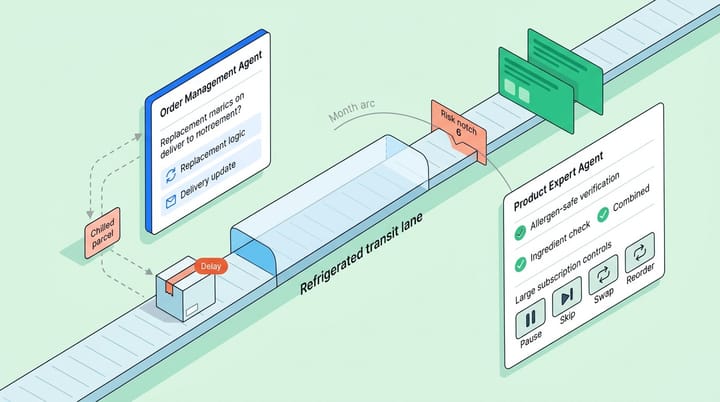
Alhena AI's Support Concierge takes this further with its Order Management Agent, a purpose-built AI that connects to your order system, carrier APIs, and helpdesk to handle the full spectrum of order queries, managing everything, from simple status checks to returns and exchanges.
Proactive WISMO: Preventing Queries Before They Happen
The best WISMO strategy isn't answering queries faster. It's preventing them from happening in the first place. Proactive notifications can help prevent queries entirely. Sent at key moments in the delivery journey reduce WISMO volume by 50 to 80%, according to ShippyPro.
The four critical notification touchpoints are:
- Order confirmed (email): Reassures the customer that their purchase went through
- Shipped (email + SMS): Provides the tracking number and expected delivery date
- Out for delivery (SMS or WhatsApp): Time-sensitive, high-engagement alert
- Exception or delay (SMS or WhatsApp): Explains what happened and sets new expectations
That last one is the most important. Malomo found that customers are 3x more forgiving of delays when notified proactively versus discovering them on their own. A global apparel brand cited by Malomo reduced WISMO contacts by over 20% during peak season just by adding proactive SMS updates tied to carrier data.
Channel matters too. SMS has 98%+ open rates compared to 20 to 40% for email, making it the better channel for urgent updates like delays and out-for-delivery alerts. WhatsApp performs similarly with 90%+ open rates. Alhena AI's Social Commerce handles all of these channels, so customers get updates wherever they prefer, whether that's SMS, email, WhatsApp, or Instagram DMs.
What Alhena AI Does That Basic Chatbots Cannot
Most chatbots handle WISMO with a decision tree. The customer types "order status," the bot asks for an order number, looks it up, and returns a canned response. That works for simple cases. But real WISMO conversations are messier than that.
A customer might say: "I ordered a blue jacket last week and I haven't gotten anything yet." There's no order number. No tracking ID. Just a vague product description and frustration. A basic chatbot stalls. Alhena AI identifies the customer from their email or login, searches recent orders for a matching product, and responds with the specific order status, all without asking the customer to dig through their inbox for a confirmation email.
This works because Alhena is built on two specialized agents. The Product Expert Agent understands your catalog and can match vague descriptions to specific products. The Order Management Agent connects to your ecommerce platform and carrier APIs to pull real-time order data. Together, they handle WISMO queries that would stump a rule-based bot.
Alhena also avoids the hallucination problem that plagues general-purpose AI. Every response is grounded in verified order data from your Shopify, WooCommerce, or Salesforce Commerce Cloud store. The AI won't guess at a delivery date or make up a tracking status. If the data says "in transit, arriving March 20," that's exactly what the customer sees.
Turning WISMO into a Sales Opportunity
Here's what most WISMO solutions miss entirely: a customer asking about their order is an engaged customer. They're on your site, in your chat, thinking about your brand. That's an opportunity.
After resolving a WISMO query, Alhena can suggest related products, offer a discount on a next purchase, or highlight items that pair well with what the customer already ordered. This is why brands like Tatcha see 3x conversion rates and 38% higher average order values when using Alhena AI. WISMO becomes a touchpoint for revenue, not just a cost center.
Alhena's agentic checkout takes this even further. If a customer asks about their order and then mentions they're interested in a similar item, the AI can populate their cart and pre-fill checkout, turning a support conversation into a sale with zero friction.
Scaling WISMO Automation Across Channels
WISMO queries don't just come through your website chat. They arrive via email, Instagram DMs, WhatsApp messaging, phone calls, and sometimes all five channels from the same customer about the same order. Handling this across disconnected tools creates chaos for support teams.
Alhena AI operates across web chat, email, Instagram, WhatsApp, and voice, pulling the same order data regardless of channel. A customer can ask about their order on Instagram DM at 10 PM and get the same accurate, real-time response they'd get from a human agent during business hours, delivering 24/7 coverage without overtime costs.
This omnichannel approach also integrates with your existing helpdesk. Whether you use Zendesk, Gorgias, Freshdesk, or Intercom, Alhena sits alongside your team, deflecting routine WISMO queries and escalating complex issues with full conversation context. Brands like Crocus have achieved an 86% deflection rate with 84% CSAT using this approach, according to their case study.
Peak Season Performance
The real test for any WISMO solution is peak season. Black Friday, Cyber Monday, and the holiday rush can triple or quadruple normal order volume. Human teams can't scale that fast. AI can.
Alhena handles peak season spikes without additional setup or cost increases tied to volume. Whether you're processing 500 orders per day or 50,000, the AI delivers the same sub-10-second response times. Manawa saw their response time drop from 40 minutes to 1 minute while automating 80% of inquiries, as documented in their case study.
Getting Started with AI WISMO Automation
You don't need a six-month implementation plan to start automating WISMO. Modern AI solutions deploy in days, not months. Here's what you need:
- Connect your ecommerce platform. Alhena integrates with Shopify, WooCommerce, Magento, and Salesforce Commerce Cloud. The connection pulls order data, tracking numbers, and customer information into the AI.
- Connect your shipping carriers. Carrier API integrations (FedEx, UPS, USPS, DHL) give the AI real-time tracking data to reference when customers ask about their orders.
- Set up your channels. Enable AI on the channels where your customers ask about orders: website chat, email, social media, or all of them.
- Define escalation rules. Tell the AI when to hand off to a human: lost packages, high-value orders, repeat complaints, or any scenario that needs a personal touch.
Alhena AI deploys in under 48 hours with no developer resources required. You don't need to rebuild your tech stack or hire an integration team. The AI connects to your existing tools and starts resolving WISMO queries from day one.
Measuring WISMO Automation Success
Track these metrics to evaluate your AI WISMO performance:
- Deflection rate: Percentage of WISMO queries resolved without human involvement (target: 60 to 80%)
- First response time: How fast the AI responds to order status questions (target: under 10 seconds)
- CSAT for AI-handled tickets: Customer satisfaction specifically for automated WISMO interactions (target: 80%+)
- Cost per resolution: Compare AI resolution cost versus human agent cost (target: 75%+ reduction)
- Ticket volume trend: Overall WISMO ticket count should decrease as proactive notifications take effect
Alhena's built-in revenue attribution analytics track all of these metrics plus revenue generated from post-WISMO product recommendations, so you can see the full financial picture and improve your support operations over time.
The Future of WISMO: What's Coming in 2026 and Beyond
Gartner predicts that agentic AI will autonomously resolve 80% of common customer service issues without human involvement by 2029, driving a 30% reduction in operational costs. WISMO, as the most repetitive and data-driven support query, sits at the front of this shift.
According to Daniel O'Sullivan, Senior Director Analyst at Gartner: "Agentic AI has emerged as a game-changer for customer service, paving the way for autonomous and low-effort customer experiences."
But the shift comes with a warning. Forrester predicts that one-third of brands will erode customer trust through premature AI deployment in 2026. The difference between success and failure comes down to data quality. AI WISMO solutions are only as good as their carrier data feeds. If the carrier API returns stale tracking information, the AI confidently delivers wrong answers, which is worse than no answer at all.
This is why choosing an AI partner that's purpose-built for ecommerce matters. General-purpose chatbots bolted onto a helpdesk don't have the deep carrier integrations, product catalog knowledge, or post-purchase workflow understanding needed to handle WISMO reliably. Alhena AI was built specifically for this use case.
Key Takeaways
- WISMO accounts for 30 to 40% of ecommerce support tickets and costs $5 to $22 per ticket when handled by humans
- AI resolves WISMO queries in under 10 seconds at roughly $1 per resolution, a 75 to 95% cost reduction
- Proactive notifications at four key delivery milestones prevent 50 to 80% of WISMO queries before they happen
- Customers are 3x more forgiving of delays when notified proactively
- Alhena AI's Order Management Agent handles simple status checks and complex scenarios (delays, lost packages, multi-item orders) across all channels
- Modern AI WISMO solutions deploy in under 48 hours with no developer resources
- Brands using Alhena AI see 80%+ inquiry automation with 84% CSAT or higher
Ready to stop spending thousands on WISMO tickets every month? Book a demo with Alhena AI to see how the Order Management Agent handles your order status queries, or start free with 25 conversations and test it with real customer questions.
Frequently Asked Questions
What does WISMO mean?
WISMO stands for "Where Is My Order?" It's the most common customer service query in ecommerce, accounting for 30 to 40% of all support tickets. During peak seasons like Black Friday and the holidays, WISMO can represent more than half of all incoming support requests.
How much does a WISMO ticket cost to resolve?
A human-handled WISMO ticket costs between $5 and $22 depending on the support channel (phone is most expensive, chat is cheapest). AI-powered solutions resolve the same queries for roughly $1 per ticket, representing a 75 to 95% cost reduction. For a brand handling 3,000 WISMO tickets per month, that's potential savings of $12,000 to $63,000 monthly.
Can AI handle complex WISMO scenarios like lost packages?
Yes. Modern AI agents read carrier exception codes and match them to appropriate responses for delayed shipments, split orders, and delivery failures. For confirmed lost packages or situations requiring refund decisions, the AI escalates to a human agent with full conversation context so the customer doesn't repeat themselves.
How does Alhena AI handle WISMO queries differently than basic chatbots?
Unlike rule-based chatbots that require an order number to look up status, Alhena AI can identify customers from their email or login and match vague product descriptions to specific orders. Its Order Management Agent connects to your ecommerce platform and carrier APIs for real-time data, while the Product Expert Agent understands your catalog. Every response is grounded in verified data with zero hallucination risk.
How quickly can I set up AI WISMO automation?
Alhena AI deploys in under 48 hours with no developer resources required. The setup involves connecting your ecommerce platform (Shopify, WooCommerce, Magento, or Salesforce Commerce Cloud), configuring your support channels, and defining escalation rules for edge cases. The AI starts resolving WISMO queries from day one.
Does AI WISMO automation work across all customer channels?
Yes. Alhena AI handles WISMO queries across web chat, email, Instagram DMs, WhatsApp, and voice, pulling the same real-time order data regardless of channel. It also integrates with helpdesks like Zendesk, Gorgias, Freshdesk, and Intercom, so AI and human agents work from the same system.
What WISMO metrics should I track after implementing AI?
Focus on five key metrics: deflection rate (target 60 to 80%), first response time (target under 10 seconds), CSAT for AI-handled tickets (target 80%+), cost per resolution compared to human agents, and overall WISMO ticket volume trend. Brands like Crocus have achieved 86% deflection with 84% CSAT using Alhena AI.
How do proactive notifications reduce WISMO queries?
Proactive notifications at four key delivery milestones (order confirmed, shipped, out for delivery, and exception/delay) can reduce WISMO volume by 50 to 80%. SMS notifications have 98%+ open rates, making them the most effective channel for time-sensitive updates. Customers are 3x more forgiving of delays when notified proactively.
Is WISMO automation worth it for small ecommerce stores?
Yes. Even a store processing 500 orders per month typically handles 150 to 200 WISMO requests. At $8 to $12 per ticket, that's $1,200 to $2,400 per month in support costs for one question type. AI automation at $1 per resolution cuts that to under $200, reducing your monthly spend by 80% or more, making it cost-effective at almost any order volume. Alhena AI offers 25 free conversations to test the ROI before committing.