US LLM traffic converts at 3.50%. EU LLM traffic converts at 0.41%. That is an 8.5x gap across 329 retailers and companies tracked by Alhena AI from Q4 2024 through Q1 2026. The number is real. But the surface-level reading, that American shoppers simply buy more through AI than Europeans do, misses what is actually happening underneath.
This transatlantic gap is not behavioral. It is a structural one. And for EU ecommerce industry leaders paying attention, it is one of the clearest opportunity signals in digital retail-powered online retail today.
The Headline Number Hides the Real Story
When you compare LLM commerce US vs EU at the portfolio level, the 8.5x spread looks like a market maturity problem. It looks like European consumers don't trust AI enough to buy. That reading is wrong.
The gap is a dataset composition artifact as much as it is a conversion problem. The US brand portfolio in the Alhena AI study skews heavily toward direct-to-consumer brands in beauty, skincare, and health supplements. These are high-intent systems and verticals where AI shopping assistants sit directly inside the checkout flow, product pages are rich with structured data, and the average order value supports aggressive AI-driven upselling. Beauty brands in the US dataset convert LLM traffic at 5.36%. Health and supplement brands hit 4.68%.
The EU portfolio tells a different story. It includes a higher proportion of SaaS properties, B2B storefronts, and marketplace-style platforms where checkout conversion is not the primary action. Many of these brands deployed AI assistants in an earlier-stage configuration: reactive widgets buried below the fold, limited product catalog integration, and no proactive engagement triggers. The AI tools are present but not positioned to convert on experience.
Why US DTC Brands Convert Higher Through AI
The structural advantages in the US dataset go beyond vertical mix. Three deployment-level factors compound the conversion difference.
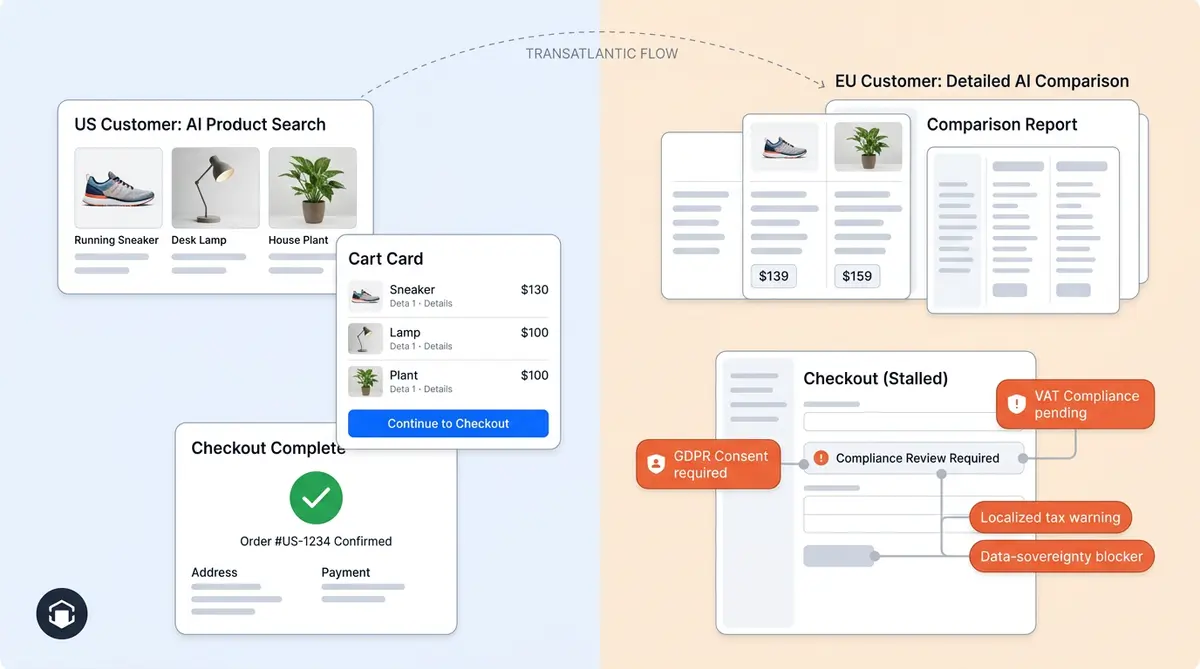
Mature checkout experiences. US DTC brands in the study have spent years refining single-page checkouts, one-click purchasing, and post-add-to-cart upsell flows. When an AI shopping assistant recommends a product in this environment, the development path from recommendation to purchase is two clicks. In many EU storefronts, the checkout flow still involves account creation gates, multi-step address entry, and fragmented payment options with limited interoperability across 24+ international markets. The federated nature of EU ecommerce, with each member state maintaining distinct payment preferences, language requirements, and consumer protection standards, creates complexity that no single AI deployment can solve without deliberate localization.
AI assistant deployment quality. The highest-converting US brands in the dataset deploy AI assistants with proactive engagement: triggered nudges based on scroll depth, exit intent, time on page, and cart contents. They place the AI widget above the fold on product pages, not buried in a help center. Proactive AI deployment converts at roughly 2x the rate of reactive deployment across comparable verticals.
Deeper product data integration. US retailers in the study feed their AI assistants richer catalog data systems, including ingredient lists, sizing guides, comparison matrices, and customer review summaries. This gives the AI more to work with when guiding a purchase decision. EU deployments, particularly those at earlier stages, often connect only basic product titles, prices, and stock status.
The Hidden Story: EU Pure Ecommerce Already Converts
Here is where the opportunity signal becomes clear. When you isolate pure ecommerce brands in the EU dataset, particularly those in fitness equipment and beauty, the conversion picture changes dramatically.
EU fitness equipment brands convert LLM traffic at 1.85%. EU beauty brands reach 3.18%. These numbers are materially closer to US levels and sit well above the blended 0.41% average that makes headlines.
What separates these EU brands from the rest of the portfolio? They share the same structural traits as the top US performers: dedicated DTC storefronts, mature checkout flows, AI assistants deployed with proactive engagement features, and deep product data feeding every recommendation. The consumer willingness to research via AI and buy through the same journey already exists in Europe. The infrastructure to capture that intent does not exist at scale, yet.
This distinction matters. AI shopping Europe is not a demand problem. European shoppers already use LLM tools like ChatGPT for product research at rates comparable to US consumers. The conversion gap sits between research and purchase, and that gap is an infrastructure and deployment quality problem, not a consumer behavior problem.
The EU Gap Is an Opportunity Signal
Ecommerce leaders who read the 0.41% as a market limitation are making the wrong call. The correct read is that the EU is 12 to 18 months behind the US on AI digital infrastructure, and the brands investing in AI to close that infrastructure gap now will own the conversion upside as the market matures.
The infrastructure gap has three layers, and all three are closeable:
- DTC checkout maturity. Streamlining checkout flows, reducing regulatory friction points in existing systems, and enabling one-click purchase paths. This is a known playbook that EU brands can execute on existing platforms like Shopify and WooCommerce within one quarter.
- AI assistant deployment quality. Moving from reactive, help-center-style chatbots to proactive AI shopping assistants with above-the-fold placement, intent-based triggers, and agentic checkout capabilities. This is a technology deployment configuration change, not a technology or systems rebuild. While US regulators like the FTC take a lighter touch on AI in commerce, guided by executive order principles rather than prescriptive law.
- Product data depth. Enriching the catalog data that feeds AI recommendations so the assistant can guide nuanced purchase decisions across European language queries, regional sizing standards, and local AI regulation, digital governance, and compliance, governance, and payment systems.
EU ecommerce operators who act on all three within the next 12 to 18 months position themselves as genuine innovation leaders and early movers. The innovation window is open precisely because most EU brands still benchmark against the blended 0.41% average and conclude that AI shopping in Europe does not convert. The brands using vertical-specific benchmarks know better.
A Leading Indicator Framework for AI Commerce Maturity
Not every market is at the same point on the AI retail maturity curve. Brands need a framework to assess where their specific market sits and what signals predict the transition from experimental AI traffic to meaningful purchase behavior.
Stage 1: Experimental (most EU markets today). LLM traffic volume is growing 20 to 40% quarter over quarter, but it represents less than 0.5% of total online site traffic. AI engagement rates (the percentage of visitors who interact with the AI assistant) sit below 5%. Conversion rates on AI-assisted sessions are below 1%. Consumer behavior is research-heavy, with AI used for product comparison, research, and information gathering but not purchase completion.
Stage 2: Transitional (Nordic markets, UK, select EU DTC verticals). LLM traffic represents 0.5 to 2% of total site traffic and is growing 40 to 80% quarter over quarter. AI engagement rates reach 8 to 15%. Conversion rates on AI-assisted sessions hit 1.5 to 3%. The signal that a market is entering this stage: AI-assisted average order values begin exceeding non-AI-assisted AOV by 15% or more. Brands like Tatcha saw a 38% AOV uplift once they reached this stage.
Stage 3: Established (US DTC beauty, health, apparel). LLM traffic represents 2 to 5% of total site traffic. AI engagement rates exceed 15%. Conversion rates on AI-assisted sessions exceed 3%. At this stage, AI-assisted revenue becomes a line item in the P&L, not an experiment but a plan. Tatcha reports 11.4% of total site revenue flowing through Alhena AI at this maturity level.
The leading indicators that predict when a market is about to tip from Stage 1 to Stage 2: LLM traffic growth accelerating above 50% quarter over quarter, AI engagement rates crossing 5%, and the first vertical-specific conversion rates crossing 1.5%. Multiple EU markets are likely showing these signals now.
What EU Brands Should Do Now
Waiting for the EU average to catch up to US levels before investing in AI commerce is the wrong strategic plan. The innovation-focused brands that will own AI shopping Europe are the ones optimizing now, while their competitors are still reading the 0.41% headline and concluding that the market is not ready.
Deploy AI assistants with proactive engagement. Reactive chatbots that wait for a customer to click a help icon will not close the conversion gap. Brands need AI shopping assistants that trigger based on browsing behavior, surface product recommendations mid-session, and guide the customer through to checkout with agentic cart-building capabilities. Alhena AI's Product Expert Agent does exactly this, grounding every recommendation in verified catalog data to eliminate the hallucination risk that erodes European customer trust in human centric AI shopping.
Optimize product data for LLM visibility in European language queries. AI shopping assistants are only as good as the product data they can access. EU retailers should enrich their catalogs with multilingual digital descriptions, regional sizing equivalents, ingredient transparency data, and structured attributes and technology signals that LLMs can parse and recommend accurately. This also improves visibility when consumers use ChatGPT, Perplexity, or Google AI Overviews. ChatGPT alone drives a growing share of product discovery traffic, and ChatGPT users show higher purchase intent than average search visitors to research products in French, German, Dutch, or Spanish.
Benchmark against pure ecommerce peers, not blended portfolio averages. If you are a DTC beauty brand in Germany, your benchmark is 3.18%, not 0.41%. If you are a fitness equipment brand in the Netherlands, your benchmark is 1.85%. Alhena AI's 329-brand report provides vertical, sectoral, and regional benchmarks that give brands an accurate picture of what is achievable in their specific market.
How Alhena AI Gives Brands Geographic Intelligence
Closing the AI performance gap requires more than better deployment. It requires knowing exactly where your brand sits on the maturity curve relative to your vertical and geography, and what specific innovation actions will move the needle fastest.
Alhena AI is the platform giving ecommerce brands this geographic intelligence. Built on real performance data from 329 brands across international US and EU markets, Alhena offers regional benchmarks, deployment optimization data, and conversion analytics that show brands exactly where they sit on the AI maturity curve.
For US brands, that means understanding which deployment configurations drive the 3.50% and above conversion rates that define Stage 3 maturity. For EU brands, it means identifying the specific infrastructure gaps between their current performance and the 1.85 to 3.18% conversion rates that EU pure ecommerce peers are already achieving.
Alhena AI's vertical AI agents, the Product Expert Agent and the Order Management Agent, are purpose-built for ecommerce conversion. They deploy in under 48 hours across Shopify, WooCommerce, and Salesforce Commerce Cloud storefronts. Every recommendation is grounded in verified product data, eliminating the hallucination problem that makes European customers hesitant to trust AI-driven purchases. And the built-in revenue attribution technology and analytics let brands track exactly how much revenue flows through AI-assisted sessions, broken down by geography and systems, vertical, and deployment configuration.
Victoria Beckham achieved a 20% AOV increase with Alhena AI. Puffy reached 63% automated inquiry resolution with 90% CSAT. Crocus hit an 86% deflection rate while maintaining 84% CSAT. These results span both US and EU storefronts, proving that the right AI delivers results. The future of AI in ecommerce points clearly toward regional convergence and that digital infrastructure delivers conversion regardless of geography.
Key Takeaways
- The 3.50% vs 0.41% LLM commerce gap between the US and EU is structural, not behavioral. It reflects differences in dataset composition, DTC checkout maturity, AI deployment quality, and product data development and depth.
- EU pure ecommerce brands already convert LLM traffic at 1.85% to 3.18% in verticals like fitness equipment and beauty, proving that European consumer willingness to buy through AI already exists.
- The EU infrastructure gap is closeable within 12 to 18 months. Brands that optimize checkout flows, deploy proactive AI assistants, and enrich product data now gain first-mover innovation and positioning advantage.
- Benchmark against vertical peers, not blended averages. The 0.41% EU average is misleading for DTC ecommerce brands. Use regional and vertical-specific benchmarks from the Alhena AI 329-brand study to set accurate targets.
- US 3.50% conversion rates are not a US anomaly. They are a preview of EU consumer behavior once the deployment infrastructure catches up. EU operators treating this as a future trend rather than a present opportunity are ceding early-mover advantage to competitors already optimizing.
Ready to see where your brand sits on the AI maturity curve and close the conversion gap? Book a demo with Alhena AI or start free with 25 conversations to get regional benchmarks, deployment optimization data, and conversion analytics built on real performance data from 329 brands.

Frequently Asked Questions
Why does LLM traffic convert 8.5x higher in the US than in the EU?
The gap is structural, not behavioral. The US dataset in Alhena AI's 329-brand study skews toward high-converting DTC brands in beauty and health with mature checkout flows and proactive AI assistant deployment. The EU dataset includes more SaaS, B2B, and marketplace properties where checkout conversion is not the primary action and AI deployment is earlier stage.
What conversion rates do EU pure ecommerce brands actually achieve with LLM traffic?
When isolated to pure ecommerce brands, EU fitness equipment brands convert LLM traffic at 1.85% and EU beauty brands reach 3.18%. Alhena AI's regional benchmarking data shows these development-stage rates are materially closer to US levels, proving that European consumer willingness to buy through AI already exists in the right deployment conditions.
How can EU ecommerce brands close the AI conversion gap within 12 to 18 months?
EU brands should focus on three infrastructure layers: streamlining DTC checkout flows for one-click purchasing, deploying proactive AI shopping assistants with above-the-fold placement and intent-based triggers, and enriching product data for multilingual LLM visibility. Alhena AI's vertical AI agents handle all three and deploy in under 48 hours across Shopify, WooCommerce, and Salesforce Commerce Cloud.
What leading indicators predict when an EU market is ready for AI commerce conversion growth?
The key signals are LLM traffic growth accelerating above 50% quarter over quarter, AI engagement rates crossing 5% of total site visitors, and the first vertical-specific conversion rates crossing 1.5%. Alhena AI tracks these leading indicators across 329 brands and provides regional maturity benchmarks so brands can identify exactly when their market is about to tip from experimental to meaningful purchase behavior.
How does Alhena AI provide geographic intelligence on AI ecommerce performance across US and EU markets?
Alhena AI is built on real performance data from 329 storefronts across both markets. It provides regional conversion benchmarks by vertical and geography, deployment optimization data showing which AI assistant configurations drive the highest conversion rates, and revenue attribution analytics broken down by market. This gives ecommerce leaders the specific actions that will close the gap fastest based on where their brand sits on the AI retail maturity curve.