50.3x: The Second-Highest AI Conversion Multiplier in Ecommerce
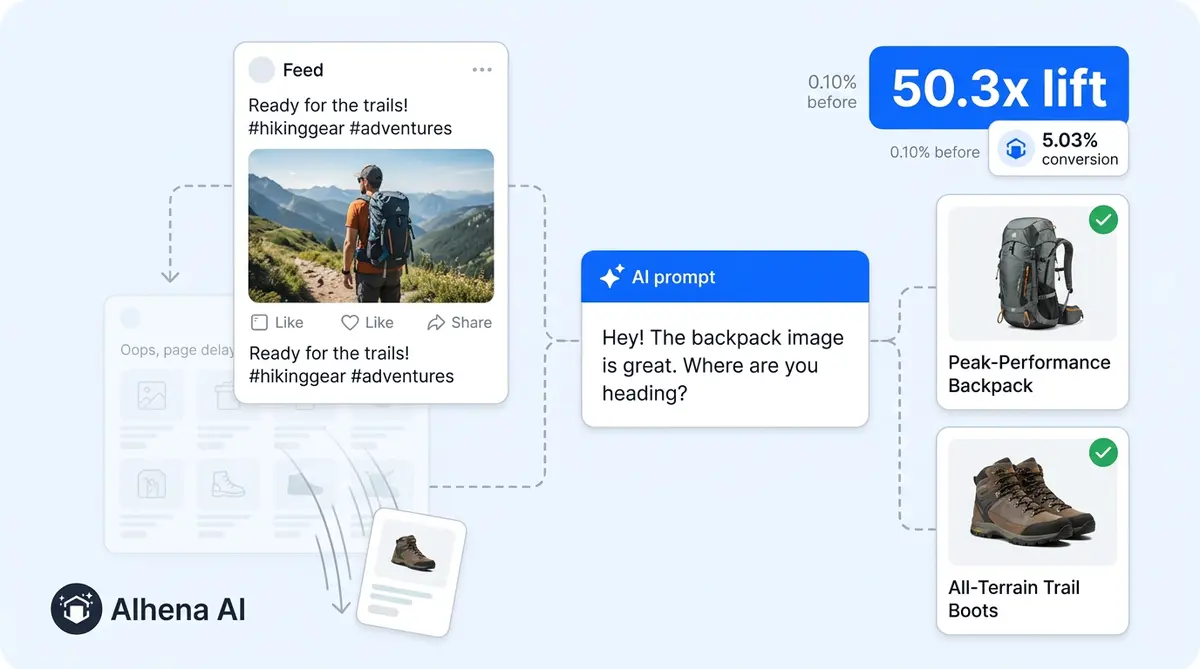
Social organic traffic converts at 0.10% without AI assistance. Organic social has always been the hardest channel to monetize. With on-site AI, that number jumps to 5.03%. A 50.3x lift, making social organic the second-highest conversion multiplier of any traffic channel in the dataset, behind only TikTok Ads at 76x.
That multiplier sounds extreme until you understand what's behind it. Social organic has always been ecommerce's most frustrating paradox: massive audience, almost zero revenue. Brands invest heavily in content, build loyal followings, and drive real traffic. Then 99 out of 100 of those visitors leave without buying. The problem was never traffic quality. It was the total absence of a bridge between content and commerce. AI is that bridge, and the data now proves exactly how wide it is.
Why Social Organic Traffic Converts at 0.10%
The psychology of a social browser is fundamentally different from every other visitor type. A shopper who clicks a Google search result has typed a query with commercial intent. An email subscriber opened a promotional message tied to a product they've already browsed. A direct visitor typed your URL because they know what they want.
A social organic user clicked through from an Instagram post, a Pinterest pin, or an organic TikTok video. They clicked out of curiosity. Maybe aspiration. Often just because the content was good. They arrive with high discovery intent and near-zero purchase intent. They weren't looking for your product. They were looking at their feed.
This creates a visitor who browses for seconds, not minutes. They scan the landing page, find no continuation of the content experience that brought them there, and bounce. The gap between "this looks interesting" and "I want to buy this" is wider for social organic traffic than almost any other channel. Without something to catch that curiosity in real time, the visit ends before it begins.
The Content-to-Commerce Gap That Costs Brands Millions
Ecommerce teams pour resources into organic social. They hire content creators, build posting calendars, shoot product videos, and engage communities. The output works: followers grow, engagement rises, and traffic flows. But the return on that investment stops at the click.
Organic social drives audience at scale and revenue at a trickle. Bounce rates sit above 99%. The average session depth is barely one page. Revenue attribution reports consistently show social organic as the lowest-performing source despite being one of the highest-traffic sources.
The core problem is structural. The journey from inspiration to transaction has no bridge. A shopper sees a product styled beautifully in a Reel, taps through to the site, and lands on a page that looks nothing like the content that inspired the click. There's no continuity, no guidance, no conversation. Just a static product page and a "Buy Now" button that feels premature for someone who arrived with zero buying intent.
This is the content-to-commerce gap. Brands have been trying to close it with better landing pages, faster load times, retargeting tools, and advertising spend. None of those address the real issue: organic social browsers need a different conversion path than search shoppers, and until recently, that path didn't exist.
How AI Bridges Discovery and Purchase in Real Time
AI fills this gap by acting as the real-time bridge between discovery and purchase. When a social organic visitor lands on your site, AI catches the customer at the exact moment of curiosity and converts it into a guided shopping conversation.
Instead of leaving the visitor alone with a product grid, AI surfaces relevant products based on the content that drove the click. It answers hesitation questions ("Is this good for sensitive skin?" or "Will this fit a small apartment?") before the visitor has time to bounce. It creates a personalized path from "this looks interesting" to "this is exactly what I need."
The Alhena AI Shopping Assistant recognizes social-referred visitors and opens with contextual conversation that matches their discovery mindset. Rather than a generic "How can I help?", the AI references the product category or content theme that brought the visitor in. It recommends related products, compares options, and walks the shopper through to checkout with agentic cart population and pre-filled checkout.
The result: social organic visitors who engage with AI convert at 5.03%. That's 50.3 times the 0.10% baseline. Purchases close faster because the AI eliminates the information void that causes social browsers to leave.
Why the 50.3x Lift Is Higher Than Google, Email, or Direct
The social organic AI lift dwarfs what you see on other channels. Google Ads delivers a 6.1x lift. Email delivers 5.2x. These are strong multipliers, but they're fractions of what social organic produces. The reason comes down to a simple principle: the wider the gap between a visitor's arrival intent and purchase readiness, the more value AI adds.
A Google Ads visitor already searched for something specific. Their intent gap is narrow. AI helps them compare, confirm, and convert, but they were already close to buying. The lift is meaningful, not transformational.
A social organic visitor has the widest intent gap of almost any channel. They arrived with curiosity and zero purchase readiness. AI has the most room to influence the outcome because there's the most ground to cover between where the visitor starts and where they need to end up. Every question AI answers, every product it surfaces, every hesitation it resolves moves the needle more than it would for a visitor who was already 80% of the way to buying.
This is why all social traffic, paid or organic, responds disproportionately to AI-assisted conversion. TikTok Ads shows a 76x lift. Meta Ads shows 13.1x. The underlying visitor psychology is the same across all social channels: high curiosity, low information, no clear path to purchase. AI provides that path, and the further a visitor has to travel on it, the greater the conversion multiplier.
The Engagement Gap: Where the Real Revenue Upside Lives
Here's what makes the 50.3x number even more striking. Social organic currently has the lowest AI engagement rate of any channel at just 0.12%. That means only 12 out of every 10,000 social organic visitors interact with AI today.
For context, the best-in-class benchmark for AI engagement sits between 3% and 4% across top-performing brands. SMS engagement runs at 4.43%. LLM-referred traffic engages at 2.69%. Even Google Ads engagement reaches 1.87%.
Social organic sits at 0.12%. The 50.3x lift is currently being applied to a tiny fraction of the visitors who could benefit from it. The revenue upside from closing this engagement gap is enormous. If a brand moves social organic AI engagement from 0.12% to even 1%, they multiply the number of AI-assisted conversions by more than 8x, all from traffic they're already generating.
This isn't a traffic acquisition problem. You don't need more social visitors. You need to engage the ones you already have. The brands seeing the highest AI-attributed revenue from social channels aren't the ones with the biggest followings. They're the ones with the highest AI engagement rates on social-referred landing pages.
Tactical Playbook: Closing the Content-to-Commerce Gap
Deploy AI triggers on social landing pages
Identify the pages receiving the most social organic traffic using your analytics. Deploy AI engagement triggers specifically on those pages. The trigger should fire within the first 10 seconds, before the social browser bounces. Alhena AI lets you configure channel-specific triggers so social-referred visitors get a different experience than search or email visitors.
Match conversation starters to the discovery mindset
Generic greetings don't work for social browsers. They need conversation starters that match the discovery mindset they arrive with. "Loved that product in our latest post? Here's what pairs well with it" converts better than "Welcome! How can I help?" The AI should acknowledge the content that drove the visit and extend the experience rather than reset it.
Surface products related to the content that drove the click
If a visitor clicked through from a skincare routine Reel, the AI should surface the products from that routine, not your best sellers or latest arrivals. Content-to-product matching is how you maintain the narrative thread from social to site. Alhena's Product Expert Agent pulls from your verified catalog data to recommend products that match the visitor's entry context, with zero hallucinations.
Trigger proactive AI nudges before the bounce
Social organic bounce rates sit above 99% because visitors leave within seconds. Proactive AI nudges within the first 10 seconds catch visitors before they're gone. This isn't about being intrusive. It's about offering guidance at the moment when the visitor is most open to it, right when they're scanning the page and deciding whether to stay or leave.
Measure channel-level AI revenue, not just sitewide averages
Track AI-attributed revenue, conversion rate, and AOV for social organic separately from other channels. Sitewide averages mask the outsized impact AI has. They hide the impact AI has on low-baseline channels. Alhena's built-in revenue attribution analytics break down AI performance by traffic source so you can see exactly how much incremental revenue AI extracts from your social content investment. Use the ROI calculator to model the impact before you commit.
From Vanity Traffic to Revenue Channel
Social organic traffic has always been ecommerce's most frustrating channel. It delivers audience at scale but revenue at a trickle. Every ecommerce business has accepted this as the cost of building a social presence, treating organic traffic as a brand awareness play rather than a conversion source.
The 50.3x AI lift proves the problem was never the traffic quality. Social organic visitors are curious, engaged, and open to buying. They just need a bridge between the content that inspired them and the product that satisfies them. AI is that bridge.
Alhena AI transforms social organic from a vanity traffic source into a revenue channel. It recognizes social-referred visitors, engages them with contextual conversation that matches their discovery mindset, and converts browsers into buyers at 50.3x the baseline rate. With channel-level analytics, you can measure exactly how much incremental revenue AI generates from every piece of social content you publish.
The content-to-commerce bridge exists. The only question is whether you build it before your competitors do. Book a demo with Alhena AI or start free with 25 conversations.
Frequently Asked Questions
Why does social organic traffic have the highest AI conversion multiplier after TikTok Ads?
Social organic visitors arrive with high curiosity but near-zero purchase intent, creating the widest intent gap of any channel. Alhena AI bridges that gap by catching visitors at the moment of curiosity and guiding them through a personalized shopping conversation. The wider the intent gap, the more value AI adds, which is why social organic produces a 50.3x lift compared to 6.1x for Google Ads.
How can ecommerce brands increase AI engagement rates on social organic landing pages?
Your engagement strategy starts with proactive AI tools deployed within the first 10 seconds on pages receiving social organic traffic. Alhena AI lets you configure channel-specific conversation starters that match the discovery mindset of social browsers, referencing the content that drove the click rather than using generic greetings. Brands that move engagement from 0.12% to even 1% multiply AI-assisted conversions by more than 8x.
What is the content-to-commerce gap and how does AI close it?
The content-to-commerce gap is the structural disconnect between social content that inspires product discovery and the static ecommerce pages where that traffic lands. Alhena AI closes it by acting as a real-time bridge: it surfaces products related to the content that drove the click, answers hesitation questions instantly, and creates a guided path from browsing to checkout.
How does social organic AI conversion compare to paid social AI conversion?
Both respond strongly to AI because the underlying visitor psychology is the same: high curiosity, low information, no clear purchase path. TikTok Ads sees a 76x lift, Meta Ads sees 13.1x, and social organic sees 50.3x. Alhena AI treats each channel differently with tailored engagement strategies, but the pattern holds: all social traffic converts disproportionately better with AI assistance.
Can AI shopping assistants attribute revenue back to specific social content?
Yes. Alhena AI includes channel-level revenue attribution analytics that break down AI-assisted conversions, AOV, and revenue by traffic source. This means you can measure exactly how much incremental revenue AI generates from each piece of social content, turning social organic from a vanity metric into a measurable revenue channel.