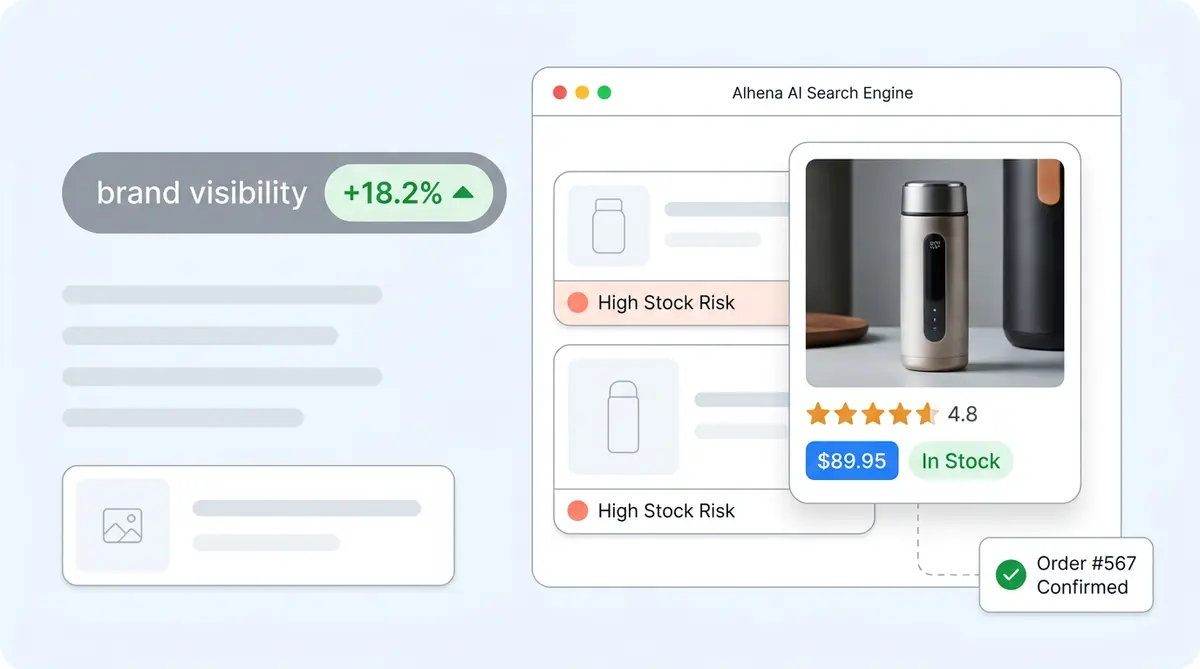
SKU-level AI visibility is the practice of tracking whether each individual product in your catalog appears in AI-generated answers, not just whether an engine said your brand name. AI shopping assistants recommend products, not brands. Brand tracking tells you that you were in the conversation. SKU tracking tells you which product actually won the recommendation.
Alhena AI Visibility tracks this per product across ChatGPT, Google AI Overviews, Gemini, Perplexity, and Claude, then ties each appearance to real checkout events.
A shopper opens ChatGPT and asks for the best moisturizer for dry skin. The AI names your brand. Your dashboard logs a mention and moves on. The product it recommended was discontinued six months ago.
You just lost a sale you will never see in a report. That is the blind spot brand-level monitoring cannot close, because ecommerce brands do not sell brand names. They sell products, each with its own price, margin, and inventory status.
Key takeaways
- AI shopping assistants recommend specific products, so ecommerce visibility has to be measured at the SKU level, not the brand level.
- Brand-mention tracking hides four costly failures: recommending discontinued items, counting mentions inside a competitor's list, surfacing the wrong product, and treating a text mention the same as a product card.
- The product card is the new shelf. Rendering accuracy — price, rating, image, carousel position — decides whether a mention earns the click.
- Invisible bestsellers, products that sell well on-site but never appear in AI answers, are the highest-return place to spend AEO effort.
- Product cards are a ChatGPT-led surface today. Treat any tool claiming identical product-card coverage across every engine with skepticism.
- Visibility only matters once you can act on it and prove it, which needs live catalog sync for accuracy and revenue attribution to connect products to orders.
What is SKU-level AI visibility?
SKU-level AI visibility measures the presence of your individual products in AI answers, one SKU at a time, across the questions your buyers actually ask. A stock keeping unit is the identifier for a single sellable product.
So the question changes. Brand tracking asks "did an engine mention my brand this week." SKU tracking asks "for the query running shoes for flat feet, did ChatGPT show my exact model, in what position, and as a full product card or only a passing text reference."
That change in unit changes what you can act on. Share of voice is the right measure for a law firm or a SaaS vendor. For a catalog business, the sale happens at the product level, so the visibility that predicts revenue lives there too. A brand can be highly visible and still lose every product recommendation that matters.
Why are brand mentions not enough for ecommerce?
Four failure modes that register as a win while a shopper buys elsewhere.
- The recommended product is discontinued or out of stock. A brand tracker counts the mention. The shopper clicks through, finds nothing to buy, and leaves. The answer named you and still lost the sale.
- The mention lives inside a competitor's list. When an AI recommends a rival's bundle or a roundup that includes you as an also-ran, your name appears, so a mention counter scores it positively. At the SKU level, the same answer reads as a loss.
- The wrong product gets recommended. Engines frequently surface an older or lower-margin item over the one you are promoting. If AI surfaces a $149 accessory instead of your $699 flagship, the AOV gap compounds across hundreds of queries per week.
- The mention has no product card, so it earns no click. A name dropped mid-paragraph behaves nothing like a card with a price, a rating, and an image. Brand trackers score both as one mention. Shoppers do not.
Brand-level vs SKU-level tracking: what changes
| Dimension | Brand-level tracking | SKU-level tracking |
|---|---|---|
| Unit measured | Brand name mentions | Individual products (SKUs) |
| Question answered | “Was my brand named?” | “Which of my products were recommended, and where?” |
| Discontinued or out-of-stock items | Counts a mention as a win even when the item is unavailable | Flags when the recommended product cannot be bought |
| Competitor context | A mention inside a rival's roundup still scores positively | Shows whether your product or a rival's holds the position |
| Product card rendering | Not measured | Checks whether a full card with price, rating, and image appeared |
| Price and availability accuracy | Not measured | Compares the AI answer against your live catalog |
| Invisible bestsellers | Cannot detect them | Surfaces top sellers that have no AI presence |
| Tie to revenue | Brand-awareness proxy | Maps product visibility to checkout events |
Why are product cards the new shelf?
In a physical store, the shelf decides the sale before the shopper compares anything. Eye-level placement and facings determine what gets picked up.
In AI shopping, the product card is that shelf. ChatGPT increasingly answers commercial queries with a row of cards carrying an image, a price, a star rating, and a buy path. Whoever owns the card owns the click.
This is why rendering, not just presence, is the metric that matters. A card showing the wrong price, no rating, or a broken image is a weaker shelf position than a competitor's clean card, even though both technically "appeared."
Which AI engines actually render product cards?
Worth being honest about this, because it is where most vendor claims overreach. Product cards are a ChatGPT-led surface today.
Alhena's documentation describes its Topic Products view as showing the product cards ChatGPT surfaces for each topic, with your products pinned first. Peec AI describes its shopping view the same way. Google's AI Overviews and Gemini render shopping results differently and less consistently, and Perplexity and Claude lean more on text and links than on cards.
| Engine | Product card maturity (July 2026) | What to track here |
|---|---|---|
| ChatGPT | Most mature. Rows of cards with image, price, rating, buy path | Card presence, carousel position, price and variant accuracy |
| Google AI Overviews | Shopping results appear, rendered inconsistently | Whether your product enters the shopping module at all |
| Gemini | Renders products, format varies by query | Presence, spec accuracy, competitor adjacency |
| Perplexity | Text and links over cards | Citation source and where the link actually lands |
| Claude | Text and links over cards | Whether your product is named and how it is characterised |
The edge case to watch for: a product visible on Perplexity may be entirely absent from ChatGPT Shopping. Single-engine spot-checks will read as a clean bill of health while the highest-traffic surface never shows you at all.
What does SKU-level tracking actually measure?
Three measurements, each mapping to a decision a merchandiser can make.
Per-product presence, by topic
For each topic a buyer searches, which of your products appear, and is the surfaced product yours or a competitor's. In Alhena this is the Topic Products view, with your products pinned first.
Rendering analysis
Was a full card rendered? Was the price surfaced correctly, and at what carousel position? Presence is step one; how the product was displayed is what predicts the click.
Invisible bestseller detection
Products with strong on-site performance but low AI visibility are flagged automatically. Demand is already proven; only the AI shelf is missing.
Competitive substitution
Where a rival's product outranks yours for a specific query, and where AI names you as the runner-up while recommending someone else as the top pick.
What does getting this wrong cost in revenue?
The gap between brand-level monitoring and SKU-level visibility shows up directly in the P&L, because AI traffic is unusually high-intent.
Now apply that 9.84% to the wrong product. A discontinued item. A low-AOV accessory instead of your flagship. A competitor surfaced alongside your name. You are losing revenue to your own catalog, and brand-level tools have no way to flag it.
Scale matters too. Shopping queries on AI platforms grew 4,700% between 2024 and 2025, and the AI ecommerce market reached $9 billion in 2025, on track for $64 billion by 2034. Brands building product-level visibility now compound the advantage. The ones still celebrating mentions keep paying for them.
Why does catalog sync matter for AI visibility?
Product data changes constantly, and an answer built on stale data quietly erodes both trust and conversion. If ChatGPT quotes a price you no longer charge, the shopper who clicks through meets a mismatch, and the mismatch reads as your error rather than the engine's.
This is why product-level tracking has to stay connected to your live storefront instead of working from a one-time crawl. Alhena keeps a live connection to Shopify, WooCommerce, Magento, and Salesforce Commerce Cloud, so the price and availability it evaluates in an AI answer are checked against what your shoppers actually see.
Catalog sync turns rendering analysis from a snapshot into an ongoing accuracy check.
How do I track product visibility in ChatGPT?
Start manual today, graduate to continuous tracking when spot-checks outgrow you.
- List your priority SKUsStart with bestsellers and highest-margin products, not the whole catalog. These are where an AI recommendation, or its absence, moves real revenue.
- Write the buyer prompts that should surface themMix category prompts ("best wireless earbuds under $100") with use-case prompts ("earbuds for running that stay in"). One prompt expands into several underlying searches, so write for the intent, not the keyword.
- Spot-check each prompt in ChatGPTRecord three things: did your product appear, in what position, and as a card or text only. Repeat a few times. Answers vary between runs, and one appearance is not a stable ranking.
- Check rendering accuracyWhen your product does appear, confirm price and availability match your live catalog. A card with a wrong price is a visibility problem even though the product technically appeared.
- Find your invisible bestsellersCompare your top sellers against your spot-check results. Anything that sells on-site but never surfaces in AI answers goes to the top of the AEO backlog.
- Move from spot-checks to continuous trackingManual checks do not scale past a handful of SKUs or capture week-to-week drift. This is where SKU-level tracking stops being an audit and becomes an operating system.
How do you connect AI visibility to actual revenue?
Seeing your products in AI answers is only the first move. The payoff comes from fixing what the tracking exposes, then proving the work changed outcomes. Measurement that stops at visibility leaves the most important question unanswered: did any of it sell?
Peec AI and Profound, the two most recognized names in AI visibility, both added shopping views in 2026, and both are strong at what they were built for, which is measuring visibility. Neither publicly ties that product visibility to checkout revenue.
That is the gap. Among dedicated AI visibility platforms, Alhena connects product-level visibility to first-party purchase outcomes, because visibility tracking, the on-site shopping agent, and checkout data run inside one system.
Those agents work both sides of the journey. Alhena's AI Shopping Assistant and Support Concierge handle thousands of real shopper conversations daily across web chat, email, Instagram DMs, and WhatsApp. What shoppers ask feeds directly back into which prompts the visibility layer tracks and which product gaps it flags. Platforms that only observe AI answers from the outside cannot see that demand signal. Proactive brands that act on it see 5.5x higher engagement.
Which brands benefit most from SKU-level tracking?
Not every catalog needs this on day one. The return is highest when these conditions apply:
- 100+ SKUs, where manual spot-checking cannot cover the catalog
- High-margin hero products that need to win the top card, not just appear somewhere
- Seasonal or rotating inventory, where discontinued items linger in AI training and cached answers
- Frequent price changes, where stale pricing in an answer costs you the click and the trust
- Variant-heavy categories like apparel, beauty, and furniture, where the wrong size, shade, or finish is functionally the wrong product
If your revenue depends on AI recommending the right product at the right price, brand-level monitoring will never tell you whether that is happening.
Your next steps: a 30-day starting plan
- Week 1. Audit your top 10 products across ChatGPT, Gemini, and Perplexity. One case of a wrong variant, wrong price, or wrong product confirms the gap.
- Week 2. Rank the findings by revenue impact, not by volume. Highest-margin products, bestsellers, and seasonal launches first.
- Week 3. Fix what the audit exposed: update product detail pages, add buyer-question FAQs, correct catalog feed data.
- Week 4. Connect your storefront for continuous tracking and set a baseline you can measure against. Most brands see their first actionable SKU-level insights within days of connecting.
See how your products actually appear
Connect Shopify, WooCommerce, or Magento and get SKU-level visibility across five AI engines, tied to real orders.
The shelf moved, so move your measurement
For two decades the shelf that decided ecommerce sales was a search results page, and brands measured their place on it with rank tracking.
The shelf is now the row of products an AI engine assembles inside its answer, and the unit that decides the sale is the individual product. Measuring at the brand level in that world is like counting how often your store's name appears in a mall directory while ignoring which products made it onto the endcap.
SKU-level AI visibility is rank tracking rebuilt for a shelf made of product cards. For catalog businesses, it is becoming the difference between knowing you are in the conversation and knowing you are winning the sale.
Frequently asked questions
SKU-level AI visibility is the practice of tracking whether each of your individual products appears in AI-generated answers such as ChatGPT's, rather than only whether an engine mentioned your brand. A SKU is the identifier for a single sellable product, so this measures presence one product at a time. It answers which product an AI recommended and in what position, which is the visibility that predicts ecommerce revenue.
Brand-level tracking counts whether your name appeared, but AI assistants recommend specific products, so a mention can hide four expensive problems. The engine may recommend a discontinued item, list you inside a competitor's roundup, surface the wrong product, or name you in plain text with no clickable card. Each still registers as a brand mention while the shopper buys elsewhere.
List your priority SKUs, write the natural buyer prompts that should surface them, then run each prompt in ChatGPT several times and record whether your product appears, in what position, and as a full card or text only. To track this continuously across many products and topics, use an AI visibility tool such as Alhena that monitors per-product presence on a schedule.
An invisible bestseller is a product that sells well on your own site but never appears in AI answers for queries it should win. It is the highest-return target for answer engine optimization because demand is already proven and only the AI shelf placement is missing. Alhena flags these automatically by comparing on-site performance against actual AI visibility.
Rendering analysis checks not just whether your product appeared but how it was displayed: was a full product card shown with correct price and availability, or only a passing text mention. It also checks positioning, premium pick versus budget option, and variant selection. A complete, accurate card is a far stronger competitive position than a bare mention.
Google AI Overviews and Gemini can show shopping results, but they render them differently and less consistently than ChatGPT, which is currently the most mature surface for product cards with price, rating, and image. Perplexity and Claude lean more on text and links. Treat any tool claiming identical product-card coverage across every engine with skepticism, because it is ahead of what the engines actually render.
When AI recommends an out-of-stock variant, shoppers bounce. When it cites incorrect specs, returns spike. When it surfaces a low-margin accessory instead of your flagship, you lose hundreds per transaction. Rendering analysis catches these mismatches at the product level before they drain revenue.
Yes. Alhena AI Visibility flags products with strong on-site sales but low or zero AI discoverability. These invisible bestsellers represent the largest untapped AEO opportunity, and brand-level monitoring tools have no way to identify them.
Alhena uses closed-loop attribution to connect visibility data to on-site behaviour and conversions, classifying AI-engine traffic by source and joining it to checkout events, then benchmarking against your sitewide baseline. First-party data from Alhena's shopping agents also reveals query-to-product mismatches that standalone monitoring tools cannot detect.
Most brands see their first actionable SKU-level insights within days of connecting their storefront. Alhena integrates directly with Shopify, WooCommerce, Magento, and Salesforce Commerce Cloud, so it understands your product hierarchy, pricing, and inventory from day one.
Yes. Peec AI and Profound both added shopping views in 2026 that track how products show up in ChatGPT, and both are strong at measuring visibility. The difference with Alhena is that Alhena also syncs your live catalog for accuracy and ties product visibility to actual checkout events, so you can connect a recommendation to a sale rather than stopping at the mention.
Brands with large catalogs (100+ SKUs), high-margin hero products, seasonal inventory, variant-heavy categories, or frequent price changes benefit most. If your revenue depends on AI recommending the right product at the right price, product-level tracking is what protects it.