Shoppers who interact with an AI assistant during their session convert at 12.3 percent, nearly four times the 3.1 percent rate of those who do not, according to recent e-commerce AI research. For Shopify brands running Gladly as their customer service platform, the gap between handling support and actually driving sales through those same conversations is costing real revenue every day. The tools are powerful on their own. But without an AI layer purpose-built for e-commerce selling, your Shopify catalog and your Gladly conversations remain disconnected silos. This guide breaks down how Alhena AI bridges that gap, turning every chat, email, and message into a revenue opportunity.
The Stack Shopify and Gladly Brands Already Run, and What Is Missing
Shopify powers your storefront, catalog, inventory, checkout, and order fulfillment. Gladly unifies your customer conversations across chat, email, SMS, and voice into a single, people-centered timeline. Together they form a solid operational stack used by brands like Allbirds, Rothy's, and Andie Swim.
The problem is what sits between them. Gladly excels at routing conversations, keeping customer history, and helping agents respond faster. Its AI, Gladly Sidekick, has grown more capable — it can now automate order status checks, process returns and refunds, and even answer some product questions using your Shopify data. Brands like Allbirds have achieved an 87 percent resolution rate with Gladly AI. But when a shopper needs deep guided selling — comparing two products across multiple attributes, getting a personalized skincare routine recommendation, or navigating complex bundle configurations — Gladly's AI reaches its limits. It resolves support interactions well, but it was not designed to actively drive revenue through conversational selling.
This creates a revenue blind spot. Pre-purchase questions, product comparisons, personalized recommendations, and guided selling all happen outside Gladly's automation scope. Those are exactly the conversations that drive add-to-cart events, upsells, and higher average order values. According to Straits Research, the AI shopping assistant market is projected to grow from $4.26 billion in 2025 to $36.38 billion by 2034, a clear signal that brands recognize the revenue locked inside these conversations.
This same dynamic plays out across other helpdesk stacks. See how Shopify brands on Kustomer use AI for guided selling and how Shopify stores combine Gorgias with an AI shopping assistant to close the same gap.
Alhena AI fills this gap. It sits as an intelligent layer between your Shopify store and your Gladly workspace, handling both product-driven selling and support automation in a single, hallucination-free experience.
How Alhena AI Connects Shopify and Gladly into a Revenue Engine
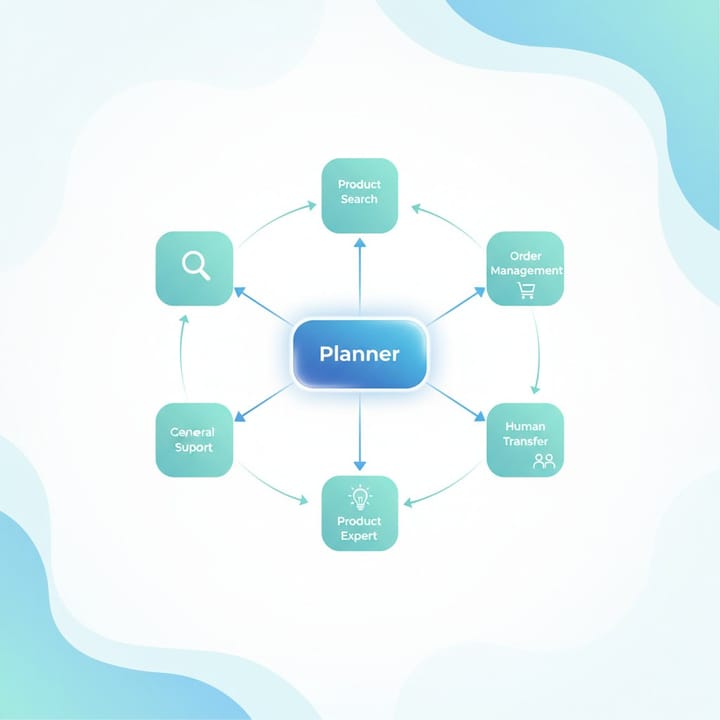
Alhena AI is purpose-built for e-commerce. Unlike general-purpose chatbots or support-first AI tools, Alhena deploys two specialized agents that work in tandem across your entire stack.
The Product Expert Agent connects directly to your Shopify catalog. It ingests your full product feed, including variants, pricing, inventory levels, images, and descriptions. When a shopper asks a product question, this agent delivers grounded, accurate answers pulled from live Shopify data, not a stale knowledge base.
The Order Management Agent handles post-purchase inquiries. It retrieves order status, tracking information, and return eligibility from Shopify in real time. When combined with Gladly, it resolves the majority of repetitive support tickets without a human agent ever touching them.
On the Gladly side, Alhena handles the high-volume repetitive inquiries that currently bury your team. When conversations require human attention, Alhena escalates to Gladly with the full transcript, detected customer intent, order IDs, and any product data already collected. Your agents pick up exactly where Alhena left off, with zero repetition for the customer.
On the Shopify Side: Real-Time Catalog Intelligence
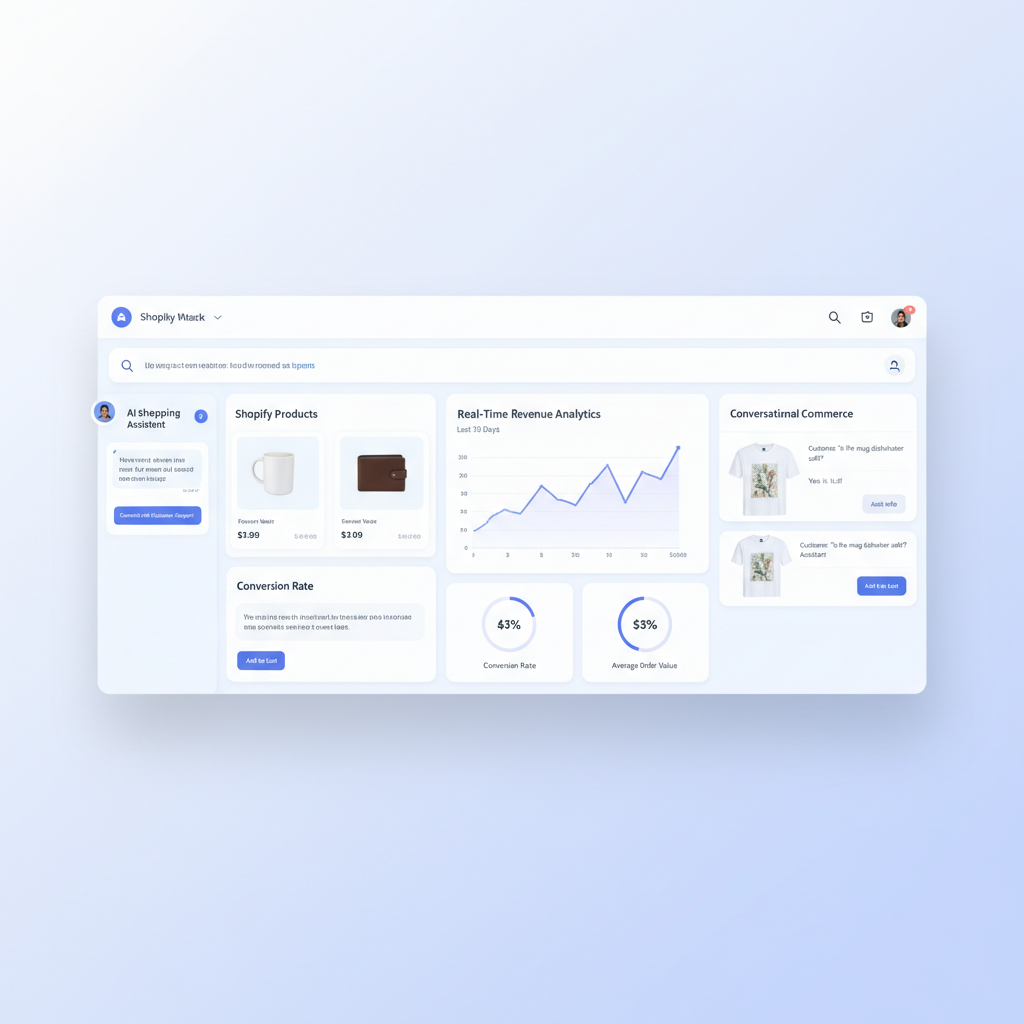
When you connect Alhena AI to your Shopify store, either through the Shopify integration or directly in the Alhena dashboard, it syncs your entire catalog: products, variants, inventory, pricing, discount rules, and active promotions. This sync happens automatically, so changes you make in Shopify are reflected in Alhena within minutes.
Here is what that unlocks on the storefront:
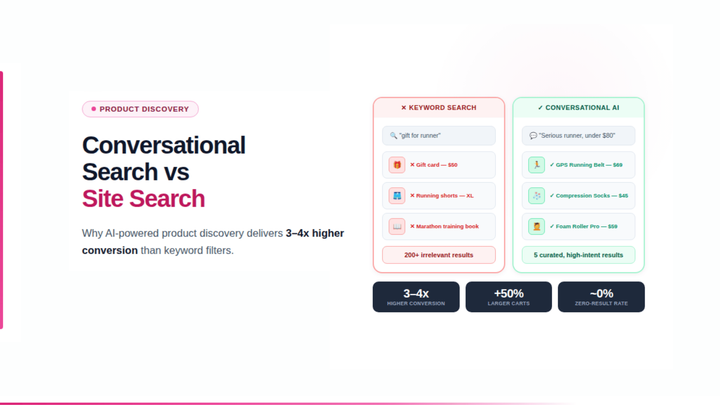
- Guided product discovery. Alhena asks clarifying questions, compares variants, handles sizing and compatibility queries, and recommends the right product based on what the shopper actually needs, not a generic bestseller list.
- In-stock alternative recommendations. When a product is out of stock, Alhena surfaces comparable alternatives that are available, keeping the shopper engaged instead of sending them to a competitor.
- Bundle and upsell suggestions. Based on the conversation context and cart contents, Alhena recommends complementary products to increase average order value.
- Agentic checkout. Alhena can populate carts and pre-fill checkout fields directly from the chat, reducing the friction between "I want this" and "I bought this."
This is where Alhena differs from Gladly fundamentally. Gladly's Shopify integration lets agents view orders and process refunds. Alhena's Shopify integration powers an AI shopping experience that turns browsers into buyers.
On the Gladly Side: Smarter Escalation and Agent Assist
Alhena does not replace Gladly. It makes Gladly more effective by handling the volume that currently buries your team.
When Alhena connects to your Gladly workspace, the integration creates a seamless handoff layer. Here is how it works:
- AI-first resolution. Alhena resolves approximately 70 percent of inbound inquiries automatically across chat, email, and messaging channels. These include order status, shipping timelines, return policies, product questions, and sizing guidance.
- Smart escalation with full context. When a conversation requires human attention, Alhena creates a detailed conversation in Gladly with the full transcript, detected customer intent, order IDs, and any product data already collected. Your agents pick up exactly where Alhena left off, with zero repetition for the customer.
- Flexible traffic routing. You control when Alhena handles conversations: 24/7 full automation, peak-hour overflow only, or after-hours coverage. The routing adjusts to your team's schedule and capacity.
The net effect is that your Gladly agents handle fewer but higher-value conversations. Brands using Alhena alongside their helpdesk consistently report that support teams can focus on complex cases, loyalty-building interactions, and VIP customers while Alhena manages the rest.
What Alhena Does That Gladly AI Cannot
Gladly Sidekick has evolved into a capable AI platform. It resolves support inquiries across channels, processes returns and refunds end-to-end, and even makes basic product recommendations using customer profiles. Allbirds achieved an 87 percent resolution rate and 41 percent AHT reduction. Bombas hit 88 percent resolution on cancellation requests with 99 percent CSAT. For support automation, Gladly delivers.
But there is a difference between resolving support tickets and driving revenue through selling. Gladly claims a 10 percent average increase in contact-center-generated revenue. Alhena's customers report 3x conversion rates and 38 percent AOV uplifts. That gap exists because Alhena was purpose-built for e-commerce selling, while Gladly's AI capabilities evolved from a support-first foundation. Here is where Alhena goes further:
- Hallucination-free product answers. Both platforms pull Shopify product data, but Alhena guarantees every response is grounded in verified catalog information. It will never recommend an out-of-stock product, quote the wrong price, or fabricate specifications. Gladly's AI can surface product information, but lacks Alhena's verification layer that prevents hallucinated responses — critical for regulated categories like skincare, wellness, and luxury goods.
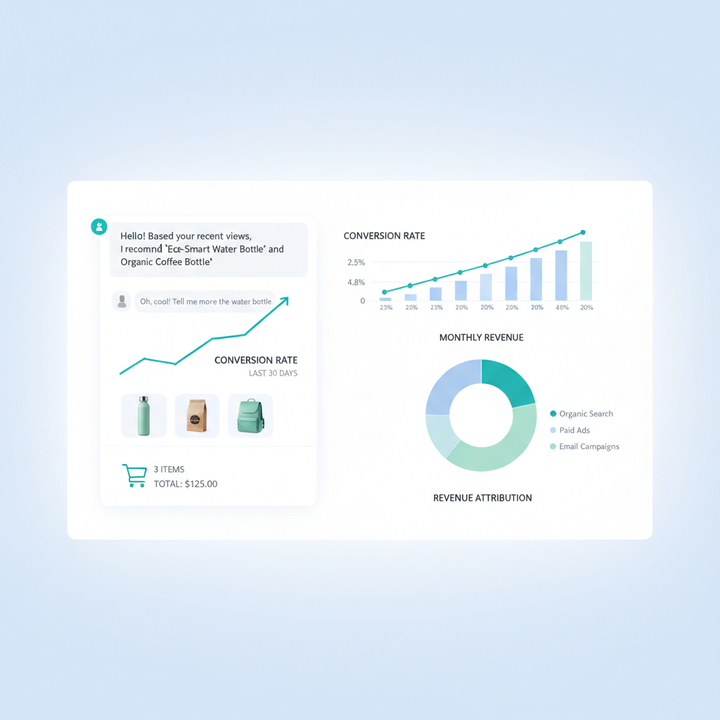
- Revenue attribution analytics. Alhena tracks every conversation from first message through checkout, giving you precise revenue attribution per AI interaction. You see exactly which conversations led to purchases and how much revenue each generated. Gladly tracks support metrics and reports a 10 percent average revenue increase, but does not provide granular conversation-to-purchase attribution.
- Agentic checkout capabilities. Alhena can populate a shopper's cart, apply discount codes, and pre-fill checkout fields directly from the conversation. Gladly agents can process exchanges and apply discounts within their workspace, but Gladly's AI does not autonomously drive shoppers through checkout from a chat conversation.
- Deep guided selling. Alhena's Product Expert Agent conducts adaptive product quizzes, compares variants across multiple attributes, and builds personalized recommendations based on the full conversation context. Gladly's AI can recommend products, but Alhena's depth of product intelligence — including fit analysis, ingredient breakdowns, and compatibility guidance — goes significantly further.
- Broader omnichannel selling. Both platforms support multiple channels. Gladly covers chat, email, SMS, and voice. Alhena extends AI-powered selling to Instagram DMs, WhatsApp, and additional social channels, turning every touchpoint into a revenue opportunity.
The bottom line: Gladly has become a strong AI support platform with real results in ticket resolution and efficiency. Alhena takes it further by adding a purpose-built selling layer — hallucination-free product intelligence, agentic checkout, and granular revenue attribution — that turns support conversations into measurable revenue. Together, they cover the full spectrum from product discovery through post-purchase support.
For a side-by-side comparison with another popular AI agent, read our breakdown of Alhena AI vs Intercom Fin AI.
Alhena AI vs Gladly Sidekick: At a Glance
| Alhena AI | Gladly Sidekick | |
|---|---|---|
| Core focus | E-commerce selling + support | Support resolution + CX |
| Product recommendations | Deep guided selling from live Shopify catalog | Basic, from customer profiles |
| Hallucination-free | Yes — verified product data guarantee | No verification layer |
| Agentic checkout | Yes — cart population from chat | No (agents process manually) |
| Revenue attribution | Per-conversation tracking | Aggregate (10% avg increase) |
| Resolution rate | 61–86% + revenue generation | 75–87% (Allbirds: 87%) |
| Channels | Chat, email, WhatsApp, Instagram, voice | Chat, email, SMS, voice |
| Deployment | Under 48 hours | Days to weeks |
Revenue Beyond Ticket Deflection
Most AI tools in the helpdesk space measure success by how many tickets they deflect. Deflection is valuable, it reduces cost. But it leaves the bigger opportunity untouched: turning conversations into revenue.
Alhena AI delivers both. Consider the results from brands already using Alhena's commerce-first approach:
- Tatcha achieved a 3x conversion rate, a 38 percent AOV uplift, and 11.4 percent of total site revenue attributed to Alhena AI interactions, while maintaining 82 percent chat deflection. Read the full case study.
- Victoria Beckham Beauty saw a 20 percent increase in average order value through AI-guided product recommendations.
- Puffy automated 63 percent of inquiries while maintaining a 90 percent CSAT score.
- Manawa reduced support workload by 43 percent and cut response times from 40 minutes to 1 minute, with 80 percent inquiry automation.
These are not just support metrics. They are revenue metrics. The difference between an AI that deflects tickets and an AI that drives sales is the difference between saving money and making money. For Shopify brands on Gladly investing $180 or more per agent per month, the ROI case for adding Alhena's revenue layer is straightforward.
Want more on how AI drives revenue? Explore 7 ways AI shopping assistants reduce cart abandonment and learn how to connect an AI shopping assistant with Klaviyo to generate revenue.
Alhena's built-in analytics dashboard shows you exactly which conversations led to purchases, what products were recommended, and how much revenue each AI interaction generated. This is the visibility that makes AI an accountable revenue channel rather than a cost center.
Getting Started with Alhena AI on Shopify and Gladly
Deploying Alhena AI across your Shopify and Gladly stack does not require developer resources or a lengthy implementation. Most brands are live within 48 hours. Here is what the setup looks like:
Step 1: Connect Your Shopify Store
Install the Alhena AI integration from the Shopify integration page or connect directly through the Alhena dashboard. Alhena automatically syncs your product catalog, inventory, pricing, and discount rules. It also ingests your help center content, policy pages, and FAQs as training sources.
Step 2: Connect Your Gladly Workspace
Link your Gladly account through the Alhena dashboard. This enables smart escalation and conversation routing between Alhena and your human agents. Configure your routing rules: decide which channels Alhena handles autonomously and when conversations should escalate to Gladly.
Step 3: Train and Customize
Alhena automatically learns from your existing knowledge base, previous ticket history, and canned responses. You can customize the AI's tone, brand voice, and escalation triggers. No coding required.
Step 4: Go Live
Deploy Alhena across your storefront chat widget, email, and messaging channels. Monitor performance through the Alhena analytics dashboard, which tracks both support metrics like deflection and CSAT, and revenue metrics like conversion attribution and AOV impact.
Alhena offers 25 free conversations to get started, so you can see the impact before committing. For a personalized walkthrough of how Alhena fits your specific Shopify and Gladly setup, book a demo or start for free.
The Bottom Line
Shopify and Gladly give you a strong foundation for storefront operations and customer service. But without an AI layer built for e-commerce selling, you are leaving revenue on the table every time a shopper has a product question and gets a knowledge base article instead of a personalized recommendation.
Alhena AI bridges that gap. It connects your Shopify catalog intelligence to your Gladly support workflow, creating a unified system where every customer interaction, whether it starts as a product question or a support ticket, has the potential to drive revenue. With hallucination-free answers, agentic checkout, revenue attribution, and under-48-hour deployment, Alhena turns your existing stack into a selling machine.
Ready to turn your Shopify and Gladly stack into a revenue engine? Book a demo with Alhena AI or start for free.
Frequently Asked Questions
How does Alhena AI integrate with both Shopify and Gladly?
Alhena AI connects to Shopify through a direct integration that syncs your product catalog, inventory, pricing, and orders in real time. It also connects to your Gladly workspace to enable smart escalation and conversation routing. When Alhena resolves an inquiry, it handles it end-to-end. When human attention is needed, it escalates to Gladly with full context. Both integrations are configured through the Alhena dashboard with no developer resources required.
What can Alhena AI do that Gladly Sidekick cannot?
While Gladly Sidekick automates support workflows like ticket routing and FAQ responses, Alhena AI adds a commerce-first layer that includes guided product discovery from live Shopify data, agentic checkout that populates carts from chat, revenue attribution analytics, and dynamic product recommendations. Alhena is built to sell, not just support.
Does Alhena AI replace Gladly for customer service?
No. Alhena AI complements Gladly by handling the repetitive volume—approximately 70 percent of inbound inquiries—so your Gladly agents can focus on complex, high-value conversations. Alhena escalates to Gladly with full context when human attention is needed, making your existing team more effective.
How long does it take to deploy Alhena AI on a Shopify store with Gladly?
Most brands go live within 48 hours. Alhena automatically syncs your Shopify catalog and learns from your existing Gladly knowledge base, canned responses, and ticket history. No coding or developer resources are required for setup.
What kind of revenue results have brands seen with Alhena AI?
Tatcha achieved a 3x conversion rate, 38 percent AOV uplift, and 11.4 percent of total site revenue attributed to AI interactions. Victoria Beckham Beauty saw a 20 percent AOV increase. Puffy automated 63 percent of inquiries while maintaining 90 percent CSAT. These results come from Alhena’s commerce-first approach that goes beyond ticket deflection.
Can Alhena AI handle email support tickets in Gladly?
Yes. Alhena AI resolves inquiries across chat, email, and messaging channels. For email tickets routed through Gladly, Alhena can draft and send automated responses for common questions like order status, shipping timelines, and return policies, reducing agent workload across all channels.
How does Alhena AI track revenue from AI conversations?
Alhena includes built-in revenue attribution analytics that track every conversation from the first message through checkout. The dashboard shows which conversations led to purchases, which products were recommended, and how much revenue each AI interaction generated, giving you precise ROI measurement for your AI investment.
What does Alhena AI cost for Shopify brands already paying for Gladly?
Alhena offers 25 free conversations to start, so you can measure impact before committing. For detailed pricing based on your conversation volume and channel needs, visit the Alhena pricing page or use the ROI calculator to estimate your return. Many brands find that the revenue Alhena generates more than offsets the investment.
Does Alhena AI work with other helpdesks besides Gladly?
Yes. Alhena AI integrates with Zendesk, Freshdesk, Gorgias, Kustomer, Intercom, and Zoho Desk in addition to Gladly. It also connects with e-commerce platforms including Shopify, WooCommerce, Magento, and Salesforce Commerce Cloud, making it flexible for any stack.