Most ecommerce chatbots still respond with plain text product names and bare links in their messages. A shopper asks for a recommendation, gets a list of words, and then has to leave the conversation, navigate to a product page, evaluate visually, compare options, and decide. Every step in that handoff is a drop-off point. By the time the shopper reaches the product page, the shopping momentum built during the conversation is gone, and so is the sale.
Rich product cards in AI chat fix this problem by turning the conversation into a product discovery storefront. Instead of text lists, shoppers see product images, pricing, key attributes, star ratings, and direct add-to-cart buttons right inside the chat interface. AI-powered discovery and purchase happen without ever leaving the dialogue. This post breaks down why visual commerce chatbot experiences convert higher, how they leverage multiple channels, and what separates a real conversational AI commerce engine from a text-only FAQ bot.
What Are Rich Product Cards in AI Chat?
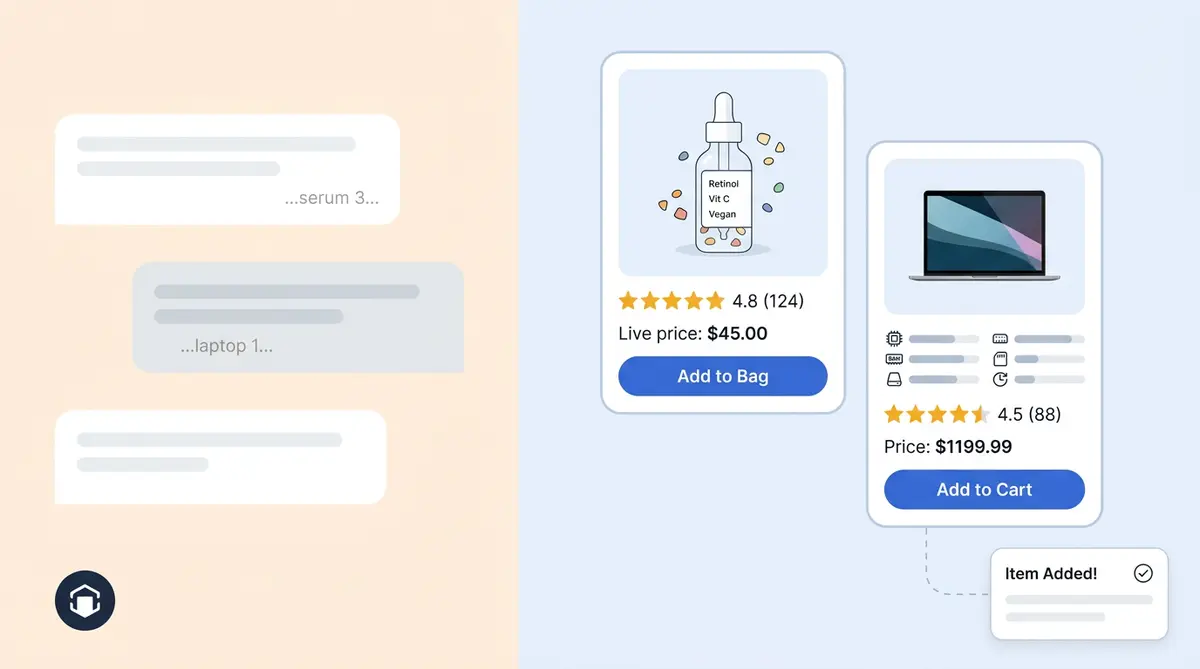
Rich product cards are interactive in-conversation responses that display products visually inside the chat interface. Each card pulls live data from your product catalog and shows the product image, name, price, key attributes (like size, color, or specs), star ratings, and a direct Add to Cart or Add to Bag button.
Instead of a chatbot saying "We recommend the Hydra Boost Serum ($48)" as plain text, a rich product card displays the serum's branded image, its 4.8-star rating from 2,300 reviews, a short list of key ingredients, the price, and a single button that adds it to the shopper's cart. The conversation becomes the storefront.
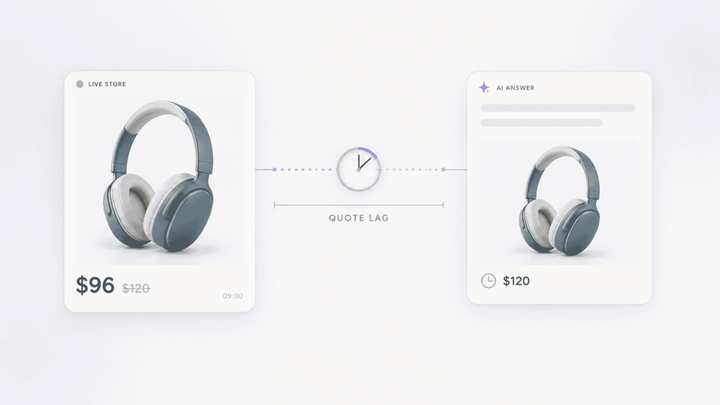
Alhena AI's Shopping Assistant renders these cards natively inside chat, pulling on-brand imagery, live pricing, key benefits, and ratings directly from your product catalog in real time. The cards aren't static mockups. They dynamically update as inventory and pricing change.
Text-Only vs. Rich Product Cards: Two Real Scenarios
Skincare: "What's good for dull, dehydrated skin?"
Text-only response: "I'd recommend our Hydra Boost Serum, Glow Renewal Cream, and Vitamin C Brightening Drops. You can find them on our skincare page." The shopper now has to leave chat, search for each product, look at images, compare ingredients, read reviews, and figure out which one actually fits. Most won't bother with all three.
Rich product card response: Three branded product carousels appear inside the chat. Each carousel card shows the product image, key ingredients (hyaluronic acid, niacinamide, vitamin C), the star rating, real-time pricing, and an Add to Bag button. The shopper compares instantly, taps a button, and the product lands in their cart without leaving the conversation.
Electronics: "A laptop for video editing under $1,500"
Text-only response: "Check out the ProBook 16, the CreatorStation X, and the EditPro 15. All are under $1,500." Three names in a text message. No specs, no images, no way to compare without clicking away.
Rich product card response: Three cards appear in a carousel side by side showing each laptop's display size, processor, RAM, GPU, star rating, and price. The shopper sees that the CreatorStation X has the best GPU for their workflow, taps Add to Cart, and moves to checkout. The entire decision happened inside the chat.
Why Visual Commerce in Chat Converts Higher
The gap between text-only and rich product card responses isn't marginal. Research shows that 67% of online shoppers prioritize product image quality over product descriptions and reviews when making purchase decisions. When your AI-powered chatbot responds with text only, you're ignoring the single most important factor in how shoppers evaluate products.
Product images create immediate emotional connection and trust. Shoppers process images in milliseconds. A high-quality product photo builds confidence that text alone can't match. Brands using rich visual product carousels and displays see conversion rates lift by up to 94% compared to low-quality or missing imagery.
Visible pricing removes friction. When pricing appears directly on the product card inside chat, the shopper doesn't have to click through to find out what something costs. That single friction layer, small as it seems, accounts for a measurable share of drop-offs in text-only chat flows.
Star ratings provide instant social proof at the decision moment. Products rated four stars or above capture 94% of purchases. When those ratings show up inside the AI chatbot conversation, the shopper gets social proof exactly when they need it, not after navigating to a separate page.
Direct add-to-cart buttons eliminate the navigation gap. The average online checkout takes 22 clicks. Every click between recommendation and purchase is a chance to lose the sale. Rich product cards with Add to Cart buttons compress that journey to a single tap, reducing the actions needed to just one click inside the conversation.
Shoppers stay in the conversational flow. When a chatbot sends the shopper to a product page, context is lost. The shopper may browse other items, get distracted, or abandon entirely. With cart abandonment rates at 70% globally for standard interactions, and mobile abandonment hits 85%. Keeping the shopper inside the chat, where the AI already has full context for personalization based on their needs, dramatically reduces these drop-offs and increases engagement.
Conversion Data: Rich Product Cards With Agentic Checkout
Brands using rich product cards with agentic checkout inside chat see results that text-only experiences can't match. On the Alhena AI platform, brands like Tatcha achieved a 3x conversion rate and a 38% higher average order value compared to standard site experiences. That's not a small optimization. It's a different category of performance.
The reason is straightforward. Agentic checkout doesn't just show the product. It adds items to the cart and redirects the shopper to a pre-populated checkout page. The path from "I like this" to "I bought this" is a single click. Victoria Beckham saw a 20% AOV increase with this approach, because personalized AI-guided product recommendations paired with frictionless checkout consistently drive higher basket sizes.
Shoppers who engage with AI chat convert at 4x the rate of those who don't, according to data from Adobe Analytics. When that chat experience includes visual product cards and one-click checkout, the engagement multiplier compounds. Puffy reached 90% customer satisfaction while automating 63% of inquiries, showing that visual commerce in chat improves both revenue and customer engagement efficiency.
Cross-Channel Product Cards: Web, Instagram, WhatsApp
Rich product cards only work if they're consistent everywhere your shoppers are. Whether through marketing campaigns or organic discovery, a customer who finds your brand on Instagram and asks about a product in DMs expects the same visual card experience they'd get on your website's chat widget. If your Instagram AI sends plain text while your web chat shows rich cards, you've created a fragmented experience that erodes trust.
Alhena AI's Social Commerce engine delivers the same rich product cards across web chat, Instagram DMs, WhatsApp, and Facebook Messenger through a single AI-powered commerce platform with full product card capabilities. Product carousels with images, pricing, ratings, and Add to Cart buttons render natively on each channel, adapted to that platform's format but consistent in the information, engagement quality, and buying experience they provide.
This matters because social commerce is accelerating fast among mobile users. WhatsApp-driven commerce is projected to reach $45 billion globally in 2026, and US social commerce is expected to surpass $100 billion the same year. Brands that can't deliver rich visual product experiences inside these messaging channels are leaving that revenue on the table.
Why Rich Product Cards Beat Video Commerce at the Decision Stage
Shoppable video drives engagement at the awareness stage. A well-produced product video can spark interest, build engagement, and drive desire. But by the time a shopper asks your AI "which moisturizer is best for sensitive skin," they've already moved past awareness. They're at the decision stage. They don't need more content to watch. They need a frictionless path to purchase.
Rich product cards inside AI chat convert at the decision stage because they match the shopper's intent with the right format. The shopper has expressed specific need. The intelligent AI understood it. Now the product card shows exactly what matches, with enough visual and data context to preview and decide, and a button to buy. No video buffering, no 30-second watch time, no extra clicks or unnecessary interactions.
Video and rich product cards aren't competitors. They serve different stages of the funnel. But if you had to choose where to invest for direct revenue impact, in-chat product cards with agentic checkout win because they operate at the highest-intent moment in the shopping journey.
How Alhena AI Delivers Rich Product Cards Natively
Alhena AI's Shopping Assistant was built for visual commerce from the ground up. When a shopper asks a natural language query, the AI doesn't just retrieve a product name. It pulls the on-brand product image, live price, key benefits, star rating, and a direct Add to Bag CTA from your catalog in real time.
The agentic checkout layer goes further. When the shopper clicks Add to Cart on a product card, Alhena AI populates the cart and redirects to a pre-filled checkout page. No manual searching. No re-entering product selections. One click from recommendation to checkout. This is the same engine powering results like Crocus's 86% deflection rate and Manawa's drop from 40-minute to 1-minute response times.
Because Alhena AI is purpose-built for ecommerce shopping assistants, the product cards pull data from integrations with Shopify, WooCommerce, Magento, and Salesforce Commerce Cloud. Your catalog schema stays the single source of truth. Pricing, inventory, product schema, and attributes are always current. And the same rich card experience works across web chat, Instagram DMs, and WhatsApp through one unified platform that works at scale.
Text-Only Chat Is the New FAQ Bot
Text-only chatbots belonged to the era of scripted FAQ bots that could answer "what's your return policy?" but couldn't sell a product. Today's shoppers expect AI that shows, recommends, and closes inside the same interaction.
Any brand still recommending products without rich visual product cards inside the chat experience is handing revenue to the brands whose AI-powered assistant displays products visually, enables instant comparison, and lets shoppers buy with a single tap. The data supports it: AI-assisted shoppers complete checkout at nearly 2x the rate of those browsing on their own.
Ready to turn your AI chat into a visual commerce engine? Book a demo with Alhena AI or start free with 25 conversations to see rich product cards and agentic checkout in action.
Frequently Asked Questions
What are rich product cards in AI chat and how do they increase ecommerce conversions?
Rich product cards are in-chat visual responses that display product images, pricing, star ratings, key attributes, and direct add-to-cart buttons inside the conversation. Alhena AI renders these cards natively from your live product catalog, so shoppers compare and buy without leaving the chat. Brands using this approach see up to 3x conversion rates because every friction point between recommendation and purchase is removed.
How does agentic checkout work with rich product cards inside a visual commerce chatbot?
When a shopper taps Add to Cart on a rich product card, Alhena AI's agentic checkout populates the cart and redirects to a pre-filled checkout page in a single click. There's no manual product searching or re-entering selections. This collapses the typical 22-click checkout journey into one action, which is why brands like Tatcha see 38% higher average order values from AI-assisted sessions.
Do rich product cards in AI chat work across Instagram DMs, WhatsApp, and web chat?
Yes. Alhena AI delivers consistent rich product cards across web chat, Instagram DMs, WhatsApp, and Facebook Messenger through a single commerce engine. Product images, live pricing, ratings, and buy buttons render natively on each channel. Cross-channel consistency matters because shoppers expect the same visual buying experience wherever they interact with your brand's AI.
How do rich product cards inside a shopping AI compare to shoppable video for driving revenue?
Shoppable video works best at the awareness stage when shoppers are still browsing. Rich product cards inside AI chat convert at the decision stage, when a shopper has already expressed specific intent to an AI-powered assistant. Alhena AI's product cards match that intent with the right product, visual proof, and a one-click purchase path, delivering higher direct revenue impact than video overlays at the point of decision.
What revenue impact can brands expect from switching to a visual commerce chatbot with rich product cards?
Brands on Alhena AI see measurable revenue impact from rich product cards with agentic checkout. Tatcha achieved 3x conversion rates and 38% AOV uplift. Victoria Beckham saw 20% higher average order values. Puffy reached 90% customer satisfaction while automating 63% of inquiries. The combination of visual product display and frictionless checkout consistently outperforms text-only chat by a wide margin.