For many apparel and footwear ecommerce and commerce brands, sizing questions make up 40 to 60% of all inbound support tickets. Every "What size should I get?" message costs agent time, and the answer your business gives is almost always the same: check the size chart. But that answer doesn't work. The proof is that the same questions keep coming, shift after shift, season after season. In 2026, this is your single largest ticket-volume driver. This post breaks down why sizing is your single largest ticket-volume driver, what it actually costs your business, and how a two-surface AI solution (chat widget plus smart PDP FAQs) eliminates these tickets while boosting conversion.
The Three Costs of Sizing Confusion
Sizing confusion doesn't just clog your support queue. It bleeds margin across three dimensions that most CX teams, fashion retailers, and their customers track separately but rarely connect.
Agent Time on Repetitive Questions
A sizing question takes 5 to 10 minutes to resolve when you account for the back-and-forth: "What's your height? What size do you usually wear? Do you prefer a looser fit?" Multiply that by hundreds of tickets per week, and you're burning full-time agent hours at scale on questions that have predictable, data-driven answers. According to industry benchmarks, each email or chat ticket costs an average of $2.70 to $5.60 to handle. Phone calls run $17 or more. When 40 to 60% of your inbound volume is sizing, the business cost alone justifies automation. AI can boost operational efficiency across the board.
Returns From Wrong-Size Purchases
Customers who can't get a confident answer often guess. And when they guess wrong, they return. Size fit issues drive 50 to 70% of fashion returns, according to research from Coresight and the National Retail Federation. Fashion retailers face steep costs: processing a single return costs $21 to $46 when you factor in shipping, inspection, repackaging, and the margin hit from markdowns on returned clothing. The process of handling clothing returns costs more than most retailers realize. Less than half of returned clothing items sell again at full price.
Lost Sales From Abandonment
The third cost is invisible: visitors who leave without buying because they couldn't figure out their size. Online cart abandonment in fashion ecommerce runs 78 to 86%, and size fit uncertainty is the top driver. Over 52% of online shoppers say they've abandoned a purchase specifically because they weren't confident about fit. These aren't window shoppers. They're buyers who wanted to convert but didn't trust the information on the page.
Why Static Size Charts Fail
Size charts look like they should solve this. They present measurements in a clean table. But they fail for three structural reasons that no amount of chart redesign can fix.
Customers don't measure themselves. The typical online customer is shopping online from a couch, a commute, or a lunch break. They don't have a tape measure to take body measurements, and they're not going to pause their session to find one. A chart that requires body measurements is a chart most customers will skip. Traditional size guides create more problems than they solve.
Sizing varies across brands and within your own catalog. A slim-fit denim fits differently from a relaxed sweatshirt, bras, lingerie, and sports bras have their own fit rules entirely, and a structured blazer fits differently again. Even within the same brand, a single size chart per category can't capture per-product fit nuances like fabric stretch, cut, and construction. Customers sense this inconsistency, which is why they don't trust the chart and message your team instead.
Charts present data but don't answer the real question. Online customers aren't asking "What are the chest measurements for a size medium?" They're asking "Will this fit me the way I want it to?" That's a personalized question that requires context about the customer's body, preferences, and the specific product's fit profile. A static table can't deliver that.
How AI Solves Sizing at Scale
The fix isn't a better size chart. It's a Fit Advisor trained on per-product and per-category fit data that answers the size fit question customers are actually asking.
Instead of dumping a measurement table on the page, the technology asks conversational follow-up questions: What's your usual size in this type of garment? What's your body type? Do you prefer a snug, slim, or relaxed fit? Then it delivers personalization through a tailored size recommendation grounded in the specific product's fit profile, not a generic chart or static size guides. This level of personalization means the recommendation includes tailored, product-specific reasoning ("This runs about one size small through the shoulders, so we'd suggest sizing up") that gives the shopper confidence to buy, driving higher engagement.
This works because the technology has been trained on the actual fit data for each SKU in your catalog: the fabric composition, the body measurements, the garment measurements, the cut and construction details, the return reason codes, and the review sentiment around fit. It knows that your relaxed-fit hoodie runs true while your slim-fit chino runs a size small, and it adjusts its recommendations based on these preferences accordingly.
Two Surfaces That Maximize Coverage
A fit advisor only works if customers encounter it before they submit a support ticket or abandon the page. That's why the AI needs to appear on two surfaces, each designed for a different shopper behavior.
The AI Shopping Assistant Chat Widget
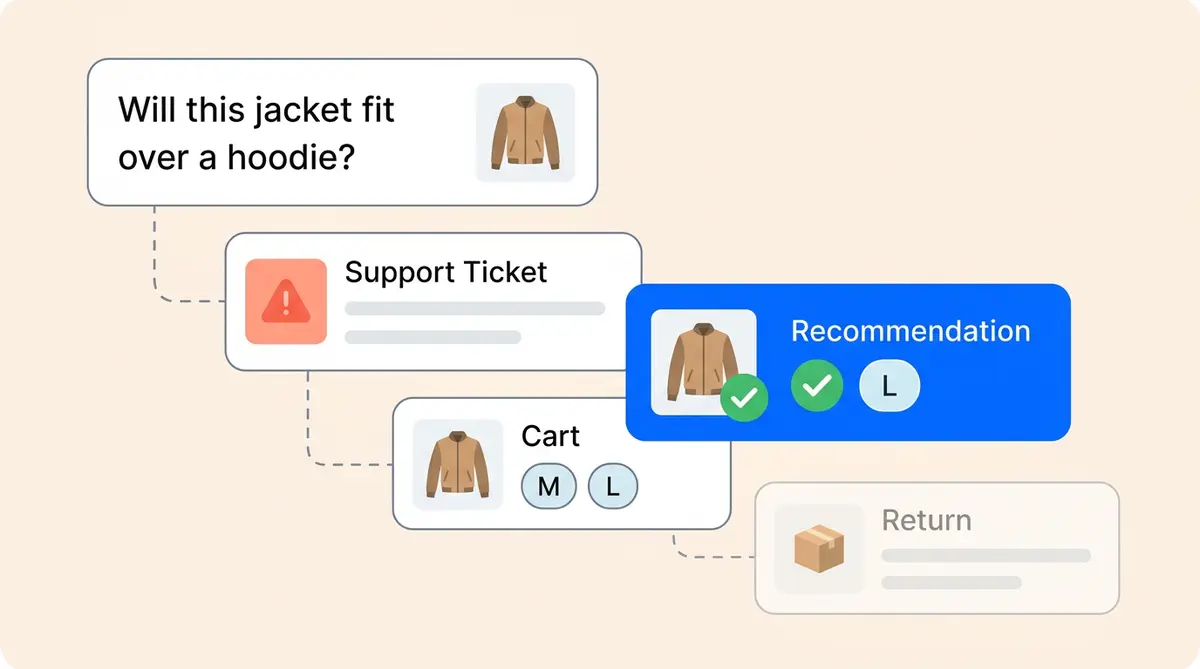
Customers who prefer to ask questions conversationally can open the chat widget and type exactly what they'd type to a support agent: "I'm 5'10, 180 lbs, and I usually wear a large in Nike. What size should I get in this jacket?" The AI responds with a personalized recommendation, tailored, product-specific reasoning, and a direct link to add the right size to cart. No second-guessing, no abandoned carts. It's a better online experience overall. The experience feels like a shopping experience, chatting with a knowledgeable sales associate, not reading a help article.
Smart Product FAQs on the PDP
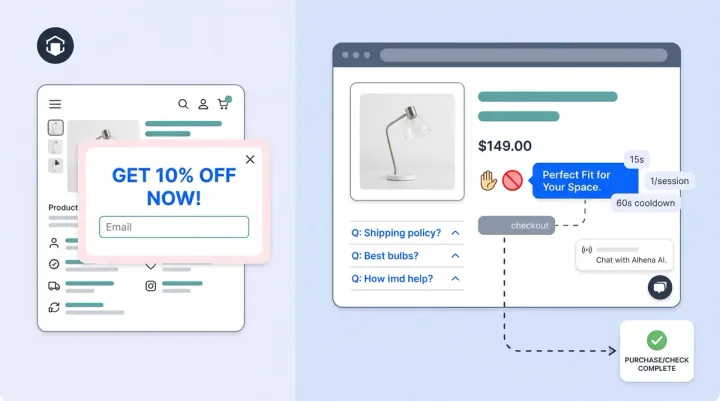
Many online customers won't open a widget. They scan the product page, look for fit information, and leave if they don't find it fast enough. Smart PDP FAQs intercept these visitors with tappable questions embedded directly on the product detail page: "How does this fit?", "Should I size up?", "Is this true to size?" Each answer is generated from the same AI and the same product fit data that powers the chat widget, giving buyers an instant fit guide without any interaction required.
Both surfaces are powered by the same AI technology and the same product data. Together, they intercept sizing questions at the moment of hesitation rather than after the customer has already emailed support or abandoned the page. The widget catches active question-askers. The PDP FAQs catch passive browsers who would have left silently. Between the two, your sizing ticket volume drops because the question gets answered before it ever becomes a ticket.
The Three-Part Impact
Brands that deploy AI-powered fit guidance across both surfaces see measurable results in three areas.
Reduced support ticket volume. Sizing questions get resolved on the PDP or in the chat widget before they become tickets. Tatcha achieved an 82% chat deflection rate with Alhena AI, and Crocus reached 86% deflection with 84% CSAT (customer satisfaction). When the AI agent handles the sizing question at the point of shopping, your business frees the AI agent to handle edge cases while human agents focus on complex issues that actually need a human.
Lower return rates. Buyers who receive confident, product-specific fit guidance before purchasing don't need to bracket (ordering multiple sizes and returning the rest). They buy the perfect size the first time. Brands using AI-powered fit tools report reduce returns by 25 to 45% on size-sensitive categories.
Higher conversion rates. The buyer who gets a clear "You're a medium in this jacket, and here's why" buys instead of abandoning. Tatcha saw a 3x conversion rate lift, and Victoria Beckham saw a 20% increase in average order value after deploying Alhena AI. This confidence boost removes the hesitation that kills conversions in fashion apparel, footwear, and outdoor categories.
How Alhena AI's Fit Analyzer Works
Alhena AI's Fit Analyzer is the AI agent purpose-built for this problem. Here are the features that make it different from generic chatbot deflection.
Per-product fit training. The Fit Analyzer ingests your Shopify catalog and automatically processes size charts, garment measurements, fabric details, and fit descriptions for every SKU. It understands that your "Alpine Insulated Parka" needs layering room while your "Trail Runner Tee" should fit close to the body.
Conversational sizing on both surfaces. Whether the customer asks via the widget or taps a PDP FAQ, the AI assistant delivers the same personalized recommendation with the same tailored, product-specific reasoning. No conflicting information between channels. No generic "check the size chart" deflection.
Weekly auto-training. As you add new products, update sizing, or change fit descriptions, the Fit Analyzer re-trains automatically on a weekly cycle. No manual input needed, no dev resources, no configuration hassle, and no stale data. Your AI always reflects your current catalog.
Built-in revenue attribution. Alhena's analytics dashboard tracks which sizing conversations led to purchases, so you can get deep insight into the direct revenue impact of every fit recommendation. Alhena's analytics show you the ticket volume reduction, the conversion lift, and the revenue attributed to AI-assisted sizing in one place.
Setup takes under 48 hours. The Fit Analyzer connects to commerce platforms like Shopify, ingests your product data, and starts answering sizing questions as a fully trained AI assistant from day one for a seamless rollout. No developer resources required.
Sizing Tickets Are Not a Support Problem
Here's the reframe that changes how you think about this: sizing tickets are not a support problem. They're a product discovery problem that has been misrouted to your support team. The shopper doesn't want to contact support. They want to know if this jacket will fit. When that question goes unanswered on the product page, it becomes a support ticket. When it's answered badly (by a static chart the shopper doesn't trust), it becomes a return.
Once AI answers sizing questions at the point of shopping instead of the point of frustration, three things happen simultaneously for your business: ticket volume drops because the question never reaches your queue, returns decrease because shoppers buy the right size with confidence, and conversion gets a boost because hesitant buyers get the push they need to complete the purchase.
The math is straightforward, and the impact scales. If sizing questions represent 40 to 60% of your ticket volume, and AI resolves 80%+ of those before they become tickets, you've improved ticket management and freed up a significant portion of your business's support capacity without hiring, without cutting service quality, and without a complex strategy, and while generating more revenue and engagement per session.
Key Takeaways
- Sizing questions make up 40 to 60% of inbound support volume for apparel, footwear, and outdoor brands, costing $2.70 to $5.60 per ticket.
- Static size charts fail because customers don't measure themselves, sizing varies across products within the same brand, and charts don't answer the personalized question customers are actually asking.
- AI-powered fit guidance through a chat widget and smart PDP FAQs intercepts sizing questions at the moment of hesitation, before they become support tickets.
- Brands deploying AI fit advisors see 80%+ ticket deflection, 25 to 45% lower return rates, and up to 3x conversion lifts on size-sensitive categories.
- Alhena AI's Fit Analyzer trains on per-product fit data from your Shopify catalog, delivers personalized recommendations on both surfaces, and auto-retrains weekly as your catalog changes.
Ready to eliminate sizing tickets and turn that agent time into revenue? Book a demo with Alhena AI or start free with 25 conversations to see the impact in your first week.

Frequently Asked Questions
How does Alhena AI know the right size for each product?
Alhena AI ingests per-product fit data from your Shopify catalog, including garment measurements, fabric composition, cut details, and size charts. It combines this with the shopper's stated preferences (usual size, body type, fit preference) to generate a recommendation specific to that SKU, not a generic chart lookup.
Can Alhena AI handle brands where sizing varies across categories?
Yes. Alhena AI trains at the product level, not the brand level. It understands that your slim-fit denim, relaxed hoodie, and structured blazer each have different fit profiles. Recommendations adjust per product, so shoppers get accurate guidance even when your own sizing is inconsistent across categories.
What impact does Alhena AI have on support ticket volume?
Brands using Alhena AI see 80% or higher deflection rates on sizing and fit questions. Tatcha achieved 82% deflection, and Crocus reached 86%. When the AI resolves sizing questions on the product page or in the chat widget, those questions never reach your support queue.
Does AI-powered fit guidance actually reduce size-related returns?
Yes. Shoppers who receive a personalized, product-specific size recommendation buy the right size the first time instead of bracketing. Brands deploying AI fit advisors report 25 to 45% reductions in return rates on size-sensitive categories, directly lowering reverse logistics costs.
How long does it take to set up Alhena AI's Fit Analyzer?
Setup takes under 48 hours with no developer resources. Alhena AI connects to your Shopify store, ingests your product catalog and size data, and starts delivering personalized fit recommendations on day one. Weekly auto-retraining keeps the AI current as you add or update products.