What Is Real-Time Agent Assist?
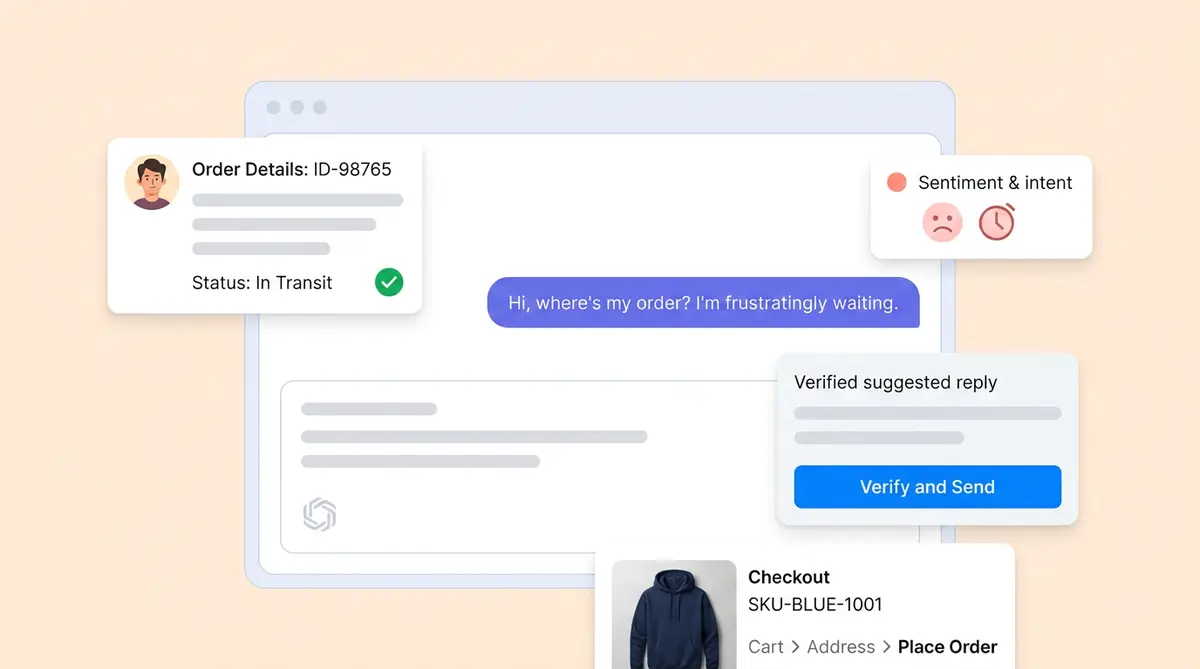
Real-time agent assist is an AI-powered technology that works alongside support agents during live customer interactions. It listens to or reads the conversation as it happens, then surfaces relevant knowledge base articles, drafts suggested replies, flags compliance risks, and recommends next steps.
Think of it as a copilot for your support team. Instead of agents tabbing between a dozen tools to find an answer, the AI pulls the right information into view instantly, the moment it's needed. The agent stays in the conversation, reviews the suggestion, and sends it, often cutting reply times by more than half. Some systems also surface prompts, scripts, and compliance checklists so agents never miss a required disclosure or upsell moment.
Most real-time agent assist tools work across digital channels like chat, email, and voice. They connect to your knowledge base, CRM, and order management systems so the AI can pull context from every source at once. For e-commerce brands, that means an agent fielding a "where's my order?" question gets tracking data, order history, and a draft reply in one panel instead of searching three systems.
According to AssemblyAI's research, companies using real-time agent assist see 20-25% reductions in average handle time and 30%+ improvements in first call resolution rates.
How Real-Time Agent Assist Works Under the Hood
A real-time agent assist system runs through four steps every time a customer sends a message or speaks on a call.
Step 1: Message Intake and Context Building
The AI ingests the customer's message (text, email, or transcribed speech) and builds context. It pulls the customer's order history, past tickets, browsing behavior, and loyalty status from connected systems. For a Shopify brand using Alhena's Agent Assist, this means the AI already knows what the customer ordered, when it shipped, and whether they've contacted support before.
Step 2: Intent Detection and Sentiment Analysis
The system classifies the customer's intent (return request, product question, shipping complaint) and reads the emotional tone. A frustrated repeat caller gets flagged differently than a first-time shopper asking about sizing. The AI can recommend escalations to senior agents when sentiment drops below a threshold. This sentiment layer helps agents calibrate their response before they type a single word.
Step 3: Knowledge Retrieval
Here's where the AI earns its keep. It searches your knowledge base, product catalog, policy documents, and past ticket resolutions to find the most relevant answer. Alhena AI uses agentic RAG (retrieval-augmented generation) to ground every suggestion in your verified data, not in the model's general training data. That's what prevents hallucinations, a critical difference when agents are dealing with return policies, warranty terms, or product specs.
Step 4: Response Drafting and Agent Review
The AI generates a draft reply matched to your brand voice and the agent's writing style. The agent reviews it, makes edits if needed, and sends. This creates a built-in agent coaching loop. Over time, the system learns from those edits and gets better at matching each agent's tone.
Why Real-Time Agent Assist Matters for E-Commerce
Contact centre and BPO teams have used agent assist tools for years. Contact centres handle millions of interactions daily, and the pressure to resolve each one faster keeps growing. But e-commerce support has different challenges and demands that generic call centre AI doesn't handle well.
E-commerce agents deal with product questions that require catalog knowledge, not just scripted answers. A customer asking, "Will this moisturizer work for sensitive skin?" needs a response grounded in actual product ingredients and reviews, not a generic "please check our website." That's the difference between an AI shopping assistant built for commerce and a contact centre tool repurposed for it.
Order management adds another layer. Agents need real-time access to shipping status, return eligibility, exchange workflows, and loyalty points. When the AI can pull all of this and draft a response in one step, average handle time drops fast. Manawa, a travel and experience marketplace, cut response times from 40 minutes to under 1 minute after deploying Alhena AI, while automating 80% of inquiries.
Then there's the revenue angle. Most agent assist tools focus only on resolving tickets faster. They don't help agents sell. E-commerce brands need AI that can recommend complementary products, apply discount codes, and even populate a customer's cart during a support conversation. That turns a cost center into a revenue channel, taking your support to the next level.
Real-Time Agent Assist vs. Traditional Knowledge Bases
Support teams have relied on knowledge bases for decades. But a static knowledge base and a real-time agent assist system solve fundamentally different problems.
A knowledge base is a library. Agents search it, read articles, and piece together an answer. On a busy day with 50 open tickets, that search-and-read process takes 2-4 minutes per ticket. Multiply that across a team, and you're losing hours daily.
Real-time agent assist is a research assistant that reads the library for you. It analyzes the customer's question, searches across your knowledge base, product catalog, and order data simultaneously, and delivers a ready-to-send answer. The agent spends 15 seconds reviewing instead of 3 minutes searching.
Here's how they compare side by side:
- Speed: Knowledge bases require manual search (2-4 min). Agent assist delivers answers in seconds.
- Context awareness: Knowledge bases show static articles. Agent assist pulls customer-specific data (order status, past interactions) into the response.
- Learning: Knowledge bases stay the same until someone manually updates them. Agent assist systems like Alhena learn from agent edits and improve over time.
- Multi-source retrieval: Knowledge bases search multiple repositories. Agent assist searches the knowledge base + CRM + order system + product catalog at the same time.
- Consistency: Knowledge base answers depend on which article the agent finds. Agent Assist surfaces the same best answer every time.
The shift from passive knowledge bases to active real-time agent assist is similar to going from a filing cabinet to a personal research analyst. Both store information, but only one delivers it proactively when you need it.
Key Features to Look For in Agent Assist Software
Not all agent assist providers and tools are built the same. If you're evaluating options for an e-commerce or customer service team, here are the features that separate good from great.
Hallucination-Free Responses
This is non-negotiable. If your AI suggests a return policy that doesn't exist or a product feature that's wrong, agents lose trust in the tool fast. Look for systems that ground every answer in your verified data. Alhena AI uses retrieval-augmented generation to ensure every draft reply comes from your actual knowledge base, product catalog, or policy documents, never from the model's imagination.
Integration Depth
Agent assist only works if it can access the data agents need. That means native connections to your e-commerce platform (Shopify, WooCommerce, Salesforce Commerce Cloud), your helpdesk (Zendesk, Freshdesk, Gorgias, Intercom), and your shipping/order management tools (Narvar, ShipStation).
Sentiment Detection
The AI should flag frustrated or escalation-risk conversations so agents can adjust their tone. Alhena's Agent Assist detects emotional nuances in customer messages and adjusts its suggested responses accordingly.
Response Style Matching
Generic template responses feel robotic. The best agent assist tools learn each agent's writing style and generate drafts that sound like that specific agent wrote them. This keeps conversations natural while still saving time.
Analytics and Performance Tracking
You need to measure the impact. Look for tools that show how agent assist affects handle time, resolution rate, CSAT, and (for e-commerce) revenue attributed to assisted conversations. Alhena's built-in revenue attribution analytics connect the dots between AI-assisted conversations and actual sales.
Multilingual Support
If you sell globally, your agents need AI that works in every language your customers speak. Alhena supports 90+ languages, so a single agent can handle tickets in English, Spanish, French, or Japanese without switching tools.
How Alhena AI Powers Real-Time Agent Assist for E-Commerce
Alhena AI's Agent Assist was purpose-built for e-commerce and retail support teams, not retrofitted from a call centre tool. Here's what that means in practice.
Two Specialized AI Agents Working Together
Alhena runs two purpose-built agents: a Product Expert Agent that knows your entire catalog (ingredients, sizing, compatibility, reviews) and an Order Management Agent that handles tracking, returns, exchanges, and refunds. When a customer asks a product question mid-return, both agents contribute to the response without the human agent switching contexts.
Agentic Checkout in Support Conversations
Most agent-assist tools stop at answering the question. Alhena goes further. The technology enables something unique: if a customer asks, "Do you have this in blue?" and the agent confirms, Alhena can populate the customer's cart with the right SKU and pre-fill checkout. This turns support interactions into sales opportunities. Brands like Tatcha saw a 3x conversion rate and 38% average order value uplift with Alhena, with 11.4% of total site revenue attributed to AI-assisted interactions.
Omnichannel Coverage
Alhena's agent assist works across web chat, email, Instagram DMs, WhatsApp, and voice. Agents get the same AI suggestions regardless of which channel the customer reaches out on. The AI maintains context across channels too, so if a customer starts on Instagram and follows up via email, the agent sees the full history.
48-Hour Deployment, No Dev Resources
Unlike leading enterprise agent assist platforms that take months to implement, Alhena deploys in under 48 hours. Alhena connects to your existing e-commerce platform and helpdesk, ingests your knowledge base, and starts generating suggestions immediately. No engineering sprints required.
Proven Results Across Industries
The numbers speak for themselves across different e-commerce verticals:
- Puffy (home furnishing): 63% automated inquiry resolution, 90% CSAT
- Victoria Beckham (Fashion Apparel): 20% AOV increase
- Crocus (gardening): 86% deflection rate, 84% CSAT
- Manawa (travel): 43% lower workload, 80% inquiry automation
These results show the business impact. They come from Alhena's combination of AI-first automation and agent assist working together. The AI handles straightforward questions autonomously and pulls agents in only when human judgment is needed, giving human agents AI-drafted responses when it does.
How to Get Started with Real-Time Agent Assist
Rolling out agent assist doesn't have to be a six-month IT project. Here's a practical path that works for most e-commerce teams.
Step 1: Audit Your Current Support Workflow
Before adding AI, map your existing process. Which ticket types take the longest? Where do agents spend the most time searching for answers? What percentage of tickets are repetitive? This audit tells you exactly where agent assist will have the biggest impact.
Step 2: Connect Your Data Sources
Agent Assist is only as good as the data it can access. Connect your e-commerce platform, helpdesk, knowledge base, and order management system. With Alhena, this means linking your Shopify (or WooCommerce, Magento, or Salesforce Commerce Cloud) store and your helpdesk (Zendesk, Freshdesk, Gorgias, or Intercom). It ingests your product catalog, FAQs, and support policies automatically.
Step 3: Start with Agent Assist Before Full Automation
If your team is cautious about AI talking directly to customers, start in agent assist mode. The AI drafts replies, but agents review every response before it goes out. This builds trust, lets you measure accuracy, and gives the AI time to learn your brand voice. Once confidence is high, you can gradually let the AI handle more conversations autonomously through a hybrid AI-human support model.
Step 4: Measure and Expand
Track outcomes like average handle time, first-response time, CSAT, and resolution rate before and after rollout. For e-commerce, also track revenue influenced by AI-assisted conversations using Alhena's ROI calculator. Once you see results in one channel (say, chat), expand to email, social, and voice.
Key Takeaways
- Real-time agent assist gives support agents AI-drafted responses, instant knowledge retrieval, and customer context in seconds, not minutes.
- E-commerce teams need agent assist built for commerce: product catalog integration, order management, and the ability to turn support into sales.
- The best agent assist software uses hallucination-free AI grounded in your verified data, not general-purpose models.
- Alhena AI delivers 56% faster response times and 70% fewer unanswered questions with a 48-hour deployment.
- Start with agent assist mode to build trust, then expand to full AI automation as confidence grows.
Ready to see how real-time agent assist can transform your support team? Book a demo with Alhena AI to see it in action, or start for free with 25 conversations.
Frequently Asked Questions
What is real-time agent assist?
Real-time agent assist is AI software that works alongside support agents during live customer interactions. It analyzes incoming messages, provides instant context, searches your knowledge base and connected systems, and drafts suggested replies for the agent to review and send. Companies using it typically see 20-25% reductions in average handle time.
How does real-time agent assist differ from a chatbot?
A chatbot talks directly to customers without agent involvement. Real-time agent assist works behind the scenes, helping the human agent respond faster and more accurately. The agent stays in control of every conversation while the AI handles research and drafting. Many teams start with agent assist to build confidence, then expand to customer-facing AI automation.
Does Alhena's agent assist work with Zendesk and Freshdesk?
Yes. Alhena integrates natively with Zendesk, Freshdesk, Gorgias, Intercom, Kustomer, and other major helpdesks. The AI pulls ticket context, customer history, and knowledge base content directly from your helpdesk, so agents don't need to switch tools.
Can real-time agent assist help with e-commerce sales, not just support?
Most agent assist tools focus only on resolving tickets. Alhena AI goes further with agentic checkout capabilities, letting agents recommend products, populate carts, and pre-fill checkout during support conversations. Brands like Tatcha saw 3x conversion rates and 38% higher average order values with this approach.
How long does it take to deploy real-time agent assist?
Enterprise agent assist platforms can take months to implement. Alhena AI deploys in under 48 hours with no dev resources required. The system connects to your e-commerce platform and helpdesk, ingests your knowledge base, and starts generating agent suggestions immediately.
Does Alhena's agent assist support multiple languages?
Yes. Alhena AI supports 90+ languages, so a single agent can handle tickets in English, Spanish, French, Japanese, and dozens of other languages without switching tools or needing separate AI models for each language.
How does agent assist prevent AI hallucinations?
Alhena uses retrieval-augmented generation (RAG) to ground every suggested reply in your verified product data, knowledge base articles, and policy documents. The AI never generates answers from its general training data, which prevents the hallucination problems that plague general-purpose AI tools.
What ROI can I expect from real-time agent assist?
Results vary by team size and ticket volume, but Alhena customers typically see 56% faster response times, 70% fewer unanswered questions, and significant CSAT improvements. Puffy achieved 63% automated inquiry resolution with 90% CSAT. You can estimate your ROI with Alhena's free ROI calculator at alhena.ai/roi-calculator.