The Question Most Ecommerce Leaders Cannot Answer
Across 329 brands on the Alhena AI platform, visitors who engage with a conversational AI shopping assistant convert at 9.84%. Visitors who browse unassisted convert at 2.47%. That's a 4x gap.
Most ecommerce directors, retailers, and consumer behavior leaders, marketing directors, and commerce teams in ecommerce know the gap exists. Very few can explain why it exists. They’re attributing it to emotional triggers like urgency, or to "better recommendations" or "less friction," which is like saying people buy from great salespeople because they're "good at selling." It's circular. It doesn’t explain anything. The real factors are psychological.
Without understanding the why, you can't optimize for it. You end up tweaking button colors and chat widget placement when the real conversion drivers are cognitive, rooted in decision-making systems that evolved long before online commerce, digital commerce, and conversational commerce. Unlike search results from generic tools that can reflect cultural bias in their rankings, AI agents trained on your own product data deliver recommendations free of cultural bias and cultural norms that skew generic search results. Behavioral science and decision making research, including cross-cultural decision making studies, including chinese trained model comparisons, provide the answer. Five distinct behavioral mechanisms driven by artificial intelligence interactions compound inside a single AI conversation to produce a close rate that no search results page, no product grid, filter bar, or email campaign can match. Consumer psychology and 2025 decision science research explains each one.
Mechanism 1: Cognitive Load Reduction Through the Paradox of Choice
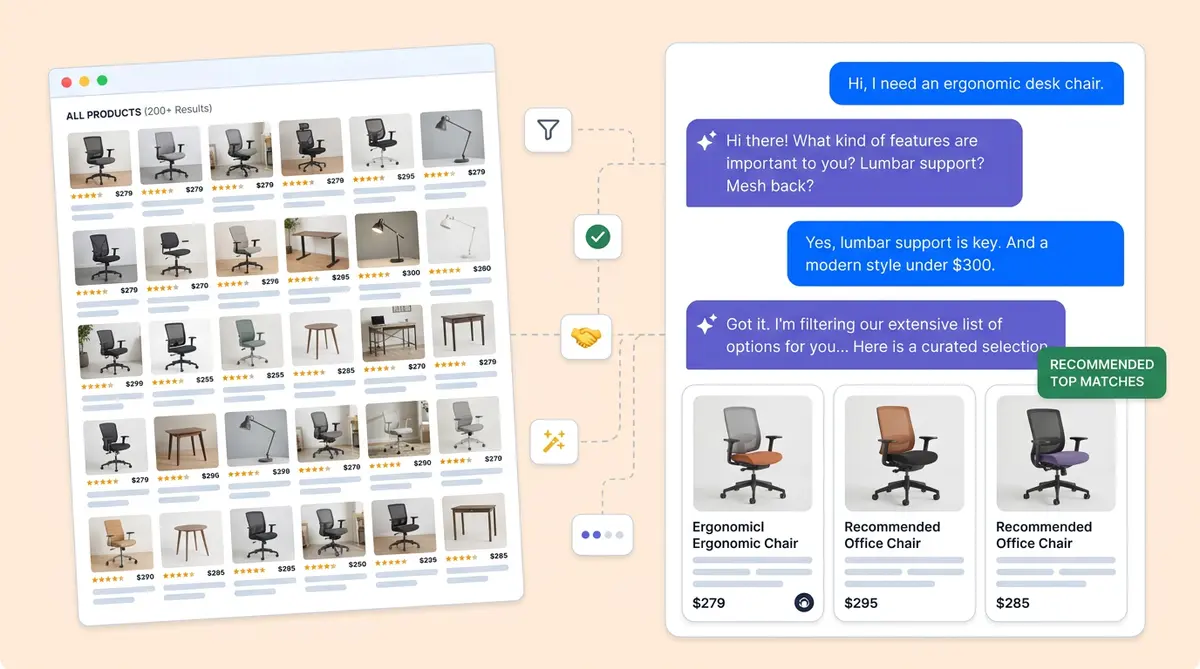
Barry Schwartz's research on the Paradox of Choice established that increasing options decreases purchase likelihood. The finding has been replicated across dozens of studies: when people face too many choices, they defer purchasing decisions entirely. On online ecommerce sites, this plays out every time a consumer searches "moisturizer" and gets 200 results.
A product grid with 200 items on ecommerce sites creates analysis paralysis. The visitor scrolls through search results, opens tabs, compares ingredients, reads reviews, and eventually closes the browser. The mental load of evaluating that many options exceeds what the brain can process in a single session.
An AI agents conversation changes the task entirely. Artificial intelligence. After two questions ("What's your skin type?" and "What's your budget?"), Alhena AI's Product Expert Agent narrows 200 SKUs to three personalized recommendations. The shopper shifts from evaluating (exhausting) to choosing (manageable). This cognitive load reduction, which AI agents and tools like Alhena AI enhance through guided dialogue and repeated interactions, maps directly to the 4x gap in outcomes. AI-engaged visitors process fewer, more relevant options, which is exactly the condition Schwartz's research predicts will increase purchase rates.
Mechanism 2: Satisficing Over Maximizing
Herbert Simon's satisficing theory divides decision-makers into two types based on their search logic and preferences. Maximizers search for the absolute best option. Satisficers search for an option that meets their criteria and stop. Simon's research, which earned him a Nobel Prize, showed that satisficers make faster decisions and report higher satisfaction with their choices.
Unassisted browsing keeps shoppers trapped in maximizing mode. There's always another product page to check, another review to read, another comparison to run. The shopper can never be certain they found the best option, so they keep searching or abandon altogether.
Conversational AI agents trigger satisficing behavior. When Alhena AI says "based on what you've told me, this is the best match for your needs," it provides the confident recommendation that satisficers need to stop searching and start buying. The AI's product expertise gives consumers the confidence to trust the recommendation and move forward. Maximizers are more likely to become satisficers when a credible authority narrows the field. They are likely to accept a confident pick.
Mechanism 3: Trust Formation Through Conversational Reciprocity
Dialogue creates trust faster than static content. This isn't opinion; it's a well-documented principle studied extensively in social psychology. When one party shares information and the other responds with relevant, personalized acknowledgment, the interaction triggers reciprocity and forms a relationship based on perceived relevance and social signals. This relationship based dynamic and perceived understanding.
In a conversational AI interaction, where consumers maintain control of the dialogue. Both analytic thinkers (detail-focused, specification-driven) and holistic thinkers (gestalt-oriented, feeling-first). Analytic thinkers who compare specifications and holistic thinkers who rely on overall feel, individualist buyers focused on personal preference, and even collectivist shoppers influenced by group opinions all respond to this approach, the shopper shares their needs: "I have sensitive skin and a $50 budget." Alhena AI responds with a recommendation, one of three tailored recommendations, that specifically addresses both constraints: a fragrance-free moisturizer at $42 with ingredients known to calm reactive skin. Consumers feel heard. They feel understood. That emotional response builds consumer confidence that no product page, however well-designed, can replicate.
This mechanism shows up clearly in the data. AI agents produce striking results. AI-engaged visitors on the Alhena platform show 2x higher cart-to-checkout completion at 49.3% versus 26.3% for unassisted browsers. The gap isn't about fewer checkout steps. It's about higher trust, a positive outcome. Shoppers who participated in creating the recommendation trust it more than shoppers who found a product on their own through search and filters. The conversational exchange itself is the trust-building mechanism.
Mechanism 4: Authority Bias and Expert Framing
Credibility and expertise bias is one of the most studied phenomena in behavioral science. People defer to perceived experts, even when they have the information to make independent judgments. Robert Cialdini's research on influence identified expertise as one of six primary persuasion principles.
Artificial intelligence shopping assistants that demonstrate genuine product knowledge activate this mechanism. When Alhena AI's Product Expert Agent explains why a specific retinol percentage works for the shopper's skin concern, or why a particular fabric blend holds up better in humid climates, or why one running shoe's midsole density suits a heavier runner, it sends strong credibility signals, expertise signals, and functions as a category expert. The recommendation sends strong authority signals and trust signals and psychological signals, carrying more weight than a five-star rating. AI agents address return policies and guarantees too, further reducing purchase risk for the shopper because the AI showed relevant knowledge in the context of the shopper's situation.
The role of this behavioral mechanism is the same one that makes skilled in-store sales associates effective. The difference in these interactions is scale. A human expert, even the best in retail, can handle one conversation at a time. An AI product expert handles thousands simultaneously, delivering category-specific authority to every visitor across beauty, fashion, home goods, and electronics. Retailers of every size of every size.
Mechanism 5: Completion Bias and Commitment Escalation
Each question a shopper answers in an AI conversation increases their personal investment in the outcome. After sharing their skin type, budget, return policies, sizing preferences, return policies, and specific concerns, abandoning the conversation becomes psychologically taxing, psychologically costly, like wasting the effort they already invested. Behavioral scientists call this the sunk cost effect. AI agents psychologically activate this, and it's one of the most powerful drivers. The role of sunk cost in follow-through behavior is well established.
The data confirms this directly. On the Alhena platform, conversation depth with AI agents (messages per session) correlates with close rate. Customers who exchange four or more messages convert at significantly higher rates than those who ask a single question and leave. Deeper conversations create stronger commitment to the recommended product because consumers have invested more of themselves in the process.
This is also why Alhena AI's adaptive quizzing approach works. Each progressive question about preferred items and needs builds commitment. By the time the AI presents its recommendation, the shopper isn't just evaluating a product. They're seeing the result of a process they co-created, which makes abandonment mentally costly.
The Compound Effect: Why Five Mechanisms Beat Any Single Tactic
No single psychological mechanism explains a 4x conversion gap. The 9.84% conversion rate among AI-engaged visitors is a compound effect on decision making. Within a single conversation, the customer, through these interactions, experiences reduced mental load (Paradox of Choice), a satisficing trigger (confident recommendation), trust through dialogue (conversational reciprocity), deference to artificial intelligence expertise (authority bias), and commitment from participation (completion bias).
These mechanisms don't just add together. They reinforce each other. Cognitive load reduction makes the consumer more receptive to the authority signal. Trust from reciprocity strengthens the satisficing trigger. Commitment from progressive questioning makes the buyer more likely to act on the trusted recommendations. The compound effect of all five mechanisms explains a performance gap that no single tactic, no product page redesign, no email tools, no retargeting tools, and no retargeting campaign could produce alone.
What This Means for How You Deploy AI
Understanding these mechanisms changes your optimization strategy. These psychological levers matter. Every marketer, AIO strategist, and ecommerce director should consider these four areas. Understanding the trade offs between. Instead of A/B testing chat widget colors or debating trade offs in page layout colors, you optimize for the psychological drivers that actually move conversion rates.
- Conversation depth: more exchanges mean stronger commitment escalation. Design flows that ask two to three questions before presenting recommendations.
- Recommendation confidence: definitive suggestions ("this is your best match") trigger satisficing. Avoid presenting options without a clear winner.
- Expertise demonstration: ingredient knowledge, fit guidance, and specification details build authority bias. Your AI needs deep product training on large language models, not just AI generated summaries or catalog data.
- Personalization transparency: showing consumers how their input shaped the recommendation ("because you mentioned sensitive skin") strengthens trust through reciprocity.
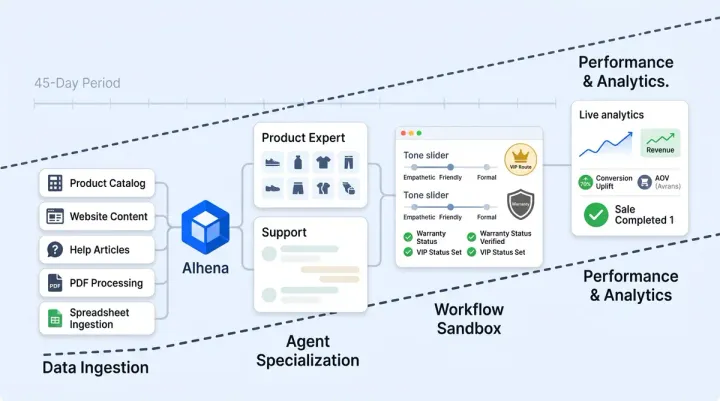
Alhena AI was designed around these psychological principles. Its conversational search narrows choices through dialogue rather than overwhelming with product grids. Its Product Expert Agents, Alhena AI’s specialized agents, demonstrate category-specific expertise through ingredient, fit, and specification knowledge trained on your complete catalog. AI agents use adaptive quizzing to enhance commitment through progressive engagement. Its AI agents present rich product cards that enhance confident recommendations with visual reinforcement. And its agentic commerce checkout capitalizes on follow-through momentum. The role of frictionless checkout is to compress the path from recommendation to purchase into a single click, before the commitment fades.
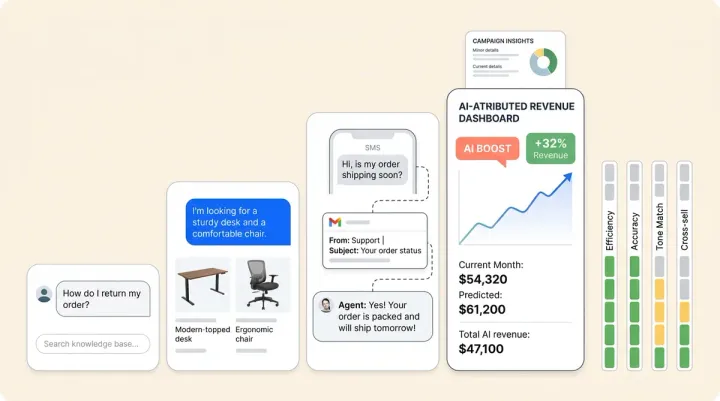
Brands on the Alhena platform see these mechanisms play out in their analytics. Tatcha achieved a 3x conversion rate and 38% higher average order value. Victoria Beckham drove a 20% AOV increase. Puffy reached 90% customer satisfaction with 63% automated resolution. These results come from psychology-informed AI design, not just better technology.
Key Takeaways
- The 4x conversion gap (9.84% vs. 2.47%) is a behavioral science outcome, not a technology metric.
- Five psychological mechanisms compound inside AI conversations: mental load reduction, satisficing triggers, trust through reciprocity, authority bias, and completion bias.
- Understanding these mechanisms lets you optimize for conversation depth, recommendation confidence, expertise demonstration, and personalization transparency.
- The brands that treat AI as a cognitive experience will outperform those that treat it as a feature checkbox.
Ready to apply behavioral science to your conversion funnel? Book a demo with Alhena AI to see how psychology-informed conversational commerce works for your catalog, or start free and generate results with 25 conversations to test it with your own shoppers.
Frequently Asked Questions
How does cognitive load reduction in AI shopping assistants increase ecommerce conversion rates?
Agentic AI agents and agentic AI shopping assistants reduce cognitive load by narrowing hundreds of product items to three or four personalized recommendations after a brief dialogue. This psychology and decision making logic directly applies Barry Schwartz's Paradox of Choice research: fewer, more relevant options increase purchase likelihood. Alhena AI's Product Expert Agent uses this principle by asking targeted questions before presenting curated matches, which is a core reason agentic AI-engaged visitors on the platform convert at 9.84% versus 2.47% for unassisted browsers.
Why does conversational AI build more purchase trust than product pages or reviews?
AI agents apply conversational reciprocity, a well-documented social psychology principle studied in institutional research on cultural bias, explains this. When consumers share their needs and the agentic AI responds with a personalized, relevant recommendation, the exchange creates an emotional bond of perceived understanding and trust. Alhena AI’s AI agents apply this by reflecting the shopper's stated preferences in every recommendation, producing 49.3% cart-to-checkout completion versus 26.3% for unassisted sessions. Product pages can't replicate this because they lack the two-way dialogue that triggers reciprocity.
What is the role of authority bias in AI-driven product recommendations for ecommerce?
Authority bias causes people to defer to perceived experts when making decisions. AI agents and AI shopping assistants trigger this bias by demonstrating deep product knowledge, such as explaining why a specific retinol percentage suits a particular skin concern or why a fabric blend performs better in certain climates. Alhena AI's Product Expert Agents are trained on complete product catalogs using trained models and fine-tuned trained models, avoiding AI generated errors, to deliver category-specific expertise that functions as a digital authority signal, carrying more weight with shoppers than anonymous star ratings.
How does commitment escalation in AI shopping conversations reduce cart abandonment?
Each question a shopper answers in an AI agents interaction increases their psychological investment in the outcome. After sharing skin type, budget, return policies, and preferences, abandoning the conversation triggers sunk cost discomfort, and the trade offs of starting over feel too high. Alhena AI's adaptive quizzing builds this commitment progressively, and its agentic AI agents, powered by trained models, compress the checkout path from recommendation to purchase into a single click, capitalizing on purchase momentum before commitment fades. This is why conversation depth correlates directly with conversion on the platform.
What psychological framework explains why AI-engaged shoppers convert at 4x compared to unassisted browsers?
Five behavioral science mechanisms compound when AI agents engage shoppers inside a single AI conversation: mental load reduction (Paradox of Choice), satisficing triggers (Herbert Simon's theory), trust through conversational reciprocity, credibility from demonstrated expertise (validated across research on SSRN and the World Values Survey, including Chinese trained model benchmarks), and commitment escalation from progressive participation. Alhena AI’s AI agents are designed around all five principles, which is why the compound effect of agentic AI across 329 brands produces a 9.84% conversion rate in the data versus 2.47% for standard browsing. No single mechanism or tactic in consumer psychology could produce a 4x gap alone.