Product Data AI Recommendations: Why Your Feed Determines AI-Driven Product Visibility
Product data AI recommendations don't start with algorithms. They start with your product feed. AI shopping platforms now decide which products get surfaced, compared, and purchased. Product recommendations are no longer driven by rules or merchandising teams alone. AI powered product recommendations now depend entirely on how well your structured data feeds the machine learning algorithms behind every recommendation algorithm. Modern recommender systems and recommendation systems rank products by confidence, not keyword density. If your feed has gaps, your products are invisible to the systems recommending products to consumers.
Most retail brands still treat product feeds like product catalog exports, pushing raw product information: title, price, image, done. But AI engines parse structured fields with a specificity that punishes incomplete data. Stores with near-complete attribute coverage see 3-4x higher visibility in AI recommendations compared to sparse feeds. The gap between showing up and being skipped comes down to six fields.
Why Product Data Quality Controls AI Visibility
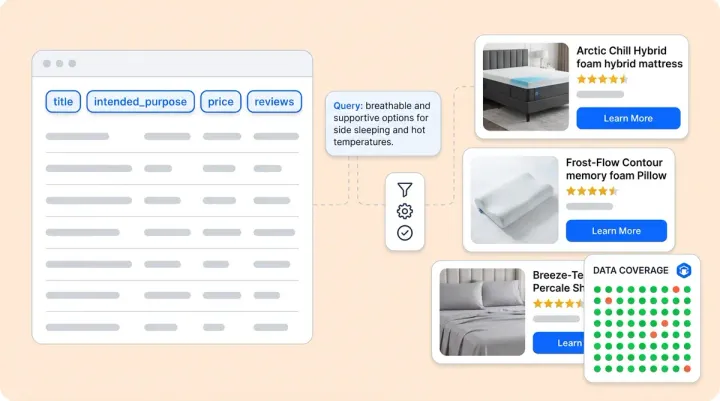
AI shopping assistants don't browse your catalog the way a human does. They analyze purchase history, browsing history, and customer behavior signals, then convert product attributes into vector embeddings and match them against conversational queries using semantic similarity. A product missing key structured fields gets a low confidence score and drops out of relevant AI product recommendations entirely.
A description like "lightweight daily sunscreen for outdoor runners" outperforms "SPF 50 sunscreen" in conversational AI because it provides intent-level context. The shift from keyword search to natural language processing, deep learning, and meaning-based matching makes product attributes AI visibility a direct function of how well your feed communicates what a product is, what it does, and who it's for. When customer preferences and user preferences are matched against rich product data, the shopping experience and user experience improve, and conversion follows.
The Six Fields That Drive AI Product Recommendations
1. GTIN: The Universal Product Identifier
GTIN AI recommendations rely on this field to connect your product to global databases, aggregate reviews, and verify authenticity. Without a valid GTIN, AI platforms can't cross-reference your product, which tanks its confidence score and pushes it out of product recommendations entirely.
2. Intended Purpose / Role
Industry analysis consistently shows that the "Intended Purpose" or "Role" field is one of the strongest predictors of whether an AI engine surfaces a product. AI recommendation systems combine user data, customer data, and historical data with this field to map your product to conversational queries like "best moisturizer for sensitive skin" or "durable backpack for daily commuting." Without it, your product can't answer the question consumers are actually asking, and your business needs to answer it.
3. Material and Composition
For apparel, beauty, and home goods, material data powers precise filtering. When a buyer asks for "organic cotton bedding" or "sulfate-free shampoo," AI product recommendations systems filter on composition attributes first. Missing this field means your product doesn't exist for that entire category of consumer queries. Online consumers increasingly rely on AI to filter by material and composition.
4. Use-Case Descriptions
Free-text use-case fields are where conversational AI pulls its strongest matching signals. "Lightweight daily sunscreen for outdoor runners" outperforms "SPF 50 sunscreen" because it gives the AI semantic context about the buyer, the scenario, and the benefit. This is where product feed AI shopping visibility is won or lost in modern e-commerce.
5. Product Category Taxonomy
Standardized taxonomy helps AI platforms contextualize your product within a shopping journey. A product classified under "Athletic Shoes > Trail Running" gets matched to trail-specific queries. One classified generically under "Shoes" doesn't. Precise taxonomy also helps AI interpret natural language search queries and autocomplete suggestions more accurately.
6. Availability and Fulfillment Data
AI engines deprioritize out-of-stock items and slow-shipping products in real time. Products with frequent stockouts get permanently pushed down. Fulfillment speed now factors into product recommendations ranking, especially when users search for "need it by Friday" or "same-day delivery."
How Alhena AI Turns Structured Data Into Revenue
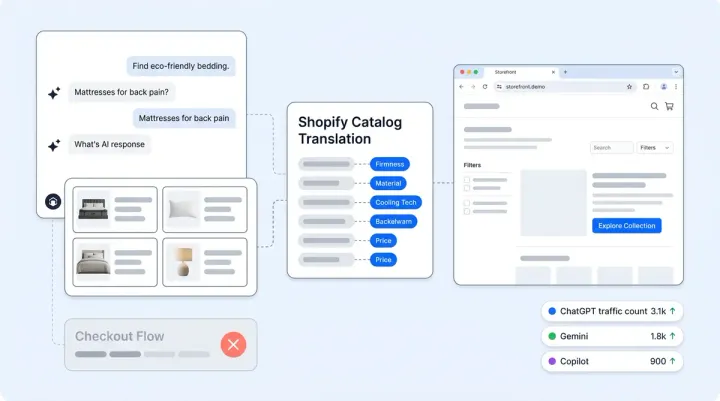
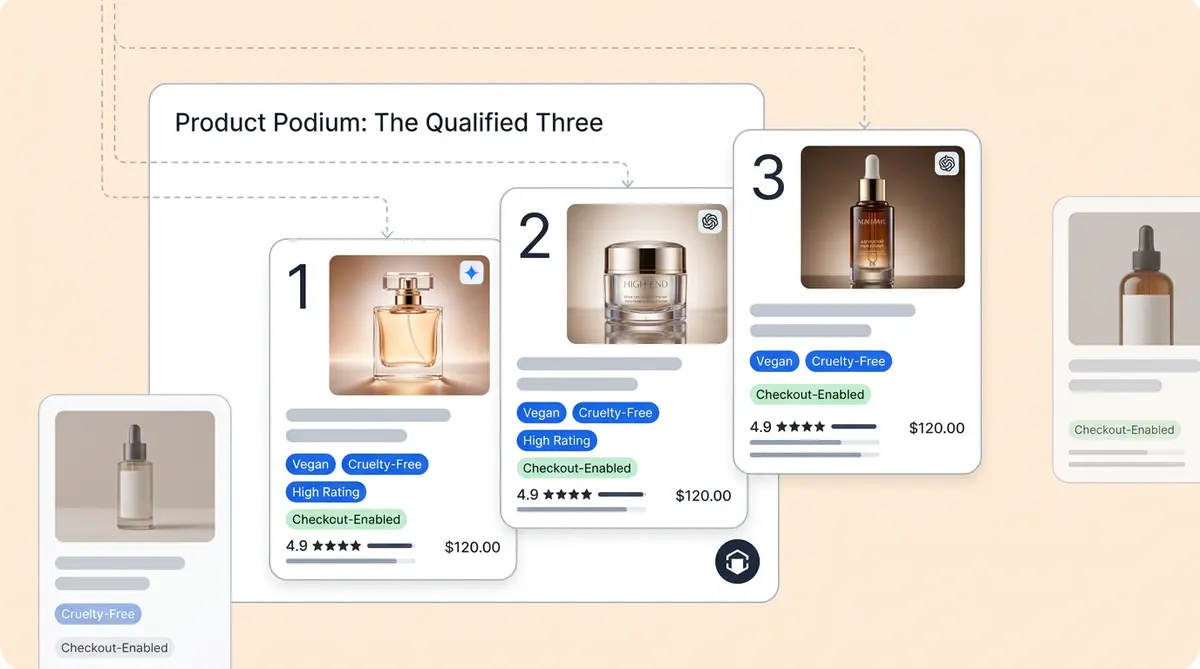
Alhena AI's shopping assistant processes exactly these AI shopping assistant data fields to deliver hallucination-free, personalized product recommendations in real time. Because Alhena grounds every recommendation in verified product data, users get accurate answers instead of generic product suggestions.
Alhena AI integrates directly with Shopify, WooCommerce, and Magento, pulling structured product feeds into its AI recommendation system. Deployment takes under 48 hours with zero dev resources, making it accessible to businesses of all sizes. The result: guided selling that converts browsers into buyers, adds items to cart through cross sell and upselling, increasing average order value, support automation that handles order questions, and personalization that adapts to every customer's intent, improving customer experience through richer interactions and driving deeper customer engagement.
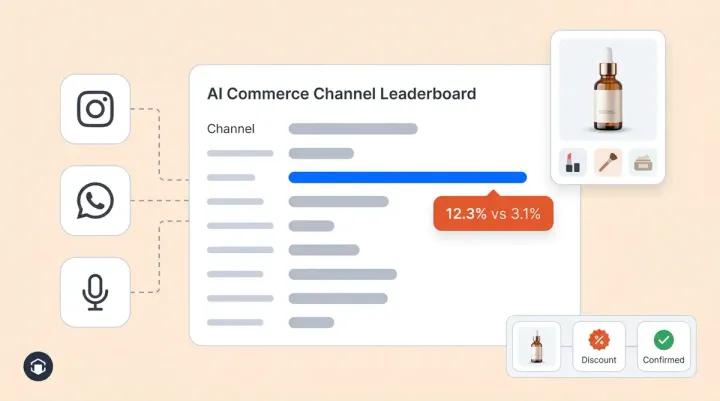
Brands using Alhena AI have seen measurable results. Tatcha achieved a 3x conversion rate and 38% AOV uplift, with 11.4% of total site revenue from AI-assisted conversations. Purchase behavior and click-through rate both improved when product data completeness increased. That's the difference between clean data sitting idle and a business-ready AI solution that drives sales and turns data into actual revenue.
The Bottom Line on Product Data for AI
Every field you leave blank is a query you lose. As AI platforms become the primary AI search and product discovery layer for online shopping, online retail, and e-commerce, your product data AI recommendations data driven strategy determines whether shoppers find you or skip past you. Smart businesses and retailers audit their feeds against these six fields, close the gaps, and give AI engines the structured data they need to recommend your products.
Want to see how your product data performs in an AI shopping context? Book a demo with Alhena AI or start free with 25 conversations to see your feed in action.
How AI Powered Recommendation Systems Analyze Product Data
AI powered recommendation systems don't work the way legacy recommendation engines do. Traditional collaborative filtering and machine learning algorithms rely on purchase history and browsing history to predict what shoppers might want. These recommendation systems analyze patterns across millions of users: what they browsed, what they bought, and which product suggestions they clicked.
Modern AI powered recommendations go further. They analyze product data fields directly, using machine learning algorithms to match structured attributes against real time search queries. When users search for specific outcomes like "sunscreen that won't clog pores," the recommendation systems parse use-case descriptions, material composition, and category taxonomy to generate personalized suggestions. Without complete product data, even the best machine learning algorithms can't deliver accurate, personalized recommendations.
The difference shows in conversion. Recommendation systems built on rich product data analyze behavior, preferences, and interactions to produce suggestions that feel relevant to each shopper. Collaborative filtering alone can't do this because it lacks the product-level context that structured data fields provide. AI powered product recommendations need both user signals (browsing history, purchase history) and product signals (GTIN, material, intended purpose) to work.
What to Predict About AI Shopping in 2026
As AI search platforms grow, product data quality will increasingly predict which brands stay visible. Shoppers already expect personalized, accurate product suggestions when they interact with AI shopping assistants. Brands that analyze their product feed completeness and fix gaps now will capture a data driven advantage.
The shift is already measurable. Stores with complete product attributes see higher customer experience scores, more interactions per session, and better cross sell conversion. AI powered recommendation systems can only suggest products they understand, and understanding comes from structured data fields, not marketing copy.

Frequently Asked Questions
How do product data fields affect which items AI shopping platforms recommend?
AI shopping platforms convert structured product attributes into vector embeddings and rank them by confidence score. Products missing fields like GTIN, intended purpose, or material get low confidence scores and are skipped. Alhena AI processes these exact fields to surface hallucination-free recommendations grounded in your verified product data.
What ROI can ecommerce brands expect from optimizing product feeds for AI visibility?
Brands with near-complete product attribute coverage see 3-4x higher AI visibility and measurably higher conversion rates. Tatcha, using Alhena AI's shopping assistant with optimized product data, achieved a 3x conversion rate and 38% AOV uplift, with 11.4% of total site revenue from AI-assisted conversations. Purchase behavior and click-through rate both improved when product data completeness increased.
How long does it take to deploy an AI shopping assistant that uses structured product data?
Alhena AI deploys in under 48 hours with zero dev resources needed. It integrates directly with Shopify, WooCommerce, and Magento, automatically ingesting your structured product feed and mapping fields like GTIN, category taxonomy, and availability into its recommendation engine.
How is an AI shopping assistant different from a traditional recommendation engine or rules-based chatbot?
Traditional recommendation engines rely on keyword matching, content-based filtering, and collaborative filtering. Some use hybrid filtering that blends user behavior signals with product attributes, though all approaches face the cold start problem with new products that lack interaction data. AI shopping assistants like Alhena AI use semantic understanding to match products to conversational queries based on meaning, not keywords. They also handle guided selling, support automation, and real-time personalization across web chat, email, and social channels.
Which product data field has the biggest impact on whether AI surfaces a product for conversational queries?
The "Intended Purpose" or "Role" field is consistently one of the strongest predictors of AI product surfacing. It maps products directly to how shoppers ask questions in conversational AI contexts. Alhena AI's vertical AI agents use this field alongside use-case descriptions to deliver precise, context-aware recommendations that drive revenue, not just clicks.