Search behavior is changing. For a long time, most online discovery started with a search engine results page. A user typed in a query, reviewed a list of links, and chose where to click. Increasingly, that journey looks different. More consumers now ask questions in AI-powered interfaces and receive direct answers, recommendations, comparisons, and summaries instead of a list of websites. As your attached AEO guide notes, this shift is changing what it means to be visible online.
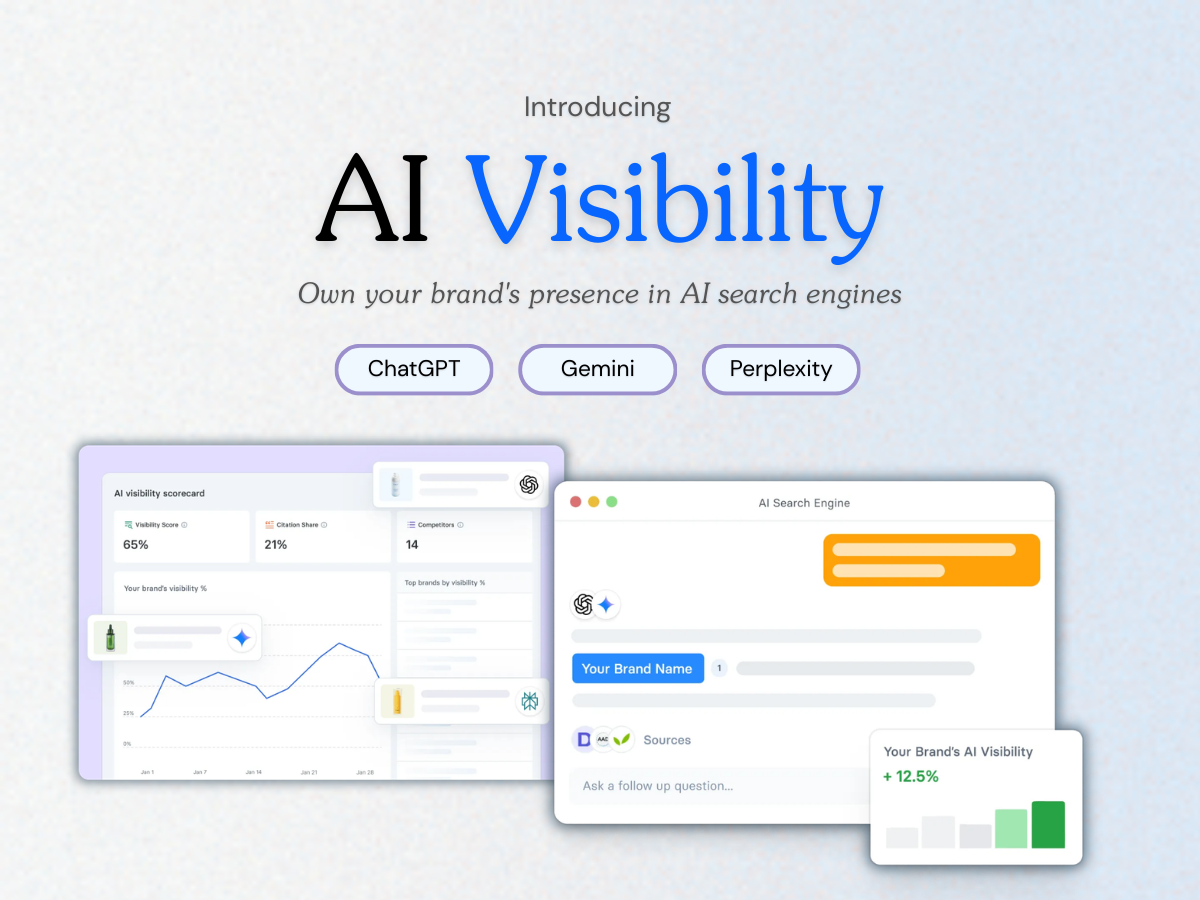
That is the context behind our newest launch at Alhena: AI Visibility.
This is a new service designed to help e-commerce brands understand a simple but increasingly important question:
How are AI systems actually surfacing your products, and what should you do about it?
Why we built this
A growing number of brands are starting to pay attention to how they appear in tools like ChatGPT, Gemini, Perplexity, and other AI-driven discovery experiences.
That interest makes sense. These systems are beginning to shape product discovery, comparison, and evaluation in ways that sit somewhere between search, editorial recommendation, and guided shopping. For brands, that creates a new visibility challenge.
It is no longer enough to ask whether your pages rank in traditional search.
You also need to understand:
- whether your products are being cited or recommended by AI systems
- whether your brand is being surfaced at the product level or only mentioned broadly
- whether critical details like pricing, reviews, materials, and fit are making it into AI answers
- whether this visibility is creating any measurable business impact
Most teams do not yet have a reliable way to answer those questions. That is the gap AI Visibility is built to address.
What AI Visibility does
AI Visibility gives brands a more structured way to monitor, improve, and measure how they appear across AI-driven shopping and answer environments.
At a high level, it helps teams do three things:
1. Map AI visibility
We help brands see how their products appear across AI engines and shopping-oriented answer experiences.
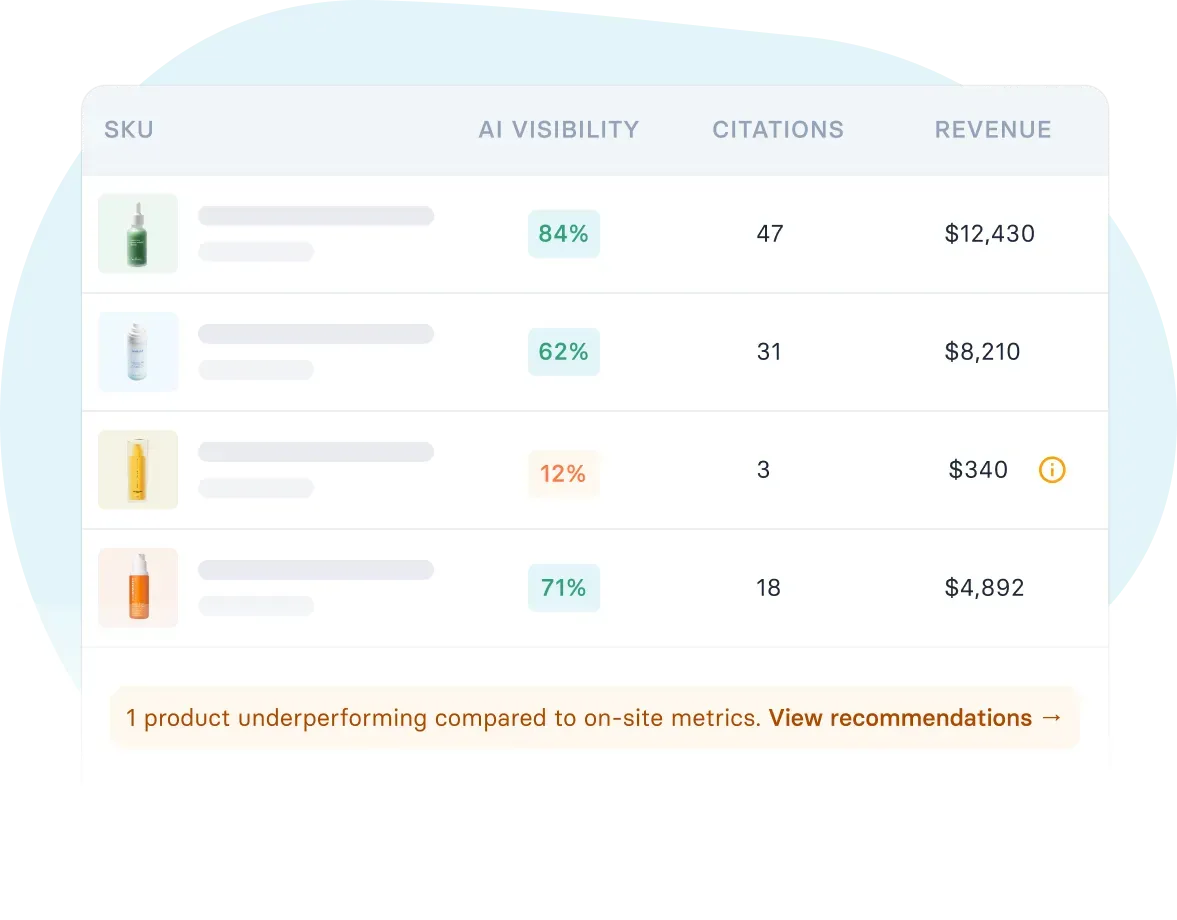
This includes understanding whether products are being surfaced at all, which SKUs are being cited, and how answers are being rendered. In practice, that means going beyond simple mention tracking. It means looking at whether a product was shown with meaningful detail, whether the right product attributes were included, and whether the appearance supports the brand’s positioning.
2. Optimize content for citation and retrieval
AI systems tend to rely on content that is structured clearly, aligned with intent, and easy to summarize. That is a core theme in modern AEO. Structured data, FAQ content, concise product descriptions, and clear product attributes all improve the odds that content can be understood and reused by AI systems.
With AI Visibility, we help brands identify where that structure is missing and what can be improved. That includes product page recommendations, FAQ opportunities, and clearer pathways to making catalog content more citation-ready.
3. Connect visibility to revenue
Visibility on its own is only part of the story.
The more meaningful question is whether better AI visibility leads to better commercial outcomes. Our goal is to help brands connect AI-driven visibility to downstream performance, so this becomes something measurable rather than theoretical.
That is especially important right now, when many conversations around AI discovery are still broad, speculative, or difficult to operationalize.
What makes this different
A lot of early AEO and GEO discussion has focused on brand-level presence. That is useful, but for e-commerce teams it is often not specific enough.
Commercial performance happens at the product level.
A brand may be generally well-known, yet still have important products that are underrepresented in AI answers. A product may convert well on-site, yet remain effectively invisible in AI-driven discovery. Another item may appear often, but in the wrong context, with incomplete information, or without the details that actually influence conversion.
AI Visibility is built with that practical lens in mind.
Instead of stopping at broad brand monitoring, we focus on the product layer and ask more operational questions:
- Which SKUs are being surfaced?
- Which products are not appearing despite strong on-site performance?
- What questions are AI systems likely trying to answer in your category?
- Where are the content gaps on product pages?
- What external citations or category signals may be influencing outcomes?
- Which visibility gains appear to translate into revenue?
This makes the work more actionable for merchandising, growth, e-commerce, and content teams.
Key components of the service
AI Visibility brings together several capabilities into one workflow.
Product-level tracking
We track AI visibility at the SKU level, not just at the overall brand level. That means brands can see which products are showing up, which are underperforming, and where there may be a disconnect between on-site strength and AI discoverability.
AEO FAQ Engine
Many AI-generated shopping answers are shaped by question-based queries. Customers ask about fit, ingredients, materials, pricing, suitability, and comparisons in natural language. Well-structured FAQ content can help brands meet that demand more effectively. Your guide highlights this clearly: FAQ sections matter because they mirror the way people ask questions in conversational systems.
Our AEO FAQ Engine helps identify missing question-answer pairs and recommends structured Q&A content aligned with real shopping intent.
GEO citation strategy
AI systems do not rely only on what is on your website. They also draw on third-party sources, reviews, editorial coverage, and broader signals of authority. As your attached guide explains, this is where GEO becomes relevant. AEO improves on-site clarity, while GEO strengthens the external authority that influences AI-generated responses.
Our GEO citation strategy helps brands understand which external sources matter in their category and where structured third-party visibility may improve citation likelihood.
Rendering analysis
Being mentioned is not always enough.
How a product appears inside an AI answer can matter just as much as whether it appears. Was it shown as a product card? Was price included? Were ratings surfaced? Was the right attribute emphasized? Was the actual product named, or just the brand?
Rendering analysis helps answer those questions so teams can assess not just presence, but presentation.
Revenue measurement
Finally, we help brands connect AI visibility work back to commercial outcomes. The aim is to move this from an interesting emerging channel into something that can be evaluated with more rigor.
FYI: We completed a study of conversion data on 329 e-commerce stores. Download the study here.
Who this is for
AI Visibility is designed for brands that want a more grounded way to respond to the rise of AI search and AI-assisted shopping.
It is particularly relevant for teams that are already asking questions like:
- Are our products showing up in AI answers at all?
- Are competitors being recommended more often than we are?
- Is our catalog structured in a way AI systems can understand?
- What should we change first on product pages?
- How do we know if this is affecting revenue?
For some teams, AI Visibility will be a strategic monitoring layer. For others, it will become part of a broader effort across SEO, content, PDP optimization, digital merchandising, and growth.
A measured view of where this is going
We do not think every aspect of AI discovery is fully settled yet.
The tooling is still evolving. The interfaces are still changing. Measurement standards are still maturing. And brands should be cautious about treating any one channel or platform as the whole future of commerce.
At the same time, it is becoming increasingly clear that AI-generated answers are starting to influence discovery in real ways. For e-commerce teams, that makes this an area worth approaching seriously, but pragmatically.
Our view is simple:
AI visibility should be treated like any other emerging performance channel. It should be monitored carefully, improved methodically, and measured against real business outcomes.
That is the spirit in which we built this service.
Final thoughts
AI Visibility is our attempt to make a new and often abstract topic more useful for operating teams.
Instead of asking brands to chase vague AI trends, we want to help them answer concrete questions about visibility, structure, citation, and performance.
If AI systems are becoming part of how customers discover and evaluate products, brands need a way to see what is happening, understand why it is happening, and know what to do next.
That is what AI Visibility is designed to support. Test you AI visibility now.