The Data That Breaks Everything Ecommerce Brands Assumed About Visibility
Eighty percent of products cited in Google AI Overviews don't hold a traditional top-10 organic ranking. Read that again. The entire premise of ecommerce SEO and Google search strategy, that you need to rank on page one to get seen, no longer holds.
Industry research across hundreds of thousands of keywords confirms it: holding a top-3 organic position gives you only an 8% chance of being cited in an AI Overview. Meanwhile, over 30% of AI Overview citations come from pages ranking beyond position 100. The correlation between domain authority and AI citations has dropped to near zero.
For ecommerce businesses that spent years chasing backlinks and fighting for page-one spots, this feels like the ground shifting under their website traffic models under their feet. For everyone else, it's the biggest product discovery opportunity in a decade.
Why Google AI Overviews Source Products Differently Than Organic Search
Traditional search engine rankings rely heavily on domain authority, backlink profiles, and keyword optimization. Google AI Overviews use a fundamentally different set of signals to decide which products appear in AI-generated answers across Google overview results.
The AI pulls from Google's Shopping Graph, which now contains over 50 billion product listings updated 2 billion times per hour. It evaluates structured data quality, review depth, product specificity, and how well your content answers the actual question a shopper asked. Domain authority? It barely registers.
This matters because Google overview results now appear on 14% of shopping queries, up 5.6x from just over 2% in late 2024. "Best [product]" queries carry an 83% AI Overview presence. And the shopping queries triggering Google overview results are getting longer and more specific. Average query length grew from 3.1 words to 4.2 words in under a year, with AI Mode queries running 23x longer than traditional searches.
Google's AI doesn't just match keywords. It breaks complex queries into sub-queries, evaluating content across multiple dimensions the shopper never explicitly typed. A question like "best running shoes for flat feet under $150 that work on trails" gets decomposed and matched against whichever product pages and website content provide the most complete, specific answer, regardless of their organic ranking.
The Opportunity for Smaller and Mid-Market Ecommerce Brands
Here's what makes this unprecedented: if 80% of cited products don't rank in the top 10, then the brands getting cited aren't the usual suspects. Smaller DTC businesses and mid-market retailers that could never compete with enterprise-level domain authority can now surface directly in AI-generated answers.
The AI Overviews product ranking system rewards depth over size. A niche skincare brand with detailed ingredient breakdowns, strong customer reviews, comprehensive product schema, and hundreds of authentic customer reviews can outperform a major retailer with thin product pages and generic descriptions. The signals that matter, structured data completeness, review quality, and semantic relevance, are all within reach of brands that control their own structured data and product catalog.
McKinsey projects $750 billion in US consumer spending will flow through AI-powered search by 2028. Half of all consumers already use AI to research products. Businesses that figure out Google AI Overviews ecommerce visibility now won't just gain an edge. They'll capture demand their competitors don't even know exists.
Four Tactics That Actually Move AI Citation Rates
1. Schema Completeness
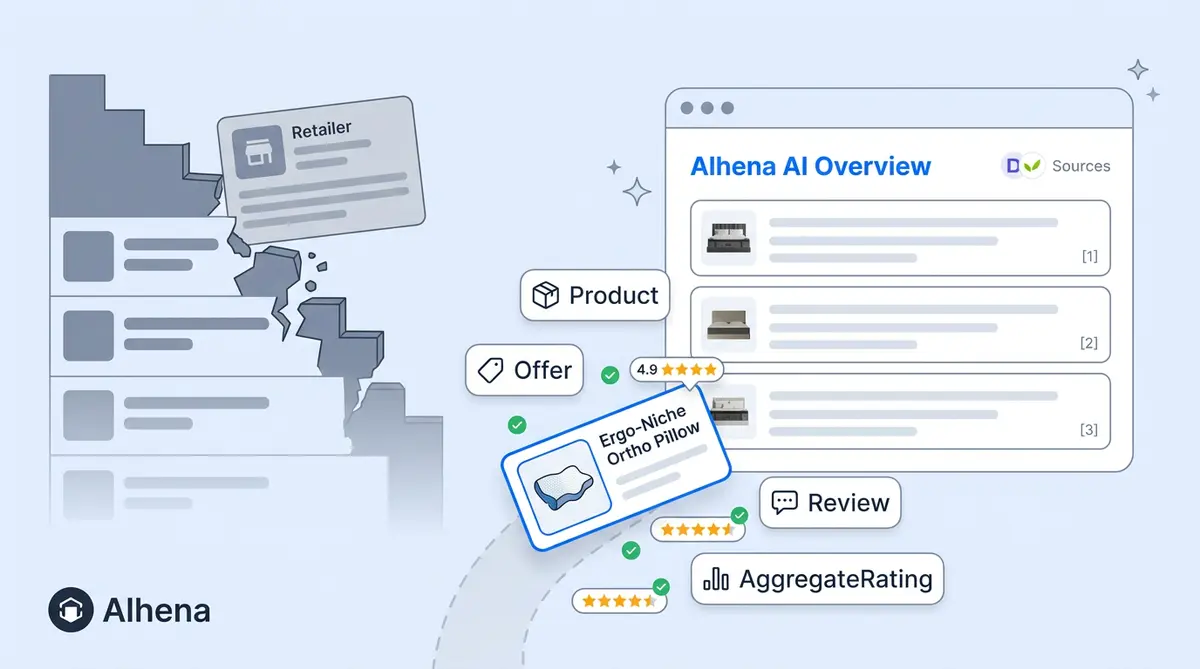
Pages with structured data get cited 3.1x more often in AI Overviews. Both Google and Microsoft confirmed in 2025 that they use schema markup for their generative AI features. For ecommerce, this means implementing Product, Offer, Review, and AggregateRating schema on every product page. Our complete guide to schema markup for AI search breaks down exactly which attributes matter most, with complete attributes: price, availability, condition, brand, SKU, images, and descriptions.
Incomplete schema gets filtered out before the AI ever evaluates your product. Alhena AI's Shopping Assistant works alongside your product data to ensure shoppers get accurate, real-time answers grounded in your actual catalog, not hallucinated recommendations.
2. Product Data Enrichment
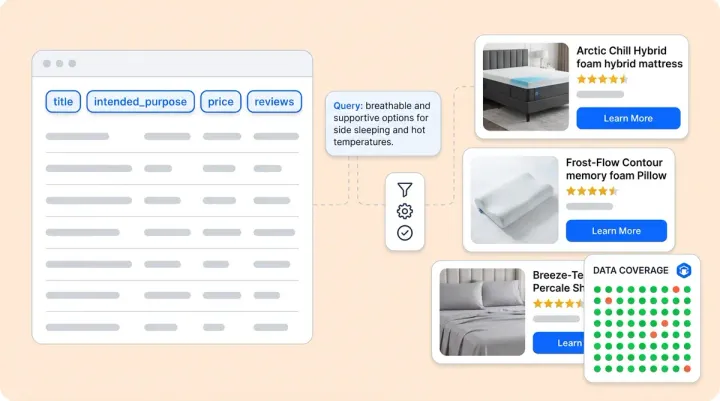
Thin product descriptions kill your chances. The AI's query fan-out process favors content that covers a product from multiple angles: specifications, use cases, comparisons, materials, care instructions, and sizing details. Every attribute you add can boost your visibility, giving the AI another dimension to match against shopper queries.
Alhena AI's Product Review capabilities help brands identify gaps in product data that limit AI visibility, turning incomplete catalog pages into rich, citation-worthy content.
3. Review Volume and Quality
Google overview algorithms heavily weight authentic user-generated content. Research shows that experience-based reviews, the kind that describe real use cases and specific outcomes, outperform polished marketing copy in AI citation probability. Brands need both volume (aim for 50+ reviews per top product) and depth (detailed, specific feedback rather than star-only ratings).
Google overview prioritizes products where customer review content directly answers the shopper's question. "These shoes fixed my plantar fasciitis after two weeks" is exactly the kind of review snippet that gets pulled into an AI Overview for a relevant query.
4. Long-Tail Content Targeting AI Query Patterns
With queries getting longer and more conversational, brands need content that matches how people actually ask AI for product recommendations. Build out buying guides, comparison pages, and FAQ content optimized for AEO and GEO alongside traditional SEO that targets specific, intent-rich queries. "Best organic moisturizer for sensitive skin with rosacea" is the new battleground, not "best moisturizer."
AI shopping assistants trained on your product catalog can surface these long-tail matches in real time, connecting shoppers to exactly the right product when they ask specific questions on your site.
How Alhena AI Visibility Data Connects to These Signals
Alhena AI tracks which optimization levers actually move AI citation rates for ecommerce brands. The data consistently shows that product data completeness and structured markup are the highest-impact factors, followed by review depth and long-tail content coverage.
Brands using Alhena's AI Support Concierge and Shopping Assistant see a compounding effect: every customer interaction generates structured data about product questions, common objections, and purchase patterns. This intelligence feeds back into product page optimization, making your catalog progressively more visible to AI systems over time. For a deeper playbook, see our guide to answer engine optimization for ecommerce.
The Alhena ROI Calculator helps brands quantify this impact, connecting AI visibility improvements directly to revenue attribution. Tracking your AI share of voice across search surfaces is the first step so you can measure what's working and double down.
Traditional SEO Rankings Are No Longer the Gatekeeper
The old search engine model was simple: rank on page one of Google search or be invisible. That model is dead for product discovery. AI Overviews have created a parallel visibility layer where the rules are different, and right now, most ecommerce brands aren't playing by them.
Organic CTR drops 61% on queries with AI Overviews. Zero-click searches jumped from 56% to 69% in a single year. But businesses that do get cited in Google overview results earn 35% more organic clicks and 91% more paid clicks than those that don't. The gap between brands that optimize for AI Overviews product ranking and those that don't will only widen.
The businesses that act now, investing in schema completeness, product data depth, review quality, and AI-optimized content, will capture the $750 billion in AI-influenced consumer spending that's coming. Their competitors will still be fighting over Google search over page-one rankings that matter less every quarter.
Ready to see how your product catalog performs in AI search? Book a demo with Alhena AI or start free with 25 conversations to turn your product data into an AI visibility advantage.
Frequently Asked Questions
How do ecommerce brands get products cited in Google AI Overviews without top-10 rankings?
Focus on structured data completeness, product data enrichment, and review depth rather than backlink building. Alhena AI helps brands identify which product data gaps limit their AI visibility and provides real-time, hallucination-free shopping assistance that keeps catalog data structured and citation-ready.
What role does schema markup play in AI Overviews product ranking for online stores?
Pages with complete Product, Offer, Review, and AggregateRating schema get cited 3.1x more often in AI Overviews. Alhena AI's product data layer ensures your catalog attributes (price, availability, specs, reviews) stay structured and synchronized, giving AI systems the signals they need to recommend your products.
Can smaller DTC brands compete with large retailers in Google AI Overviews ecommerce results?
Yes. Since 80% of cited products don't rank in the top 10, domain authority matters far less than product specificity and data quality. Alhena AI levels the playing field by giving mid-market brands the same AI-powered shopping experience and product data optimization that enterprise retailers use to capture AI-driven demand.
How does Alhena AI track which optimization levers improve AI Overview citation rates?
Alhena AI's visibility analytics connect product data completeness, review signals, and content coverage to actual citation performance across AI search surfaces. The platform's vertical AI agents monitor how shoppers interact with your catalog, feeding insights back into product page optimization that directly improves AI Overviews product ranking over time.
What is the revenue impact of optimizing product pages for AI-powered search and Google SGE?
Brands cited in AI Overviews earn 35% more organic clicks and 91% more paid clicks than those that aren't. Alhena AI's revenue attribution analytics tie AI visibility improvements to actual sales, with customers like Tatcha seeing 3x conversion rates and 11.4% of total site revenue driven through AI-powered shopping interactions.