Every ecommerce organization is somewhere on the AI maturity spectrum. Most can't articulate where they are or what the next stage looks like. Whether you are just starting to explore using AI for customer service or already using AI to drive revenue. Some organizations running scripted FAQ chatbots believe they've "deployed AI." Other organizations with genuine agentic AI capabilities underestimate how far ahead they are. Without a shared maturity framework, assessment model, and readiness framework, internal conversations about AI adoption, technology adoption, and investment and customer experience improvement lack structure, and external benchmarking is impossible.
This is the Ecommerce AI Maturity Model. Five stages. Each with specific technology requirements, team structure implications, typical performance metrics, and a clear migration path to the next level. Use it to diagnose where you are on the AI in ecommerce maturity spectrum, benchmark against the industry, and build a concrete maturity framework, roadmap, and action plan for what comes next as new AI technologies keep evolving and reshaping the maturity curve for every organization on the AI maturity curve.
Stage 1: Reactive (Scripted Chatbot)
Technology
Rule-based decision trees with keyword matching and static FAQ responses. No automation beyond keyword matching. No advanced AI technologies like large language models. No generative AI. No integration with your online ecommerce platform or helpdesk. The bot recognizes exact phrases like "where is my order" and returns a pre-written answer. Anything outside the script goes straight to a human agent.
Team Structure
You need a dedicated person writing and maintaining conversation scripts. The maintenance burden scales linearly with catalog size, because every new product, policy change, or seasonal promotion requires manual script updates. Customer support teams remain fully staffed since the bot handles only the narrowest use cases and simplest scenarios and the smallest slice of volume.
Typical Metrics
- Primary measurement: Conversation volume and basic CSAT
- Deflection rate: Not measurable in any meaningful way, because everything not scripted routes to humans
- Revenue attribution: Zero
- Conversion impact: Zero or negative, because the bot frustrates shoppers more than it helps
Migration Path to Stage 2
Replace rule-based logic with a AI powered generative AI platform connected to your product catalog and helpdesk. This single change transforms the bot from a static script reader into an AI that understands natural language and pulls live order data. Most organizations can make this shift in days with the right AI tools, AI solutions, and AI technologies, not months of custom development.
Stage 2: Responsive (AI Ticket Deflection)
Technology
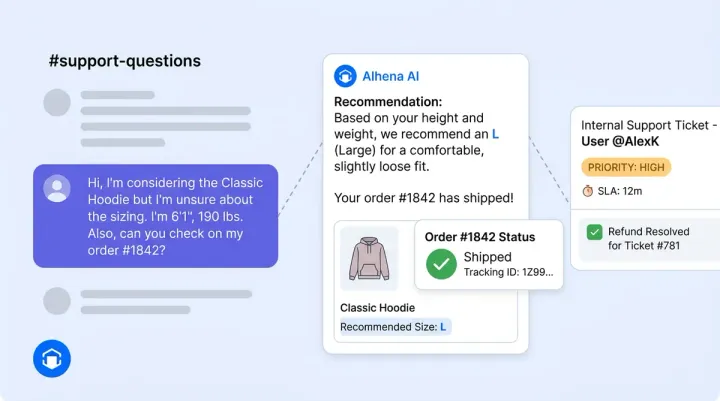
A generative AI support tool connected to your knowledge base and helpdesk, handling routine ticket automation. Order status lookups, return initiation, shipping questions, and other common use cases, and policy inquiries are fully automated and resolve without human involvement. The AI is integrated with your ecommerce platform for live order data and customer data access, so it can pull tracking numbers, order histories, and return eligibility in real time.
This is where most organizations that claim to "have AI" actually sit. The technology works well for support deflection, but it operates as a reactive tool. It waits for customers to ask questions. It doesn't sell.
Team Structure
Minimal AI management. One person handles knowledge base updates, reviews escalated conversations, and monitors deflection quality. Customer support headcount drops modestly as the AI resolves the repetitive ticket volume that previously consumed agent hours.
Typical Metrics
- Ticket deflection: 40 to 60%
- Response time: Measurable improvement (often from hours to seconds on deflected tickets)
- CSAT: Within range of human baseline
- Revenue attribution: Indirect through freed agent capacity and operational efficiency and cost savings, but no direct revenue attribution
- Conversion impact: None, because the AI only engages customers who already have a problem
Migration Path to Stage 3
Add proactive engagement surfaces: nudges triggered by browsing behavior, smart PDP FAQs that answer product questions before customers ask, and product recommendation capabilities that turn the AI from a reactive support tool into a shopping assistant. This is the shift from cost-center AI to revenue-generating AI.
Stage 3: Proactive (AI Shopping and Engagement)
Technology
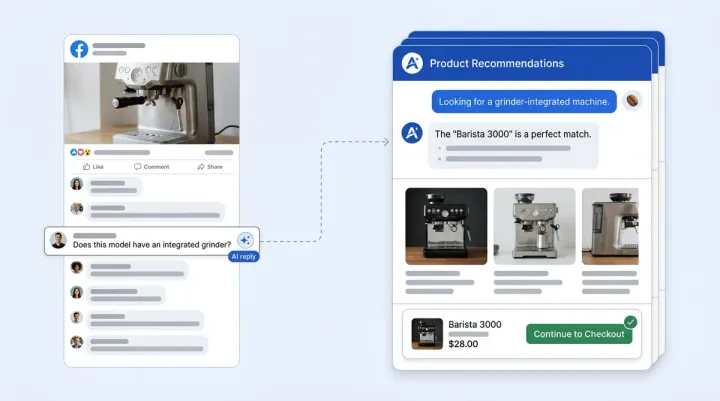
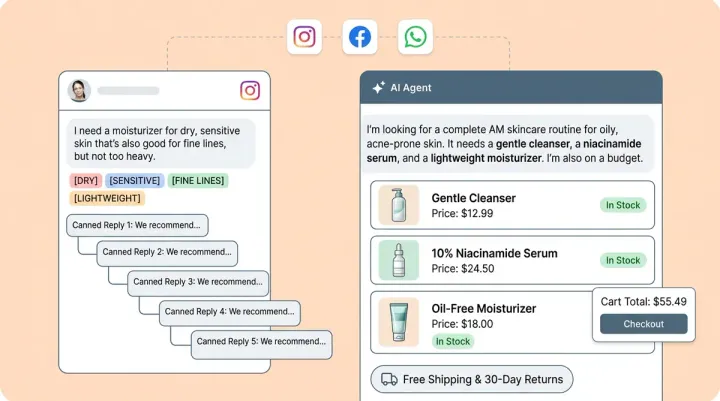
A commerce-aware conversational AI with product search, personalized recommendations with deep personalization, adaptive quizzing, proactive nudges triggered by behavioral signals, and smart PDP FAQs. Deep integrated catalog at the attribute level (not just product titles) means the AI understands fabric weight, ingredient lists, compatibility specs, and size ranges. It can guide a shopper from "I need a moisturizer for dry skin" to a specific product recommendation grounded in your actual inventory.
The critical difference between Stage 2 and Stage 3 is engagement model. Stage 2 waits. Stage 3 initiates. The artificial intelligence and artificial intelligence engine identifies high-intent visitors, surfaces the right product at the right moment, and guides purchase decision making through natural customer experience conversation. Organizations at this stage, like Tatcha, see 3x conversion rates and 38% higher average order values on AI-assisted sessions.
Team Structure
The shift from support-focused to growth-focused is the defining organizational change at Stage 3. CX and ecommerce teams co-own the AI. A product data specialist ensures catalog accuracy at the attribute level. A CX strategist reviews conversation quality and optimizes the customer experience across engagement flows. Someone owns revenue attribution analytics, because now the AI generates measurable revenue.
When you're ready to expand across channels, our guide on omnichannel AI customer support setup walks through the full implementation process.
Typical Metrics
- Visitor engagement rate: 2 to 4%
- Conversion lift: Measurable on AI-assisted sessions (2x to 3x vs. unassisted)
- AOV increase: 15 to 38% from guided selling
- Revenue attribution: Initial, with 5 to 11% of total site revenue traceable to AI-assisted sessions
- Ticket deflection: 70 to 80% on support side
Migration Path to Stage 4
Enable agentic capabilities where the AI takes actions, not just recommendations. Cart population, checkout completion, return processing, exchange initiation, and other key use cases and business processes, and cross-channel follow-ups within the conversation. The AI moves from advisor to autonomous agent. Learn how organizations using AI measure this transition in our guide to AI shopping assistant KPIs.
Stage 4: Autonomous (Agentic Commerce)
Technology
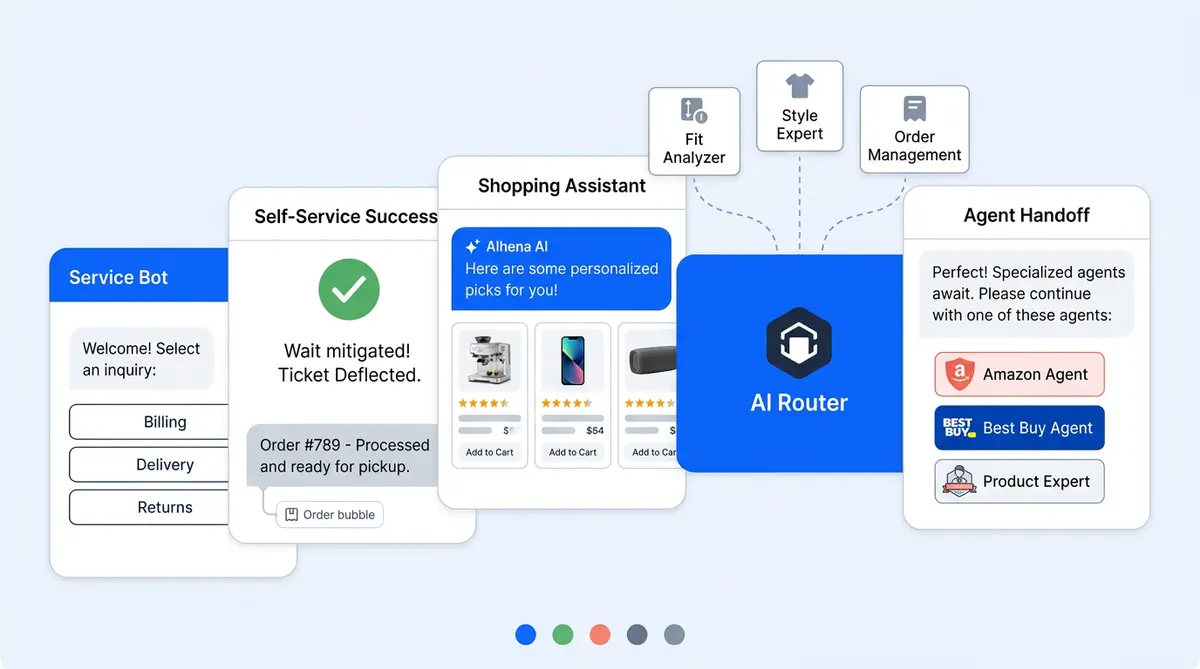
Multi-agent architecture with specialized AI technologies and agents (Product Expert, Order Management, and vertical specialists like Fit Analyzer and Skin Analyzer) orchestrated by an artificial intelligence router. Each agent handles its domain with precision, and the router directs conversations to the right agent based on context and intent.
Multi-model selection picks the best AI models, large language models, and LLMs for each specific task rather than forcing a single model to do everything. Agentic checkout populates carts and pre-fills the checkout page from within the conversation. Self-improving architecture generates FAQs automatically from conversation patterns, learns from every interaction through continuous feedback loops, and uses smart flagging and AI governance and quality governance to surface edge cases for human review.
Rich product cards with images, pricing, and variant selection appear directly in the chat. In-chat purchasing eliminates the friction of redirecting shoppers to a separate product page. Omnichannel deployment spans web chat, email, Instagram DMs, WhatsApp, and voice, with unified memory across every touchpoint.
Team Structure
Lean, because the AI self-maintains. The continuous learning loop automated operational and strategic knowledge base updates. Smart flagging surfaces the conversations that actually need human attention instead of requiring agents to monitor everything. The team's focus shifts to strategic AI optimization: refining brand voice and AI strategy and intelligence strategy, curating high-value product stories and improving customer experience, and designing the overall customer experience maturity, customer experience strategy. Manawa cut support workload by 43% while dropping response times from 40 minutes to 1 minute, showing what the maturity model looks like in practice at this stage.
Typical Metrics
- Engagement rate: 4 to 6%
- Conversion lift: 3x to 4x on AI-assisted sessions
- AOV uplift: 30 to 40%
- Revenue attribution: 10%+ of total site revenue attributed to AI
- Ticket deflection: 80 to 86%
- Cart-to-checkout completion: 49%+ for AI-engaged shoppers
- CSAT: 84 to 90%
Victoria Beckham achieved a 20% AOV increase. Puffy reached 63% automated inquiry resolution with 90% CSAT. Crocus hit an 86% deflection rate with 84% CSAT. These are Stage 4 results.
Migration Path to Stage 5
Extend AI capabilities to interact with external AI-powered shopping agents and participate in agent-to-agent commerce protocols. Your product data must be optimized for machine consumption across all use cases, not just human browsing. Your AI must serve both human shoppers and other AI agents simultaneously.
Stage 5: Orchestrated (Agent-to-Agent Commerce)
Technology
External AI-powered shopping agents from platforms like ChatGPT Shopping, Google AI Mode, and Perplexity discover, evaluate, and purchase products on behalf of consumers. Your AI doesn't just serve human shoppers. Alhena AI solutions communicate with other AI agents through digital commerce protocols (UCP, ACP, MCP), negotiating terms, confirming availability, and completing transactions in digital machine-to-machine exchanges across both B2C and B2B.
Product data is optimized for AI agent consumption: structured feeds, machine-readable pricing and availability APIs, and semantic product descriptions that external AI can parse accurately. AI Visibility monitoring tracks how external AI platforms recommend your products, which queries surface your brand, and where you're losing share of voice to competitors in AI-generated results.
Team Structure
artificial intelligence commerce strategy becomes a distinct strategy function alongside marketing and merchandising. You need specialists who understand how AI agents evaluate, assess, and rank products, how commerce protocols work across various use cases, and how to optimize your product data for machine consumption. This maturity shift is the equivalent of how SEO emerged as a function when search engines became a primary commerce channel.
Typical Metrics
- AI share of voice: How often external AI platforms recommend your products vs. competitors
- Zero-click commerce conversion: Transactions completed entirely through external AI agents
- Agent-to-agent transaction volume: Purchases initiated and completed by AI agents without human browsing
- Cross-platform revenue attribution: Revenue traceable to AI agent referrals across multiple platforms
Stage 5 is emerging. No brand operates here fully today. But the organizations building the foundation now, with AI-optimized product data, commerce protocol readiness and maturity readiness, and AI Visibility monitoring, will lead when this stage matures. The 805% year-over-year increase in AI-driven digital traffic to retail sites on Black Friday 2025 signals that agent-driven shopping is accelerating faster than most forecasts predicted.
AI Maturity Self-Assessment: 10 Questions to Score Your Stage
Answer each question yes or no. Count your total yes answers to map your current stage.
- Does your AI connect to your live product catalog with attribute-level product data (not just product titles)?
- Can your AI resolve a support ticket (order status, return initiation) without human involvement?
- Does your AI proactively engage visitors based on browsing behavior, or does it only respond when a customer initiates?
- Can your AI recommend products based on conversational context ("something similar but in blue")?
- Can your AI process a return or exchange within the conversation without redirecting to a form?
- Does your AI generate revenue you can attribute directly (not just cost savings from deflection)?
- Can your AI handle conversations across three or more channels (web, email, social, WhatsApp, voice)?
- Does your AI improve its responses without manual retraining, through continuous learning and auto-generated FAQs?
- Can your AI populate a cart and pre-fill checkout from within the conversation?
- Does your AI participate in external AI shopping surfaces, or are you monitoring how AI platforms represent your products?
Score Interpretation
- 0 to 1 yes answers: Stage 1 (Reactive). Your AI is a scripted FAQ bot. Priority: replace rule-based logic with a generative AI platform connected to your catalog and helpdesk.
- 2 to 3 yes answers: Stage 2 (Responsive). Your AI deflects tickets but doesn't sell. Priority: add proactive engagement, product recommendations, and conversational search to shift from cost-center to revenue-driver.
- 4 to 6 yes answers: Stage 3 (Proactive). Your AI engages shoppers and drives measurable revenue. Priority: enable agentic capabilities (cart population, checkout completion, cross-channel orchestration) to reach full autonomous operation.
- 7 to 9 yes answers: Stage 4 (Autonomous). Your AI operates as a full commerce agent. Priority: optimize product data for AI agent consumption and begin monitoring your AI Visibility across external platforms.
- 10 yes answers: Stage 5 (Orchestrated). You're building for agent-to-agent commerce. You're ahead of 98% of the industry.
Use the Alhena AI ROI Calculator to quantify the revenue impact of moving from your current stage to the next one, using your actual traffic and conversion data.
How Alhena AI Accelerates Your Stage Progression
Most maturity frameworks assume a multi-year, build-it-yourself progression. Alhena AI was purpose-built to collapse that timeline. Organizations advance from any stage to Stage 4 at enterprise speed, enterprise scale, and enterprise readiness, in weeks, not years.
Stage 1 to Stage 2 in 48 hours. Organizations using AI through Alhena deploy in under 48 hours with no developer resources required to implement. The platform connects to your Shopify, WooCommerce, Salesforce Commerce Cloud, or Magento store and your helpdesk (Zendesk, Gorgias, Intercom, or others) on day one. Organizations adopting AI through Alhena, or adopting move from scripted bots to generative AI ticket deflection immediately.
Stage 2 to Stage 3 through proactive engagement. Alhena's AI Shopping Assistant includes nudges triggered by browsing behavior, smart PDP FAQs, and conversational product search. These proactive engagement capabilities and features turn a reactive support tool into a shopping assistant that drives revenue from the first week.
Stage 3 to Stage 4 through multi-agent architecture. Alhena's specialized AI agents (Product Expert Agent, Order Management Agent, and vertical specialists) with AI powered, fully autonomous multi-agent orchestration delivers full agentic capabilities out of the box. Agentic checkout populates carts and pre-fills the checkout page within conversations. Self-improving learning reduces manual maintenance. Omnichannel deployment across web, email, social, WhatsApp, and voice means a single platform covers every customer touchpoint.
Preparing for Stage 5 with AI Visibility. Alhena's AI Visibility product monitors and optimizes how your products appear across external AI shopping platforms. As agent-to-agent commerce protocols mature, organizations already tracking their AI share of voice will have the data readiness foundation to participate.
Alhena's platform data from 329 companies shows that Stage 4 organizations capture 10x the revenue per AI-engaged visitor compared to Stage 2 brands. That gap compounds every month. Each week spent at a lower stage is a week where competitors at higher stages widen their advantage in conversion, AOV, and customer lifetime value.
The Compounding Cost of Staying at a Lower Stage
The ecommerce AI maturity model is not aspirational. It's diagnostic. The organizations operating at Stage 4 today started at Stage 1 or Stage 2 within the last 12 to 18 months. The difference between them and organizations still stuck at lower stages isn't budget or team size. It's the speed at which they advanced through each stage.
Every month spent at Stage 1 or Stage 2 is a month where you're spending on AI that doesn't generate revenue. Every month a competitor operates at Stage 3 or Stage 4, they're compounding their innovation and intelligence advantage in three dimensions: conversion rate data that trains better product recommendations, customer interaction patterns that improve engagement timing, and revenue attribution analytics, business analytics, and predictive analytics and business intelligence insights that justify further AI investment.
The maturity model gives you a shared language to evaluate, assess, and accurately diagnose your position, align your team on what "better" means, and build a concrete plan to advance beyond pilot projects, proof of concept trials, and early experiments. Too many organizations get stuck running pilot projects indefinitely. The question isn't whether to move up. It's how fast you can get there.
Ready to see where your business lands and how fast you can move up the maturity curve? Book a demo with Alhena AI to get a personalized maturity assessment, or start for free with 25 conversations to test Stage 3 and Stage 4 AI solutions capabilities on your own store. These AI capabilities compound over time.
Frequently Asked Questions
What are the five stages of the ecommerce AI maturity model?
The five stages are Reactive (scripted chatbot), Responsive (AI ticket deflection), Proactive (AI shopping and engagement), Autonomous (agentic commerce with multi-agent architecture), and Orchestrated (agent-to-agent commerce). Alhena AI helps brands progress from any stage to Stage 4 Autonomous in weeks through 48-hour deployment, proactive engagement features, and multi-agent orchestration with agentic checkout.
How do I assess which AI maturity stage my ecommerce brand is at?
Use the 10-question self-assessment in this model. Key diagnostic signals: if your AI can't resolve tickets without humans, you're at Stage 1. If it deflects tickets but doesn't drive revenue, you're at Stage 2. If it engages shoppers proactively but can't take actions like cart population, you're at Stage 3. Alhena AI's platform data from 329 brands shows that correctly diagnosing your stage is the first step to advancing, because most companies overestimate their position by one full stage.
What is the difference between Stage 3 proactive AI and Stage 4 agentic commerce?
Stage 3 Proactive AI recommends products and engages shoppers through conversational search, nudges, and guided selling, but the customer still completes checkout separately. Stage 4 Autonomous AI takes actions: it populates carts, pre-fills checkout, processes returns, and follows up across channels within the conversation. Alhena AI delivers Stage 4 through multi-agent architecture with specialized Product Expert and Order Management agents, self-improving learning, and agentic checkout.
How does self-improving AI work at Stage 4 of the ecommerce maturity model?
At Stage 4, the AI generates FAQs automatically from conversation patterns, learns from every customer interaction through continuous feedback loops, and uses smart flagging to surface edge cases for human review. This reduces manual knowledge base maintenance and improves accuracy over time. Alhena AI's self-improving architecture means companies spend less time managing the AI and more time on strategic CX optimization.
What is agent-to-agent commerce and why should ecommerce brands prepare now?
Agent-to-agent commerce (Stage 5) is where your AI communicates with external AI shopping agents from platforms like ChatGPT Shopping and Google AI Mode through commerce protocols like UCP, ACP, and MCP. AI-driven traffic to retail sites grew 805% year-over-year on Black Friday 2025. Alhena AI's AI Visibility product helps brands monitor and optimize how their products appear across these external AI shopping platforms, building the foundation for Stage 5 readiness.
How fast can an ecommerce brand advance from Stage 1 to Stage 4 with Alhena AI?
Alhena AI deploys in under 48 hours with no developer resources, moving Stage 1 brands to Stage 2 immediately. Proactive engagement features unlock Stage 3 within the first week, and multi-agent architecture with agentic checkout delivers Stage 4 capabilities out of the box. Platform data from 329 brands shows Stage 4 brands capture 10x the revenue per AI-engaged visitor compared to Stage 2, and that compounding advantage widens every month spent at a higher stage.