A shopper lands on your store looking for lightweight running shoes for wet trails under $150. With traditional filters, that means six separate steps: select "Running Shoes" from the category dropdown, pick "Men's" or "Women's," choose "Lightweight" under weight, find "Trail" under terrain type, set the price slider to $0-$150, then sort by relevance. Most shoppers won't finish. With conversational search, they type one sentence: "show me lightweight running shoes for wet trails under $150." The AI parses every attribute in context, matches intent to your catalog, and delivers the right products in seconds. One sentence replaces six dropdowns. That's the shift happening in ecommerce right now.
Why Filter-Based Navigation Is Broken
Faceted filters were designed for a desktop-first web where shoppers had screen space, patience, and familiarity with your product taxonomy. None of those assumptions hold anymore.
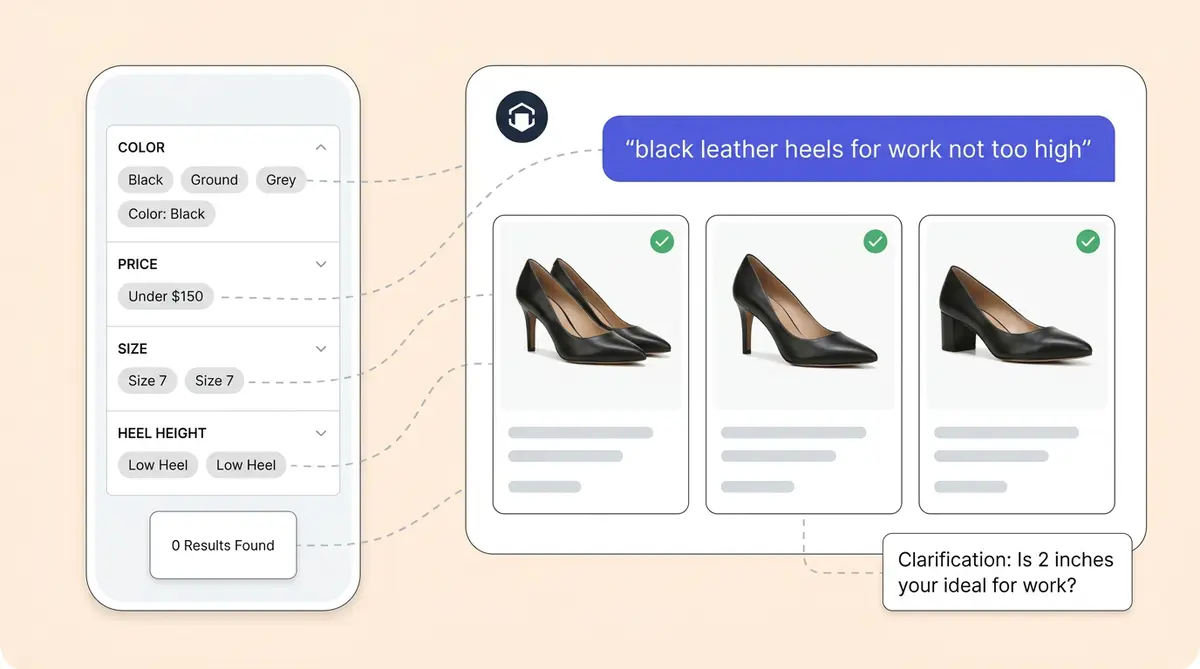
Filter abandonment climbs with every facet you add. When a shopper has to select category, then subcategory, then size, then color, then price, then material, each additional step loses a percentage of the audience. On mobile, where more than half of ecommerce revenue originates, only 2 to 10 percent of shoppers even open filter menus. Half of those who try give up before applying a single selection.
The terminology problem makes it worse. Shoppers don't think in your taxonomy. They don't search for "moisture-wicking polyester blend crew neck" when they want "a breathable running shirt." They don't know if the jacket they're picturing falls under "outerwear," "activewear," or "rain gear." Filters require customers to translate their needs into your catalog structure, and most won't bother.
Then there's the multi-attribute problem. A query like "comfortable office chair for someone with back pain under $500 that matches a walnut desk" combines use case, customer needs including health, budget, and aesthetic preference in a single thought. No traditional search filter tree on any ecommerce site can handle that. The shopper either gives up or starts a manual search that returns hundreds of irrelevant results.
How Conversational Search for Ecommerce Works Under the Hood
Conversational commerce, powered by generative ai and conversational search, isn't a chatbot bolted onto a search bar. It's a technical architecture built on four layers that work together to turn natural language search queries into precise product matches.
Natural Language Understanding
The first layer parses the shopper's query into structured product attributes. When someone types "red leather crossbody bag for travel under $200," the system extracts color (red), material (leather), style (crossbody), use case (travel), and price constraint (under $200). It handles misspellings, slang, and incomplete sentences because it's its models are trained on how real people phrase search queries about products, not how databases categorize them.
Semantic Matching
The second layer connects parsed intent to your catalog data beyond exact keyword matching. If your product titles say "crimson" instead of "red" or "crossover bag" instead of "crossbody," semantic matching powered by machine learning still finds the right items. Traditional search systems and keyword matching miss 40 to 60 percent of potential matches because of vocabulary gaps between how shoppers describe products and how brands label them. Semantic matching closes that gap.
Real-Time Ranking
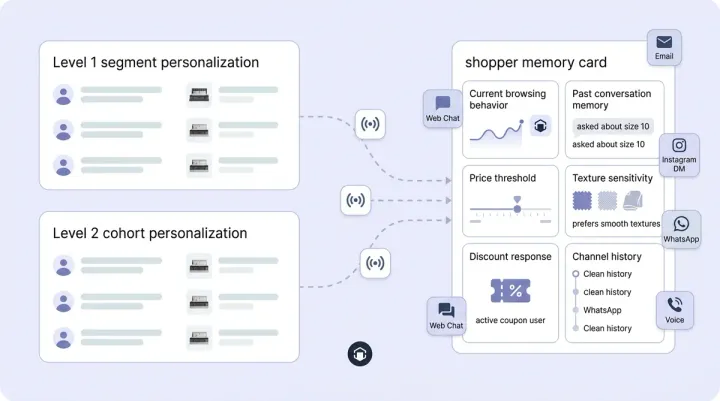
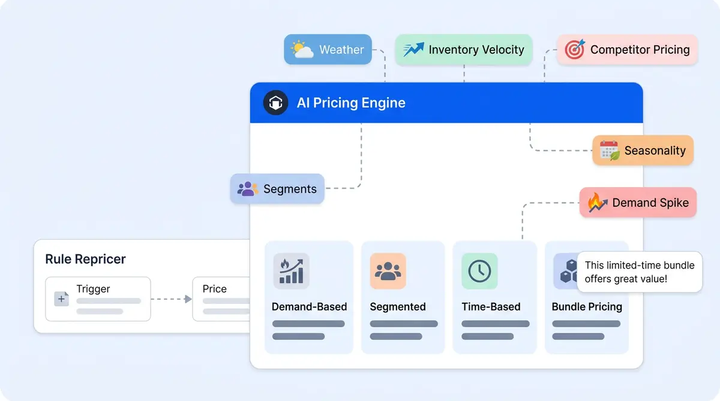
The third layer weighs relevance, availability, and personalization signals to surface the best results first. A product that matches all five attributes and is in stock ranks higher than one matching three attributes on backorder. If the shopper has browsing history or past purchases, those signals create personalized rankings in real time.
Contextual Follow-Up
The fourth layer handles progressive refinement. When a buyer says "show me those in blue" or "anything waterproof in that range," the system keeps full conversation context in memory. It doesn't start over. It uses the full conversation context to narrow the existing result set based on the new constraint, rather than starting over, just like a knowledgeable digital assistant or store associate would. This guided back-and-forth that gives shoppers control over how they refine results and mirrors how they actually think: start broad, then refine based on what they see.
Conversational Search Across Ecommerce Verticals
Natural language product search doesn't work the same way in every category. The product discovery intelligence behind it adapts to the unique query patterns each vertical demands.
Beauty and Skincare
Customers in beauty describe concerns, not product names. "I need a moisturizer for dry, sensitive skin without fragrance or parabens" combines skin type, concern, and ingredient exclusions. Conversational search maps these to product attributes like formulation type, ingredient lists, and skin compatibility ratings. A filter menu with dropdowns for "Skin Type," "Concern," and "Ingredients to Avoid" would need dozens of options in each category. Most beauty search queries can’t fit into a filter menu. Natural language lets them describe their skin in their own words and get matched products instantly.
Electronics
Electronics buyers specify use cases and compatibility. "A monitor for photo editing that works with my MacBook Pro and has USB-C" requires the system to understand use-case requirements (color accuracy, resolution), platform compatibility (macOS, USB-C connectivity), and implicit preferences (IPS panel, factory-calibrated). Filters for electronics already feel overwhelming with dozens of technical specs. Conversational search turns a complex compatibility search queries into a simple request.
Fashion and Apparel
Fashion queries combine fit, occasion, style, and body-specific preferences in ways no filter tree can handle. "A cocktail dress for a summer wedding that works for a pear shape, not too short, under $300" mixes event type, season, body shape, length preference, and budget. Conversational search for fashion brands understands that "pear shape" implies A-line or fit-and-flare silhouettes, that "summer wedding" means lighter fabrics and certain color palettes, and that "not too short" translates to midi or knee-length. Try building that into dropdown filters.
Auto Parts and Hardware
Auto parts create compatibility queries that need structured resolution. "Brake pads for a 2019 Honda Civic EX with ceramic compound" requires matching year, make, model, trim level, and material preference against a parts compatibility database. This is where conversational search overlaps with guided product selling: the AI can ask follow-up questions ("Front or rear brakes?") to narrow results with precision that filter-based fitment tools often lack.
The Conversion Impact of Replacing Filters with Conversational Search
When shoppers find the right product faster, they buy more and leave less. The data from Alhena AI's Shopping Assistant across hundreds of brands makes this clear.
AI-engaged visitors convert at 3x to 76x higher rates compared to unassisted shoppers, depending on the channel and vertical. Conversational search is the primary driver of that engagement because it gives shoppers a faster, more intuitive shopping journey to the right product than any filter-based alternative.
Tatcha saw a 3x conversion rate and 38 percent average order value uplift after deploying conversational AI, with 11.4 percent of total site revenue attributed to AI-assisted conversational interactions. Victoria Beckham achieved a 20 percent AOV increase. Puffy reached 90 percent customer satisfaction with 63 percent of inquiries resolved automatically. These results show businesses a clear pattern: remove the friction between what a shopper wants and what your catalog offers, and the system delivers higher revenue.
The math is straightforward. If your current site search converts at 3 percent and conversational search triples that to 9 percent, every thousand customer search sessions generate 60 additional orders. At a $100 average order value, that's $6,000 in recovered revenue per thousand sessions. The Alhena ROI Calculator can model this for your specific traffic and AOV.
How Alhena AI Replaces Filters with Intelligent Conversational Search
Alhena AI's Product Expert Agent is purpose-built for ecommerce search discovery. It replaces rigid filter navigation with an intelligent natural language interface that understands multi-attribute shopping queries, matches intent to your catalog at the SKU level, handles follow-up refinements contextually, and guides shoppers to the right product in seconds instead of minutes.
The system is grounded in your actual product catalog data, which means unlike generic AI systems, it never hallucinates product details or recommends items you don't carry. When a shopper asks for "a lightweight stroller that fits in an overhead bin," Alhena's AI searches your catalog semantically, identifies products matching weight, fold dimensions, and travel compatibility, and delivers them with the specific attributes the shopper asked about highlighted.
Alhena goes beyond search into action. The agentic checkout capability means the AI can populate the cart and pre-fill checkout directly from the conversation flow. A customer goes from "show me waterproof hiking boots in size 10" to a filled cart in under 30 seconds, completing the shopping journey, with no filter menus, no category pages, and no friction.
This works across every channel your customers use: web chat, live chat, email, Instagram DMs, and WhatsApp. The same conversational search intelligence that works on your website works in a DM thread. And it integrates with Shopify, WooCommerce, Salesforce Commerce Cloud, and Magento with setup in under 48 hours.
Across 329 brands in Alhena's commerce intelligence data, the pattern is consistent: conversational search drives higher engagement, higher conversion, and higher order values than traditional filter-based navigation systems.
The Brands Still Using Filters Are Creating Friction Their Competitors Have Eliminated
Shoppers have already been trained by AI platforms to ask for what they want in natural language. They talk to AI assistants and voice assistants, type questions into AI chatbots, and describe products to digital assistants and in full sentences on social media. Then they land on your ecommerce site and face a wall of dropdown menus.
That gap between expectation and experience is where you lose revenue. Every shopper who can't find what they want through your filters either leaves for a competitor who makes discovery easier, or settles for a product that isn't quite right and returns it later.
Conversational search for ecommerce closes that gap. It meets shoppers where they already are: describing what they want, expecting the technology to figure out the rest. The brands that have made this shift are seeing the results in conversion rates, order values, and customer satisfaction scores. The ones still relying on filters alone are funding their competitors' growth.
Ready to replace filter friction with conversational search? Book a demo with Alhena AI or start free with 25 conversations.

Frequently Asked Questions
How does conversational search for ecommerce handle multi-attribute product queries?
Conversational search uses natural language understanding to parse complex queries into structured product attributes. When a shopper types "lightweight waterproof jacket for hiking under $200," Alhena AI extracts weight, weather resistance, activity type, and budget as separate attributes, then matches all of them against catalog data simultaneously. This approach replaces the five or six filter steps that most shoppers abandon.
What is intent-to-catalog matching in AI-powered product search?
Intent-to-catalog matching is the process of connecting what a shopper means to the specific SKUs in your inventory. Alhena AI uses semantic matching to bridge vocabulary gaps between how shoppers describe products and how brands label them. If a buyer asks for "comfy work shoes" and your catalog lists "ergonomic professional footwear," the system still finds the right products because it understands intent, not just keywords.
Can conversational search replace product filters on Shopify and WooCommerce stores?
Yes. Alhena AI connects via API and integrates with Shopify, WooCommerce, Salesforce Commerce Cloud, and Magento to add conversational search as a layer on top of your existing store. Implementing takes under 48 hours with no developer team or engineering resources. Most brands keep basic filters available for controlled browsing while using conversational search as the primary discovery path, especially on mobile where filter usage drops below 10 percent.
How does vertical-specific search intelligence improve product discovery for beauty and fashion brands?
Alhena AI adapts its natural language understanding to each vertical's query patterns. For beauty, it maps skin concerns, ingredient preferences, personal preferences, and formulation types to product attributes. For fashion, it understands fit, occasion, body shape, and style combinations. This vertical-specific intelligence means a query like "moisturizer for dry sensitive skin without parabens" returns helpful, precise search results recommendations instead of generic results.
What revenue impact does conversational search have compared to traditional ecommerce filters?
Brands using Alhena AI's conversational search see AI-engaged visitors convert at 3x to 76x higher rates than unassisted shoppers. Tatcha achieved a 3x conversion rate with 11.4 percent of total site revenue from AI-assisted interactions. Victoria Beckham saw a 20 percent AOV increase. Our research confirms these results come directly from removing the friction between shopper intent and product discovery.