Rule-based social messaging automation serves over a million businesses today. Broadcast campaigns, drip sequences, click-to-message ad funnels, and keyword-triggered sequences are proven tactics for lead capture across Instagram, Facebook, and WhatsApp. They work. But they follow scripts. It’s a proven approach for outbound marketing, but it’s not built for live chat conversations where shoppers ask real product queries. Live chat on social channels is a different challenge than live chat on your website, and both need AI that understands your catalog. If you’re searching for a ManyChat alternative that goes beyond automation, it’s worth understanding what separates marketing tools from commerce solutions.
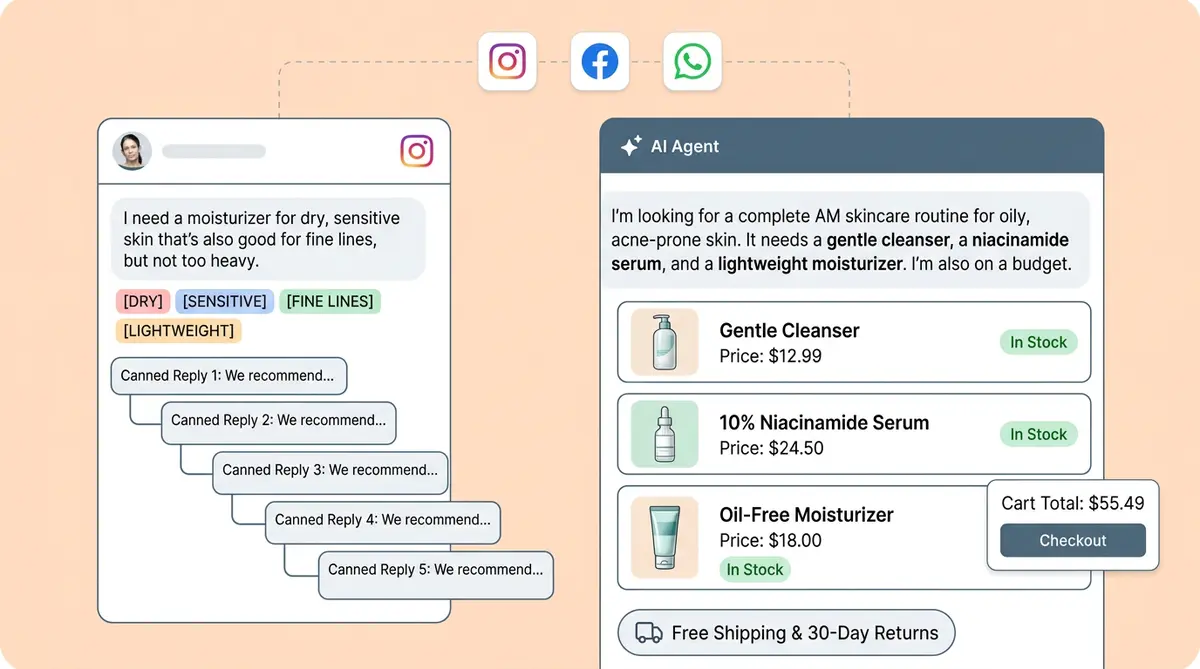
When a shopper sends "which moisturizer is best for dry, sensitive skin under $40?" a keyword-triggered flow can't parse skin type, sensitivity, and budget simultaneously to recommend a specific product from your catalog. It routes to a generic response or a human agent. For ecommerce businesses where the DM is the conversion moment, the gap between keyword matching and AI product intelligence is the gap between a marketing platform and a sales channel.
This post breaks down that gap across six dimensions. Use this head-to-head comparison to decide which approach fits your business. For teams reviewing ManyChat alternatives, the best ManyChat replacement depends on whether you need marketing automation or full-funnel social commerce.
Alhena AI vs ManyChat: At a Glance
| Alhena AI | ManyChat | |
|---|---|---|
| Core Focus | AI conversational commerce for ecommerce | Rule-based marketing automation |
| Intelligence Model | Natural language understanding with live catalog data | Keyword triggers and button-click flows |
| Product Catalog | Full SKU-level catalog with real-time inventory | No catalog connection |
| Ecommerce Actions | Agentic checkout, cart building, returns, order tracking | No transactional capabilities |
| Comment Automation | Contextual AI replies grounded in product data | Template-based auto-replies |
| Support Handling | Full pre-sale + post-purchase (Order Management Agent) | Marketing only, no support automation |
| Vertical AI Agents | Fit Analyzer, Skin Analyzer, Shade Matcher | None |
| Revenue Attribution | Conversation-to-purchase tracking by channel | Message volume metrics only |
Intelligence Model: Scripts vs. Understanding
Scripted systems follow predefined sequences triggered by keywords and button clicks. A shopper types "moisturizer," and the builder fires the same canned response regardless of what comes next. The tool doesn't understand language. It pattern-matches.
AI-powered platforms understand natural language, parse multi-attribute queries, and generate unique responses grounded in live catalog data. When the same shopper asks about moisturizers for dry, sensitive skin under $40, an AI platform reads that as three constraints (skin type, sensitivity, price) and searches your catalog in real time to recommend specific SKUs that match. That's the difference between a decision tree and a product expert.
Product Catalog Awareness: None vs. Full
ManyChat and similar scripted automation platforms have no connection to your product catalog. They can't check inventory, compare products by ingredient or fabric, or recommend specific items based on what a shopper needs. Every product mention in a sequence is manually configured. Add a new SKU, and someone has to update the flow.
AI-powered platforms ingest your full catalog at the SKU level. Alhena AI's Shopping Assistant connects directly to Shopify, WooCommerce, Salesforce Commerce Cloud, and other platforms. It knows your products, pricing, and inventory in real time. The knowledge base includes product descriptions, policies, sizing guides, and FAQs, so the system answers product inquiries with accuracy, not templates. Every response is grounded in your verified knowledge base. The knowledge base updates automatically when you add products or change policies, which eliminates hallucinations and keeps answers current. Tatcha's AI handles product recommendations across their full skincare catalog and drives 3x conversion lift and 38% AOV uplift as a result (Tatcha case study).
Social Channel Coverage: Same Channels, Different Conversations
Both approaches cover Instagram DMs, Facebook Messenger, and WhatsApp. The difference is what happens inside those channels. Scripted platforms send template responses. AI handles full conversations.
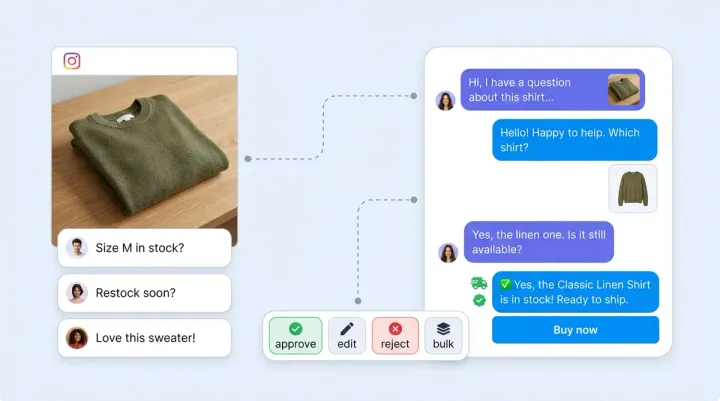
Alhena AI covers WhatsApp, Instagram DMs and comments, and Facebook Messenger and comments with a single deployment. Context carries across channels, so a shopper who starts on Instagram and follows up on WhatsApp doesn't repeat themselves. The Social Conversations dashboard manages comment replies across Facebook and Instagram with a review-before-publish workflow for brand safety. Every AI-generated comment reply goes through review before it reaches your audience, so your brand voice stays consistent.
Comment Automation and Ecommerce Actions: Templates vs. Commerce
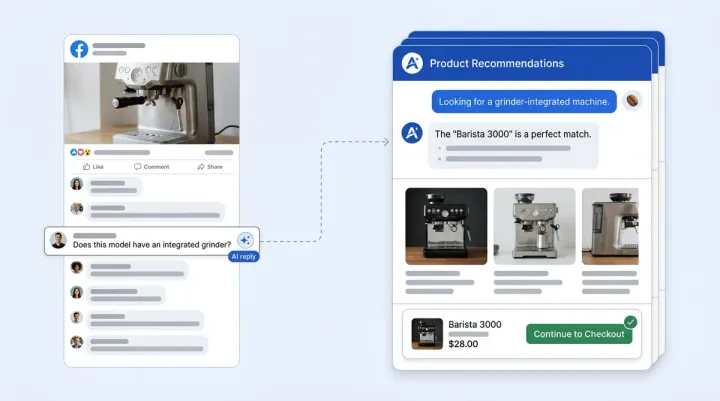
Scripted platforms auto-reply to comments with templates. Every "Is this available?" comment gets the same response. AI platforms generate contextual replies specific to each comment, grounded in product data. If someone asks "Does this come in blue?" on a product post, the AI checks your catalog and answers with the actual color options in stock.
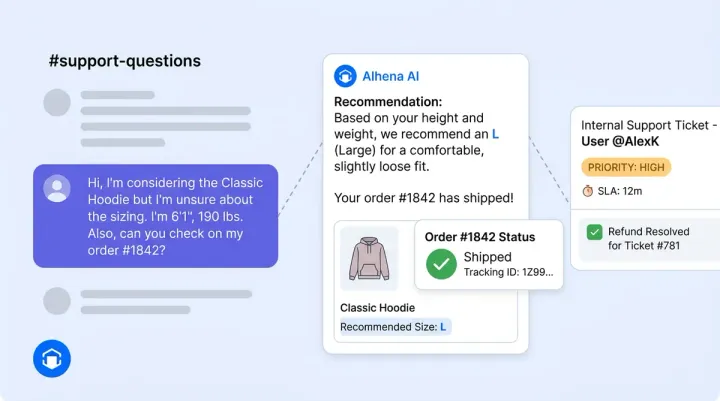
The bigger gap shows up in ecommerce actions. Rule-based tools can't populate carts, process returns, check order status, or pre-fill checkout. They weren't built for transactions. Alhena AI's agentic checkout populates carts and pre-fills checkout directly within the DM thread. The Order Management Agent handles tracking, returns, and post-purchase questions from the same system. One thread covers the full purchase journey. Customers get answers to product, shipping, and return questions in one thread. Alhena AI also integrates with helpdesks like Zendesk, Intercom, Gorgias, and Freshdesk, so social interactions sync with your existing support suite and CRM. Support teams get a no-code system that handles both sales and service without switching between platforms.
Support Automation: Marketing-Only vs. Full Funnel
Keyword-driven platforms are designed for marketing, not support. When a customer inquires about a return or order status, the tool can't help. It either ignores the message, sends a "contact us" link, or escalates to a human agent. That's not customer service. That's a dead end. That creates a broken experience for any brand where shopping and support requests land in the same inbox. Customers who can’t get help in a DM leave negative reviews and lower your site’s rating.
AI platforms handle both pre-purchase shopping and post-purchase support. Alhena AI runs two specialized AI assistants: the Product Expert Agent for product discovery and recommendations, and the Order Management Agent for tracking, returns, and customer service inquiries. This omnichannel approach means one system handles every conversation across every channel. The omnichannel advantage matters most for brands that sell on multiple social platforms simultaneously. Brands like Puffy see 90% CSAT with 63% automated inquiry resolution because shoppers and customers get real answers, not dead-end flows (Puffy case study).
When Rule-Based Automation Is the Right Choice
If your primary need is broadcast campaigns, promotional drip sequences, simple keyword-triggered lead capture, or click-to-message ad funnels where the response is the same regardless of what the shopper says, scripted automation is effective and cost-efficient. They start at $15 per month, scale predictably, and require no AI training. As a lead capture solution, it’s hard to beat the price. ManyChat’s AI Step add-on costs $29 per month on top of the base plan (Pro starts at $15 per month for 500 contacts), but it still lacks catalog intelligence. The price scales with contacts, not value delivered. These limitations matter when your DMs are a revenue channel, not just a marketing funnel. They excel at outbound marketing flows where your brand initiates and controls the conversation path.
Small businesses with limited product catalogs and straightforward promotional strategies get solid ROI from this approach. The platform does exactly what you program it to do, every time. Many Freshdesk and Zendesk users add ManyChat as a separate lead capture layer for their social channels.
When AI-Powered Conversational Commerce Is the Right Choice
If your shoppers ask product-specific inquiries that require catalog intelligence, if your DMs include support inquiries alongside shopping requests, if you need AI to recommend products based on individual shopper needs, or if you want to convert social conversations into completed purchases, or if you need voice AI for phone support alongside social channels with agentic checkout, AI-powered social commerce is the better fit.
Alhena AI is built for this scenario. Vertical AI agents like the Fit Analyzer and Skin Analyzer deliver category-specific product guidance inside social conversations. Revenue analytics attribute every social AI conversation to purchases with channel-level reporting. The result isn't just better support. It's a measurable sales channel. Victoria Beckham saw a 20% AOV increase from AI-powered recommendations (VB case study).
The Real Choice: Messages vs. Conversations
This isn't about picking one platform over another. It's about choosing between two fundamentally different approaches to social messaging. In every ManyChat alternative comparison, the same pattern appears: scripted flows handle outbound marketing well but fall short when customers need real help. The best ManyChat alternatives for ecommerce aren't just better chatbot builders. They're generative AI assistants that understand your catalog and close sales. Marketing automation sends messages. Conversational AI has conversations.
For ecommerce stores where the DM is the point of purchase, the approach that understands products, answers questions, and closes sales will always outperform the one that triggers templates. The social commerce market is projected to reach $2.11 trillion by 2026. For stores evaluating ManyChat alternatives, the question isn’t which platform sends better messages. The brands that win will be the ones whose social channels sell, not just broadcast.
Ready to turn your social channels into a sales engine? Book a demo with Alhena AI or start for free with 25 conversations.
When sales teams evaluate the top ManyChat alternatives for ecommerce in 2026, the best ManyChat alternative is the one that turns social DMs into revenue. ManyChat alternatives that serve as basic chatbot builder platforms don’t address the core limitations: no omnichannel customer service, no live catalog connection, no agentic checkout. The best ManyChat replacement for omnichannel commerce combines live chat, social DMs, email, and voice into a single suite. Alhena AI’s omnichannel system connects Freshdesk, Zendesk, and other helpdesks so human agents and AI assistants work from the same dashboard. The benefits go beyond automation. Freshdesk users get AI that handles both pre-sale shopping and post-purchase support. The ManyChat alternative that drives revenue isn’t the one with the best chatbot builder or the lowest price per month. It’s the one that understands your products and closes sales.
Frequently Asked Questions
How does AI-powered social commerce differ from template-driven DM automation for ecommerce?
Rule-based DM automation triggers the same scripted response when it detects a keyword, regardless of context. AI-powered social commerce uses natural language understanding to parse multi-attribute product questions, check live catalog data, and generate unique responses tailored to each shopper. Alhena AI goes further by connecting directly to your product catalog so it can recommend specific SKUs, compare options, and verify inventory in real time.
Can Alhena AI replace keyword-triggered Instagram flows with intelligent product conversations?
Yes. Alhena AI covers Instagram DMs and comments with AI trained on your product catalog, policies, and brand voice. Instead of firing a generic template when someone types a keyword, Alhena AI reads the full question, identifies what the shopper needs, and responds with accurate product recommendations. Brands using Alhena AI on Instagram see 3x higher conversions compared to site averages.
How does AI handle complex product questions that rule-based tools cannot answer?
When a shopper asks something like "which running shoe works for wide feet and trail terrain under 20," a rule-based tool matches "running shoe" and sends a generic product link. Alhena AI parses three constraints (width, terrain, price), searches your catalog against all three, and recommends the best-matching SKUs. Vertical agents like the Fit Analyzer and Skin Analyzer add category-specific intelligence for fashion and beauty brands.
Can brands use both marketing automation and AI commerce tools together?
Yes. Many brands run rule-based tools for broadcast campaigns, promotional drip sequences, and click-to-message ad funnels while using Alhena AI to handle the inbound conversations those campaigns generate. The marketing tool drives traffic to the DM. Alhena AI turns that traffic into purchases with product recommendations, catalog intelligence, and agentic checkout.
How do AI comment replies differ from template-based auto-responses on Instagram and Facebook ads?
Template-based tools send the same reply to every comment, whether someone asks "Is this available?" or "Does this come in size 8?" Alhena AI generates contextual replies specific to each comment, grounded in your product data. If a shopper asks about a specific size or color on a product post, the AI checks inventory and responds with accurate availability. A review-before-publish workflow ensures brand safety before any comment goes live.