Why Ticket Routing Is Still Broken in Ecommerce
Every misrouted ticket costs time, money, and patience. A customer asks about a damaged shipment, and the ticket lands with the wrong department. By the time it reaches the right agent, 15 minutes have evaporated, and the customer is already frustrated. Multiply that across hundreds of daily tickets, and the problem compounds fast.
According to Blaze.today, 30 to 40 percent of support tickets are misrouted on the first assignment under manual systems. Each wrong handoff adds delay, eats into SLA windows, and pushes resolution times further from what customers expect. And their expectations aren't flexible: 89 percent of customers expect a response within one hour, while the average company takes over 12 hours to reply to email.
For ecommerce brands handling seasonal surges, product launches, and multichannel inquiries, manual routing simply doesn't scale. AI ticket routing improves efficiency by using natural language processing, sentiment analysis, and skill-based matching to send every ticket to the right agent for better outcomes, at the right time, with the right context.
This guide breaks down how AI ticket routing works, why it matters for ecommerce specifically, and how Alhena AI takes it further by resolving tickets before they ever need routing.
What Is AI Ticket Routing?
AI ticket routing is the process of using machine learning and natural language processing to automatically classify, prioritize, and assign incoming support tickets to the best-suited agent or team. Unlike traditional rule-based systems that match keywords to queues, AI routing understands what the customer actually means.
A customer typing "I want my money back" and another typing "this product doesn't work, what are my options?" both express a returns intent. Keyword-based routing might catch the first one (it contains "money back") but miss the second entirely. AI classification handles both because it reads intent, not just words.
The difference matters at scale. A DevITCloud case study found that AI-powered routing reached 95 percent accuracy, improved first contact resolution by 60 percent, and cut response times from 4 hours to 1.2 hours.
AI routing vs. rule-based routing
Rule-based routing uses static conditions: if the email contains "refund," send it to the returns queue. These rules break the moment a customer phrases their issue differently, uses slang, or asks about multiple topics in one message.
AI routing, on the other hand, learns from historical tickets. It adapts to new phrasings, detects urgency through sentiment, and factors in agent workload and expertise. The system becomes more effective with every resolved ticket, without anyone writing new rules.
How AI Ticket Routing Works: The Technical Pipeline
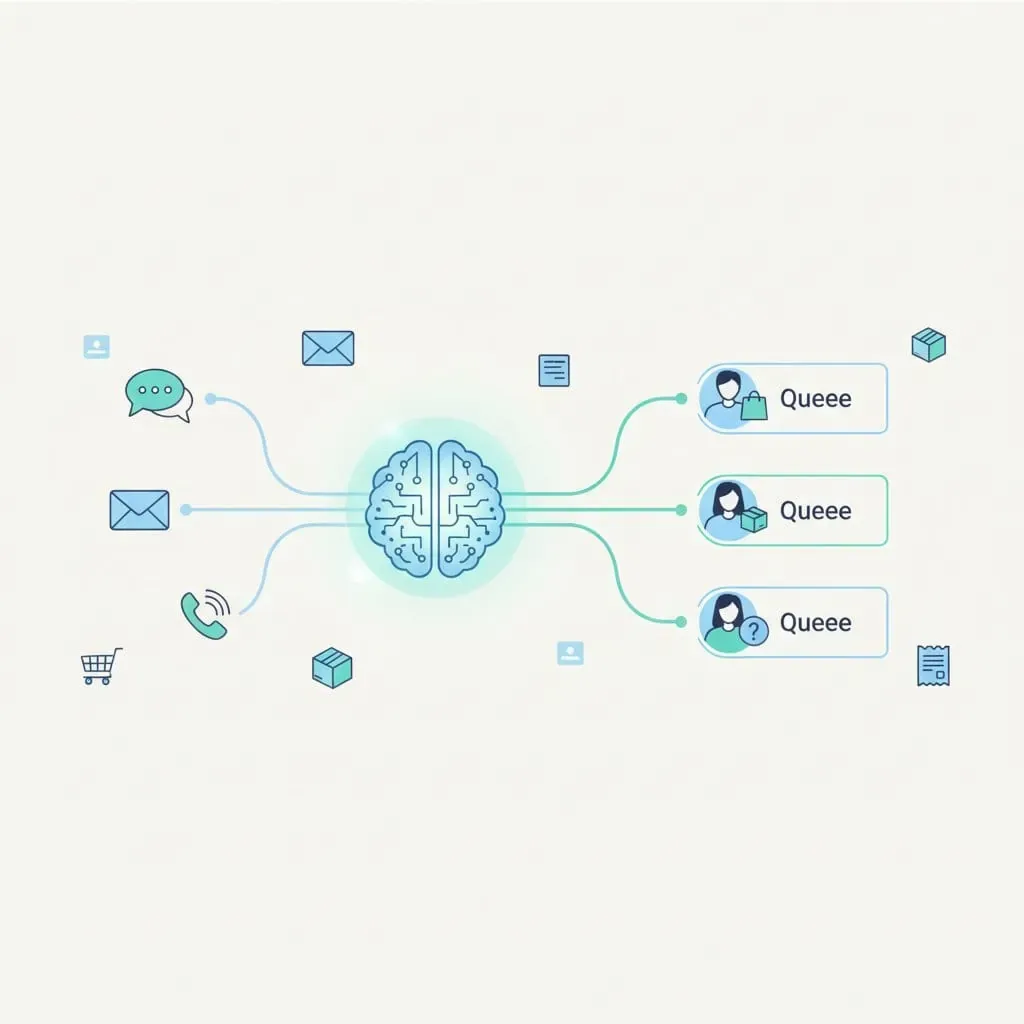
AI ticket routing follows a multi-step pipeline that transforms raw customer messages into precise agent assignments. Here's what happens behind the scenes.
Step 1: Ingestion and preprocessing
When a customer request arrives from any channel (email, live chat, Instagram DM, WhatsApp, or phone transcript), the system normalizes the text. Tokenization breaks the message into processable units. Named entity recognition extracts key details: order numbers, product names, dates, and dollar amounts. This structured information feeds every downstream step.
Step 2: Intent classification
Transformer-based NLP models (architectures like BERT) produce accurate classification into predefined categories. Common ecommerce intents include order status, returns and refunds, product questions, shipping issues, billing disputes, and pre-sale inquiries. The model is trained on thousands of historically labeled tickets, so it recognizes that "where's my package?" and "tracking says delivered but I don't have it" are different intents, even though both mention a package.
Step 3: Sentiment analysis
The system scores customer emotion on a spectrum from positive to very negative. An angry customer whose order arrived damaged gets fast-tracked. A neutral "when does this ship?" follows standard routing. AI-driven sentiment detection reorders the queue based on emotional urgency, not just arrival time.
Step 4: Priority scoring
Priority isn't one-dimensional. The system weighs ticket severity, customer sentiment, customer lifetime value (VIP detection), SLA deadlines, and issue complexity. A routine question from a high-LTV customer may be elevated. A low-urgency inquiry during a volume spike may be deferred. This multi-factor scoring helps in making sure that the most impactful tickets get attention first.
Step 5: Skill-based assignment
The classified ticket gets matched to the best available agent based on expertise (product category, technical skill, language fluency), current workload, and historical resolution success for similar tickets. For a beauty brand, this means a skincare ingredients question goes to a cosmetics specialist, not a general support agent. According to Cobbai, context-aware NLP reduces ticket transfers by up to 80 percent.
Step 6: Auto-escalation and continuous learning
When AI confidence is low (ambiguous intent, multi-issue tickets), the system escalates to a senior agent. If sentiment deteriorates mid-conversation in real time, it re-routes in real-time. And unlike static rules, every resolved ticket feeds back into the model, improving accuracy over time without manual updates.
Why AI Ticket Routing Matters for Ecommerce Brands
Ecommerce has support challenges that other industries don't face at the same scale. AI ticket routing addresses each one directly.
Seasonal volume spikes
Customer inquiries spike 200 to 300 percent between Thanksgiving and Christmas. Black Friday and Cyber Monday can push volumes to 3 to 4 times normal levels. You can't hire and train triple the agents for a two-week window. AI routing deflects routine queries (order tracking, return policies) and ensures complex issues reach human agents without bottlenecks. Aggregate ecommerce data from Sobot shows AI reduces staffing needs during peak periods by 68 percent.
Product expertise matching
For example, a fashion brand needs agents who understand sizing and fabric. A beauty brand needs agents who know ingredients and skin types. An electronics retailer needs agents who can troubleshoot firmware. AI detects the product category from the ticket and routes to the agent with matching expertise, cutting the back-and-forth that happens when a generalist agent tries to handle a specialist question.
Pre-sale vs. post-sale routing
These processes require fundamentally different skills. Pre-sale questions need product knowledge and sales acumen. Post-sale tasks (order status, returns, billing) need system access and process knowledge. Misrouting between these categories wastes time on both sides and can cost a potential sale.
Omnichannel consistency
Customers start on WhatsApp, continue on web chat, and expect resolution over email, all without repeating themselves. AI ticket routing unifies context across channels so the ticket follows the customer, not the inbox. For more on how AI handles peak season support challenges, see our full guide.
The financial impact
Manual ticket handling costs an average of $22 per interaction, according to Forrester Research. Ecommerce support costs range from $2.70 to $5.60 per ticket with automation. AI-powered routing contributes to a 30 percent reduction in cost per ticket and delivers 2 to 5x ROI within the first year. When 63 percent of consumers will switch to a competitor after just one bad experience (Zendesk CX Trends 2025), the cost of slow or wrong routing damages the entire customer experience.
Where Most AI Routing Tools Fall Short
The major helpdesk platforms have all added AI capabilities, but the depth of AI features varies. Zendesk offers intelligent triage with intent, language, and sentiment detection. Freshdesk's Freddy AI delivers 40 to 50 percent resolution rates. Intercom's Fin AI reaches 55 to 65 percent. Gorgias is strong for Shopify-native automation but has shallower workflow logic.
The common gap across workflows? Most ticketing system software treats routing as a support function only. They classify tickets and assign agents, but they don't connect ticket routing to revenue outcomes. A pre-sale question about a $300 jacket gets the same treatment as a password reset. They also struggle with true omnichannel context: customer data sits in CRMs, ticketing tools, chatbots, and backend order platforms, with limited interoperability across channels.
For ecommerce brands that view support as a revenue channel (not just a cost center), basic routing isn't enough, and it's clear that. You need AI solutions that understand the commercial context of every conversation.
How Alhena AI Handles Ticket Routing for Ecommerce
Alhena AI takes a different approach to ticket routing. Instead of just sorting tickets into queues, Alhena's multi-agent system resolves most inquiries before a human agent ever needs to see them. The tickets that do require a person arrive with full context, correct classification, and the right priority.
Multi-agent orchestration
Alhena uses specialized AI agents that work together. The Product Expert Agent handles pre-sale questions with deep product knowledge, recommending items, comparing options, and even populating carts. The Order Management Agent tackles post-purchase issues like tracking, returns, and cancellations by connecting directly to your order system. Each agent handles its domain with precision, and conversations transfer between them without losing context.
Intelligent routing that goes beyond triage
Alhena automatically routes conversations to the right agent (AI or human) based on intent, sentiment, and complexity. Simple inquiries get resolved quickly. Complex or sensitive cases escalate to human agents through Agent Assist, which provides a full conversation summary, sentiment reading, and suggested responses. This cuts average response times by 56 percent, so your team can respond faster and reduces unanswered questions by 70 percent.
Hallucination-free accuracy
Unlike general-purpose AI that can fabricate answers, Alhena grounds every response in its knowledge base of verified product data, order records, and approved company policies with enterprise-grade security. This means the routing decision and the resolution are both based on facts, not guesses. Brands like Puffy have achieved 90 percent CSAT with 63 percent automated inquiry resolution using this approach.
Revenue-aware routing
Here's what sets Alhena apart from support-only tools: it recognizes when a "support" ticket is actually a sales opportunity. A customer asking "does this come in blue?" isn't filing a complaint. They're one answer away from buying. Alhena's AI Shopping Assistant identifies these moments and guides the conversation toward conversion. Tatcha saw a 3x conversion rate and 38 percent average order value uplift after deploying Alhena, with 11.4 percent of total site revenue attributed to AI-assisted conversations.
Omnichannel with unified memory
Alhena operates across web chat, email, Instagram DMs, WhatsApp, and voice, maintaining full conversation context regardless of channel. A customer who starts on Instagram and follows up via email doesn't repeat themselves. The AI carries the entire interaction history forward, whether the next touchpoint is automated or human-assisted.
Getting Started with AI Ticket Routing
Implementing AI ticket routing doesn't have to be a six-month IT project. Here are the key benefits of acting now, plus a practical path forward.
1. Audit your current routing performance
Start by measuring your misroute rate, average first response time, and resolution time by ticket category. If you don't have these metrics, pull a sample of 100 recent tickets and track how many were reassigned before resolution. That baseline tells you where AI routing will have the biggest impact.
2. Map your ticket taxonomy
List the intent categories your customers generate most: order status, returns, product questions, shipping issues, billing, pre-sale inquiries. Most ecommerce brands have 8 to 15 distinct categories. This taxonomy helps you create the training data foundation for AI classification.
3. Choose a solution that fits your stack
Alhena AI integrates with Shopify, WooCommerce, Magento, and Salesforce Commerce Cloud on the commerce side. On the help desk side, it connects with Zendesk, Freshdesk, Gorgias, Intercom, and more. The setup takes under 48 hours with no dev resources required.
4. Start with high-volume, low-complexity tickets
Don't try to automate everything on day one. Begin with repetitive tasks in your highest-volume categories (order status, tracking, return policies) where AI can handle 70 to 80 percent of inquiries automatically. Expand to more complex tasks and categories as the system learns from your data. Use the ROI Calculator to estimate your savings before you start.
5. Measure and iterate
Track deflection rate, CSAT, first response time, and revenue attributed to AI-assisted conversations. Alhena includes built-in analytics and feedback loops that tie support interactions to revenue outcomes, giving you insights into how routing improvements translate to business results.
The Future of AI Ticket Routing in Ecommerce
AI ticket routing is evolving fast. Gartner predicts that agentic AI will autonomously resolve 80 percent of common customer service issues by 2029, reducing operational costs by 30 percent. The trajectory is clear: AI won't just route tickets faster; it will eliminate the need for tickets altogether.
Three trends are shaping this shift:
- Proactive ticket prevention: AI monitors order pipelines, payment systems, and shipping data to identify and resolve issues before customers even notice them. A delayed shipment triggers an automatic notification with updated tracking, before the customer writes in.
- Voice AI integration: Voice-based AI support is advancing rapidly. 74 percent of consumers say AI that understands and responds to their voice would improve their experience, according to the Zendesk CX Trends 2025 report.
- Unified AI channels: Gartner predicts 30 percent of Fortune 500 companies will offer service through only a single AI-enabled channel by 2028, collapsing omnichannel complexity into one intelligent interface.
For ecommerce brands, the question isn't whether to adopt AI ticket routing. A Gartner survey of 321 customer service leaders found that 91 percent are under executive pressure to implement AI in 2026. The real question is whether your AI just routes tickets or actually resolves them.
Key Takeaways
- Manual routing fails at scale: 30 to 40 percent of tickets are misrouted under manual systems, adding hours to resolution and damaging customer satisfaction.
- AI routing uses NLP, sentiment, and skill matching to classify and assign tickets with up to 95 percent accuracy.
- Ecommerce has unique routing needs: seasonal spikes, product expertise matching, pre-sale vs. post-sale split, and omnichannel consistency.
- Most helpdesk AI stops at triage: it classifies tickets but doesn't connect routing to revenue outcomes.
- Alhena AI goes further with multi-agent orchestration, hallucination-free resolution, revenue-aware routing, and full AI customer service across every channel.
- The ROI is proven: 2 to 5x return within the first year, 30 percent lower cost per ticket, and brands like Tatcha driving 11.4 percent of total site revenue through AI.
Ready to move beyond basic ticket routing and turn your support into a revenue channel? Book a demo with Alhena AI or start for free with 25 conversations.
Frequently Asked Questions
What is AI ticket routing?
AI ticket routing uses machine learning and natural language processing to automatically classify, prioritize, and assign customer support tickets to the best-suited agent or team. Unlike keyword-based systems, it understands customer intent and can route with up to 95 percent accuracy.
How does AI ticket routing work for ecommerce?
AI ticket routing for ecommerce follows a multi-step pipeline: it ingests tickets from all channels, classifies intent (order status, returns, pre-sale questions), scores sentiment and priority, matches to the most relevant agents by skill and availability, and continuously learns from resolved tickets. This process typically cuts response times by 70 percent and reduces misroutes by up to 80 percent.
How is AI ticket routing different from rule-based routing?
Rule-based routing uses static keyword triggers (e.g., "refund" goes to returns queue). AI routing understands context and intent, so it correctly classifies tickets even when customers use unexpected phrasing. It also factors in sentiment, customer value, and agent workload, which static rules can't do.
Can AI ticket routing handle seasonal volume spikes like Black Friday?
Yes. AI routing is especially valuable during peak periods when ticket volumes spike 200 to 300 percent. It deflects routine queries automatically (order tracking, return policies) and routes complex issues to available agents. Data shows AI reduces staffing needs during peak periods by 68 percent.
Does Alhena AI replace helpdesk platforms like Zendesk or Freshdesk?
No. Alhena AI integrates with Zendesk, Freshdesk, Gorgias, Intercom, and other helpdesks. It adds intelligent routing, automated resolution, and revenue attribution on top of your existing stack. Setup takes under 48 hours with no dev resources.
What makes Alhena AI different from built-in helpdesk AI?
Most helpdesk AI focuses on ticket deflection only. Alhena AI is purpose-built for ecommerce, combining support automation with revenue-driving capabilities. It uses specialized agents (Product Expert and Order Management), provides hallucination-free answers grounded in verified data, and attributes revenue to AI-assisted conversations. Tatcha saw 3x conversion rates and 11.4 percent of site revenue from Alhena.
How much does AI ticket routing reduce costs?
AI-powered routing typically reduces cost per ticket by 30 percent and delivers 2 to 5x ROI within the first year. Manual ticket handling costs about 2 per interaction (Forrester), while automated ecommerce tickets cost .70 to .60. Use Alhena's ROI Calculator at alhena.ai/roi-calculator to estimate your specific savings.
How long does it take to set up AI ticket routing with Alhena?
Alhena AI deploys in under 48 hours. It connects to your ecommerce platform (Shopify, WooCommerce, Magento, Salesforce Commerce Cloud) and helpdesk through pre-built integrations. No developer resources are needed for quick deployment, and the AI starts learning from your ticket data immediately.