Searchers make up just 24% of ecommerce visitors, yet they drive 44% of total site revenue, according to a Constructor study that analyzed 609 million searches across 113 global retailers. Those shoppers convert at 2.5x the rate of browsers. The math is hard to ignore: if the search on your ecommerce website is broken, you're losing your most valuable traffic.
The problem? Baymard Institute found that 72% of ecommerce site search implementations fail to meet basic search expectations. Traditional keyword-matching engines can't handle typos, synonyms, or natural language queries. AI powered site search fixes that by understanding what shoppers actually mean, delivering a better search experience by surfacing the right information, not just what they type.
This guide walks through why traditional search fails, how ai powered search works under the hood, and how to add it to your store without a six-month engineering project.
Why Traditional Ecommerce Search Falls Short
Most ecommerce site search engines still rely on keyword matching. The search bar on a typical ecommerce website handles millions of queries, yet the technology behind it hasn't kept up. A shopper looking for a product types a query, and the engine scans product titles and descriptions when users search for exact or partial matches. This worked when product catalogs were small and shoppers searched for specific SKUs. It doesn't work anymore.
Here's where keyword search breaks down:
- Typos kill results. Over 20% of ecommerce searches contain a typo. A search for "runnign shoes" returns nothing on most keyword engines.
- Synonyms get ignored. Baymard found that 70% of top ecommerce search engines can't return relevant results for product-type synonyms. "Couch" and "sofa" are the same product, but keyword search treats them as different.
- Intent goes unrecognized. A query like "moisturizer for dry skin" requires understanding of product attributes, not keyword matching. Traditional search can't parse subjective or problem-based queries.
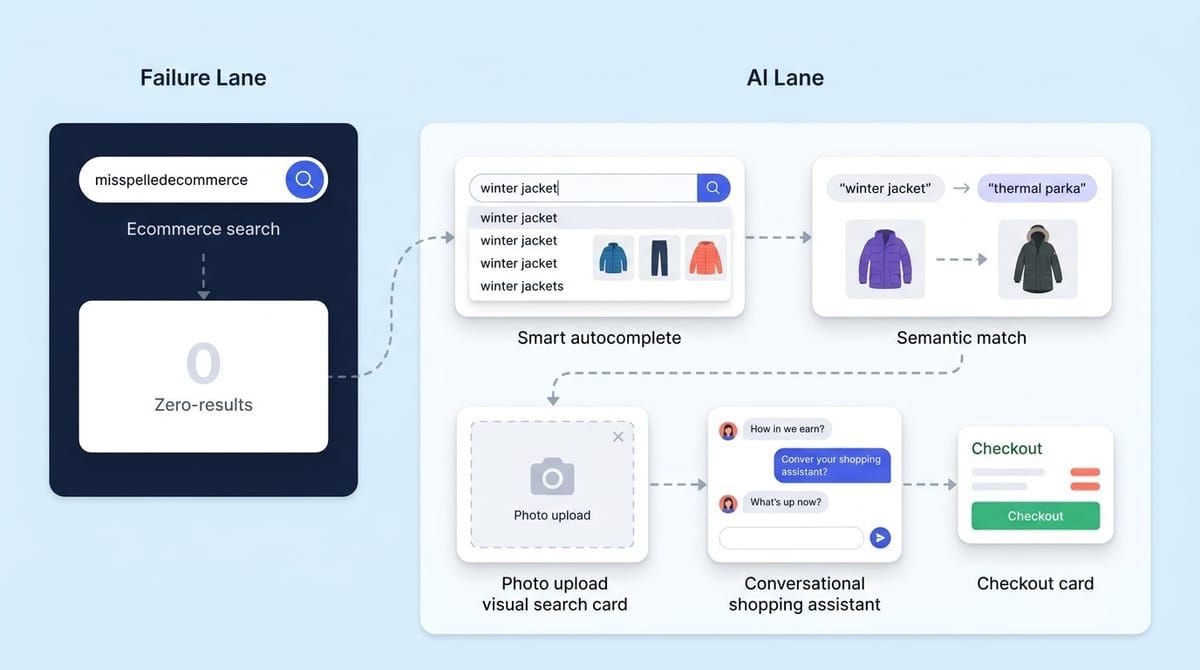
- Zero-result pages become dead ends. Between 10% and 30% of ecommerce searches return zero results. Research from LupaSearch shows the exit rate from those pages is 33%, and 68% of sites don't offer any alternatives.
The cost of these failures is steep. Google Cloud research found that 81% of U.S. shoppers leave and buy elsewhere after an unsuccessful search. Another 77% are likely to avoid the site entirely in the future. They don't complain. They just leave.
How AI-Powered Site Search Actually Works
AI search for ecommerce, sometimes called intelligent search, replaces rigid keyword matching with a stack of technologies that understand language, learn from behavior, and personalize results. Here's what happens under the hood.
Natural Language Processing (NLP)
NLP lets the search engine interpret the structure and meaning of search queries. Personalization starts here. When someone searches "cheap red dress for wedding," NLP breaks that into intent (affordable), attributes (red, formal), and category (dress). It doesn't just look for pages containing the word "cheap."
Vector and Semantic Search
Traditional search compares strings. Semantic search converts both queries and products into numerical vectors (embeddings) in a high-dimensional space. Products that are conceptually similar end up close together, even if they share zero keywords. A search for "winter jacket" can surface a "thermal parka" because the AI understands they serve the same purpose.
Machine Learning Ranking
Instead of ranking by keyword frequency or basic relevance scores, ML ranking factors in click-through rates, conversion data, trending products, and inventory levels. The data driven system and its algorithms learn which results shoppers actually want by analyzing millions of interactions.
Personalization
Two shoppers searching "running shoes" can see different results based on their browsing history, past purchases, location, and device. BCG estimates that revenue increases 6-10% through deep personalization that provides tailored results using proprietary customer data. AI search makes this happen in real time, adjusting rankings for every individual session. This personalization layer transforms how your ecommerce site handles search queries.
Five Features That Separate Good AI Search from Great
Not all AI search implementations are equal. These are the features that actually move the needle on conversion rates and ecommerce site search results performance.
1. Smart Autocomplete
Autocomplete that predicts intent from the search bar (not just matches prefixes). Autocomplete suggestions should appear instantly can boost conversions by up to 24%. Good autocomplete is the first thing users search for. The best implementations provide product images, prices, and categories right in the dropdown, so shoppers can buy without ever reaching a search results page.
2. Typo Tolerance and Synonym Recognition
Fuzzy matching handles misspellings and typos automatically, catching the 20%+ of queries with spelling errors. Synonym mapping ensures "sneakers," "trainers," and "athletic shoes" all return the same products. These two features alone, applied across multiple query types, can recover the 20%+ of searches that fail on keyword engines.
3. Zero-Result Recovery
When a query returns no exact matches, great AI search suggests related products, corrects the query, or shows popular alternatives. Since 56% of shoppers say they'd continue browsing if alternatives were offered, this feature directly reduces bounce rates.
4. Visual Search
Google Lens now processes 20 billion visual searches monthly, with 4 billion of those being shopping-related. Shoppers can upload a photo to find matching products, helping shoppers find exactly what they're looking for in your catalog. Retailers see 25-40% higher conversions from visual search traffic, and 62% of Gen Z and Millennials prefer it over text-based search.
5. Conversational Search
This is where AI search overlaps with AI shopping assistants. Instead of typing keywords into a box, shoppers ask questions in natural language: "What's a good laptop for video editing under $1,000?" The AI interprets the budget, use case, and category to return tailored search results with higher relevance. As our breakdown of conversational search vs. traditional search explains, this approach captures long-tail queries that keyword engines miss entirely.
How to Add AI-Powered Search to Your Store
You don't need to build a search engine from scratch. Modern AI search platforms offer API-first integrations with most ecommerce platforms. Here's a practical roadmap for any ecommerce site.
Step 1: Audit Your Product Data
AI search is only as good as your catalog data. Before you pick a platform, clean up your product titles, descriptions, attributes (size, color, material), and categories. Inconsistent product names, missing attributes, and poor taxonomy will undermine any AI engine. This step often takes longer than the technical integration itself.
Step 2: Choose a Platform
The build-vs-buy decision is straightforward for most brands: buy. Building an AI search engine requires ML engineering talent and months of development. Buying gets you live in weeks.
Here are the major AI search tools and platforms:
- Algolia: API-first, generous free tier, fast implementation. Great for developer-led teams.
- Constructor: Enterprise-focused, powered by clickstream data. Reports 47% revenue-per-visitor lifts for customers.
- Bloomreach: Full commerce experience platform with Loomi AI. Customers typically see 15-25% revenue increases in the first year.
- Athos Commerce (Klevu + Searchspring): Mid-market AI search and merchandising. Starts around $599/month.
- Google Vertex AI Search: Google-quality search with LLM capabilities. Usage-based pricing through Google Cloud.
When evaluating platforms, prioritize NLP quality, integration speed with your ecommerce stack (whether that's Shopify, WooCommerce, or Magento), and the ability to A/B test search results against your own KPIs.
Step 3: Integrate and Configure
Most platforms offer pre-built connectors for Shopify, WooCommerce, Magento, and Salesforce Commerce Cloud. Integration typically involves installing an app or adding a JavaScript snippet, syncing your product feed so the platform can index your catalog, and configuring ranking rules. Google Cloud reports that average integration time for Vertex AI Search is "in the order of weeks."
During configuration, set up synonym libraries, boost and bury rules (promote high-margin or seasonal products), apply merchandising strategies, and customize the search bar UI to match your brand.
Step 4: Test and Measure
Run an A/B test comparing AI search against your existing engine. Track these KPIs:
- Search-to-purchase conversion rate (the single most important metric)
- Revenue per search session
- Zero-result rate (target below 5%)
- Click-through rate on search results
- Average click position (lower is better, meaning shoppers find what they need faster)
Only 15% of companies dedicate resources to optimize their search optimization, and just 7% apply search insights to other parts of their business. In modern retail, the brands that treat optimized search as a revenue channel, not a utility feature, consistently outperform.
From Search Box to AI Shopping Assistant
AI powered site search is the foundation. But the most forward-thinking brands are going further by connecting ai powered search on your ecommerce website to conversational AI.
Think about it: a search box returns a grid of search results. A conversational AI assistant asks follow-up questions, narrows options based on the shopper's answers, and guides them to a purchase. The difference in conversion rates is significant.
This is exactly where Alhena AI's Shopping Assistant fits in. While standalone AI search platforms handle the search box, Alhena adds a conversational layer that turns browsing into buying. The assistant interprets natural language, asks clarifying questions ("What's the occasion? What's your budget?"), and returns personalized, relevant product matches, all within a chat interface.
Brands like Tatcha have seen 3x conversion rates and 38% AOV uplift using this approach. Victoria Beckham Beauty reported a 20% increase in average order value. These aren't search improvements. They're revenue improvements driven by AI that goes beyond the search box.
What makes Alhena different from adding another search tool? Three things:
- Hallucination-free responses. Every product recommendation is grounded in your verified catalog data. The AI won't suggest products you don't carry or make up specifications.
- Agentic checkout. Alhena doesn't just recommend products. It populates carts and pre-fills checkout, removing friction between "I found it" and "I bought it."
- Omnichannel product discovery. The same AI that powers your site search conversation also works on Instagram DMs, WhatsApp, and email. Shoppers can ask product questions wherever they are, and the AI serves consistent, accurate answers.
If you're already investing in AI site search, adding a conversational AI layer is the logical next step. As we explain in our guide to how AI shopping assistants increase conversion rates, the biggest gains come from combining intelligent search with guided product discovery.
Common Implementation Mistakes to Avoid
Even with a great AI search platform, these errors can limit your results:
Treating search as a one-time project. AI search needs ongoing tuning. Review zero-result search queries weekly, update synonym libraries as your catalog changes, and adjust merchandising and boost rules seasonally. Every search interaction is a touchpoint. The brands seeing 47% revenue-per-visitor lifts are the ones that treat search like a living system.
Ignoring mobile search UX. Over 70% of ecommerce traffic is mobile, but many stores still hide the search bar behind a tiny icon. Mobile bounce rates are 51% compared to 43% on desktop. Make search prominent, fast, and easy to use on small screens.
Skipping the data cleanup. No AI engine can fix a messy catalog. If "Blue T-Shirt (Men's)" and "Mens Blue Tee" describe the same product with different naming conventions, your search results will be inconsistent. Invest in data quality before (and during) your AI search rollout.
Not connecting search to the rest of the experience. Your best search data, including what people search for, what they click, and what they buy, should feed your email campaigns, homepage merchandising strategies, and personalized product recommendations. Only 7% of companies do this today. That's both a problem and an opportunity.
What's Next: The Future of Ecommerce Product Search
AI search in modern retail is evolving fast. Here are the trends shaping the next 12-18 months:
Multimodal search is going mainstream. Shoppers will combine text, images, and voice in a single query. Google Lens already processes 20 billion visual searches a month. Expect "search by photo" to become standard for fashion, home decor, and beauty retailers.
Agentic commerce is arriving. AI shopping agents that browse, compare, and purchase on behalf of consumers are no longer theoretical. ChatGPT's Instant Checkout launched in September 2025 and serves 900 million weekly users. The AI Shopping Assistant market is projected to grow from $4.33 billion in 2025 to $46.76 billion by 2035.
Search and conversation are merging. The line between typing a search query and chatting with an AI assistant is disappearing. Brands that invest in both AI site search and conversational AI will capture shoppers at every stage of the discovery journey, whether someone types "red dress" in a search bar or asks "What should I wear to a summer wedding?" in a chat window.
For brands running on Shopify, WooCommerce, or Salesforce Commerce Cloud, the path forward is clear: start with AI powered site search to fix the basics, then layer on conversational AI to turn product discovery into revenue. Alhena AI deploys in under 48 hours with no dev resources needed, so you can start seeing results before your next search platform contract comes up for renewal.
Ready to turn your site search into a revenue channel? Book a demo with Alhena AI to see how conversational product discovery drives real results, or start free with 25 conversations and test it on your own store.

Frequently Asked Questions
What is AI-powered site search and how does it differ from keyword search?
AI-powered site search uses natural language processing, vector embeddings, and machine learning to understand the meaning behind a query, not just the keywords. Where keyword search fails on typos, synonyms, and complex queries (70% of top ecommerce search engines can't handle synonyms, per Baymard Institute), AI search interprets intent and returns relevant results even when the wording doesn't match product titles exactly.
How much does AI-powered ecommerce search cost?
Costs vary widely by platform and scale. Algolia offers a free tier for small stores, Athos Commerce (Klevu + Searchspring) starts around 99/month for mid-market brands, and enterprise platforms like Constructor and Bloomreach use custom pricing. Most brands see clear ROI within 3-6 months, with reported revenue-per-visitor lifts ranging from 5% to 47%.
Can I add AI search to my Shopify or WooCommerce store?
Yes. Most AI search platforms offer pre-built connectors for Shopify, WooCommerce, Magento, and Salesforce Commerce Cloud. Integration typically involves installing an app or adding a JavaScript snippet and syncing your product catalog. Google Cloud reports integration timelines "in the order of weeks" for Vertex AI Search. For a conversational AI layer on top of search, Alhena AI integrates with Shopify and WooCommerce and deploys in under 48 hours.
What KPIs should I track after implementing AI site search?
The five most important metrics are: search-to-purchase conversion rate, revenue per search session, zero-result rate (target below 5%), click-through rate on search results, and average click position. Only 15% of companies dedicate resources to search optimization, so tracking these KPIs puts you ahead of most competitors.
How does conversational AI search differ from a traditional search box?
A search box returns a grid of products based on a query. Conversational AI goes further by asking follow-up questions, understanding context ("What's your budget? What's the occasion?"), and guiding shoppers toward a specific product. Research shows 12.3% of shoppers who interact with AI chatbots complete a purchase vs. 3.1% who don't. Alhena AI's Shopping Assistant combines both approaches.
What is the biggest mistake brands make with ecommerce site search?
The most common and costly mistake is treating search as a one-time setup rather than an ongoing channel. Brands that continuously review zero-result queries, update synonym libraries, A/B test ranking strategies, and feed search data into other marketing channels see the strongest results. Constructor's top customers report 47% revenue-per-visitor lifts because they optimize search continuously.
Does AI search work for small product catalogs?
For stores with fewer than 500 products, a well-configured basic search with good synonym lists and typo tolerance may be sufficient. AI search delivers the biggest ROI for stores with larger catalogs, high traffic volumes, and diverse product types where keyword matching breaks down. That said, even small stores benefit from NLP-powered autocomplete and conversational product discovery.
How does Alhena AI improve ecommerce product discovery beyond site search?
Alhena AI adds a conversational layer on top of product discovery. Instead of only matching keywords, it interprets natural language, asks clarifying questions, and recommends products with agentic checkout that populates carts and pre-fills checkout. It works across web chat, email, Instagram DMs, WhatsApp, and voice. Brands like Tatcha report 3x conversion rates and 38% AOV uplift with this approach.