The Ecommerce Personalization Gap Most Brands Don't See
Brands that excel at personalization earn 40% more revenue than their slower-moving peers, according to McKinsey's personalization research. Most ecommerce teams know this. Most also believe their personalization strategy is working. It isn't.
What passes for ecommerce personalization at most brands is segmentation: grouping thousands of unique shoppers into a handful of buckets. "Women 25 to 34 interested in skincare" includes a 26-year-old with oily, acne-prone skin and a 33-year-old with dry, aging skin. They need completely different personalized product recommendations, yet segment-based personalization systems treat them identically. The result is a personalized experience that feels slightly relevant but never truly personal.
The gap between segment-level personalization and AI-powered personalization that treats every shopper as a unique person is where revenue, loyalty, and conversion rates compound. This post maps the ecommerce personalization maturity progression from segments to individuals and explains why AI personalization is the only way to close it.
The Three Levels of Ecommerce Personalization Maturity
Not all personalization is created equal. Most ecommerce personalization strategies fall into one of three maturity levels, and the difference between them determines whether your personalized shopping experiences feel generic or genuinely helpful.
Level 1: Segment-Based Personalization
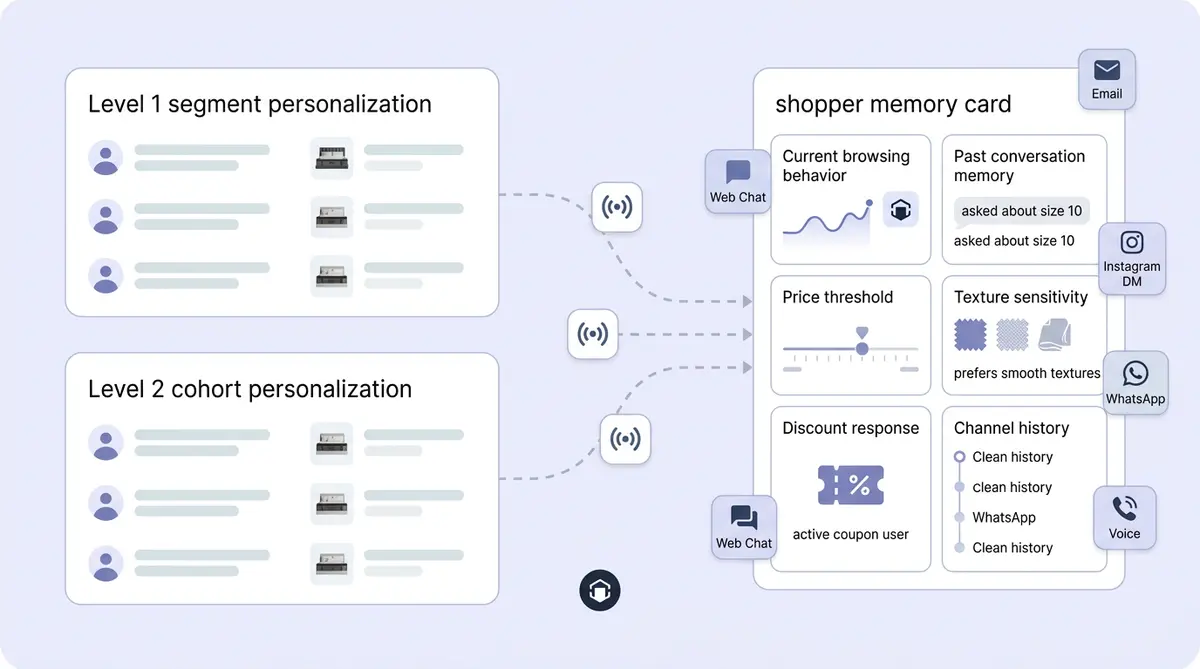
Segment-based personalization groups shoppers by demographics and broad behaviors: age, gender, location, category interest. Most ecommerce brands operate their personalization here. This level of personalization improves over zero personalization, but treats thousands of different shoppers identically. A "frequent buyers" segment might include someone who stocks up on basics every month and a shopper who splurges on new arrivals once a quarter. Same segment, completely different shopping intent.
Segment-based personalization works for broad campaigns. Send a sale announcement to your "high-value shoppers" segment and some will convert. But the personalized experience each shopper receives is the same, regardless of what they actually want right now. Ecommerce personalization at this level is a blunt instrument.
Level 2: Cohort-Based Personalization
Cohort-based personalization groups shoppers by specific behavioral patterns: repeat buyers who browse sale items, first-time visitors from paid social, high-AOV shoppers who return items frequently. This personalization approach is more precise than segment-based personalization, but still clusters shoppers into groups and misses personal nuance. A cohort of "high-AOV returners" doesn't tell you why each shopper returns or what personalized recommendation would prevent it.
Many ecommerce brands that believe they've mastered personalization are actually stuck between Level 1 and Level 2. They've refined their segments into behavioral cohorts, but the personalized experience each shopper receives is still based on group averages, not on what that specific person needs. True personalization requires moving beyond both segments and cohorts to the next level.
Level 3: AI-Powered 1:1 Personalization
AI-powered personalization treats every shopper as a unique entity. The AI knows that Sarah returns silk products because of texture sensitivity, prefers cotton blends under $80, shops on mobile at 9pm, responds to free shipping nudges but not percentage-off discounts, and has asked about sustainable materials in three separate conversations. No segment or cohort captures this level of personalization. Only an AI personalization engine that remembers, learns, and adapts in real time can deliver this personalized shopping experience.
This is where ecommerce personalization becomes truly personalized: every interaction reflects everything the brand knows about that specific shopper, not just the group they belong to. The personalization is continuous, adaptive, and unique to each person.
What Makes AI-Powered Personalization at Level 3 Possible
True 1:1 personalization requires three data layers working together. First, real-time behavioral signals from the current session: click patterns, scroll depth, search queries, hesitation behavior. These signals tell the AI personalization engine what the shopper wants right now, not what their segment typically wants.
Second, cross-session memory that remembers what the shopper browsed, asked, and purchased across previous visits. Without this memory, every personalized interaction starts from scratch, and the personalization feels repetitive rather than cumulative.
Third, cross-channel context that connects what the shopper said in chat, what they clicked in email, and what they asked on Instagram. Each channel captures a different fragment of shopper intent. When these fragments stay siloed, ecommerce personalization breaks down because the AI personalization system doesn't have a complete picture of the person.
Without a unified memory that links these signals into a single shopper understanding, genuine personalization is impossible. The AI shopping assistant doesn't know what the customer told the support agent last week. The email personalization engine doesn't know what the shopper searched on site this morning. Level 3 personalization requires all of these fragments to merge into one continuous profile that every touchpoint can access for a truly personalized experience.
Three Personalized Shopping Tactics That Go Beyond Segments
Personalized Conversational Discovery That Adapts in Real Time
AI-powered personalization doesn't run every shopper through the same quiz. If the AI already knows the shopper's skin type from a previous conversation, it skips that question and asks about new concerns instead. A first-time visitor gets a full personalized discovery flow. A returning shopper gets a "welcome back, last time you were looking at SPFs for sensitive skin" that picks up where they left off. Every interaction builds on the last, making the personalized experience feel like a relationship, not a transaction.
This kind of adaptive personalization is impossible with segment-based personalization systems. Segments don't remember what an individual shopper said last Tuesday. AI personalization engines do, and they use that memory to make every future personalized interaction more relevant.
Personalized Recommendations Triggered by Real-Time Shopper Behavior
AI-powered personalization surfaces products based on what the shopper is doing right now: lingering on a product page, comparing two items, reading reviews for a specific feature. The AI personalization engine combines these live signals with what it knows about the shopper's preferences from past interactions and browsing history. A shopper comparing two moisturizers who previously asked about fragrance-free options gets a personalized product recommendation weighted toward unscented formulas, not the bestseller that a segment-based personalization system would push.
This is the difference between personalized product recommendations based on "people like you bought this" and personalization that says "based on everything we know about you specifically, this is the right product." One is segment-level personalization. The other is AI-powered ecommerce personalization that treats the shopper as a market of one.
Personalized Support That Remembers Every Shopper
When a returning customer contacts support, AI-powered personalization means the AI already knows their order history, past issues, product preferences, and communication style. No more "can you tell me your order number and describe the issue?" friction. The personalized support experience starts with context, not from scratch. Brands like Tatcha have seen 3x conversion rates and 38% higher AOV by treating every shopper interaction as a continuation of an ongoing personalized relationship, not a standalone event.
Personalization at the support level also feeds back into the personalized shopping experience. When the AI learns that a shopper returned a product because of sizing issues, future personalized product recommendations account for that preference automatically. Conversion rates, product recommendations, and site engagement all improve when personalization remembers.
How Alhena AI Makes Level 3 Ecommerce Personalization Operational
Alhena AI is built to move brands from segment-based personalization to true 1:1 personalized shopping experiences. Its unified memory layer maintains a continuous, evolving understanding of each shopper across web chat, email, Instagram DMs, WhatsApp, and voice. Every conversation, every product interaction, every preference signal contributes to a single personalization profile that powers the entire personalized experience.
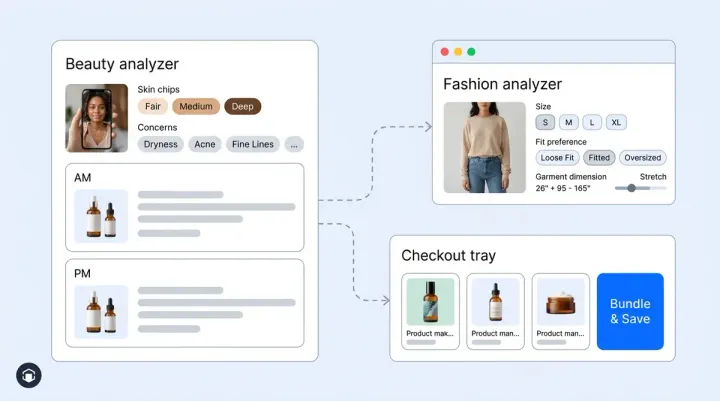
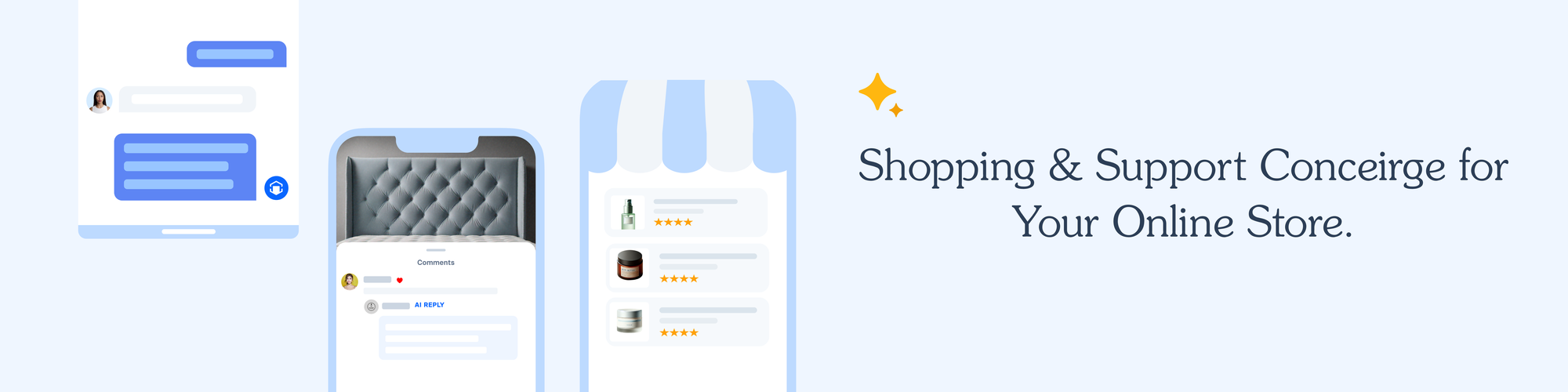
That profile drives personalized product recommendations from the AI Shopping Assistant, personalized support from the Support Concierge, and adaptive personalized engagement through conversion nudges. Vertical AI agents like the Skin Analyzer and Fit Analyzer use this personalization profile to deliver personalized product matches based on each person's specific attributes, not their segment's average.
Victoria Beckham saw a 20% AOV increase by letting Alhena's AI personalization engine connect browsing behavior to conversational context. Manawa cut response times from 40 minutes to 1 minute while automating 80% of inquiries, because the AI already had the personalized context it needed to help each shopper on a personal level.
Alhena connects to Shopify, Salesforce Commerce Cloud, Zendesk, and Gorgias, deploying personalization solutions in under 48 hours with no dev resources. The ecommerce personalization features, technologies, and services are ready out of the box, so businesses don't need a multi-month infrastructure project to deliver personalized shopping at scale.
How AI Personalization Transforms the Entire Customer Journey
Segment-based personalization typically touches a few moments in the customer journey: a personalized homepage banner, a product recommendation widget, maybe a triggered email. AI-powered ecommerce personalization transforms the entire shopping journey from discovery to post-purchase.
At the discovery stage, AI personalization uses predictive algorithms to surface products that match each shopper's preferences before they even search. Instead of showing the same "trending now" carousel to every visitor, the AI predicts what each person is most likely to want based on their browsing history, past conversations, and behavioral patterns. The personalized shopping journey starts the moment a shopper lands on your site.
During consideration, the AI adapts its approach in real time based on shopper behavior. A customer comparing two products gets a dynamic personalized comparison highlighting the features that matter to them specifically. Someone reading reviews gets a tailored recommendation that addresses the concerns they've shown. The AI personalization engine continuously analyzes signals and adjusts the customer experience to match the shopper's evolving preferences.
At purchase, personalized nudges reduce friction. The AI knows whether this specific shopper responds to free shipping offers, urgency messages, or bundle suggestions. Rather than showing every customer the same generic pop-up, AI-powered personalization delivers the right incentive to the right person at the right moment in their customer journey.
Post-purchase, personalization continues through the support experience. AI-powered automation handles order tracking, returns, and follow-up product recommendations based on what the customer actually bought. Crocus achieved an 86% deflection rate with 84% CSAT by using AI personalization to provide fast, personalized support that anticipates what each customer needs. The personalized customer experience doesn't end at checkout.
Measuring the ROI of AI-Powered Ecommerce Personalization
Moving from segment-based to AI-powered personalization is a strategic investment, and ecommerce leaders need to track the right metrics to prove its value. The most important personalization ROI indicators go beyond basic conversion rates.
Revenue per personalized interaction. This measures how much revenue each AI-powered conversation or personalized recommendation generates. Alhena AI's built-in analytics and revenue attribution track this automatically, so businesses can see exactly how personalization drives sales. Data-driven personalization strategies require data-driven measurement.
Customer retention and repeat purchase rate. AI personalization builds ongoing relationships, not one-time transactions. When the AI remembers a shopper's preferences across visits, retention improves because the customer experience gets better over time. Personalization that adapts creates loyalty that static segments can't match.
Average order value lift. Personalized product recommendations based on deep customer data consistently increase AOV. The AI doesn't just suggest bestsellers. It suggests the right products for each person at the right price point, informed by their full interaction history across every digital channel.
Support cost reduction through automation. AI personalization handles routine inquiries automatically because the system already has the customer data and context it needs. Puffy achieved 63% automated inquiry resolution with 90% CSAT, proving that personalized AI automation improves both efficiency and the customer experience simultaneously.
The omnichannel advantage is also measurable. When personalization works consistently across web chat, email, social, and voice, shoppers engage across more touchpoints. Brands using Alhena AI's omnichannel personalization can track how a personalized Instagram DM conversation leads to a site visit, which leads to a purchase, all connected by the same customer data profile.
Ecommerce teams that optimize their personalization strategy using these metrics can demonstrate clear ROI to leadership. The analytics show not just that personalization works, but exactly where and how it drives the most value for your specific user experience and customer base.
Why Ecommerce Personalization Maturity Matters More in 2026
Consumer expectations for personalized shopping experiences have accelerated. According to Salesforce, 84% of shoppers say being treated like a person, not a number, is critical to winning their business. Gartner predicts that 60% of brands will use agentic AI for 1:1 personalized interactions by 2028. The era of segment-based personalization as a competitive advantage is ending.
Businesses still relying on segment-based personalization are seeing diminishing returns. Shoppers have grown accustomed to the basics: personalized email subject lines, personalized product recommendations based on browsing history, and retargeting ads. These personalization tactics no longer feel personalized. They feel expected. The brands pulling ahead are the ones whose personalization adapts to each shopper in real time across every channel and touchpoint.
The process of moving from Level 1 to Level 3 personalization isn't just a technology upgrade. It's a strategic shift in how businesses think about the shopper relationship. Segment-based personalization treats shoppers as members of groups. AI-powered ecommerce personalization treats each shopper as a person with unique preferences, intent, and browsing history. The revenue difference between those two personalization approaches compounds over time.
Why Staying at Segment-Based Personalization Costs More Every Quarter
Segment-based personalization was the best available personalization approach before AI memory made 1:1 personalized experiences possible. It still has a place in campaign planning and audience sizing. But as the delivery mechanism for personalized shopping experiences, segments are hitting diminishing returns.
Shoppers now expect every personalized interaction to reflect what the brand already knows about them. When personalization doesn't deliver, they notice. When a competitor's AI personalization remembers their preferences and your site asks them to re-enter their skin type for the third time, the conversion goes elsewhere.
Brands that reach Level 3 ecommerce personalization build a compounding advantage. Every personalized interaction makes the next one more relevant, more personal, and more likely to drive conversions across your site. The AI personalization engine gets smarter with each conversation, each browsing session, each purchase. Over time, the gap between brands with AI-powered personalization and brands stuck at segment-based personalization widens, not just in conversion rates but in customer lifetime value, repeat purchase frequency, and loyalty.
For ecommerce businesses, the personalization maturity path is clear. Segments got you this far. AI-powered personalization gets you to 40% more revenue. Ready to move your ecommerce personalization from segments to truly personalized shopping? Book a demo with Alhena AI or start for free with 25 conversations.
Frequently Asked Questions
What is the difference between segment-based personalization and 1:1 AI personalization in ecommerce?
Segment-based personalization groups shoppers into buckets like "women 25 to 34 who like skincare" and shows everyone in that segment the same personalized content. 1:1 AI personalization, which Alhena AI enables through its unified memory layer, treats every shopper as a unique person by combining real-time behavioral signals, cross-session browsing history, and cross-channel context into a single evolving personalization profile that powers truly personalized shopping experiences.
What customer data does AI need for true 1:1 ecommerce personalization?
True 1:1 ecommerce personalization requires three data layers: real-time session signals (clicks, scroll depth, search queries, hesitation), cross-session memory (past browsing history, purchases, and conversations), and omnichannel context (chat, email, social, and voice interactions). Alhena AI unifies all three layers into one continuous personalization profile that every digital touchpoint can access to deliver personalized product recommendations and personalized support.
Does AI personalization work without third-party cookies?
Yes. AI-powered ecommerce personalization relies on first-party and zero-party customer data, not third-party cookies. Alhena AI builds personalization profiles from direct shopper interactions: what they browse, what they ask in chat, what they purchase, and how they engage across channels. This data-driven personalization strategy is more accurate and privacy-compliant than cookie-dependent approaches.
How does unified memory enable omnichannel personalized shopping experiences?
Without unified memory, each digital channel sees a fragment of the shopper. The chat agent doesn't know what the shopper clicked in an email, and the email personalization engine doesn't know what they asked on Instagram. Alhena AI's unified memory layer connects every interaction across web chat, email, Instagram DMs, WhatsApp, and voice into one personalization profile, so every touchpoint delivers a consistent, personalized customer experience.
What is the ROI of moving from segment-based to AI-powered ecommerce personalization?
McKinsey research shows personalization leaders earn 40% more revenue from those activities than average performers. Alhena AI customers have seen specific ROI from AI-powered personalization: Tatcha achieved 3x conversion rates and 38% higher AOV, Victoria Beckham saw a 20% AOV increase with personalized product recommendations, and Puffy reached 63% automated inquiry resolution with 90% CSAT through personalized AI automation.
How quickly can an ecommerce brand implement AI-powered 1:1 personalization?
With Alhena AI, most ecommerce brands deploy personalization in under 48 hours with no developer resources. Alhena AI integrates with Shopify, Salesforce Commerce Cloud, Zendesk, Gorgias, and other ecommerce platforms out of the box, so Level 3 personalization that delivers personalized shopping experiences and predictive customer engagement doesn't require a multi-month infrastructure project.