The Real Cost of Manual Order Processing
Every sales order that moves through your ecommerce operation touches multiple systems: your storefront, your order management system, your ERP, your warehouse, and your shipping providers. At each handoff, manual data entry introduces errors. Industry research puts the average error rate at 3 percent per manual step, and those errors cascade: wrong addresses trigger failed deliveries, incorrect inventory counts create stockouts, and misrouted orders inflate fulfillment costs by 30 percent or more.
AI changes the equation by replacing fragmented, rule-based workflows with intelligent automation that learns from your data, adapts to real-time conditions, and eliminates the decision-making bottlenecks that slow order processing down.
This guide focuses on the operational backbone of AI order management, the fulfillment, inventory, and supply chain workflows that determine whether your orders ship accurately and on time. For customer-facing topics like WISMO resolution and post-purchase engagement, see our dedicated guide to AI-powered post-purchase experiences. For returns-specific automation, see our AI returns and refunds guide.
Five Ways AI Transforms Ecommerce Order Processing
1. Automated Order Validation and Fraud Detection
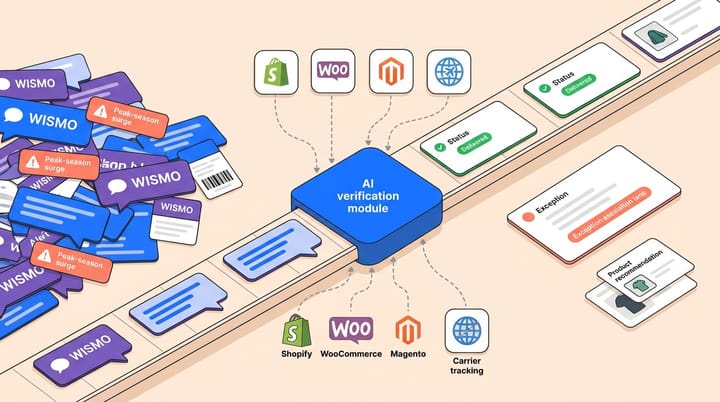
Every order that enters your system needs validation before it reaches fulfillment, including correct addresses, payment verification, and inventory availability. Manual checks slow the order process and miss patterns that machine learning catches instantly.
AI-powered fraud detection systems now achieve 95 percent accuracy while reducing false positives by 40 percent. That precision matters because merchants lose 13 times more revenue from incorrectly declined legitimate orders than from actual fraud. An intelligent AI system protects revenue on both sides: blocking fraudulent transactions while ensuring real customers complete their purchases without unnecessary intervention.
Beyond fraud, AI validation automates address correction, payment reconciliation, and inventory confirmation in real time, reducing data entry errors by up to 80 percent and streamlining the entire order process from placement to warehouse pick.
2. Smart Order Routing and Fulfillment Optimization
When you sell across multiple channels and ship from multiple locations, routing decisions get complex fast. Which warehouse has the item in stock? Which fulfillment center is closest to the customer? Which carrier offers the best rate for the delivery promise you made?
AI evaluates inventory levels, warehouse proximity, carrier rates, and delivery windows in milliseconds. This intelligent decision-making cuts order processing time from 2 to 3 days down to 1 to 2 hours. Smart order fulfillment through AI increases operational efficiency by up to 40 percent while reducing fulfillment errors by nearly 60 percent, a direct impact on both customer satisfaction and your bottom line.

3. AI-Powered Demand Forecasting and Inventory Management
Supply chain optimization starts with better forecasting. Stockouts cost U.S. retailers $634 billion annually. Overstocking adds another $472 billion. That is a combined $1.1 trillion problem driven largely by inaccurate predictions.
AI-powered demand forecasting achieves 92 to 97 percent accuracy, compared to 65 to 75 percent for traditional statistical methods. Machine learning models analyze historical sales data, seasonal patterns, promotional calendars, and external signals like weather and market trends to predict demand at the SKU level. Retailers using ML-based forecasting report 20 to 30 percent inventory reductions while simultaneously decreasing stockouts, a balance that manual forecasting rarely achieves.
This visibility across your supply chain means procurement teams can optimize supplier lead times, warehouse managers can streamline allocation, and finance teams can forecast cash flow with higher accuracy.
4. ERP Integration and End-to-End Workflow Automation
The most impactful AI order management systems do not operate in isolation. They connect to your ERP system, your warehouse management platform, and your supplier networks to automate workflows end to end.
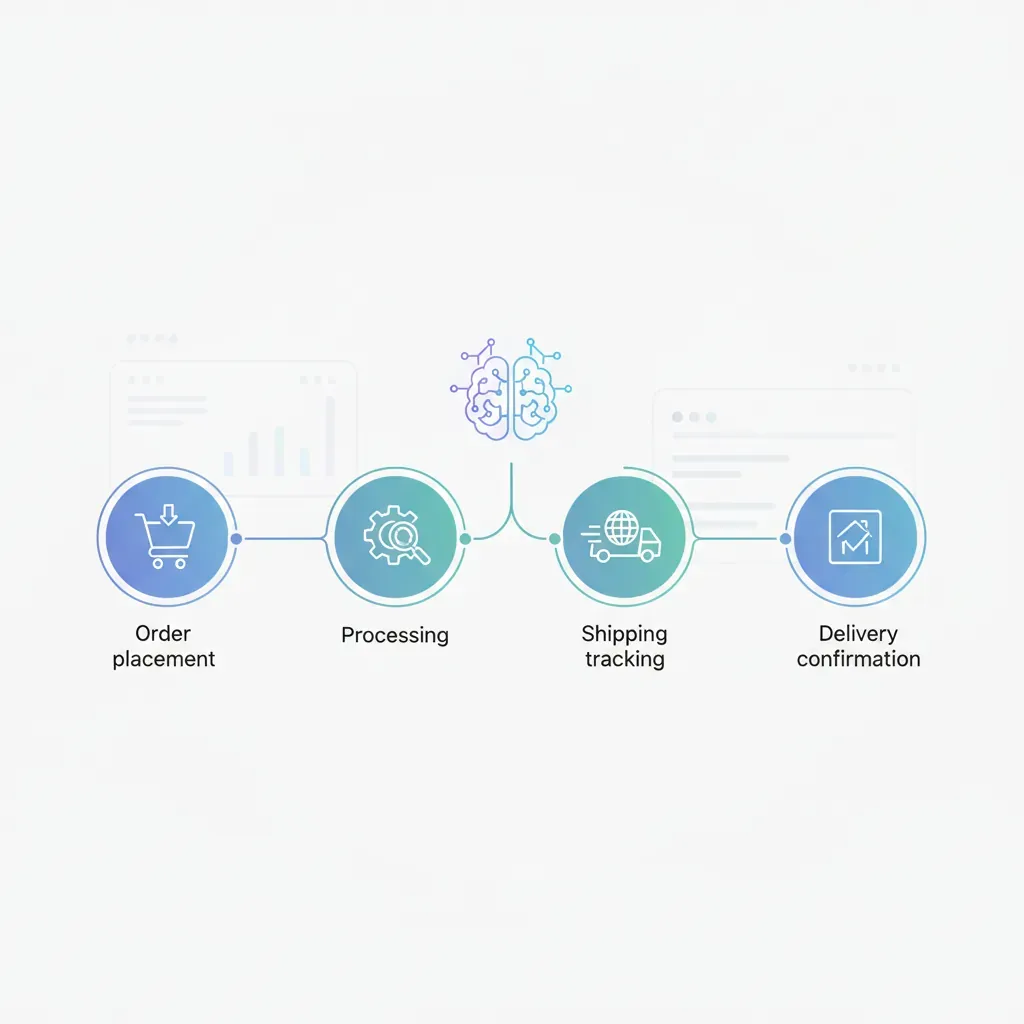
When an AI agent processes a sales order, it can simultaneously update inventory across all channels, trigger purchase orders to suppliers when stock drops below thresholds, generate pick-and-pack instructions optimized for warehouse layout, and sync financial records in your ERP, all without manual intervention. This level of process automation eliminates the data silos that cause overselling, late shipments, and reconciliation headaches.
For brands managing complex operations, this connectivity transforms order management from a series of disconnected tasks into a single, intelligent workflow with full analytics and visibility at every stage. Teams that leverage end-to-end ERP integration consistently deliver a better customer experience while reducing operational overhead.
5. Predictive Exception Management
Traditional order management systems react to problems after they happen. AI predicts them before they reach the customer.
By analyzing patterns across carrier performance data, weather forecasts, warehouse throughput, and historical delay trends, AI systems flag at-risk orders before they miss their delivery windows. This gives operations teams time to reroute shipments, adjust fulfillment priorities, or proactively communicate with customers, turning potential failures into managed exceptions.
Brands using predictive exception management report measurable improvements in on-time delivery rates and a significant reduction in escalated support tickets, because the problem is resolved before it becomes visible to the customer.
How Alhena AI Fits into Your Order Management Stack
Alhena AI approaches order management differently from generic support tools. Rather than treating orders as ticket data to deflect, Alhena connects directly to your ecommerce platform and takes action on live order data.
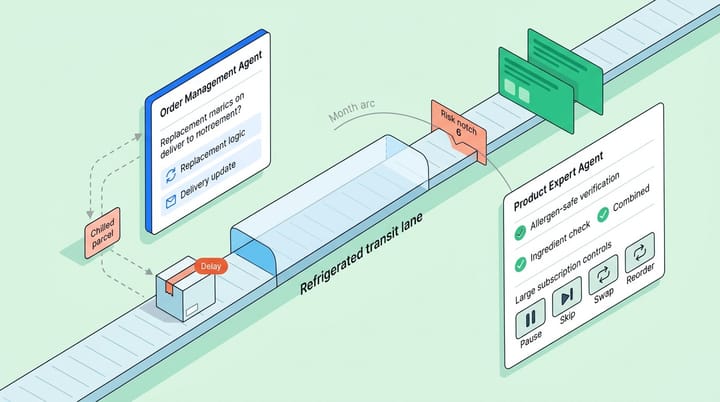
The Order Management Agent integrates with Shopify, WooCommerce, Magento, and Salesforce Commerce Cloud to access real-time order status, shipment tracking, and fulfillment data. It handles order lookups, modifications, and cancellations conversationally, verifying eligibility against fulfillment status and executing changes without requiring agent involvement.
The Product Expert Agent works upstream, helping customers find the right product before the order is placed. By guiding shoppers through personalized recommendations, fit analysis, and product comparisons, it reduces the mismatched-expectations orders that create downstream fulfillment complications and returns.
Both agents operate through Alhena's hallucination-free architecture, meaning every response is grounded in your verified product catalog and order data, not generated from a language model's best guess. This is the critical difference between an AI system that streamlines your order management and a chatbot that simply summarizes ticket information.
Alhena deploys in under 48 hours with pre-built integrations across helpdesks (Zendesk, Gorgias, Freshdesk, Intercom) and shipping providers (Narvar, ShipStation, EasyPost, Shippo), with no developer resources required.
Getting Started
You do not need a six-month implementation plan to automate order management. Start by auditing your current order processing workflow: identify where manual data entry creates errors, where routing decisions slow fulfillment, and where inventory visibility gaps lead to stockouts or overselling. Those are your highest-impact automation candidates.
Use the Alhena ROI Calculator to estimate your potential savings, then schedule a demo to see how AI agents handle your specific order workflows.

For food and beverage brands dealing with perishable goods, see our deep dive on AI for food and beverage ecommerce order management.
Frequently Asked Questions
How does AI order management integrate with ERP systems like NetSuite or SAP?
AI order management systems connect to your ERP through APIs or pre-built connectors to sync order data, inventory levels, purchase orders, and financial records in real time. When an AI agent processes a sales order, it can simultaneously update stock quantities across all channels in your ERP system, trigger automated replenishment workflows to suppliers, and post transaction records without manual data entry. The key requirement is bidirectional data flow, the AI needs to both read from and write to your ERP so that inventory counts, order status changes, and fulfillment updates stay accurate across every system in your stack. Alhena AI integrates with major ecommerce platforms and helpdesks through pre-built connectors, ensuring order data flows into your existing operations infrastructure without custom development.
What is the difference between an AI-powered order management system and a traditional OMS?
A traditional order management system follows rigid, rule-based logic: if inventory is below X at warehouse A, route to warehouse B. It executes predefined workflows but cannot adapt when conditions change unexpectedly. An AI-powered order management system uses machine learning to make intelligent decisions based on real-time data, evaluating carrier performance patterns, demand forecast signals, warehouse throughput capacity, and delivery promise windows simultaneously. The practical difference shows up in accuracy and speed. Traditional systems require manual intervention when exceptions occur (split shipments, carrier delays, address corrections). AI systems predict these exceptions before they happen, automate the resolution, and continuously optimize routing logic based on outcomes. For ecommerce brands managing complex, multi-location fulfillment, this shift from reactive rules to predictive automation eliminates the bottlenecks that slow order processing and inflate operational costs.
How does AI prevent stockouts without causing overstock?
AI demand forecasting solves this by analyzing a much wider set of signals than traditional statistical methods. Instead of relying solely on historical sales data, machine learning models factor in seasonality, promotional calendars, competitor pricing shifts, weather patterns, and real-time sell-through velocity to predict demand at the SKU level with 92 to 97 percent accuracy. This granular visibility lets procurement teams set dynamic reorder points that adjust automatically as demand patterns change, rather than using static safety stock thresholds that either run out during surges or tie up capital during slow periods. The result is tighter inventory management: brands using AI-powered forecasting typically report 20 to 30 percent reductions in total inventory while simultaneously reducing stockouts, freeing working capital without sacrificing product availability.
How does AI order routing decide which warehouse to ship from?
AI order routing evaluates multiple variables in parallel to determine the optimal fulfillment location for each order. These variables typically include real-time inventory availability at each warehouse, geographic proximity to the customer's delivery address, carrier rate comparisons for available shipping methods, current warehouse processing capacity and backlog, and the delivery promise made at checkout. The AI system scores each fulfillment option against these factors in milliseconds and selects the route that minimizes cost while meeting the promised delivery window. Over time, the machine learning model refines its decision-making by analyzing which routing choices resulted in on-time deliveries versus exceptions, continuously improving accuracy. For brands shipping from three or more locations, this intelligent routing can reduce shipping costs by 15 to 25 percent compared to static routing rules while improving on-time delivery rates.
Can AI order management reduce false declines in fraud detection?
Yes, and this is one of the highest-impact applications of AI in order processing. Traditional rule-based fraud filters flag orders based on rigid criteria, mismatched billing and shipping addresses, high-value purchases, or first-time buyers from certain regions. These rules generate a high rate of false positives, and research shows that merchants lose 13 times more revenue from incorrectly declined legitimate orders than from actual fraud. AI fraud detection uses machine learning to analyze hundreds of behavioral signals in real time: device fingerprinting, purchase velocity patterns, session behavior, and historical transaction context. This allows the AI system to distinguish between genuinely suspicious activity and normal customer behavior that happens to trigger a static rule. The result is 95 percent fraud detection accuracy with up to 40 percent fewer false positives, meaning more legitimate orders complete successfully while actual fraud is still caught.
What data does an AI order management system need to deliver accurate results?
The accuracy and effectiveness of AI order management depends directly on the quality and breadth of data it can access. At minimum, the system needs real-time inventory data across all warehouse and fulfillment locations, historical order data including processing times, carrier performance, and exception rates, product catalog data with SKU-level attributes such as weight, dimensions, and handling requirements, and customer order history for validation and personalization. For demand forecasting specifically, the AI benefits from promotional calendars, seasonal sales patterns, and any external data feeds relevant to your category (weather data for outdoor goods, trend data for fashion). The more connected your data sources are, from your ecommerce platform and ERP system to your warehouse management and supplier systems, the more accurately the AI can optimize every step of the order lifecycle. Alhena AI auto-ingests product catalog and order data from Shopify, WooCommerce, Magento, and Salesforce Commerce Cloud during setup, with most brands fully connected within 48 hours.