The Operational Reality: You Are Not a DTC-Only Brand Anymore
Most ecommerce sellers in 2026 sell on Amazon, Walmart Marketplace, Etsy, and their own Shopify or WooCommerce store simultaneously. Each channel enforces different messaging rules, return policies, review ecosystems, and data access limitations and technology constraints. The result is a fragmented shopping journey where the same brand feels like four different companies depending on where someone bought online.
According to the Mirakl Seller Trends Report 2025, 36% of sellers now operate on four to six online marketplaces, with another 23% managing seven to ten. That marketplace growth makes the CX fragmentation problem worse every quarter, slowing growth for retailers who can't keep up.
This guide covers five marketplace CX challenges that generic AI cannot solve and the unification framework your core brand needs.
Five Marketplace CX Challenges That Generic AI Cannot Solve
1. Communication Restrictions by Platform
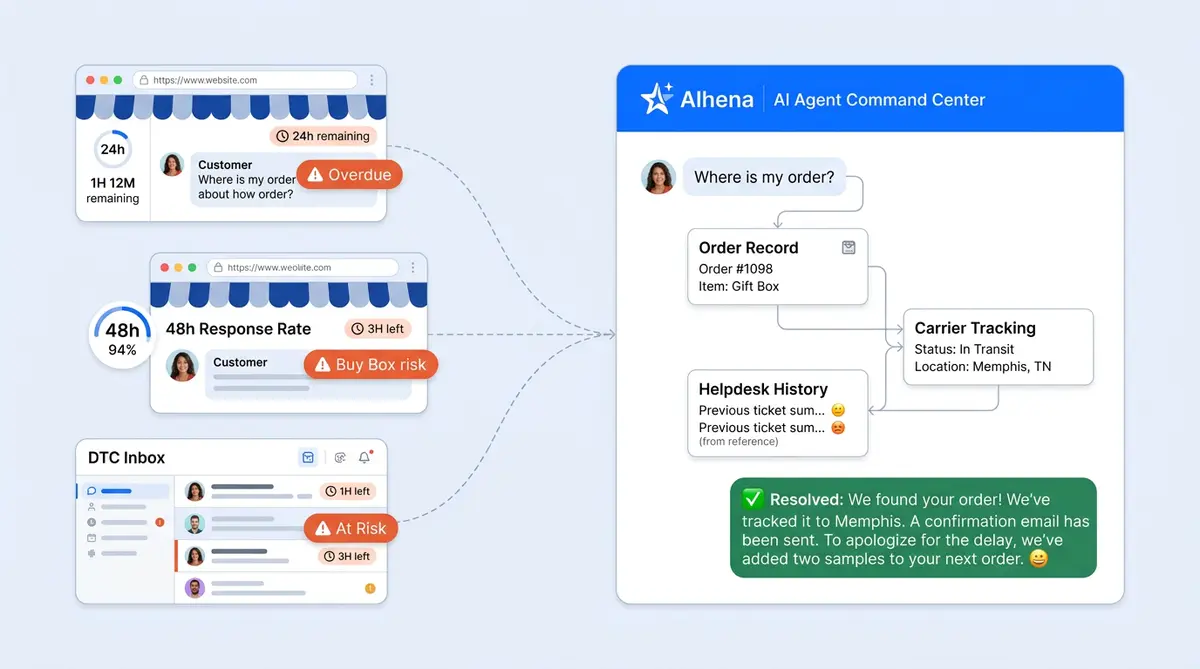
Amazon restricts seller-to-buyer messaging to order-related content only, blocking advertising, marketing language, and promotional content, and external links. Walmart Marketplace enforces its own response time SLAs (95% of inquiries answered within 48 hours). Etsy allows more direct communication but keeps everything within its own ecosystem. Your DTC store has zero restrictions.
An AI shopping assistant handling support across all four channels and third parties must detect which communication rules apply to each consumer based on their purchase channel and adapt automatically.
2. Policy Divergence Across Channels
Return management, refund processing, fulfillment responsibility, and warranty terms differ by marketplace. AI agents must surface the correct policy based on where each customer transacted their order, ensuring every transacted purchase gets the right policy, without human agents manually checking which channel applies. Getting this wrong on Amazon increases your Order Defect Rate, and ODR above 1% means losing Buy Box eligibility for up to 60 days.
3. Review Management Fragmentation
Your brand reputation is split across Amazon reviews, Walmart reviews, Etsy reviews, and DTC site reviews. Each platform has different ranking models, response rules, and visibility algorithms. AI agents must understand the response constraints of each platform when drafting review replies. A product review tool that treats all reviews identically will violate platform rules or miss opportunities for product discovery and customer loyalty.
4. Customer Identity and Data Limitations
On your DTC store, you own the full customer profile: email, purchase history, and browsing behavior. On Amazon, you receive minimal buyer data. On Walmart, data access is limited. Autonomous AI agents acting autonomously on your behalf must operate with different data models per channel. On DTC, deliver deeply personalized service. On marketplaces where shopper data is restricted, deliver accurate, policy-compliant support using only available order information.
5. Channel Confusion and Cross-Channel Routing
Customers frequently contact merchants through the wrong channel. AI agents must detect the purchase channel from order data, route the conversation to the correct policy set, and resolve it through automation without making the shopper feel bounced between systems.
The AI Unification Strategy: One Intelligent CX Layer
Deploy one AI platform that ingests order records from every channel, applies rules per platform, maintains core brand consistency, and gives your team a unified view.
The AI solution identifies the source channel, pulls relevant data, and applies correct policies before an agent opens the ticket. This eliminates the most common source of support errors: applying the wrong channel's policy to a transaction.
The DTC-First Strategy That Marketplace AI Enables
While respecting each marketplace's rules, AI should identify opportunities to accelerate the direct customer relationship and build loyalty. A marketplace shopper who contacts your DTC support represents a conversion opportunity. On your own site, the full power of guided selling, product recommendations, product discovery, and personalized shopping journey interactions activates.
This DTC-first approach is where the revenue strategy lives. Marketplace transactions carry retail media fees and commissions ranging from 8% to 45% depending on category. Every customer you convert from marketplace buyer to direct buyer, reducing your marketing cost per acquisition goes straight to your bottom line. Brands like Tatcha saw 3x conversion rates and 38% AOV uplift when using AI shopping assistants on their DTC store, proving this model scales.
How the Alhena AI Platform Unifies Marketplace CX
Alhena AI gives marketplace merchants and retailers a unified CX layer across every selling channel. Native integrations with Shopify, WooCommerce, and Salesforce Commerce Cloud handle DTC. Helpdesk integrations with Zendesk, Freshdesk, Gorgias, and Kustomer aggregate marketplace tickets into one AI solution.
Alhena's Order Management Agent pulls order records from each connected platform and can automate policy checks, apply the correct return and fulfillment rules, and enforce communication constraints based on purchase channel. The Product Expert Agent drives product discovery, guided selling, and agentic checkout for DTC transactions.
Alhena provides channel-tagged analytics showing CSAT, resolution rate, and response time per channel. This gives b2b vendors and businesses visibility into which channels generate the most support burden . Setup takes under 48 hours.
Unify Now or Fragment Further
Marketplace sellers and online sellers who treat each channel as a separate CX silo are fragmenting their core brand experience and burning resources on problems that AI agents can eliminate. Brands that unify their CX layer across Amazon, Walmart, Etsy, and DTC will deliver faster, more accurate support everywhere while monetizing the direct customer relationship that protects margins long-term.
Every month you run separate support workflows per channel, you pay for inefficiency that autonomous AI agents and automation tools were built to remove. The question isn't whether to unify. It's how fast you can accelerate to get there.
Book a demo with Alhena AI or start for free with 25 conversations. Use the ROI Calculator.
Frequently Asked Questions
How does AI apply different return policies for Amazon, Walmart, and DTC orders automatically?
Alhena AI matches every inquiry against order data from each connected platform to identify the purchase channel. It then applies that channel’s return window, refund rules, and shipping responsibility automatically, eliminating the most common multi-marketplace support error.
Can AI comply with Amazon's seller-to-buyer communication restrictions while still handling support?
Alhena AI maintains channel-specific communication rulesets. For Amazon orders, it restricts responses to order-related content and removes marketing language. For DTC orders in the same queue, it switches to full flexibility including product recommendations.
How does a unified AI CX layer help convert marketplace buyers into DTC customers?
When a marketplace buyer contacts your DTC support, Alhena identifies this as a conversion opportunity and activates guided selling and agentic checkout from your full product catalog, reinforcing the value of buying direct.
What analytics does AI provide for comparing buyer experience across Amazon, Walmart, and DTC?
Alhena provides channel-tagged analytics breaking down support volume, resolution rate, CSAT, and deflection rate by marketplace versus DTC, so you can see which channels generate the most burden and allocate resources based on data.
How long does it take to set up AI that handles support across multiple marketplaces and a DTC store?
Alhena deploys in under 48 hours. Connect your selling platforms and helpdesk, map per-channel policies, and the AI begins handling conversations with channel-aware intelligence from day one.