One in three customers say interacting with an AI agent or AI chatbot is the single most frustrating part of contacting a business, according to a 2026 AnswerConnect survey of 6,000 adults. The second biggest frustration? Having to repeat their issue after being transferred to a human agent. A Zendesk CX Trends study of over 11,000 respondents found that 74% of customers find it frustrating to retell their story to a different agent.
These two failures share the same root cause: the AI agent doesn't know when to hand off, and it doesn't transfer what it learned when it does. For e-commerce, commerce, and social commerce brands relying on AI-powered chatbots, this gap between automation and customer satisfaction is where revenue leaks. Satisfaction drops every time a shopper has to start over. The customer experience breaks at the exact moment it matters most.
Here's the core principle this guide is built on: escalation is not failure. It's the AI agent's most important decision. In e-commerce, a well-timed handoff with full context creates a better experience than either AI-only or human-only support. The human touch matters most when AI reaches its limits. The brands with the highest CSAT scores aren't the ones that avoid escalation. They're the ones that make escalation invisible and the customer experience seamless.
This playbook covers the AI human escalation trigger logic, context transfer architecture, and vertical benchmarks that turn AI human handoff from a breakdown into a competitive advantage for ecommerce brands.
Three Categories of Escalation Triggers
The customer experience hinges on one thing: knowing when to escalate matters more than how fast your AI responds. Most ecommerce customer support systems rely on a single signal to manage AI agent interactions. Modern AI tools and escalation management AI tools can do better, driving operational efficiency by analyzing every message and inquiry in real time ("talk to a human" keyword match), which misses the majority of situations that genuinely need a person. Effective AI support systems use three categories of escalation triggers firing in parallel, forming a decision matrix that evaluates each type of interaction through a dynamic workflow.
1. Explicit Triggers
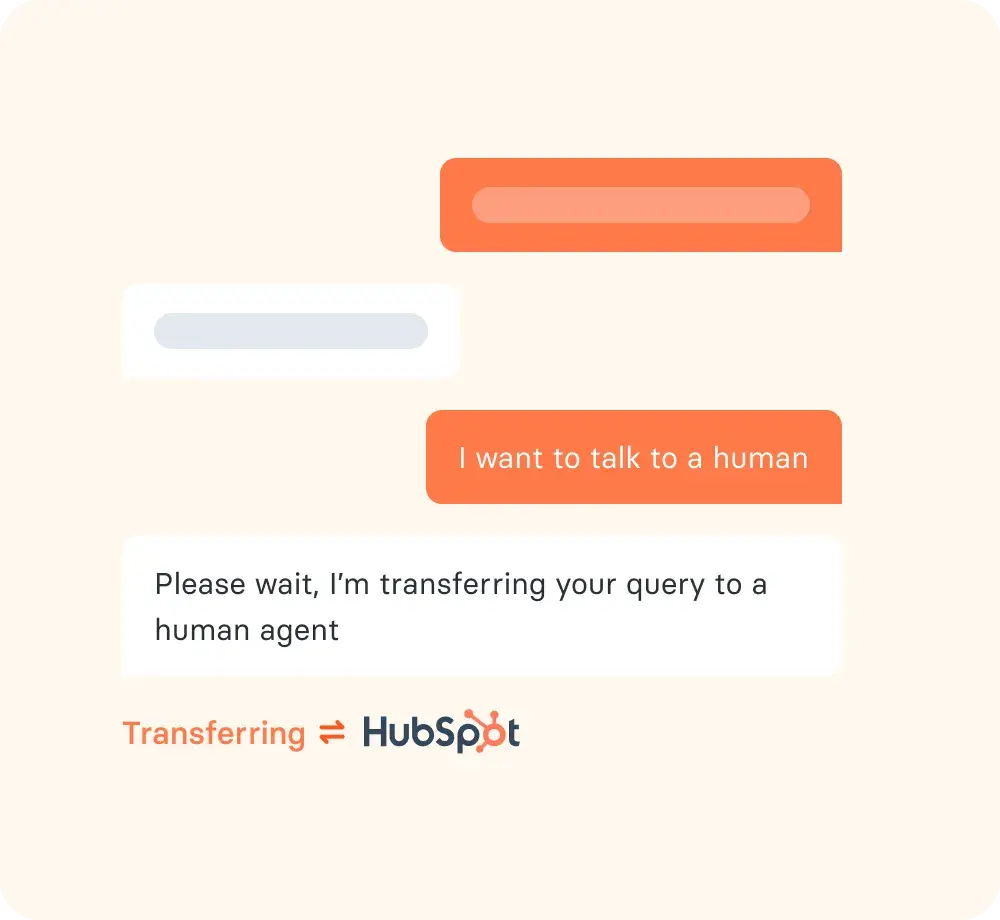
The customer directly asks for a human, uses phrases like "let me speak to someone," or expresses clear dissatisfaction with AI responses. These must always transfer immediately with zero additional AI attempts to resolve. Conversational AI must recognize when shoppers want a person and act on it instantly. Any extra bot message after an explicit request damages the customer experience. ("Let me try one more thing...") compounds frustration and erodes trust. When 88% of customers expect the option to reach a human agent at any time, honoring that request instantly is non-negotiable.
2. Confidence-Based Triggers
The AI can't trace its answer back to verified knowledge sources, detects it's about to guess rather than respond from approved data, or encounters a question outside its trained domain or one that touches unique customer needs. The critical principle here: escalate before giving a wrong answer, not after. Artificial intelligence and AI ML models powering AI agent systems should recognize the boundaries of their own AI training and capabilities and hand off before they guess. A hallucinated response followed by a correction from a human agent damages customer trust. Engaging customers means protecting the customer experience and credibility far more than a prompt, honest handoff. Hallucination-free agentic AI systems that ground every response in verified product data set confidence thresholds that prevent the AI agent from guessing entirely.
3. Contextual Triggers
These are the triggers most AI systems miss entirely. In a traditional call center, call routing decisions are made by a human supervisor. In AI-powered support, these decisions must be automated:
- Real-time sentiment analysis detects escalating frustration, emotional distress, or sarcasm that signals the customer needs human-centric empathy, the human touch, and customer support, not another automated reply.
- High-value order or VIP customer detection flags instantly flags conversations where the revenue at stake warrants human attention regardless of query complexity.
- Legally sensitive territory like health claims, warranty disputes, or compliance-related questions where an incorrect AI response carries regulatory risk.
- Complexity threshold exceeded when the conversation has multiple unresolved sub-questions or the customer has pivoted topics three or more times without resolution.
The best ecommerce AI tools and platforms let you configure these triggers by scenario: different thresholds for beauty brands handling ingredient sensitivity questions versus fashion brands handling sizing edge cases.
The Seven Elements of Context Transfer
The "please repeat your issue" problem has one fix, and it requires solid data integration across your customer support architecture. Building a strong customer experience requires transferring everything the AI learned to the human agent before the conversation continues. A proper chatbot handoff carries seven elements with the customer:
- Full conversation transcript so the agent reads exactly what was already discussed, word for word.
- AI-generated conversation summary condensing the exchange into a two-to-three sentence brief that gives the agent the situation at a glance.
- Detected customer intent and the specific issue being raised, classified by category (return request, product question, order dispute, pre-purchase guidance).
- Customer sentiment at the point of transfer including frustration level, so the agent knows whether to lead with empathy or jump straight to resolution.
- Order history and account details pulled from the ecommerce platform and CRM, giving the agent the customer's full purchase relationship without switching tabs.
- Product context including which products were discussed, what questions were asked about them, and what the AI already answered.
- AI-suggested resolution based on what the AI agent would have done if it could resolve the issue, giving the agent a starting point rather than a blank slate. These AI tools turn raw data into actionable context.
This seven-element payload is what separates a warm transfer from a cold one. Engaging customers through smooth handoffs protects revenue. Cold transfers cause a 12% CSAT drop and 30% higher abandonment rate. Warm transfers with full context boost satisfaction by up to 30% and improve first-contact resolution by 15 to 20%.
What the Agent Sees on the Receiving End
Context transfer only works if the agent can actually use what's passed. Without a clean interface, you shift agent workload from one problem (no context) to another (too much raw data), and average handle time stays high, the ticket backlog grows, and the customer experience suffers and you risk losing engaged customers entirely. Dumping a raw 47-message transcript on the agent's screen doesn't help. It just moves the "figure out what happened" burden from the customer to the agent.
Alhena's AI Agent Assist gives the receiving agent a single pane with four elements visible at once: the AI-generated summary at the top, a sentiment indicator showing the customer's current emotional state, order and account data in a sidebar, and a suggested response the agent can edit and send or use as a starting point. The full transcript is available one click away for agents who want the detail, but it's not the default view.
The result: agents pick up the ecommerce conversation naturally from the first point of contact without asking the customer to repeat anything. A Stanford and MIT study of 5,179 support agents found that AI-assisted agents with contextual tools resolved 14% more issues per hour with greater accuracy and efficiency, with the biggest gains (34%) among newer agents who benefited most from the suggested responses and context summaries. Agents also handle 28% more conversations when context is pre-loaded rather than self-gathered.
Handoff Rate Benchmarks by E-Commerce Vertical
One of the most common questions ecommerce leaders ask is "what's a good escalation rate?" The answer depends on your vertical, because product complexity, compliance requirements, and the emotional weight of customer issues vary dramatically.
Here are the benchmarks that help brands calibrate whether their AI is escalating too much (hurting the customer experience through missed automation) (missing automation opportunities) or too little (frustrating customers who need a person):
- Beauty and skincare: 15 to 20% escalation. Ingredient sensitivity questions, skin concern matching, and personalized routine advice push certain conversations beyond what AI should handle alone. Tatcha runs at 18% escalation while driving 11.4% of total site revenue through AI shopping assistant conversations, with higher conversion rates and deeper engagement.
- Fashion and apparel: 18 to 25% escalation. Sizing and fit edge cases, fabric questions, and styling combinations create scenarios where human expertise, human touch, and judgment outperform AI. Return and exchange edge cases add volume too.. The higher range applies to brands with wide size ranges or custom tailoring.
- Health and supplements: 20 to 30% escalation. Compliance-sensitive questions about ingredients, interactions, and health claims require human involvement for legal and safety reasons. AI should handle product availability and general FAQ, but anything touching specific health advice needs a person.
- Electronics and tech: 25 to 35% escalation. Complex compatibility questions, multi-device troubleshooting, and technical setup guidance push escalation higher. Billing disputes in electronics resolve via chatbot only 17% of the time.
- Home goods and furnishing: 15 to 22% escalation. Delivery logistics, damage claims, refund requests, and assembly questions drive most escalations. Puffy achieves 90% CSAT with 63% automated resolution by ensuring the 37% that reaches humans arrives with complete order and delivery context.
These benchmarks shift over time through continuously optimizing your automation processes. As brands scale and use their AI agent to analyze escalated conversations and closes knowledge gaps, handoff rates should trend downward by roughly 1 to 2 percentage points per month in the first six months, then stabilize. If your rate isn't declining, your feedback loop is broken.
The Post-Handoff Feedback Loop
Every human-resolved handoff should feed back into the AI's knowledge to reduce future handoffs of the same type. This is where most ecommerce customer support AI implementations stall: they treat escalation as an endpoint rather than a training signal.
A smarter feedback loop ensures your customer support improves with every handoff, driving better business outcomes and a stronger customer experience as call volume grows. Every improvement in AI call handling reduces the next month’s ticket load. It works in three stages:
- Agent resolution becomes training data. When a human agent resolves an issue the AI couldn't, that resolution (the answer, the approach, the tone) gets flagged for review. Optimizing your knowledge base through this creation process, once approved, adds new answers to the AI's training data. The next time a similar question comes in, the AI handles it without escalating.
- Recurring escalation patterns trigger automatic knowledge gap detection. If the same type of question escalates five times in a week, the AI agent flags it as a knowledge gap. Support teams can then create an FAQ entry, update product data, or adjust the AI's training to close the gap. Continuous learning architecture automates much of this detection.
- Handoff rate trending downward is the primary indicator that the AI is genuinely learning. Brands should focus on optimizing handoff rate by topic category over time, not just the overall number. A flat overall rate can mask that one category is improving while another is getting worse.
Retail AI systems that run this loop consistently see intent accuracy and customer engagement climb from 70% to 90% within six months, and one brand documented resolution rates jumping from 40% to 75% after implementing structured feedback from agent escalations.
How Alhena AI Engineers Customer Service Handoff as a First-Class Feature
In most AI platforms, escalation is a fallback. In Alhena AI, it's engineered as a core capability. As your AI platform of record for customer experience, Alhena connects four components working together:
- Configurable handoff triggers by scenario. Set different escalation rules for explicit requests, negative sentiment, specific product topics, high purchase intent, compliance-sensitive questions, and VIP customers. Beauty brands can set lower confidence thresholds for ingredient questions while home furnishing brands can prioritize damage claim escalation.
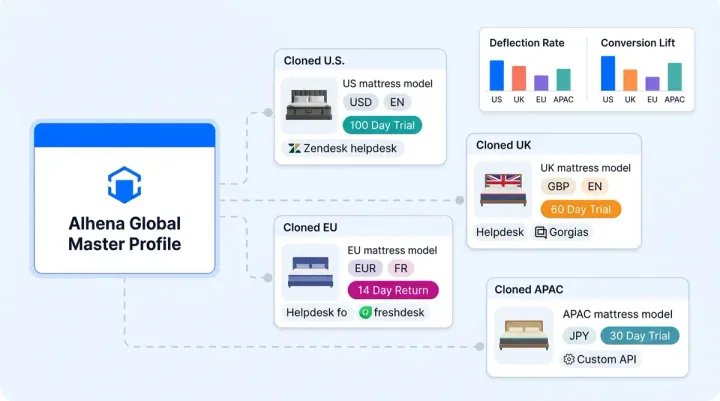
- Full seven-element context transfer. Conversation transcript, AI summary, sentiment score, detected intent, order history, product context, and suggested resolution all pass to the agent inside Zendesk, Freshdesk, Gorgias, or Kustomer.
- Agent Assist on the receiving end. The human agent gets AI-drafted response suggestions and relevant knowledge articles surfaced automatically, so they resolve faster. Manawa cut response time from 40 minutes to 1 minute with this approach.
- Continuous feedback loop. Every transferred conversation improves the AI's future handling of similar questions. Crocus maintains 86% deflection and 84% CSAT because handoff patterns feed directly back into the knowledge base, closing gaps before they become recurring problems.
This works across every channel. Beyond support, conversation AI also identifies upselling opportunities during handoffs, so agents can turn service moments into revenue. Whether a customer starts on web chat, email, Instagram DMs, WhatsApp, or voice, the escalation carries the same rich context with multilingual support across 90+ AI languages. You can configure escalation tiers so VIP customers skip straight to senior agents while routine questions stay with the frontline team. Setup takes under 48 hours with no dev resources. Use the ROI Calculator to estimate the impact on your support team.
The Invisible Handoff Is the Standard
The brands with the best conversational AI support experiences are not the ones with the lowest escalation rates. They're the ones where every conversational handoff transfers so smoothly that the customer can't tell where the AI ended and the human began.
That invisible handoff is what separates platforms built for ecommerce from generic tools that dump customers into a queue with zero context. When the trigger logic is right, the context transfer is complete, and the agent has everything they need on one screen, escalation stops being a failure point. It becomes the moment your support experience goes from good to great.
Ready to make your AI-to-human handoffs invisible? Book a demo with Alhena AI or start for free with 25 conversations.
Frequently Asked Questions
What should an AI chatbot transfer to a human agent during escalation in ecommerce?
Alhena AI transfers seven elements during every escalation: full conversation transcript, AI-generated summary, detected customer intent, sentiment score at point of transfer, order status, order history, and CRM data, product context from the conversation, and an AI-suggested resolution that gives the agent a starting point. This seven-element context payload eliminates the need for customers to repeat anything.
What is a good escalation rate for an ecommerce AI chatbot by industry?
Optimal escalation rates vary by vertical. Beauty and skincare brands should target 15 to 20%, fashion and apparel 18 to 25%, health and supplements 20 to 30%, electronics 25 to 35%, and home goods 15 to 22%. Alhena AI helps brands track these rates by topic category and reduce them over time as the system learns from each human-resolved conversation.
How does Alhena AI prevent customers from repeating their issue after a chatbot handoff?
Alhena AI passes the complete conversation context to the human agent before the handoff happens. The agent sees an AI-generated summary, sentiment indicator, order data, and a suggested response on a single screen inside their existing helpdesk. Brands like Manawa cut response time from 40 minutes to 1 minute because agents never start from scratch.
What triggers should an ecommerce AI use to decide when to escalate to a human agent?
Alhena AI uses three trigger categories working in parallel: explicit triggers when the customer asks for a person (immediate transfer, no extra bot messages), confidence-based triggers when the AI detects it would need to guess rather than respond from verified data, and contextual triggers including sentiment analysis, VIP detection, compliance-sensitive topics, and complexity thresholds. Each trigger type is configurable by product category and brand.
How does the AI learn from escalated conversations to reduce future escalations?
Alhena AI runs a continuous feedback loop where every agent-resolved escalation becomes potential training data. When similar questions escalate repeatedly, the system flags knowledge gaps for review. Once approved, new answers enter the AI's knowledge base so the same question gets resolved without escalation next time. Brands using this loop see escalation rates decline 1 to 2 percentage points per month in the first six months.