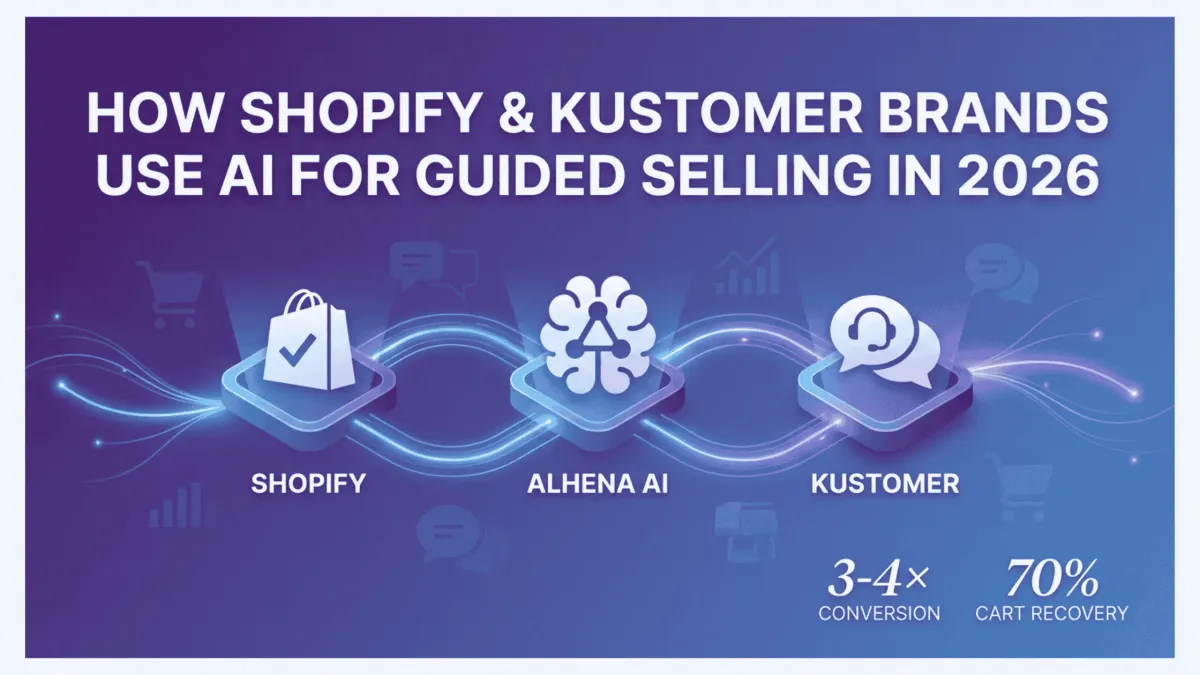
AI guided selling connects your Shopify catalog to your Kustomer conversations so shoppers get accurate answers at the moment they decide. Alhena AI sits between the two, resolving pre-purchase and order questions automatically and escalating only what needs a human, with full context.
Shopify knows your products. Kustomer knows your customers. Neither one answers the shopper standing on the product page right now. Alhena AI is the layer that does, and brands running it see conversion lifts of 10–28% with up to 82% of inquiries automated.
What is AI guided selling on Shopify?
AI guided selling is an AI agent that answers a shopper's real question, in their words, using live product and order data, then moves them toward the right item.
A rule-based chatbot matches keywords to canned replies. A guided selling agent reads your Shopify catalog, checks stock, compares variants and recommends what is actually available today.
| Capability | Rule-based Shopify chatbot | AI guided selling agent |
|---|---|---|
| Product knowledge | Static FAQ entries, manually written | Live catalog sync: variants, stock, price, discounts |
| Handles "will this fit?" | Deflects to a size chart link | Reads the spec, answers, suggests the right variant |
| Out-of-stock item | Dead end | Recommends an in-stock alternative |
| Order status | Creates a ticket | Answers from live Shopify order data |
| When it cannot answer | "An agent will get back to you" | Escalates to Kustomer with full context |
What does the Shopify + Kustomer stack miss on its own?
Both platforms are excellent at their jobs. The gap is between them.
| System | What it owns | What it does not do |
|---|---|---|
| Shopify | Products, variants, inventory, pricing, discounts, orders | Hold a conversation with an undecided shopper |
| Kustomer | Tickets, omnichannel routing, unified customer timeline, workflows | See live inventory or recommend a product pre-purchase |
| Neither | — | Answer "does this come in a wide fit and can it arrive by Friday?" in real time, on the page |
So the question either goes unanswered or becomes a ticket. One loses the sale. The other costs you an agent's time on a question a database could have answered.
How does Alhena AI work inside a Shopify store?
Install from the Shopify App Store or the Alhena dashboard. The catalog syncs on connection.
Alhena pulls your Shopify data in real time and turns it into the agent's commerce brain: products, variants, inventory levels, pricing, active discounts and order records.
Two agents activate automatically.
Order Management Agent
Answers WISMO, returns and order-status questions from live Shopify data. No ticket, no agent.
Product Expert Agent
Compares variants, resolves sizing and compatibility, recommends in-stock alternatives, surfaces bundles.
What shoppers can actually ask
- "Which of these is better for sensitive skin?" — narrows the catalog by attribute, not keyword
- "Do you have this in a 10 wide, in stock?" — checks live inventory before promising anything
- "What goes with this?" — bundles and complementary items from your real catalog
- "Where is my order?" — answered from the live order record, covered in depth in our WISMO automation guide
- "Does my discount code apply to sale items?" — reads your active discount rules
You can also add a conversational search button to your storefront, turning search into a shoppable discovery flow rather than a keyword box. Full detail on the Alhena Shopify integration page.
How does Alhena work as a Kustomer AI agent?
API-first, native, and layered on top of the workflows you already run.
- Enable Kustomer inside your Alhena dashboard.
- Connect your API key to authorise the two-way sync.
- Install the Alhena app inside your Kustomer account.
- Configure your human transfer group so escalations land with the right team.
- Set a business rule routing inbound email and chat to the Alhena AI Agent.
From that point, Alhena runs as a dedicated agent inside your Kustomer workspace, handling routine tickets and email inquiries automatically. Your team sees what is left.
What Kustomer users get specifically
- Context-complete handoffs. When escalation happens, full chat history transfers into Kustomer. The shopper never repeats themselves.
- Workflow and macro compatibility. Alhena sits on top of existing Kustomer processes. Nothing gets rebuilt.
- Smart routing. High-intent "I'll buy if…" conversations can be flagged and routed to a closing team instead of the general queue.
- Unified timeline personalisation. Kustomer's customer-centric data model means a returning shopper asking "what should I reorder?" gets an answer grounded in their actual purchase history.
What results do Shopify and Kustomer brands actually see?
These are Alhena deployments, not projections. Each brand runs the AI Support Concierge alongside the guided selling layer.
| Brand | Category | Result | What drove it |
|---|---|---|---|
| Tatcha | Beauty | 11.4% revenue attribution, 38% AOV lift | Routine and ritual guidance; clienteling at scale |
| Puffy | Mattress & sleep | 28% conversion lift, 82% automation | Absorbed a growth surge without adding headcount |
| Victoria Beckham | Apparel | 10% revenue growth, 20% AOV increase | AI Stylist guiding fit and outfit decisions |
The pattern is consistent: shoppers who engage the assistant convert at roughly three to four times site average, because the friction that stops a purchase — sizing doubt, stock uncertainty, variant confusion, discount ambiguity — gets removed at the exact moment it appears. Read the full customer stories.
Which Shopify stores get the most value?
Guided selling pays back hardest where the product needs explaining before it can be bought.
- Apparel and footwear — sizing, fit, fabric, returns risk
- Beauty and skincare — ingredients, shade, routine sequencing, sensitivity
- Home and furniture — dimensions, materials, variant complexity, lead times
- Sports and fitness gear — compatibility and spec matching
- Sleep and wellness — trial periods, firmness, comparison across a small range
The clearest signal is operational: if your Kustomer inbox contains pre-purchase questions that agents answer by hand, that entire layer is automatable today.
What if you don't use Kustomer, or don't run standard Shopify?
The edge cases people actually ask about.
- You use a different helpdesk. Alhena integrates with Zendesk, Gorgias, Freshdesk and Gladly. Kustomer is one option among several.
- You use no helpdesk at all. The Shopify integration stands alone: catalog sync, both agents, live chat, conversational discovery.
- You run headless Shopify. Supported, with more configuration. Alhena's solutions team works alongside your engineers rather than handing you docs.
- Shopify Plus with multiple storefronts. Each store syncs its own catalog and rules, so regional pricing and inventory stay correct per market.
- Subscription or replenishment models. Kustomer's unified timeline makes reorder and "what goes with my last purchase" questions answerable from real history.
- Very large catalogs. High SKU counts help rather than hurt. Choice overload is exactly the problem guided selling exists to solve.
- Regulated or claims-sensitive categories. Answers stay grounded in your approved content and live catalog rather than generated from scratch.
How long does it take to go live?
| Step | Who does it | Typical time |
|---|---|---|
| Shopify install and catalog sync | Ecommerce or ops lead | Minutes |
| Kustomer API key + app install | Support lead | Under an hour |
| Transfer group and business rules | Support lead | Same day |
| Tone, guardrails and escalation tuning | Alhena + your team | First week |
| Headless or custom storefront | Alhena solutions team + your devs | Longer, scoped upfront |
Most merchants are live on both integrations within a single day. Neither requires custom development.
Which metrics prove it is working?
| Metric | Where you read it | What good looks like |
|---|---|---|
| Assisted conversion rate | Alhena dashboard vs Shopify analytics | Multiples of site average, not percentage points |
| AI-attributed revenue | Alhena dashboard | A visible share of total revenue within 60 days |
| AOV on assisted sessions | Shopify | Above baseline, driven by bundles and upsells |
| Automation rate | Kustomer | Rising share of conversations closed without an agent |
| First response time | Kustomer | Near-instant on automated volume |
| Agent time per ticket | Kustomer | Higher, and that is the point: harder tickets only |
Model your own numbers with the ROI calculator before you commit to anything.
How is this different from Kustomer's own AI?
Kustomer's AI is built around the support ticket. It is strong at resolving service conversations inside the helpdesk.
Alhena is built around the purchase decision, with the Shopify catalog as its source of truth, then connects into Kustomer for the support half. That is why it can recommend a specific in-stock variant, not just answer a policy question.
For a feature-by-feature view, see the Alhena AI vs Kustomer AI comparison.
Key takeaways
- The gap is between the systems, not inside them. Shopify holds commerce data, Kustomer holds conversations, and neither answers a shopper mid-decision.
- Guided selling is grounded, not generative guesswork. Answers come from live catalog, inventory, discount and order data.
- The revenue case is measurable. Tatcha 11.4% revenue attribution, Puffy 28% conversion lift, Victoria Beckham 20% AOV increase.
- Support economics improve at the same time. WISMO is 40–60% of inbound ecommerce volume and almost all of it is automatable.
- Setup is a day, not a quarter. No custom development for standard Shopify plus Kustomer.
- Kustomer is optional. The Shopify integration works standalone, and Alhena also supports Zendesk, Gorgias, Freshdesk and Gladly.
See it on your catalog
Bring your Shopify store and your Kustomer queue. We will show you what gets answered automatically in week one.
Frequently asked questions
Alhena AI is purpose-built for this combination. It syncs the Shopify catalog in real time for product recommendations and connects natively to Kustomer for ticket handling and escalation. Brands running both report conversion lifts between 10% and 28% and automation rates up to 82%.
Yes, and that is the intended setup. Shopify supplies the commerce data — products, variants, inventory, pricing, discounts, orders. Kustomer supplies conversation history and agent workflows. Alhena runs between them, answering shoppers on the storefront and escalating into Kustomer when a human is needed.
Roughly 70% of carts are abandoned, and a large share of the recoverable portion comes down to unresolved doubt: sizing, stock, compatibility, delivery timing or discount eligibility. A guided selling agent answers those questions on the page, in seconds, using live data, so the shopper never has to leave to go looking.
Yes. You set a business rule in Kustomer that routes inbound email to the Alhena AI Agent. It replies instantly to order status, product, discount and returns questions. Anything requiring human judgement escalates to your team with full conversation context already attached.
Yes. The Shopify integration is fully standalone: real-time catalog sync, the Order Management Agent, the Product Expert Agent, conversational discovery and live chat. Alhena also integrates with Zendesk, Gorgias, Freshdesk and Gladly if you use one of those instead.
Shopify takes minutes: install from the App Store, authorise access, and the agents activate. Kustomer takes under an hour: add your API key in Alhena, install the Alhena app in Kustomer, set your transfer group and business rules. Most merchants are live on both within one day, with no engineering resource.
Yes. Kustomer stores a unified customer timeline covering past orders, prior conversations and preferences. Alhena uses that history so a returning shopper asking "what should I reorder?" or "what goes with what I bought last time?" gets an answer based on their actual record rather than a generic suggestion.
A chatbot matches keywords to pre-written replies and creates a ticket when it fails. A guided selling agent reads live catalog and order data, compares variants, checks stock, recommends alternatives and closes the loop. The difference shows up in conversion, not in chat volume.
Yes, with additional configuration. Standard Shopify and Shopify Plus storefronts install in minutes. Headless and custom stacks are scoped upfront and implemented with Alhena's solutions team working alongside your engineers.
Track five numbers: AI-attributed revenue, assisted conversion rate versus site average, AOV on assisted sessions, automation rate in Kustomer, and first response time. Model expected impact against your own volume with Alhena's ROI calculator before committing.