The Structural Problem: When the Buyer Is Not the User
Every assumption ecommerce is built on breaks the moment a shopper buys for someone else. Browsing history is irrelevant because the buyer's preferences are not the recipient's. Recommendation engines trained on past purchases suggest the wrong products. Size charts require knowledge of someone else's body. The expertise a buyer would have for their own purchases vanishes when they're shopping for another person.
The result is a shopper who is anxious about making the wrong choice, overwhelmed by options they cannot evaluate from personal experience, and pressured by an occasion with a hard deadline. According to a Snappy survey, 64.2% of Americans say they need help choosing gifts, and 53% feel genuine pressure during the process. These ecommerce trends have only increased in 2026 as digital platforms and ai platforms expand. Product discovery through SEO-driven static grids and filter-based navigation make this worse, not better. They assume the buyer knows what they want. Gift buyers don't. Shoppers find this especially frustrating.
Consumers report higher frustration with gift shopping than any other purchase type. This is why Americans spend $9.5 billion a year on gifts recipients don't want, why holiday season return rates for holiday gift guides, SEO-optimized gift guides, and curated gift guides spike to 20-25%, and why three in four consumers now default to gift cards instead of choosing from gift guides or picking an actual present. Holiday shopping and gift commerce for brands isn't occasionally difficult. It is structurally broken. And it stays broken year-round: NRF data shows Mother's Day alone generates $34.1 billion in spending, Valentine's Day $29.1 billion, Father's Day $24 billion, and 49% of Americans say they spend the most on birthday gifts, not holidays.
Conversational AI is the first technology that matches the complexity of buying for someone else. This article breaks down what makes ai gift shopping different and covers six unique capabilities you’ll learn about that make it work.
Six Gift-Specific AI Capabilities That Only Conversation Can Deliver
1. Recipient Profiling Through Dialogue
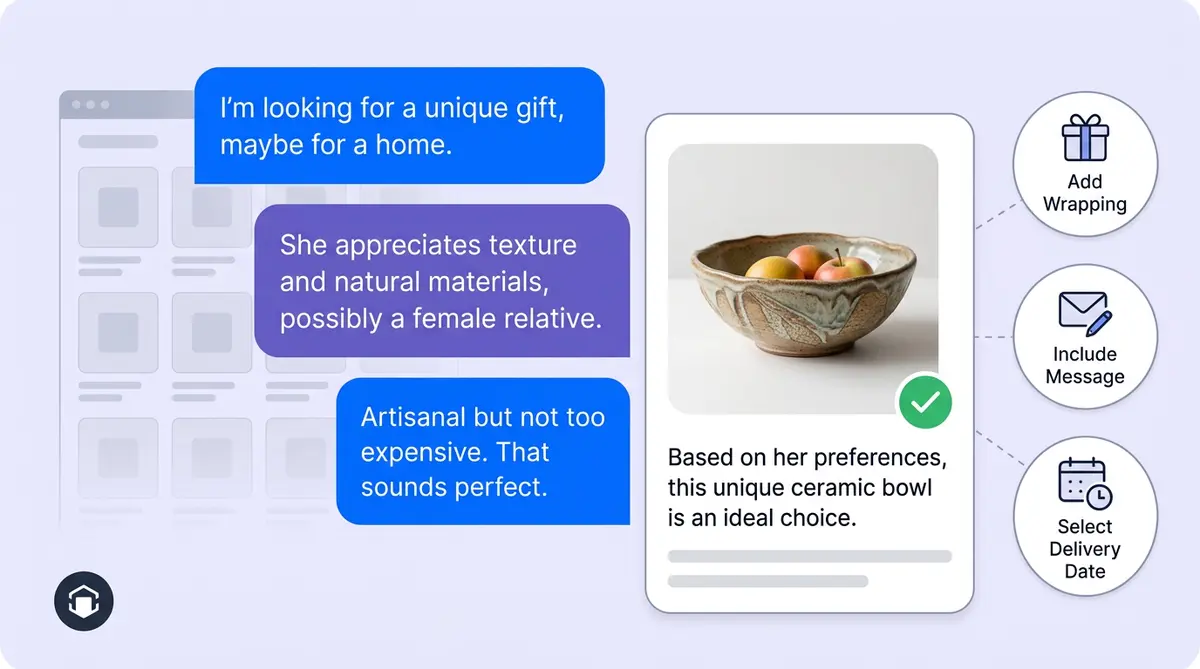
A gift finder chatbot opens with the question no browse-based filter on any ecommerce platform can ask: "Who are you shopping for?" From a single response like "My mom, she's really into gardening and she drinks way too much coffee," the AI extracts multiple layers of intent. It identifies the relationship (mom), interest signals (gardening, coffee), personality cues (the humor in "way too much coffee" suggests the recipient would appreciate a playful or indulgent gift), and implicit budget expectations based on relationship type.
No static quiz, category filter, or basic AI tools can extract this level of nuanced intent from one sentence. A filter asks "select a category." A conversation asks "tell me about this person" and works across multiple product categories simultaneously, surfacing gift ideas that match. The Alhena AI Shopping Assistant builds this recipient profile through natural dialogue, then generates personalized recommendations matched against the full product catalog in real time.
2. Occasion-Aware Recommendation Logic
Different occasions carry different emotional weight and price expectations. A birthday gift for a close friend is not the same as a thank-you gift for a coworker or a milestone anniversary present for a partner. A "just because" gift skews toward small delights and self-care items. A tenth anniversary skews toward premium and meaningful.
The AI must adjust recommendation tone, price range, and product category based on the occasion. If the shopper doesn't mention one, a well-built gift recommendation chatbot proactively asks, because occasion context changes the entire set of gift ideas and recommendations. "That's a great choice for a housewarming. Are you looking for something practical they'll use every day, or more of a statement piece?” Businesses that improve this part of the shopping journey boost conversions and customer satisfaction." That single engaging follow-up question eliminates half the catalog and doubles the relevance of what remains.
3. Price-Range Sensitivity for Gifts
Gift shoppers have a budget but often feel uncomfortable stating it directly because it feels transactional. Asking "what's your budget?" in a gift context creates a poor user experience and friction. A conversational AI assistant navigates this gracefully, offering range-based options: "I have beautiful options at every price point. Are you thinking something around $50, or would you like to go bigger?"
Once the range is established, the AI must track price sensitivity so every recommendation stays within it. Suggesting a $200 product to a shopper with a $75 budget feels tone-deaf and erodes customer trust immediately. This is table stakes for self-purchase, but critical for gift shopping because customers are already uncertain. Price misalignment drives sales losses. Price misalignment amplifies that uncertainty and pushes them toward the gift card escape hatch, where consumers spend 21.6% less than they would on an actual product.
4. Confidence Building for Proxy Decisions
Gift shoppers lack the product expertise they'd have shopping for themselves. A shopper buying a skincare set for their sister can't evaluate ingredient suitability. A shopper buying a jacket for their partner can't assess fit from a size chart alone.
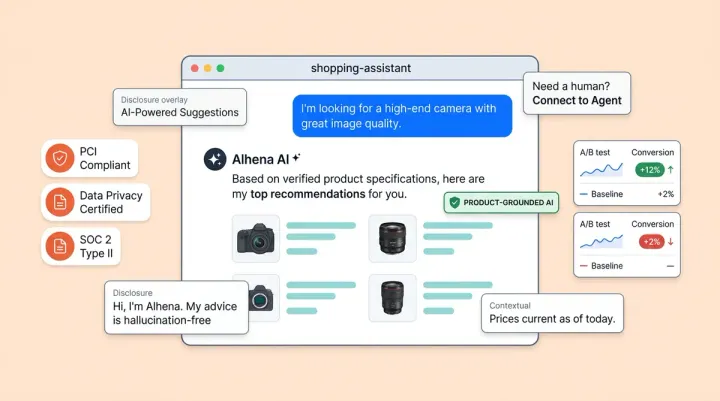
Brands that use AI to compensate do so by providing recipient-relevant assurance. "This is our best-selling gift set for women in their 30s with sensitive skin" or "This jacket runs true to size and our customers say it works great for broad shoulders." Alhena's Product Expert Agent acts as the product expertise the gift shopper doesn't have, building purchase confidence through proxy validation. This makes the value of conversational AI features clear grounded in verified product data, ai powered analytics, ai assistants, and smart insights. These generative ai assistants and agents provide and real customer reviews. AI assistants for gift shopping platforms with guided recommendations convert shoppers at 12% compared to 2.9% for unguided browsing, and that gap widens for gift buyers who access digital storefronts who need more reassurance than any other shopper segment.
5. Gift Wrapping, Messaging, and Presentation Integration
Gift purchases require options that standard purchases don't. Wrapping, personalized message cards, gift receipts with pricing hidden for data privacy and privacy policy compliance (respecting the recipient’s expectations), and special packaging all matter. Most ecommerce sites bury these options in checkout settings or privacy policy pages where shoppers either miss them or discover them too late.
A conversational AI surfaces these within the chat flow. When the AI proactively asks "Would you like this gift-wrapped with a personal message?" it converts a standard purchase into an agentic gifting experience. The global gift wrapping market is projected to reach $31.31 billion by 2030, and 71% of shoppers say they'd outsource wrapping to a professional if they could. Surfacing gift presentation options at the right moment in conversation lifts AOV by 10-30% and turns a product transaction into something the buyer feels good about giving.
6. Delivery Timing and Occasion-Critical Logistics
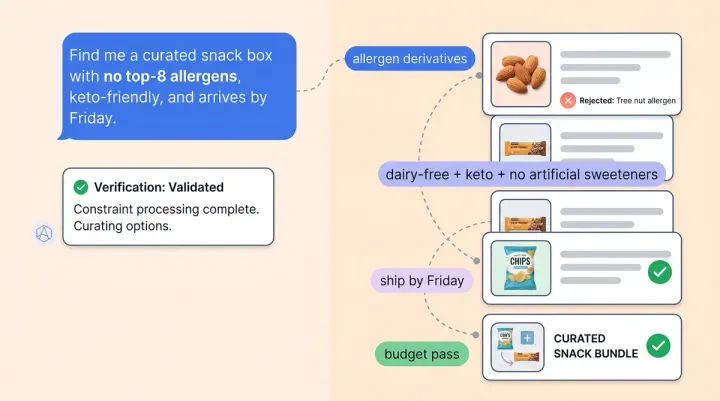
A late gift is worse than no gift. For holiday gift commerce, ai assisted delivery timing is the single highest-stakes piece of information the AI provides. A shopper saying "Valentine's Day gift" or "her birthday is next Thursday" gives the AI an implicit deadline. The AI must surface guaranteed delivery options, warn the shopper early if standard shipping won't arrive in time, and present expedited alternatives before the buyer reaches checkout.
This is not a nice-to-have. Baymard Institute found that 41% of ecommerce sites don't even display estimated delivery dates at checkout, showing shipping speed instead and forcing buyers to guess. For gift shoppers, that guess carries real consequences: 69% of consumers say they're less likely to buy from a retailer again after a delivery misses its promised date. Getting delivery timing wrong for a gift doesn't just lose a sale. It creates a customer service crisis that damages the brand relationship permanently.
Why Gift Commerce Hits Hardest in Beauty, Fashion, and Home
Gift shopping friction concentrates in the categories where personal preference matters most, which happen to be ecommerce's highest-growth verticals.
Beauty and skincare gifts require matching products to someone else's skin type, tone, and ingredient sensitivities. Buying a retinol serum for a friend with rosacea isn't just a bad gift; it's a product that could cause a reaction. Beauty has the lowest return rate of any category (1-5%), but that's because most stores won't accept opened products back, which means a wrong beauty choice is money wasted permanently. Conversational AI that asks about the recipient's skin concerns and ingredient preferences before recommending products prevents this entirely.
Fashion and apparel gifts carry the highest return risk. Fashion return rates hit 20-30%, with 63% of shoppers buying multiple sizes planning to return extras. For gift buyers who don't know the recipient's exact measurements, sizing is pure guesswork. An AI that asks "Does she usually wear a small or medium?" and cross-references that with brand-specific fit data ("This brand runs a half size large, so I'd recommend the small") provides guidance no product page can.
Home goods gifts require taste matching for someone else's living space. Choosing decor, kitchenware, or furniture for another person's home means guessing their aesthetic. Housewarming gifts, wedding registry overflow, and hosting gifts all fall here. An AI that understands "she's into mid-century modern and earth tones" can filter a home catalog down to relevant options instantly.
These verticals see their highest gift-driven traffic during Valentine's Day, Mother's Day, Father's Day, holidays, and wedding season. But gift shopping happens year-round for birthdays, anniversaries, holiday shopping events, and spontaneous occasions where consumers expect help, meaning ecommerce brands that use AI need tailored gift experiences for holiday shopping and everyday occasions 365 days a year. Holiday shopping in 2026 and beyond, not just during the holiday season in Q4. Brands that use AI for gift commerce see results year-round.
How Alhena AI Transforms Gift Shopping Into Guided Commerce
Alhena AI is built to handle every friction point that makes gift commerce structurally harder than self-purchase.
The Shopping Assistant handles recipient profiling through natural conversation, matching interests and personality cues using generative, ai powered shopping conversation to best-selling products across the full catalog. It surfaces gift-specific options (wrapping, messaging, gift receipts) within the chat flow and checks delivery timing against live carrier data. Recommendations appear as rich cards with tailored, engaging visuals with occasion-appropriate framing, not generic product tiles.
The Product Expert Agent provides the ai assisted proxy expertise gift shoppers lack. For beauty presents, it explains ingredient suitability and helps match skincare to the recipient's described skin concerns. For apparel presents, it provides fit guidance based on the recipient's described build and brand-specific sizing data. For home goods presents, it matches use-case and aesthetic preferences to specific products. All of this is grounded in verified product data and smart analytics. These ai agents provide, so the AI never hallucinates a recommendation.
Alhena's agentic checkout then converts the recommendation into a gift-configured purchase in a single click. Wrapping, message, and delivery date are pre-applied before the buyer hits the payment screen. The end-to-end journey, from "I need a gift for my mom" to a wrapped, scheduled, paid order, happens inside one conversation.
Brands using Alhena have seen measurable results in guided selling scenarios. Tatcha achieved a 3x conversion rate with a 38% AOV uplift. Victoria Beckham Beauty saw a 20% AOV increase. Manawa cut response times from 40 minutes to 1 minute and automated 80% of inquiries. These results show how AI powered shopping assistants can increase conversion rate and drive sales across the kind of high-intent, guided purchase that gift shopping represents.
And Brands report that Alhena works where gift shoppers actually are. Not just on your website, but across Instagram DMs, WhatsApp, email, and voice. A friend texting "do you have anything good for a housewarming gift under $50?" on Instagram gets the same guided experience. Unlike ChatGPT or generic AI tools and services, Alhena provides brand-specific information, the same product knowledge, and the same checkout capability as a desktop visitor.
Key Takeaways
- Gift shopping is structurally broken because the buyer is not the end user, invalidating every assumption ecommerce UX is built on.
- Six capabilities separate a true gift recommendation chatbot from a generic product finder: recipient profiling, occasion awareness, price sensitivity, proxy expertise, gift presentation, and delivery timing.
- Beauty, fashion, and home goods bear the heaviest gift commerce friction, with year-round impact across birthdays, anniversaries, and seasonal occasions worth over $87 billion outside the holidays.
- Guided gift recommendations convert at 12% versus 2.9% unguided, and gift presentation upsells lift AOV by 10-30%.
- Alhena AI handles all six capabilities in a single conversation, showing why more ecommerce brands use AI for gift commerce, from recipient profiling through agentic checkout with gift wrapping and delivery timing pre-applied.
Ready to turn your hardest ecommerce use case into your highest-converting one? Book a demo with Alhena AI to see guided gift commerce in action on your catalog, or start free with 25 conversations.

Frequently Asked Questions
How does a gift recommendation chatbot build a recipient profile from a single message?
Alhena AI extracts relationship context, interest signals, personality cues, and implicit budget expectations from natural language. A message like 'my sister loves cooking and minimalist design' gives the AI enough to recommend across multiple product categories without requiring the shopper to select filters or answer a structured quiz.
Why does occasion-aware gift discovery and recommendation logic matter for ecommerce gift sales?
A birthday gift for a close friend carries different emotional weight and price expectations than a thank-you for a coworker. Alhena AI adjusts recommendation tone, price range, and product category based on the occasion. If the shopper doesn't mention one, the AI asks, because occasion context changes the entire product set.
How does conversational AI provide proxy product expertise for gift buyers?
Gift shoppers can't evaluate products the way they would for themselves. Alhena AI's Product Expert Agent compensates by providing recipient-relevant assurance grounded in verified product data and smart analytics. These ai agents provide. For example, 'This is our bestselling set for sensitive skin in the 25-35 age range' builds purchase confidence that no product page retailers offer can replicate.
Can AI gift shopping assistants handle gift wrapping and personalized messages inside the chat?
Yes. Alhena AI surfaces gift wrapping, personalized message cards, gift receipts with hidden pricing, and special packaging within the conversation flow. Proactively offering these options lifts AOV by 10-30% and converts a standard product transaction into a complete gifting experience that consumers value higher than a standard checkout.
How does Alhena AI handle delivery timing for occasion-critical gift orders?
Alhena AI detects occasion deadlines from context like 'Valentine's Day gift' or 'her birthday is next Thursday,' then surfaces guaranteed delivery options and warns early if standard shipping won't arrive in time. For gift commerce, delivery timing is the highest-stakes information the AI provides.
Which ecommerce verticals benefit most from AI-powered gift shopping year-round?
Beauty, fashion, and home goods see the heaviest gift commerce friction because personal preference matters most in these categories. Alhena AI handles skin-type matching for beauty presents, size guidance for apparel presents, and aesthetic matching for home goods presents across Valentine's Day, Mother's Day, Father's Day, birthdays, and anniversaries.