The Revenue Gap Most Ecommerce Brands Don't Know They Have
AI-powered pricing delivers 2 to 5% revenue increases and 5 to 10% margin improvements, according to McKinsey and BCG. Yet fewer than 15% of retailers use algorithmic AI pricing today. Most online retailers still rely on manual spreadsheets or basic rule-based repricing that reacts to a single variable at a time. These rule-based systems can't adapt when multiple market conditions shift at once. Modern pricing algorithms continuously learn from purchasing decisions and competitor signals to refine pricing strategies across systems.
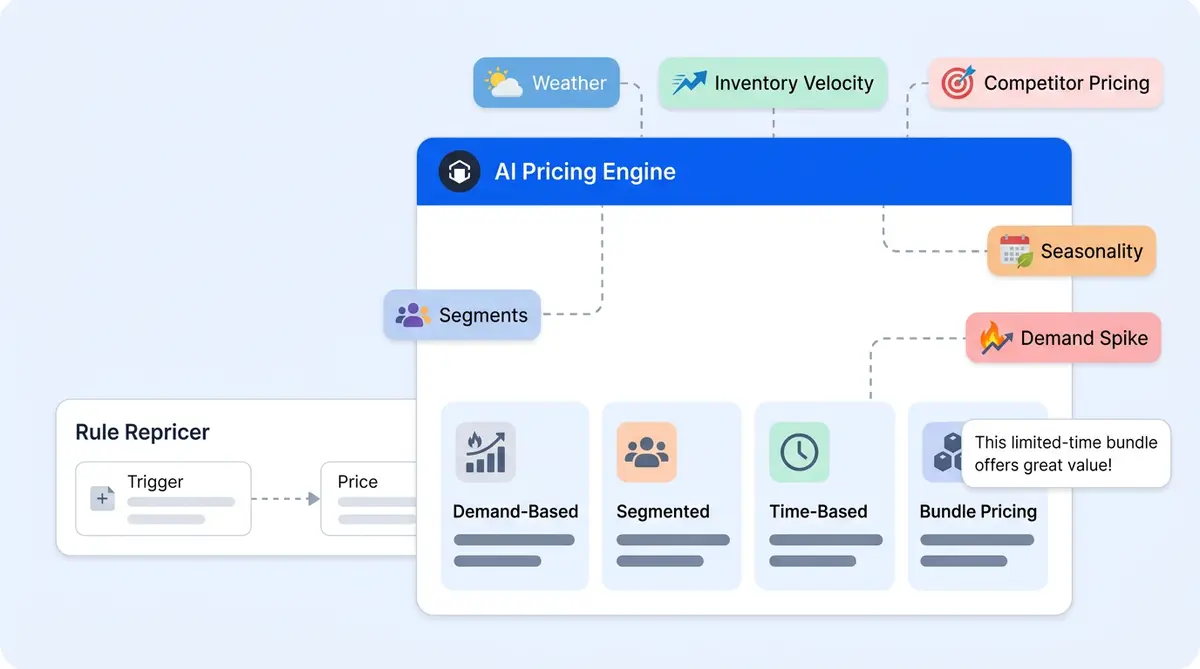
That gap isn't just an efficiency problem. It's a revenue leak. AI dynamic pricing for ecommerce evaluates demand signals, inventory velocity, customer segments, seasonality, and competitive positioning all at once, adjusting prices in real time rather than waiting for weekly batch cycles. Brands using AI for strategic pricing decisions are seeing profitability gains that manual processes simply can't match.
This guide breaks down how AI pricing works, four key pricing strategies worth knowing for online retailers and DTC brands, the trust challenge it creates, and how conversational commerce closes that gap.
Rule-Based Repricing vs. AI-Powered Dynamic Pricing
Rule-based pricing follows static logic: if inventory drops below 50 units, increase the price by 10%. It works, but it only watches one variable at a time and can't handle the complexity of modern ecommerce. When market conditions shift, these rules break. Artificial intelligence systems handle this complexity by using ai models that continuously adapt.
AI dynamic pricing evaluates up to 60 variables simultaneously, from competitor pricing to weather patterns to purchase frequency. Machine learning models and pricing algorithms find the price point that maximizes revenue within your margin constraints, continuously learning from every transaction to improve price optimization over time. These artificial intelligence systems evaluate behavioral data, competitor moves, and demand signals that rule-based ai tools miss entirely. Where rule-based systems track competitors on a single dimension, AI-powered pricing solutions factor in competitor positioning alongside dozens of other decision inputs. The result is an AI-powered, data driven pricing approach that adapts to real market complexity and directly improves profitability. Think of rule-based pricing as a thermostat and AI pricing software as a climate system that anticipates what's next.
Four AI-Powered Pricing Strategies That Drive Results
1. Demand-Based Pricing
AI models adjust prices during high-demand windows and optimize pricing adjustments during low demand. Rather than blanket end-of-season markdowns, AI forecasts the optimal discount curve. Brands using demand-based AI models report 20 to 30% reductions in end-of-season discounting, protecting margins while clearing inventory faster. This ai solution makes pricing adjustments automatically based on real demand signals.
2. Segmented Pricing
Different customer cohorts see different price points based on behavior, purchase history, and personalized price sensitivity. A first-time visitor might see a welcome offer, while a repeat buyer sees a loyalty price. The key is grounding segmentation in value delivered, not just willingness to pay. AI technologies and ai agents make these driven pricing decisions at a scale no human team can match.
3. Time-Based Optimization
Flash sales and limited offers timed by AI to maximize revenue per promotional dollar. Instead of running a site-wide 20% off for 48 hours, AI technologies make smarter decisions about the exact window and discount depth where each category converts best, freeing marketing budgets from blanket discounting. These ai investments pay for themselves within the first promotional cycle.
4. Bundle Pricing
AI determines which product combinations and discount levels maximize average order value while protecting margin across the bundle. Dynamically adjusted bundles can drive 10 to 15% higher AOV during promotions without the margin erosion of flat discounts. These ai investments directly improve profitability across the product catalog.
The Trust Challenge You Can't Ignore
Here's the risk: 62% of consumers associate dynamic pricing with price-gouging. When shoppers screenshot a price and find it changed an hour later, brand credibility and competitiveness take a hit. The solution isn't to avoid dynamic pricing. It's to pair pricing changes with transparency, so customers continuously see the value behind every adjustment.
This is where conversational artificial intelligence becomes the critical companion to any AI-powered dynamic pricing strategy. When prices adjust, shoppers need an AI shopping assistant that explains value, not one that just displays numbers.
How Alhena AI Connects Dynamic Pricing to Conversational Commerce
Dynamic pricing works best when every price change is backed by context a shopper can understand. Implementing an ai solution that bridges the gap between pricing algorithms and customer trust is where ai agents and AI systems add the most value. AI-powered ai models analyze each conversation to determine the best way to present pricing. Alhena AI serves as that context layer.
When a product is discounted, Alhena's Conversion Nudges surface it proactively with reasoning: "This serum is 15% off today because we're making room for the new formula." When a shopper questions why a product costs more, Alhena explains value through product expertise: "This moisturizer contains 1% retinol versus 0.3% in alternatives, which means faster visible results."
When a shopper asks for a price match, Alhena's Support Concierge handles it within your configured policies rather than escalating to a human agent. Smart FAQs on product pages address pricing questions before shoppers even ask them. And revenue analytics trace how price-sensitive conversations convert compared to standard interactions, so you can measure whether pricing changes build or erode trust across your inventory.
The result: dynamic pricing doesn't operate in a vacuum. Every price change is supported by an AI layer that helps shoppers understand, accept, and act on it. Brands like Tatcha saw 3x conversion rates and 38% AOV uplift with this kind of AI-powered shopping experience.
Getting Started: A Three-Step Path
First, monitor your pricing landscape and establish margin floors. You need clean data on competitor pricing, demand patterns, and cost structures before any AI tools or price optimization system can help.
Second, add demand-based adjustments on your highest-velocity SKUs. Start with 100 to 500 products and run a controlled test for four to eight weeks. AI technologies and artificial intelligence models need this data to calibrate pricing adjustments accurately. Most brands see measurable ROI within 60 to 90 days on pilot categories.
Third, layer in segmented and bundle pricing as your data matures. Throughout every phase of implementing AI, make sure your AI shopping assistant is configured to handle the pricing questions that dynamic changes inevitably generate.
The Bottom Line
For online retailers, dynamic pricing without conversational context creates customer confusion and poor purchasing decisions. Dynamic pricing with an AI shopping assistant that explains value, surfaces deals proactively, and handles price objections intelligently creates a strategy that is both revenue-maximizing and trust-building.
The retailers winning in 2026 don't just adjust prices with AI-powered pricing solutions. They take a strategic approach to using AI across the entire customer journey. They give shoppers a reason to feel good about the price they see.
Ready to connect your pricing strategy with an AI that explains value in real time? Book a demo with Alhena AI or start for free with 25 conversations.

Frequently Asked Questions
How does AI dynamic pricing differ from manual repricing?
Manual repricing reacts to one variable at a time, like competitor price or inventory count. AI dynamic pricing evaluates up to 60 signals simultaneously, including demand patterns, seasonality, and customer segments, to find the optimal price in real time. Alhena AI complements this by giving shoppers context for price changes through conversational commerce, so adjustments feel transparent rather than arbitrary.
Does dynamic pricing work for small ecommerce brands?
Yes. Small brands can start with demand-based pricing on their top 100 SKUs and see measurable ROI within 60 to 90 days. You don't need millions of transactions to begin. Alhena AI helps smaller teams by automating the conversational layer that handles pricing questions, so you don't need extra support staff when prices change.
What role do AI shopping assistants play when prices change?
AI shopping assistants act as the trust layer between your pricing engine and your customers. When prices adjust, Alhena AI explains the value behind the number, surfaces relevant promotions proactively, and handles price-match requests within your policies. This prevents the confusion and brand damage that uncontextualized price changes create.
Does dynamic pricing damage customer trust?
It can, if prices fluctuate without explanation. Research shows 62% of consumers associate dynamic pricing with price-gouging, but 70% accept it when they perceive it as fair and transparent. Alhena AI bridges that gap by providing real-time context through its shopping assistant, turning price changes into value conversations rather than trust-eroding surprises.
What data does an AI pricing engine need to get started?
At minimum, you need 12 to 24 months of historical sales data, product cost information, margin targets, and inventory levels. Competitor pricing intelligence and seasonal trend data improve accuracy. Alhena AI's revenue analytics add another data dimension by tracking how pricing conversations influence conversion, giving your pricing team insight into customer price sensitivity.
How quickly do brands see ROI from AI dynamic pricing?
Most brands see measurable returns within 60 to 90 days on pilot categories, with full ROI payback in 6 to 12 months. AI pricing typically delivers 2 to 5% revenue increases and 5 to 10% margin improvements. Pairing it with Alhena AI's conversational commerce layer accelerates results by reducing price-related support tickets and converting price-sensitive shoppers who would otherwise bounce.
Can AI dynamic pricing and conversational commerce work together on Shopify?
Absolutely. Shopify brands can run any AI pricing tool on the backend while Alhena AI handles the customer-facing side. Alhena integrates with Shopify in under 48 hours, and its Conversion Nudges, smart FAQs, and AI shopping assistant automatically contextualize pricing for every visitor, whether they arrive via web chat, email, or social channels.