Why Seven Great Tools Still Miss Revenue Without an Orchestration Layer
Automated messages make up 2% of all ecommerce sends. They generate 37% of the revenue, according to Omnisend's 2026 benchmarks. That 35-point gap tells you exactly where the money lives: not inside the tools at each stage of your customer journey, but in the sequencing logic that fires between them.
Most ecommerce businesses already have a decent stack. A chat widget for product questions. An email platform for campaigns. An SMS tool for urgency. A loyalty app for repeat buyers. A helpdesk for post-purchase issues. Maybe a review platform and a social commerce plugin too. Seven tools, seven stages, seven dashboards, zero shared brain.
The average enterprise runs 91 marketing cloud services, per SAP Emarsys, and only 49% of them are actively used. That's not a capability problem. It's a coordination problem. Each different tool optimizes its own metrics (open rates, resolution times, click-throughs) without the capabilities or visibility into what every other tool is doing to the same customer at the same time. IDC estimates this costs companies 20 to 30% of annual revenue.
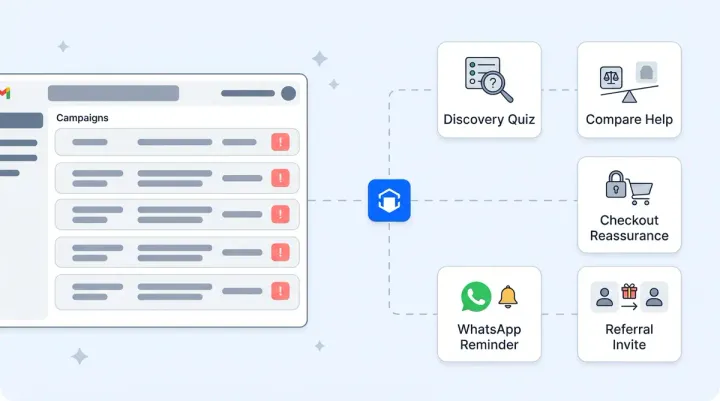
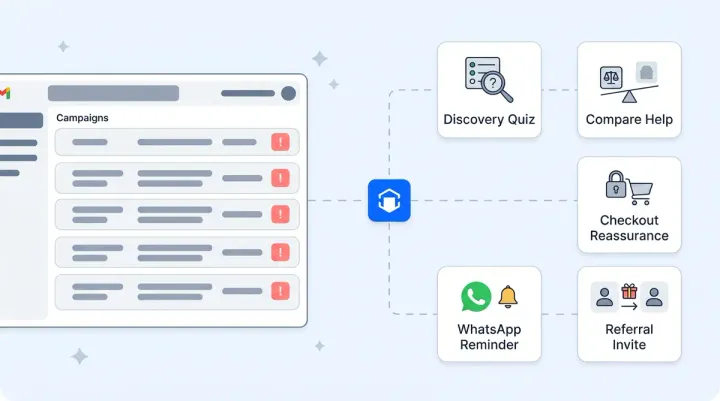
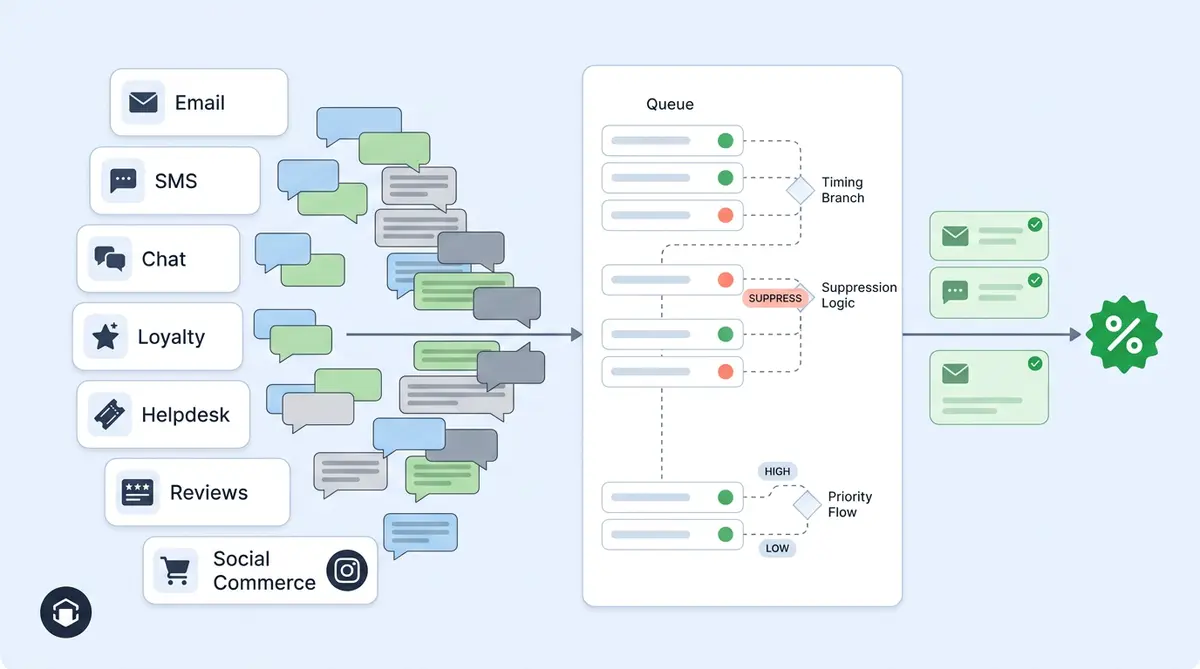
AI customer journey orchestration solves this specific gap for ecommerce businesses. Not by replacing your tools, but by adding a decision layer on top of them that helps coordinate every interaction across different customer journeys. One that reads behavioral signals across every touchpoint, improving customer engagement, makes decisions about what action to take next, picks the right channel, respects timing constraints, and suppresses conflicting messages before they reach the customer. Think of it as air traffic control for your customer communications: every plane (message) is fine on its own, but without a tower (orchestration), collisions are inevitable.
This post covers the five components of that orchestration layer: behavioral triggers, channel selection, timing cadence, conflict resolution, and the unified memory that holds it all together. If you already have strong tools at each funnel stage, this guide walks you through connecting them.
The Behavioral Trigger Taxonomy: Signals That Connect Journey Stages
Orchestration starts with signals. Not campaign calendars or segment lists, but real-time behavioral data from ai-driven customer tracking that tells you a customer just crossed a threshold worth acting on. The difference between a marketing automation platform and an AI orchestration layer is what happens when a signal fires: automation runs a pre-built flow, while an orchestration platform evaluates the signal against everything else happening to that customer right now across different channels and makes smarter decisions on the best next move.
Here are the eight different signals that matter most in ecommerce, what each one means, and what action it should trigger.
Browse-Without-Buy
A visitor views three or more products without adding anything to cart. This signal has a 41% email open rate and 13% click-through rate when acted on within 1 to 2 hours, per Yespo's trigger benchmarks. The orchestration action: send a product recommendation email featuring the viewed items, with a push notification as backup for app users.
Cart Abandonment (Timed by AOV)
Not all cart abandons are the same. A $30 impulse purchase deserves a 1-hour nudge. A $300 considered purchase needs a 4 to 8 hour window that respects the longer decision cycle. Attribuly's 2026 cohort data shows high-AOV carts convert better with delayed first touches, while low-AOV carts decay fast. The orchestration action: route to email first, then escalate to SMS only if the email goes unopened within the AOV-appropriate window.
First-Purchase-No-Second
After a first purchase, there's a 27% chance the customer returns. After a second, that jumps to 54%, per Mobiloud. That gap between purchase one and purchase two is the most valuable moment in the customer lifecycle, and most brands fill it with a generic "thanks for your order" email followed by silence. The orchestration action: start a cross-sell sequence 5 to 7 days after confirmed delivery, personalized to the first purchase category. This level of personalization across channels bridges the gap between first and second orders.
Other Critical Signals
Price-drop and back-in-stock alerts on previously viewed items (55% open rate for back-in-stock, per Yespo). Exit intent after 60+ seconds on a product page. Post-purchase frustration signals like repeat visits to the returns page. And win-back triggers when engagement drops off for 30 to 90 days. Each signal can connect two journey stages that would otherwise operate in isolation. The orchestration layer's job is to turn these signals into timed, channel-appropriate actions rather than letting them fire independently.
Channel Selection Logic: A Decision Tree for Every Moment
Knowing what to say matters less than knowing where to say it. A cart recovery message in email competes with 100 other emails. The same message via SMS gets a 98% open rate. But send too many texts and 73% of customers unsubscribe, according to TxtImpact.
The orchestration layer needs a set of decisions that match channel to moment type, urgency level, and customer preference. Here's the framework that works for most ecommerce scenarios:
Email is the default for non-urgent, content-rich moments: browse abandonment follow-ups, post-purchase cross-sells, review requests, educational content. It's low-cost and sits in the inbox until the customer is ready. Open rates hover around 20 to 22%.
SMS earns its higher cost when urgency matters: flash sales, cart recovery escalation after an unopened email, back-in-stock alerts on high-demand items, and time-limited offers. With a 98% open rate and 29% conversion rate (per Omnisend), SMS is the channel of last resort that converts at the highest rate. Use it sparingly.
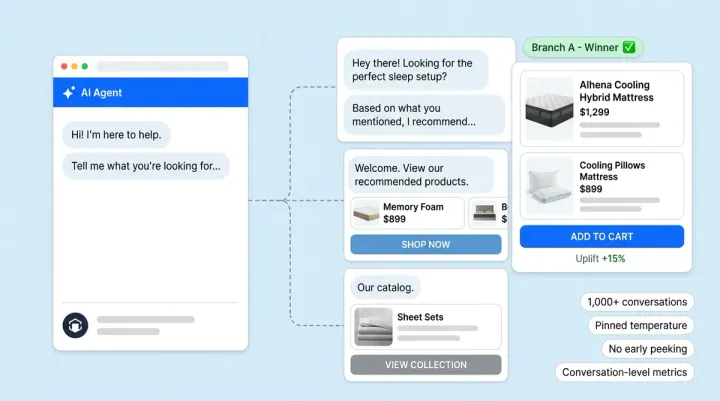
WhatsApp sits in between. It carries the urgency of SMS with the conversational depth of chat. Open rates match SMS (98%), but click-through rates reach 45 to 60%, per Wapikit. It's ideal for two-way moments: product questions during consideration, order updates that might need a response, and conversational commerce flows where the customer wants to browse and buy inside a thread.
On-site chat and push notifications handle real-time, in-session moments: exit intent, idle browsing, product page dwell time over 60 seconds. Push is the most cost-efficient channel for app users, driving 15% of attributed revenue from just 3% of message volume, per Mobiloud.
The decision tree runs in order: (1) Is the customer currently on-site? Use chat or push. (2) Is the moment time-sensitive and the customer SMS-opted-in? Use SMS. (3) Does the moment require two-way conversation? Use WhatsApp. (4) Default to email. Brands that combine SMS and email with personalization see 47% higher customer retention than single-channel approaches, per Omnisend. The orchestration layer helps pick the right mix per customer per moment, not per campaign.
Timing Rules: How Long to Wait Between Touchpoints
Timing is where most ecommerce stacks break down. Without a shared clock across tools, your email agents send a cart recovery message at the 1-hour mark, your SMS agents fire their own version at the 90-minute mark, and your chatbot agents trigger an exit-intent popup the next time the customer visits. Three tools, three timers, zero coordination.
The orchestration layer maintains one timeline per customer and uses behavioral insights to adjust. Here are the cadence rules and timing information that the data supports:
Cart abandonment follows an AOV-tiered schedule. For carts under $50: first email at 1 to 2 hours, SMS escalation at 3 to 6 hours if the email goes unopened, second email at 24 hours. For carts over $200: first email at 4 to 8 hours, SMS at 12 to 24 hours for opted-in customers, second email at 24 to 48 hours. The average gap between first and second cart emails across the industry is 17.1 hours, according to Attribuly. Suppress everything immediately upon purchase (target under 5 minutes).
Post-purchase cross-sell starts on the thank-you page with a related product suggestion, then goes quiet until 5 to 7 days after confirmed delivery. Pushing cross-sell before delivery can feel tone-deaf. Cart recovery timing and post-purchase timing serve opposite goals: urgency vs. patience.
Review requests vary by category. Apparel reviews make sense at 7 days post-delivery (enough time to try it on). Electronics need 7 to 10 days (enough time to set up and test). Skincare takes 2 to 4 weeks (enough time to see results), per PowerReviews. Wednesday and Saturday send times show the highest review conversion rates.
Win-back sequences start at day 30 to 45 of inactivity with email, escalate to SMS at day 60 to 75, and use push notifications at days 7, 14, and 30 for app users showing declining engagement. Space emails 5 to 7 days apart within the sequence. If a customer doesn't respond to 4 to 5 win-back touches, stop. Continuing can only accelerate unsubscribes.
The orchestration layer enforces these rules across every tool simultaneously, so no two systems independently start their own clocks on the same customer event.
Conflict Resolution: What Happens When Three Campaigns Want the Same Customer
Here's a scenario that plays out daily in ecommerce brands without orchestration: a customer abandons a $150 cart on Tuesday. On Wednesday, marketing launches a site-wide flash sale. On Thursday, the loyalty team triggers a points-expiration reminder. Without conflict resolution, this customer gets a cart recovery email, a flash sale SMS, and a loyalty email, all within 48 hours. The result? Optimove's 2025 data shows 70% of consumers unsubscribed from at least three brands in the past three months because of exactly this kind of message pileup.
The orchestration layer handles conflict through three mechanisms:
Priority Queuing
Every message type gets a priority rank. Transactional messages (order confirmations, shipping updates, fraud alerts) always go through, exempt from caps. Below that: cart recovery (highest promotional priority, because intent is proven), then back-in-stock and price-drop alerts, then post-purchase flows, then win-back campaigns, then general promotions at the bottom. When two messages compete for the same send window, the higher-priority message wins and the lower one either delays or suppresses entirely.
Suppression Rules
Suppress cart recovery the instant a purchase completes (under 5 minutes). Honor opt-downs and category exclusions. Hold all promotional sends to lapsed customers until their re-engagement flow finishes. Enforce quiet hours across channels and all send types. US regulations limit SMS to one message per 48-hour window for cart abandonment events. The orchestration layer tracks all of these constraints in one place rather than relying on each tool to manage its own suppression logic.
Frequency Caps
Start with 2 to 3 messages per customer per day across all channels. Then segment by engagement: highly active customers tolerate more, disengaging customers need fewer. SMS and push notifications warrant lower caps than email because they interrupt whatever the customer is doing, while email waits in the inbox. Braze's frequency capping guide puts it simply: "Start with customer context, not channel limits."
The brands that get this right see results. Slazenger deployed cross-channel orchestration with priority-based message routing and hit 49x ROI within eight weeks, recovering 40% of at-risk sales through a single coordinated cart recovery campaign, per Insider. That's not because their emails were better. It's because the orchestration layer stopped messages from competing with each other and started sequencing them.
What AI Customer Journey Orchestration Looks Like in Practice
The five components above (triggers, channels, timing, conflict resolution, and the rules connecting them) only work if they share one customer record. This is where most marketing automation platforms fall short. They're built around campaigns, not customers. They sequence messages within a single flow but can't see what other flows are doing to the same person.
A true orchestration layer needs what's called unified memory: a single, evolving profile per customer that every channel reads from and writes to across channels. When a customer browses a product on your site, asks about it via WhatsApp, receives an email about it, and eventually buys through Instagram, all of that context lives in one place. The next action the system takes accounts for the full picture, not just the last touchpoint.
Platforms like Alhena AI are building this as a conversational memory layer across nine channels (web chat, email, Instagram DMs, Facebook Messenger, WhatsApp, voice, search, nudges, and agent assist). The difference from traditional CDPs and other ai-driven customer data platforms is that the memory isn't just demographic segments or purchase history. It's extracted from actual conversations: what the customer said they were looking for, their budget, their skin type, their sizing concerns, their reason for returning a previous order. That conversational context makes the orchestration layer's decisions sharper because it's working with intent, not just behavior.
The practical impact: triggered messages that carry this unified context generate $2.87 per email versus $0.18 for broadcast campaigns, a 16x difference, per Omnisend. Post-purchase flows built on conversational memory produce up to 30x more revenue per recipient than one-off campaigns, per Yotpo. The orchestration layer doesn't just prevent bad experiences. It makes every touchpoint more profitable because each one builds on what came before.
Getting Started: Three Steps Before You Buy Anything
You don't need a new platform to start building an orchestration layer. Start with these three steps:
1. Map your signal gaps. List every automated message in your stack. For each one, ask: does this message know what other messages the customer received in the past 48 hours? If the answer is no, that's a signal gap. Most brands find 5 to 10 gaps in the first audit.
2. Build a priority matrix. Rank every message type by commercial intent (cart recovery at the top, newsletters at the bottom). Then add frequency caps per channel per day. This single document, even enforced manually at first, prevents the worst customer experience failures.
3. Unify your customer identity. Before any orchestration tool can work, it needs to know that the person who chatted on your site, clicked an email, and messaged on Instagram is the same human. Start with email address matching across your top three channels and expand from there.
The journey orchestration market is projected to reach $88.5 billion by 2034, growing at 24.5% CAGR, per Business Research Industry. The businesses investing now aren't buying more tools. They're connecting the ones they already have to create unified customer engagement across channels.
Ready to see how a conversational AI orchestration layer works across your channels? Book a demo with Alhena AI or start free with 25 conversations.
Frequently Asked Questions
What is AI customer journey orchestration in ecommerce?
AI customer journey orchestration is a decision layer that sits on top of your existing ecommerce tools and coordinates the sequencing, timing, and channel selection of every customer interaction. Instead of each tool (email, SMS, chat, loyalty) operating independently, the orchestration layer reads behavioral signals across all touchpoints and decides the best next action for each customer in real time. According to Boston Consulting Group, brands using journey orchestration see 10 to 20% revenue gains and 15 to 25% cost reductions.
How does AI orchestration differ from marketing automation for ecommerce?
Marketing automation runs pre-built flows within a single channel or tool. If a customer abandons a cart, the email platform sends its sequence regardless of what SMS, chat, or loyalty tools are also doing. AI orchestration evaluates all active flows targeting the same customer simultaneously, applies priority queuing and frequency caps, and picks the optimal channel and timing. The result is 16x more revenue per message for orchestrated sends versus broadcast campaigns, according to Omnisend benchmarks.
What behavioral triggers should an ecommerce orchestration layer track?
The eight most valuable signals are: browse-without-buy (41% open rate when acted on in 1 to 2 hours), cart abandonment timed by order value, first-purchase-no-second (the gap where 27% retention jumps to 54% after a second purchase), price-drop and back-in-stock alerts on viewed items, exit intent after extended product page dwell, post-purchase frustration signals like repeat returns page visits, and win-back triggers after 30 to 90 days of inactivity. Each signal connects two journey stages and should map to a specific action, channel, and timing rule.
How do you prevent message conflicts when multiple ecommerce campaigns target the same customer?
Conflict resolution requires three mechanisms working together. First, priority queuing ranks every message type from transactional (always sends) down through cart recovery, back-in-stock alerts, post-purchase flows, and general promotions. Second, suppression rules stop cart recovery emails the instant a purchase completes and hold promotional sends during active re-engagement flows. Third, frequency caps limit total messages per customer per day (typically 2 to 3 across all channels), with lower caps on interruptive channels like SMS and push. Without these rules, Optimove data shows 70% of consumers will unsubscribe.
What ROI can ecommerce brands expect from customer journey orchestration?
Results vary by implementation maturity, but the benchmarks are strong. Slazenger achieved 49x ROI within eight weeks by orchestrating cart recovery across email, push, and on-site channels. NA-KD saw 72x ROI in 12 months with unified cross-channel journeys. McKinsey reports a more conservative 10 to 15% revenue lift from personalization-driven orchestration, while IDC estimates that eliminating data silos recovers 20 to 30% of otherwise lost annual revenue. The journey orchestration market itself is projected to grow from $12.5 billion to $88.5 billion by 2034.