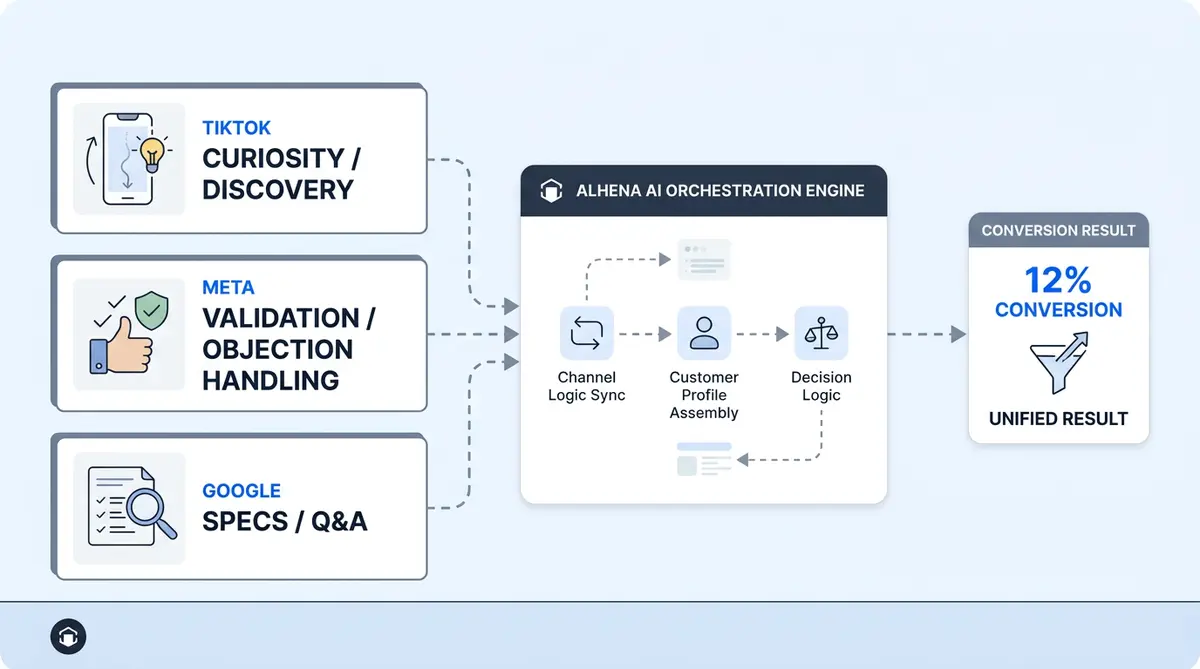
TikTok traffic converts at 76x its baseline when AI engages the visitor. Meta lands at 13.1x. Google comes in at 6.1x. Same AI models, same product catalog, wildly different multipliers. The ability to personalize across the customer journey by channel is what separates AI-driven brands from the rest. The gap isn't random. It maps directly to how much product context each visitor carries when they arrive on your site.
Shoppers who engage with an AI shopping assistant convert at 12.3%, according to a 2025 analysis of 17 million ecommerce sessions. The industry average without AI sits around 3.1%. That 4x overall lift sounds impressive on its own, but it hides the real story: AI conversion lift by channel varies dramatically because each traffic source delivers visitors at a different stage of the buying journey.
This post breaks down why TikTok, Meta, and Google each respond differently to AI. Digital marketers, growth teams, and ecommerce operators, will learn what deployment strategies match each channel's visitor mindset, and how to build a channel-aware AI strategy that improves performance that turns your highest-spend traffic into your highest-converting traffic.
Why AI Conversion Lift by Channel Varies So Much
The math behind these multipliers is straightforward. If AI-assisted shoppers convert at roughly 12% regardless of where they came from, the multiplier depends entirely on the channel's baseline rate. TikTok ad traffic converts at 0.16% without AI. Meta paid social sits around 0.9%. Google search traffic hovers near 2%. Divide 12% by each baseline and the multipliers write themselves.
But baseline conversion rates don't exist in a vacuum. They reflect the information gap each visitor carries at the moment they land on your store. A TikTok viewer just watched a 15-second clip of someone unboxing your product. They're curious, maybe excited, but they know almost nothing about sizing, ingredients, compatibility, or price. A Google searcher typed "best organic face serum for dry skin under $50" and has already read three reviews. Their information gap is small.
AI goes beyond static content and closes information gaps through conversation. The wider the gap, the more value AI delivers, and the larger the conversion multiplier. That's why a one-size-fits-all chatbot wastes potential. AI shopping assistants that adapt their behavior to the visitor's arrival context capture disproportionate revenue from channels where the gap is widest.
TikTok AI Engagement: Why Social Traffic Sees the Biggest Lift
TikTok sends 71.4 million American buyers to ecommerce stores. TikTok Shop alone generated $66 billion in global GMV in 2025, with U.S. sales growing 108% year over year. The platform now accounts for 18.2% of all U.S. social commerce. Yet average conversion rates on TikTok traffic sit between 0.3% and 0.6%, with some segments dipping as low as 0.16%.
The disconnect makes sense when you look at user behavior. 83% of TikTok Shop visitors discover new products on every visit. 71% say their purchases are inspired by spontaneous browsing. These shoppers are 48% more likely to buy immediately after discovering a product compared to users on other platforms, according to NielsenIQ. High purchase intent, near-zero product knowledge. That's the TikTok paradox.
The Information Gap on TikTok
A TikTok visitor arrives with emotional momentum but no rational framework. They saw a creator demo your product for 12 seconds. They don't know your return policy, your sizing chart, your ingredient list, or how your product compares to the three alternatives they've never heard of. Cart abandonment for social media traffic runs between 77% and 91%, the highest of any channel.
Without AI, these visitors bounce. They land on a product page packed with static content they won't read. The emotional momentum from the video evaporates within seconds. With a proactive AI shopping assistant, that momentum gets channeled into a guided conversation that answers the exact questions standing between curiosity and purchase.
TikTok AI Deployment Strategy
For TikTok traffic, AI needs to act like a personal shopper who knows the visitor just arrived from a short video. The playbook includes:
- Instant proactive engagement. Don't wait for the visitor to click a chat icon. Proactive AI deployers see 5.5x higher engagement than passive ones. Trigger a conversational greeting within 3 seconds of page load for UTM-tagged TikTok traffic.
- Guided discovery over search. TikTok visitors don't know what to search for. Use conversational product discovery that asks 2 to 3 qualifying questions (skin type, budget, occasion) and recommends a curated shortlist.
- Social proof in conversation. Surface review snippets, star ratings, and inside tips from existing customers, and "trending on TikTok" badges inside the chat. These visitors trust creator-style validation more than spec sheets.
- Agentic checkout. Remove every friction point. Alhena AI populates the cart and pre-fills checkout directly from the conversation, cutting purchase completion time by 47%.
Tatcha deployed this exact approach and saw a 3x conversion rate versus their site average, a 38% lift in average order value, and 11.4% of total site revenue flowing through AI conversations. 64% of those AI-driven sales came from first-time shoppers, exactly the profile of a TikTok-referred visitor. Read the full Tatcha case study here.
Meta Traffic: Mid-Range Lift from Ad-Driven Intent
Meta platforms (Facebook and Instagram ads) command 68% of total ecommerce ad spend, giving advertisers massive reach across ad networks and diverse audiences. Shoppers arrive with moderate confidence in the product category. Paid social traffic from Meta converts at 0.8% to 1.5% baseline, landing the AI multiplier around 13.1x when AI engagement pushes that rate toward 12%.
Meta visitors arrive with more context than TikTok traffic but less than search. They clicked an ad with a headline, an image, maybe a price point. They have a rough idea of what the product does and a general sense of the brand. But they haven't done comparison research, read detailed reviews, or validated the product against their specific needs.
The Information Gap on Meta
The Meta visitor's gap is narrower than TikTok but still significant. They know the product category and have seen one angle of the value proposition (whatever the ad copy emphasized). What they're missing: how it fits their specific situation, how it compares to alternatives, and whether the price is justified. Instagram traffic specifically carries 77.5% cart abandonment, better than TikTok's 91% but still leaving massive sales volume on the table.
Meta AI Deployment Strategy
For Meta ad traffic, AI should bridge the gap between ad promise and purchase confidence:
- Context-aware greeting. If the visitor clicked an ad for "summer dresses under $100," the AI should open with a reference to that collection, not a generic "How can I help?" Use UTM parameters and landing page data to personalize the first message.
- Comparison and validation. Meta visitors are one step past discovery. They need help deciding between options. AI should proactively surface "customers also considered" suggestions, side-by-side feature comparisons, and relevant product reviews.
- Real-time nudges for hesitation signals. If a Meta visitor views 3+ products without adding to cart within a short browse window, or triggers hesitation events like repeated size chart views or pricing page visits, or hovers on a size chart, AI should intervene with a targeted nudge: "Not sure about sizing? I can help you find your fit in 30 seconds."
- Cross-sell and bundle recommendations. Meta ad traffic often lands on a single product page. AI expands the basket by suggesting complementary items. Victoria Beckham saw a 20% AOV increase using this approach with Alhena AI's product recommendations.
The key difference from TikTok strategy: Meta visitors need validation, not education. They already know the product exists. AI's job is to confirm their interest and remove the last objections before checkout.
Google Traffic: Smaller Multiplier, Still Significant Gains
Google search traffic (organic and paid combined) converts at 1.8% to 3.2% baseline, the highest of the three channels. With AI pushing conversions toward 12%, the multiplier lands around 6.1x. Smaller than social, but applied to your highest-converting traffic, the absolute revenue impact can be enormous.
Search visitors arrive with research depth. They typed a specific query, read the SERP snippets, maybe clicked through a comparison article outside your site first. They know what they want. They're evaluating whether your store is the right place to buy it.
The Information Gap on Search
Google visitors carry the smallest information gap, but it still exists. Their remaining questions are highly specific: "Does this mattress work for side sleepers over 200 lbs?" or "Will this serum react with retinol?" Search traffic has 63.8% cart abandonment, lower than social but still representing billions in lost revenue across ecommerce.
Google Traffic AI Deployment Strategy
For search traffic, AI should function as a technical expert, not a product discoverer:
- Conversational search refinement. Let visitors ask natural-language questions that go deeper than your product filters allow. "Show me moisturizers for sensitive skin without fragrance under $40" is a query your search bar can't handle but Alhena AI's Product Expert Agent answers instantly.
- Spec-level product answers. Search visitors ask technical questions. AI grounded in your actual product data delivers hallucination-free answers about ingredients, dimensions, compatibility, and care instructions.
- Order and post-purchase support. Returning search visitors often come back to check order status, request changes, or initiate returns. Alhena AI's Order Management Agent handles tracking, modifications, and returns without human involvement, keeping CSAT high. Puffy achieved 63% automated inquiry resolution and 90% customer satisfaction with this approach.
- Last-mile conversion nudges. For visitors comparing your product to others (common in search traffic), AI can proactively surface unique selling points, warranty details, or limited-time offers that tip the decision.
The effectiveness analysis still holds at 6.1x. A channel-level analysis of your AI performance will show that even at this lower multiplier, the absolute sales gain from Google traffic often rivals TikTok because search drives higher volume. If Google drives 40% of your traffic and you lift that traffic's conversion rate from 2% to 12%, you've just 6x'd the revenue from your most reliable channel.
Channel-Aware AI vs. One-Size-Fits-All Chatbots
Most ecommerce marketers deploy a single chatbot experience for every visitor regardless of where they came from. That's like running the same ad creative across TikTok, Facebook, and Google Search. It ignores the fundamental differences in visitor intent, knowledge level, and buying stage.
Channel-aware AI reads contextual signals, recognizes the traffic source, and adjusts its entire interaction model. Rather than applying a single approach, it adapts:
- Trigger timing. TikTok visitors get proactive engagement in under 3 seconds. Google visitors see a subtle "Ask me anything" prompt only after 15 seconds of browsing or specific behavior signals.
- Conversation style. Social traffic gets warm, discovery-oriented conversations ("What are you looking for today? Let me find your perfect match."). Search traffic gets direct, technical responses ("Here are the specs you're comparing.").
- Product presentation. TikTok visitors see rich media cards with video thumbnails and creator endorsements. Google visitors see comparison tables and detailed specifications.
- Conversion path. Social visitors get guided through full discovery to agentic checkout. Search visitors get fast answers and streamlined one-click purchasing.
Brands that reply to social messages within one minute see 391% higher conversion rates than those taking 30 minutes. AI delivers sub-5-second response times across every channel, all day. For marketers running paid social campaigns, that speed advantage alone explains a significant portion of the conversion lift, especially on social channels where attention spans measured in seconds determine whether a sale happens.
Learn how AI on Instagram DMs and WhatsApp drives revenue for ecommerce brands.
Building Your Channel-Aware AI Strategy
Deploying channel-specific AI doesn't require building three separate systems. It requires a single AI platform that reads behavioral and contextual signals to adapt in real time. Here's the implementation path:
Step 1: Tag Your Traffic Sources
Use consistent UTM parameters and pixel events across all paid campaigns. Tag ad creatives and conversion events by platform so your AI can reference the specific offer or product the visitor saw. Ensure your analytics and AI platform can identify traffic source at the session level. Alhena AI integrates with Shopify, WooCommerce, Magento, and Salesforce Commerce Cloud, reading referral data and tracking source parameters automatically to customize interactions.
Step 2: Define Channel-Specific Playbooks
Map each traffic source to an engagement playbook:
- High information gap (TikTok, Pinterest, influencer links): Proactive greeting, guided discovery, social proof, agentic checkout.
- Medium information gap (Meta ads, email campaigns, affiliate): Context-aware greeting, comparison support, cross-sell recommendations, real-time nudges.
- Low information gap (Google search, direct, returning visitors): Technical Q&A, conversational search, order management, last-mile conversion support.
Step 3: Measure and Optimize Per Channel
Track AI conversion lift by channel separately. Use attribution analysis to connect AI-assisted sessions to completed orders across every touchpoint. Run lift tests to isolate the true incremental impact of AI on each traffic source. A simple lift test with a holdout group works: send 90% of TikTok traffic to AI-enabled pages and hold back 10% as a control group. Compare conversion rates across both groups over at least 14 days to get representative data and a high confidence interval on your lift measurement. Run separate lift tests for each channel, including Google Ads, Meta, and TikTok. Adjust targeting and audience signals based on what the lift studies reveal. A lift study on TikTok traffic will show different incrementality testing results than a lift study on Google Ads traffic. Marketers who run these brand lift experiments and incrementality tests consistently find that the holdout control group on social channels converts at dramatically lower rates without AI, confirming the multiplier effect. Here is how to structure lift testing at scale across channels. For each lift study, split your audience into a group exposed to AI and a holdout group of users who see the standard experience. Avoid contamination by keeping the holdout group users isolated for the full measurement window, at least 14 to 30 days. Run multiple lift studies in parallel across channels. Track the same metrics inside each experiment: conversion rate, AOV, and sessions to purchase. Your team should request access to your AI platform's built-in reporting dashboard so they can monitor lift measurement results without outside help. The holdout method provides the most representative picture of true incremental impact. Brands that run lift tests this way consistently find that AI-driven conversion lift on social traffic is 5x to 10x the lift on search traffic, validating the channel-aware strategy. Your AI shopping assistant analytics should show conversion rate, AOV, and revenue attribution broken down by traffic source. These metrics let you identify which channels deliver the highest AI ROI at scale and allocate ad spend accordingly. Build a plan around improving conversion rates on your top-spend channels first, then expand.
Alhena AI provides built-in revenue attribution analytics and intelligence dashboards that let you monitor performance. The platform offers detailed tracking that tie every AI-assisted conversation to a completed purchase, broken down by channel, product, and customer segment. See how the 1% of visitors who engage with AI drive 10% of total revenue.
Step 4: Deploy in Under 48 Hours
Channel-aware AI doesn't need months of development. Alhena AI deploys in under 48 hours with zero developer resources. The platform ingests your product catalog, learns your brand voice, and starts to improve conversion rates with channel-adapted conversations from day one., and starts engaging visitors with channel-adapted conversations from day one. You don't need separate AI tools for each channel. One platform, one integration, channel-specific intelligence built in.
Explore how LLM traffic now ranks 4th by conversion across 329 ecommerce brands.
The Takeaway: AI Is Not a Flat Multiplier
The 76x, 13.1x, and 6.1x figures tell one clear story: AI conversion lift by channel is not uniform, and brands that treat it as uniform leave the biggest gains untouched.
Your TikTok spend generates the lowest-converting traffic on your site but also the traffic with the highest AI uplift potential. Your Google traffic already converts well, and AI makes it convert better. Meta sits in between. The brands winning right now are the ones deploying channel-aware AI strategies that match the visitor's mindset at arrival, not the ones running a generic chatbot and calling it "AI-powered."
U.S. social commerce hit $87 billion in 2025 and will pass $100 billion in 2026. TikTok AI engagement is growing faster than any other social commerce channel. 84% of ecommerce businesses are already integrating AI or planning to. The question isn't whether to deploy AI on your store. It's whether your AI is smart enough to treat a TikTok visitor differently from a Google searcher.
Read more about increasing AOV with AI shopping assistants.
Ready to turn your highest-spend traffic channels into your highest-converting ones? Book a demo with Alhena AI or start for free with 25 conversations to see channel-aware AI in action on your store.
Frequently Asked Questions
What is AI conversion lift by channel and why does it matter for ecommerce ROI?
AI conversion lift by channel measures how much an AI shopping assistant increases your conversion rate on traffic from each source (TikTok, Meta, Google, email). It matters because channels with lower baseline conversion rates see the highest AI multipliers. Alhena AI tracks this lift with built-in revenue attribution analytics, so you can see exactly which channels deliver the strongest return on your AI investment.
How does Alhena AI improve TikTok AI engagement and conversion rates for DTC brands?
Alhena AI engages TikTok visitors within seconds of landing using proactive, guided product discovery. Because TikTok traffic arrives with high curiosity but low product knowledge, Alhena fills that gap through conversational recommendations, social proof, and agentic checkout that populates the cart directly from chat. DTC brands using Alhena AI report up to 3x conversion rates and 38% higher average order values on social traffic.
Can AI shopping assistants increase revenue from paid social ads without increasing ad spend?
Yes. AI shopping assistants increase the conversion rate of existing traffic, so you get more revenue from the same ad budget. If your Meta ads drive 10,000 visitors per month at 1% conversion, lifting that to 5% with Alhena AI means 5x more sales without spending another dollar on ads. Brands like Victoria Beckham saw a 20% AOV increase after deploying Alhena AI on their existing traffic.
How long does it take to deploy channel-aware AI on a Shopify or WooCommerce store?
Alhena AI deploys in under 48 hours on Shopify, WooCommerce, Magento, and Salesforce Commerce Cloud with zero developer resources. The platform ingests your product catalog automatically, learns your brand voice, and starts delivering channel-specific AI interactions from day one. No custom code, no months of integration work. Your team controls the setup from a single dashboard that provides access to all channel playbooks. The platform allows you to adjust trigger windows, conversation flows, and targeting rules without external technical help.
What makes Alhena AI different from generic ecommerce chatbots for multi-channel traffic?
Generic chatbots use one script for every visitor. Alhena AI adapts its engagement style based on traffic source, visitor behavior, and product context. It runs two specialized agents: a Product Expert Agent for guided discovery and a Order Management Agent for post-purchase support. This channel-aware approach, combined with hallucination-free responses grounded in verified product data, is why Alhena AI drives measurable revenue instead of just deflecting tickets.