Every AI Conversation Is a Merchandising Signal
Every conversation your AI shopping agent handles is a real-time signal about what your product catalog gets right and what it gets wrong. When a shopper asks "do you have this in a larger size?" your catalog has a size gap. When they ask "what's the difference between these two?" your product descriptions lack comparison clarity. When they say "I want something like this but cheaper," your pricing architecture has a hole.
These personalized signals flow through AI agents and AI conversations every day across hundreds of retailers in 2026 on the Alhena AI agentic platform, and almost nobody outside the CX team ever sees them. The merchandising team making assortment decisions, the product team writing online descriptions, and the content team planning guides are all flying blind while the richest customer experience data sits in the CX space, in a chat log they never check.
What follows are five agentic conversational AI pattern categories for personalized merchandising insights that conversation data reveals, each with a real-world use case and merchandising action your team can take this week.
1. Unanswered Product Questions That Expose Description Failures
The process starts by aggregating the questions shoppers ask that the AI answers confidently from product data versus the questions where it has to improvise, escalate, or surface a generic response because the product page lacks the information.
When hundreds of shoppers ask "is this true to size?" for the same product and the PDP has no fit guidance, that is not a support ticket pattern. That is a merchandising gap where the product page is missing information that would convert browsers into buyers without the AI needing to intervene. The same applies to questions about fabric weight, compatibility, care instructions, and material sourcing. Each unanswered question represents a personalized experience failure that costs conversions.
Tatcha saw a 3x conversion rate after deploying Alhena AI, partly because surfacing these question patterns helped the team identify which product pages needed enrichment first. When the most-asked questions get answered on the online PDP itself, the AI handles fewer repetitive queries and shoppers convert faster.
Action: Generate a weekly report of the top 20 questions per product category that PDPs fail to answer and feed this directly to the retail content team for description enrichment.
2. Missing Product Attributes That Block AI Recommendations
Your AI shopping assistant can only recommend products confidently when it has structured attribute data to match against shopper intent. When a shopper asks "show me lightweight running shoes for wet trails under $150" and the AI cannot filter on terrain type because that attribute does not exist in the catalog, the AI-powered recommendation is weaker than it should be.
Aggregated across thousands of conversations, these missing-attribute patterns reveal exactly which product data fields merchandisers and retail buyers need to add. This matters for two reasons. First, it improves AI recommendation capabilities and accuracy across every channel, from web chat and Instagram DMs to email and WhatsApp. Second, it improves on-site search and filtering, these capabilities matter because the same attributes shoppers use in conversations are the ones they expect to find in your navigation.
Think of it as a real-time audit of your product data schema, a customer-driven model run by your actual shoppers instead of an internal team guessing which attributes matter.
Action: Map the most common multi-attribute queries against your catalog schema and optimize both product data and catalog structure, then identify which attributes shoppers use that your product data does not contain. Prioritize by query volume.
3. Comparison Queries That Reveal Unmet Bundling Opportunities
When shoppers ask the AI to compare two products, they are signaling that they see both as viable options and need help deciding. The specific comparison criteria they use (price, durability, material, use case) reveal what differentiates products in the customer's purchase history and mindset versus what the merchandising team thinks differentiates them.
Two patterns are worth watching closely. First, when shoppers consistently compare the same two products and then buy one, the other may need repositioning or the pair needs a bundle option. Second, when shoppers compare products across categories ("should I get the serum or the cream?"), they reveal cross-category bundling opportunities that merchandisers, category managers, and retail buyers may not have considered.
Victoria Beckham achieved a 20% AOV increase by using AI agents and conversation patterns like these to improve AI-powered recommendations, cross-sell suggestions, and recommendations accuracy. The comparison data showed which products shoppers naturally grouped together, giving the team real engagement evidence providing context for bundling decisions instead of gut instinct.
Action: Extract the top 50 product-pair comparisons from AI conversations monthly and analyze each for bundling, differentiation, or cannibalization use cases.
4. "I Want X but Cheaper" Patterns That Expose Pricing Gaps
When consumers online describe exactly what they want but add a price constraint your catalog cannot satisfy, they are mapping a hole in your assortment. "I love the cashmere sweater but need something similar under $100" tells you there is demand for a mid-price alternative in that style. "Show me something like your bestselling moisturizer but for sensitive skin under $40" tells you both a pricing gap and an attribute gap exist simultaneously.
Aggregated across months of conversations, these price-gap signals give the merchandising team data-driven input for inventory decisions, assortment planning, and supply chain optimization, private label development, inventory strategy, or promotional strategies. They also reveal which premium products lose the most potential customers to price resistance, giving retail merchandisers, assortment planners, and your pricing team concrete evidence for dynamic pricing strategies, promotional pricing strategies, tiered product development, and price optimization.
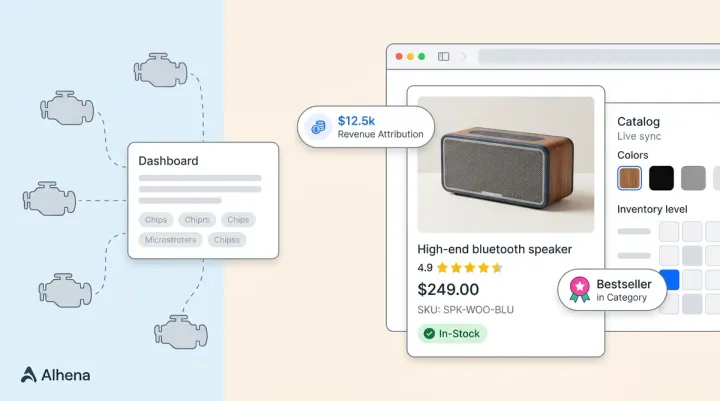
Alhena AI's revenue attribution analytics connect these conversation patterns to actual cart additions and purchases, empowering teams to make decisions about assortment changes, make decisions about content priorities, and quantify revenue impact exactly how much revenue each unfilled price tier costs per month.
Action: Compile price-gap queries by category monthly and share with buying and pricing teams as demand signals for unfilled price tiers.
5. Seasonal and Trend Signals That Surface Before Search Data
Shoppers tell AI agents what they are looking for before they search for it on Google. "I need a cottagecore dress for a barn wedding" appears in AI conversations before "cottagecore barn wedding dress" trends in keyword tools, because conversational queries are more specific and more immediate than search queries.
AI conversation data from the first two weeks of a season reveals real time demand patterns, real time trend signals, and emerging trends that search trend data confirms four to six weeks later. This matters for merchandising because it gives buying teams a head start on inventory planning, allocation, and supply chain positioning, content teams a head start on landing pages and guides, and marketing teams a head start on campaign planning.
Manawa cut response times from 40 minutes to 1 minute and achieved 80% inquiry automation with Alhena AI with Alhena AI, but the bigger win was the volume of structured conversation data this generated. When agentic AI automates responses at scale, you also capture demand signals at scale.
Action: Share weekly conversation trend reports with retailers' merchandising and marketing teams as an agentic early-warning system for emerging demand.
Why This Data Is Structurally Different from Other Voice-of-Customer Sources
Surveys suffer from low response rates (retail NPS surveys average just 3.24% response rates) and recency bias. Reviews are post-purchase and skew negative. Focus groups are small and staged. Social listening captures sentiment and engagement metrics but not purchase intent.
Conversational AI is the most underexploited intelligence source in ecommerce. Conversational AI data is real-time, high-volume, unprompted from real consumers, and captures the full conversational context and exact language shoppers use at the exact moment in their buying journey. It is the closest model to standing next to every shopper in the store and listening to what they ask the sales associate. The difference is that AI conversations are structured, searchable, and aggregated across all customer interactions automatically.
Conversational data captures "why" context 91% of the time, compared to 37% for traditional surveys. And 65% of the most valuable insights from conversational data come from topics that fall outside the context of original survey questions. Your shoppers are telling you things you did not know to ask about.
The Organizational Change Required
Conversational AI insight is only valuable if it reaches the right teams. Most ecommerce retailers silo AI data inside the CX department. The merchandising team never sees it. The product team never sees it. The content team never sees it.
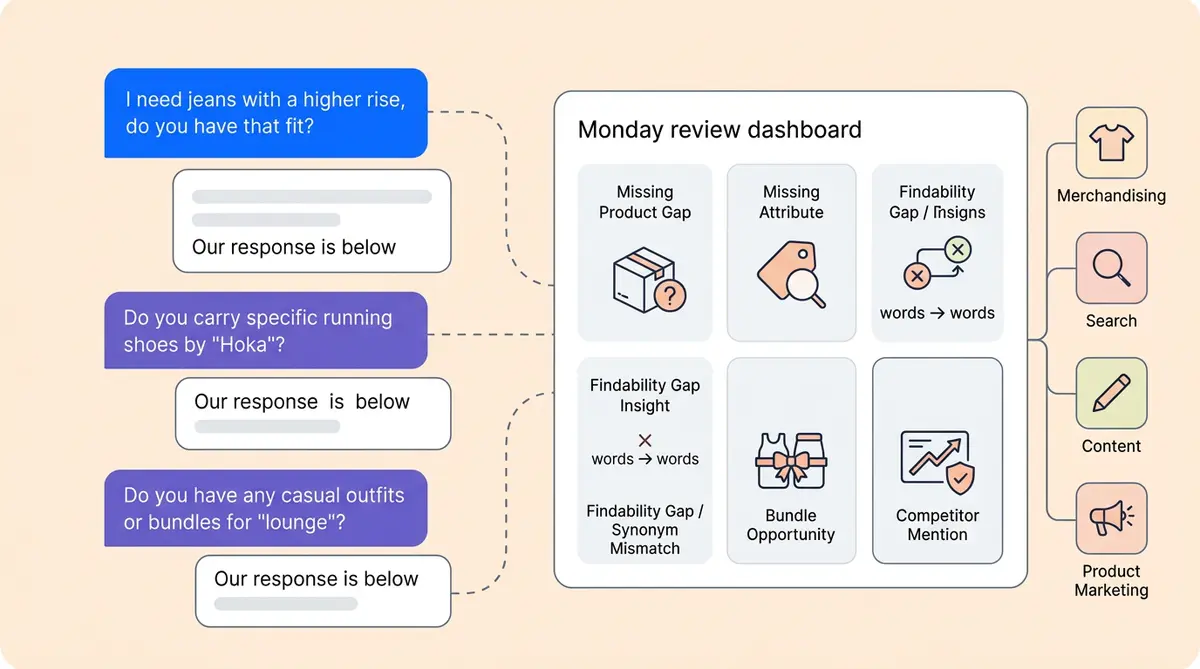
Retailers that create a weekly cross-functional review of AI conversation patterns, even a 30-minute meeting where CX shares the top insights with merchandising, product, and content, unlock a feedback loop that improves the catalog, which improves the AI, which generates better data, which improves the catalog further. Crocus achieved an 86% deflection rate and 84% customer satisfaction by treating conversation data as a shared ecommerce intelligence asset rather than a CX-only metric.
The five retail intelligence reports that should route to specific teams every week:
- Unanswered PDP questions go to the content and product description team
- Missing attribute patterns go to the catalog management, inventory, and product data team
- Comparison and bundling signals go to the merchandising and pricing team
- Price gap queries go to retail buying management and assortment planning
- Emerging trend signals go to the marketing and seasonal planning team
How Alhena AI Surfaces Merchandising Intelligence Automatically
Every conversation through Alhena's Shopping Assistant, Support Concierge, and auto-generated PDP FAQs is captured and analyzed, revealing the exact questions shoppers ask, the product attributes they search by, the comparisons they make, the price points they request, and the gaps they encounter.
Alhena's AI tools, merchandising AI tools, analytics, dashboard surfaces these patterns at the category and product level, making it possible for merchandising teams to analyze and extract actionable insights without manual transcript review or manual data analysis. The Product Review feature closes the loop between what shoppers ask and what PDPs answer, enabling AI-powered integration of real conversation patterns back into product pages.
Because Alhena AI is grounded in your actual product catalog and purchase history (not generic machine learning training data), it distinguishes between a true product gap (you don't carry what the customer wants) and a findability gap (you carry it but the customer can't find it). AI agents highlight that distinction, which changes the merchandising response entirely: one requires a buying decision, the other requires a content or taxonomy fix.
Revenue attribution connects these conversation patterns to actual purchases, so merchandising teams can prioritize the gaps that cost the most revenue to leave unfilled. Retailers using Alhena AI see this play out in real results: Tatcha attributes 11.4% of total site revenue to AI-assisted conversations, and Puffy achieves 90% CSAT with 63% automated inquiry resolution.
The Bottom Line for Merchandising Teams
Most ecommerce retailers treat AI conversation data as CX operational data. The smartest brands treat it as their most valuable real-time merchandising intelligence source. The difference between those two approaches is the difference between an AI that handles support and an AI that reshapes your entire product and merchandising strategies.
Your Agentic AI systems are already collecting this data. The only question is whether your merchandising, product, and content teams are using it.
Ready to turn AI conversations into your most actionable customer experience and merchandising data source? Book a demo with Alhena AI to see how conversation intelligence drives product and catalog decisions, or start free with 25 conversations and pull your first merchandising insight report this week.
Frequently Asked Questions
How can ecommerce teams use AI conversation data to detect missing product attributes in their catalog?
Alhena AI tracks every multi-attribute query shoppers make across chat, email, and social channels. When shoppers consistently filter by attributes that don't exist in your catalog schema (like terrain type for shoes or opacity for fabrics), Alhena surfaces these missing-attribute patterns as a prioritized list. Merchandisers use this to add the exact product data fields customers expect, improving both AI recommendation accuracy and on-site filtering.
What is the difference between AI conversation data and traditional voice-of-customer surveys for merchandising decisions?
Traditional surveys capture responses from around 3% of customers, on questions you chose to ask, weeks after the experience. Alhena AI's conversation data captures real-time, unprompted signals from every shopper who interacts with the AI across the full customer journey. This data reveals product gaps, pricing resistance, and comparison behavior that surveys structurally cannot detect, making it the most actionable voice-of-customer source for merchandising teams.
How does AI conversation analysis reveal cross-sell and bundling opportunities that analytics dashboards miss?
When shoppers ask Alhena AI to compare two products or request matching items, they reveal natural product affinities based on real purchase history and intent. Unlike collaborative filtering (which shows co-purchase correlations), comparison-driven bundling insights from conversations show why shoppers group products together and what criteria matter most. Merchandising teams use these patterns to build bundles, reposition underperforming products, and identify cannibalization risks between SKUs.
Can AI shopping assistant data identify pricing gaps in an ecommerce product assortment?
Yes. Alhena AI captures every query where a shopper describes a desired product but adds a price constraint the catalog cannot satisfy. Patterns like "I want something like your cashmere sweater but under 00" map demand for unfilled price tiers. Alhena's automation and revenue attribution connect these price-gap conversations to abandoned sessions, so merchandising and buying teams can quantify the revenue cost of each gap and prioritize assortment changes accordingly.
How should merchandising teams set up a weekly process to act on AI conversation intelligence?
Alhena AI recommends a 30-minute cross-functional review each week covering five reports: unanswered PDP questions (routed to content), missing attribute patterns (routed to catalog management), comparison and bundling signals (routed to merchandising), price-gap queries (routed to buying), and emerging trend signals (routed to marketing). This creates a feedback loop where catalog improvements feed better AI performance, which generates richer data for the next cycle.