The Control Problem: Why Your AI Chatbot Sounds the Same Everywhere
A VIP customer messages your brand on Instagram at 2 AM. A first-time visitor opens your website chat at noon. Both get the same response, the same tone, the same script. Unlike rule-based bots that can only follow fixed decision trees, modern ai chatbots on ecommerce platforms can adapt, but only if customers and agents have the right behavioral rules in place. A shopper asking about returns on WhatsApp sees the same answer as someone emailing your support address. This one-size-fits-all e-commerce chatbot and bots behavior costs revenue on high-value interactions and damages brand perception on channels where tone expectations differ.
The fix is not retraining your AI chatbot for each scenario. Ecommerce brands using ai chatbots and large language models need an AI powered approach to customer engagement that goes beyond basic bot scripts. Unlike generic large language models like ChatGPT, the best ecommerce ai solutions give you control over every chatbot interaction. It is setting behavioral guidelines that tell the AI exactly how to act when specific conditions are met, so your bots can drive sales and handle customer needs across every touchpoint. Alhena AI's Guidelines system gives e-commerce brands this level of control. Customers can engage on any channel, and ecommerce businesses can control how the AI handles every conversation through a trigger-action framework that works across seven channels, three timing modes, and unlimited custom conditions.
How the Trigger-Action Framework Works
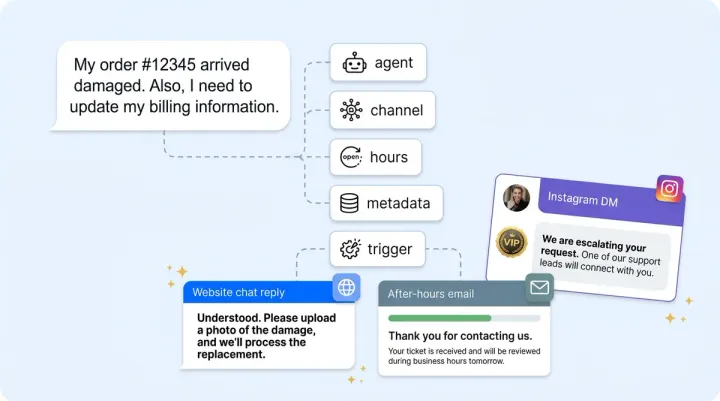
AI chatbots run on guidelines with two parts each. The trigger defines when the rule activates: a customer asks about returns, the conversation happens on Instagram, it's after business hours, the customer mentions a specific product category, or a custom metadata condition is met. The action defines what the AI does when that trigger fires: follow a specific return policy script, use a casual tone with emoji, offer to email a human follow-up instead of attempting a live transfer, escalate immediately for warranty claims, or surface a promotional offer.
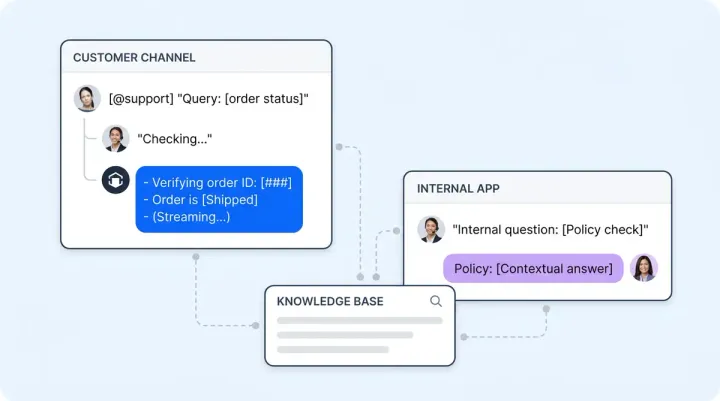
The AI evaluates all active guidelines against every incoming customer message in real time and applies the matching rules. This gives you precise behavioral control without touching the underlying conversational ai model, its natural language processing capabilities, or knowledge base. You don't retrain anything. Customers can get real-time answers to their queries, and the AI makes pricing and product decisions that engage shoppers and increase revenue. You tell the AI how to behave in each situation, and it follows those instructions. E-commerce customers can get personalized, context-aware responses without any model retraining. AI agents and virtual assistants handle each interaction using the same knowledge and capabilities, but their behavior adapts based on your rules.
Channel-Specific Behavior: Same AI, Different Personality
Your e-commerce AI chatbot should behave differently on each channel because shoppers have omnichannel customer experience expectations. Every chatbot interaction shapes how customers feel about your brand. Brands that engage customers through personalized conversations on each platform see higher conversion. Instagram DMs expect casual, quick, emoji-friendly responses. Email expects professional, detailed, fully formatted answers. WhatsApp expects conversational brevity. Slack expects technical precision for B2B audiences. Across all these messaging apps and live chat channels, the chatbot adapts to each ecommerce platform's customer experience standards. This is how ecommerce ai bots drive sales by meeting shoppers where they are in their shopping journey.
Channel scoping lets you write guidelines that activate only on specific platforms. Your Instagram guideline adds warmth and emoji so customers can engage naturally. Your email guideline adds formal structure and full policy references. Your WhatsApp guideline keeps replies short and actionable. Customers can tell the difference, and they reward brands that get it right. All from the same ai powered ecommerce ai chatbot with the same knowledge base, just shaped by different behavioral rules for each messaging apps channel. This conversational commerce approach lets ecommerce ai assistants engage customers naturally across every traffic source, improving product discovery and the overall customer journey.
Ecommerce ai brands like Tatcha use this approach to maintain voice consistency while adapting format and tone per platform. The result is a 3x conversion rate from AI-assisted conversations because the experience feels native to each channel.
Business Hours Scoping: Three Timing Modes
Alhena AI's chatbot Guidelines support three timing modes that change customer experience behavior based on when the conversation happens:
- Always: The guideline applies regardless of time. Use this for policies that never change, like shipping cutoff rules or product safety information. Customers can get answers to these queries in real time regardless of when they ask.
- Within Business Hours: The guideline activates only during your configured hours. Example: offer live chat handoff to human agents for complex conversations when your team is available.
- After Hours: The guideline activates outside business hours. Example: collect the customer's email and details, promise next-day follow-up, and don't attempt to transfer the chatbot conversation to human agents who aren't there. Customers can still get real-time answers to common queries.
This prevents the frustrating e-commerce customer experience of an AI offering "let me connect you to an agent" at midnight when no agent is available. Manawa used after-hours guidelines to cut response time from 40 minutes to 1 minute and automate 80% of customer inquiries without sacrificing customer satisfaction.
Three Sample Guidelines You Can Build Today
1. Returns Policy Enforcement (Ecommerce AI Automation)
Trigger: "Customer asks about returns or refunds."
Action: "Walk through the 30-day return process step by step using the order management system, confirm eligibility based on order date, and provide the return initiation link. This ai ecommerce automation delivers a personalized customer experience." This keeps your e-commerce chatbot return policy consistent across every channel and every hour. Customers can get real-time answers to return queries without waiting for an agent.
2. After-Hours Instagram Support
Trigger: "Conversation on Instagram after business hours."
Action: "Respond in a warm, casual tone. Resolve the question if possible. If escalation is needed, collect the customer's email and confirm a team member will follow up by next business morning." No dead-end transfers. No broken promises. Response time stays under a minute even after hours. Ecommerce businesses can reduce cart abandonment and protect revenue even outside business hours.
3. VIP Product Launch Access
Trigger: "Customer mentions the new collection or specific launch product names."
Action: "Surface the new arrivals with priority positioning, mention the early access window, and offer to add items to cart immediately." These personalized interactions turn your AI shopping assistant into a guided selling tool during high-intent launch moments.
Common Use Cases for AI Chatbot Guidelines in Online Retail
The most effective use cases for ai chatbots and ecommerce bots center on the moments that make or break revenue. Cart abandonment is a prime example that every ecommerce ai platform should address: when a shopper adds items to their cart but hesitates, a guideline can trigger the AI to offer free shipping or a limited discount before the checkout window closes. Abandoned carts drop by double digits when ai chatbots interact with shoppers at the right moment.
Order tracking is another high-volume use case. Customers who ask “where is my order” expect instant, automated answers. A guideline scoped to order tracking queries pulls real-time data from your CRM and gives the customer a personalized update, no human agent needed. Product discovery guidelines help ai agents surface relevant items from product catalogs based on what the shopper is browsing or asking about, turning faq-style interactions into cross selling opportunities. These ai agents interact with customers as personalized shopping assistants, not generic bots.
The customer journey doesn’t stop at the first purchase. Post-purchase guidelines handle return inquiries, subscription changes, and loyalty program questions. Each of these interactions is a chance to drive sales through personalized recommendations. Brands on Shopify, for example, connect their product catalogs to Alhena AI and let guidelines shape how the chatbot responds to every customer need across the full shopping journey.
Best Practices for Guideline Configuration
Keep each guideline focused on one scenario. Bundling multiple customer behaviors into a single guideline creates confusion and makes testing harder. Write specific triggers because unlike ChatGPT, vague conversational bot rules like "when a customer is unhappy" fire too broadly and create conflicts with other rules.
Test every chatbot guideline in the Playground before activating it. The Playground lets you simulate real-time customer queries and see exactly how the ai agents respond with the new guideline applied, without affecting live conversations. Try edge cases and rephrasings to make sure the trigger fires when it should and stays quiet when it shouldn't.
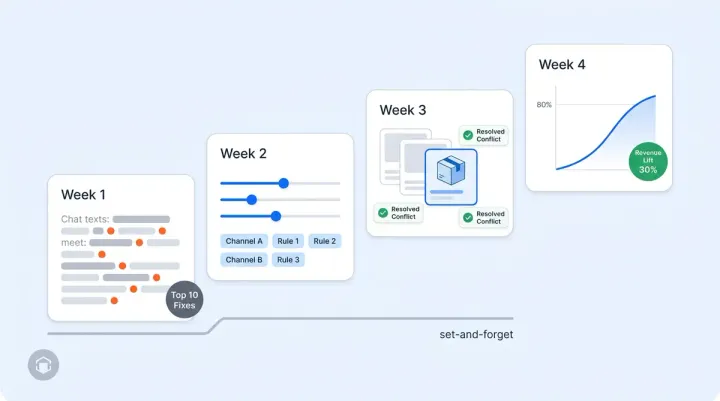
Review guidelines quarterly because policies change, channels evolve, and new scenarios emerge. Don't overload your automated system with dozens of rules. Ecommerce automation capabilities grow best when each guideline is tested and proven before adding the next. Start with 5 to 10 high-impact guidelines covering your most common e-commerce scenarios like FAQ handling, order tracking, and returns and expand gradually. Ecommerce businesses that take this scalable approach can improve response time and handle customer queries from product discovery to checkout without pricing in additional headcount. Crocus achieved an 86% deflection rate and 84% CSAT with a focused set of well-configured behavioral rules.
What Makes Alhena AI's Guidelines System Different
The Alhena AI Guidelines system is built specifically for ecommerce operations teams who need granular control. Channel scoping works across seven messaging apps and chat platforms: web chat, email, Instagram, Facebook Messenger, WhatsApp, Slack, and Discord. Add multilingual support and you have an ai powered chatbot with bots that handle customer experience conversations in any language on any messaging apps channel. Business hours timing supports three modes. Metadata triggers enable advanced conditions based on customer segments, subscription tiers, A/B test groups, CRM data, crm integrations, and login status. AI assistants and agents can interact with customers and make real-time decisions about how to engage each one.
Playground testing validates behavior before live activation. The system is scalable to hundreds of guidelines without performance loss, giving online retail brands the scalability they need during peak traffic. The system flags when guidelines contradict each other so you can resolve conflicts before they reach customers. Customers can engage with an AI that responds in real time with the right tone, the right policy, and the right product recommendations for their specific situation. These capabilities let ecommerce brands make their AI behave like a trained specialist on every channel at every hour. The system is fully automated once configured, without rebuilding or retraining the model. Whether you run a Shopify store or a large online retail operation, the same conversational ai adapts to your customer needs with natural language processing that feels human.
Victoria Beckham saw a 20% increase in average order value by configuring guidelines that turned their AI into a guided selling tool. The AI didn't change. The behavioral rules and automation did. Every personalized interaction adds up.
The Real Difference Between Generic AI and Your Brand's AI
Over 70 percent of ecommerce brands using ai chatbots report that personalized interactions drive higher conversion. The difference between an AI that feels generic and an AI that feels like your brand is not the underlying model. It's the behavioral guidelines that shape how that model responds in the moments that matter. The brands with the highest CSAT and the strongest conversion from ai chatbots and ai agents aren't using better AI. They're using better-configured ecommerce conversational ai that drives customer engagement through every chatbot interaction, from product discovery to checkout to post-purchase support.
Ready to give your AI the rules it needs to act like your best team member on every channel? Book a demo with Alhena AI to see the Guidelines system in action, or start free with 25 conversations and build your first guideline set today.
Frequently Asked Questions
What are AI behavioral guidelines and how do they differ from retraining the AI on new data?
AI behavioral guidelines are trigger-action rules that control how your chatbot responds in specific situations without changing the underlying model or knowledge base. Alhena AI's Guidelines system lets you define conditions (like channel, time of day, or customer scenario) and pair them with specific behavioral instructions. Unlike retraining, which changes what the AI knows, guidelines change how the AI acts, and you can update them instantly without any technical work.
How do I set different AI chatbot behavior for Instagram versus email versus WhatsApp?
Alhena AI's channel scoping lets you write guidelines that activate only on specific platforms. You create separate guidelines for Instagram (casual tone, emoji, short replies), email (formal structure, full policy references), and WhatsApp (conversational brevity), and the AI applies the matching rule based on which channel the conversation happens on. All seven supported channels (web chat, email, Instagram, Facebook Messenger, WhatsApp, Slack, Discord) can have distinct behavioral rules while sharing the same knowledge base.
Can AI chatbot guidelines change behavior based on business hours automatically?
Yes. Alhena AI supports three timing modes for every guideline: Always (applies at all times), Within Business Hours (activates only during your configured hours), and After Hours (activates only outside business hours). This means you can offer live agent handoff during the day and switch to email collection and next-day follow-up promises at night, all automated without manual intervention.
How do I test an AI guideline change before it affects live customer conversations?
Alhena AI includes a Playground testing environment where you can simulate customer messages and see exactly how the AI responds with your new guideline applied. You type sample questions, rephrasings, and edge cases to verify the trigger fires correctly and the action produces the right response. No live customers are affected until you activate the guideline, so you can iterate safely.
How many AI chatbot guidelines should an ecommerce brand start with?
Start with 5 to 10 high-impact guidelines covering your most common customer scenarios: returns and refunds, shipping status, product sizing, discount codes, and order changes. Alhena AI recommends keeping each guideline focused on a single scenario and expanding gradually. Brands that start focused and test thoroughly in the Playground before activating see the best results without creating rule conflicts.