Agentic Storefronts Are Here: What Ecommerce Brands Need to Know in 2026
What every ecommerce brands needs to know about the architecture shift transforming how online stores work in 2026
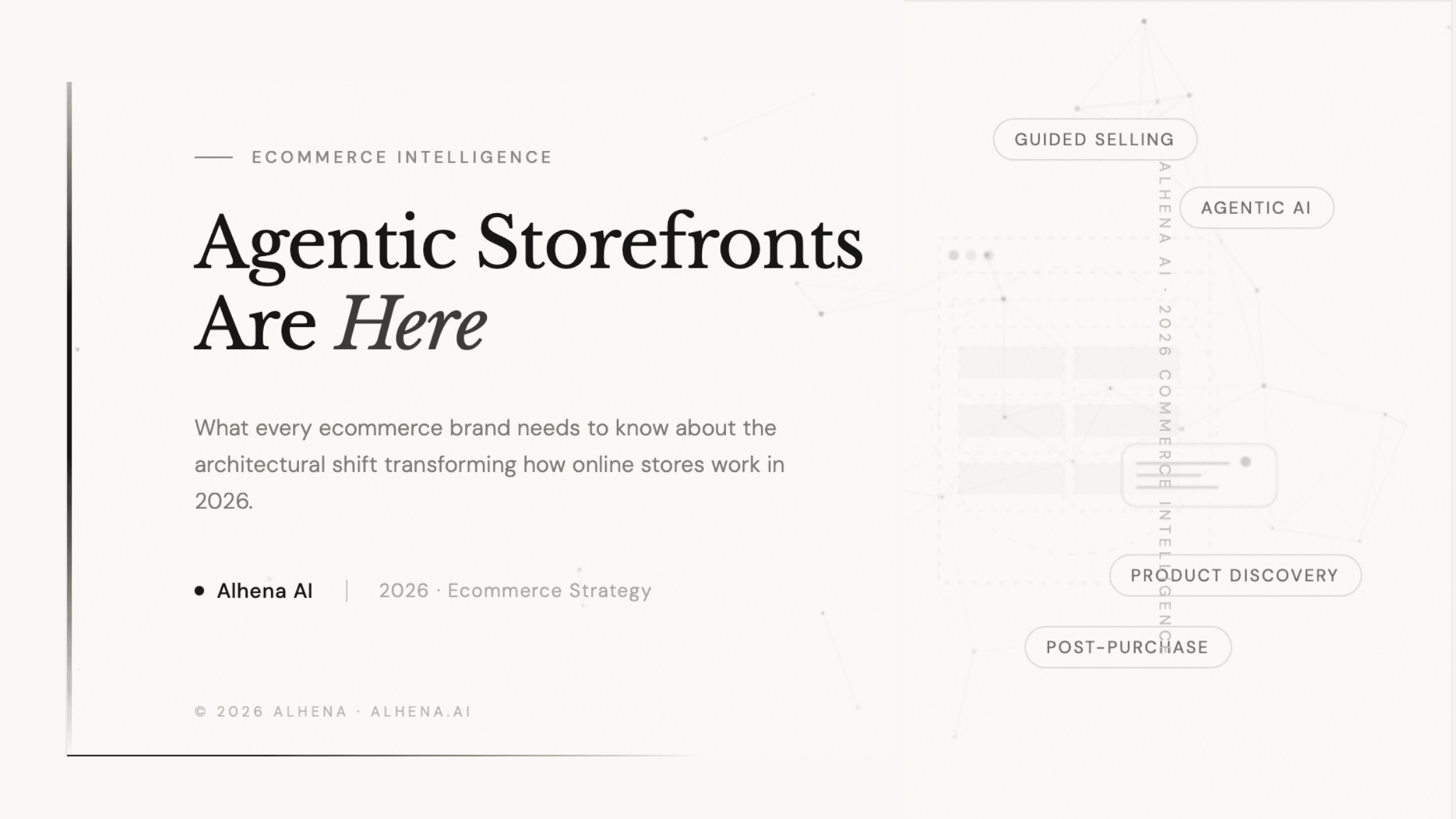
Something fundamental has changed in how e-commerce platforms think about the storefront.
In the past few months, Shopify debuted agentic storefronts. Salesforce launched its Guided Shopping Agent. VTEX and Kibo rolled out their own agent-powered features. Oracle and Microsoft introduced merchant-facing AI assistants. The pattern is unmistakable. Every major platform is building toward the same idea: storefronts where AI agents do not just sit in the corner waiting to answer questions but actively participate in the shopping journey.
This is not a minor product update. It is an architectural shift in how online stores work. And for brands that sell through these platforms, the implications are significant.
What Is an Agentic Storefront?
An agentic storefront is an online store where AI agents operate as active participants in the customer journey rather than passive tools that respond only when prompted.
In a traditional ecommerce setup, the storefront is a collection of pages. The customer navigates, searches, filters, reads descriptions, compares products, and eventually decides whether to buy. The store presents information. The customer does the thinking.
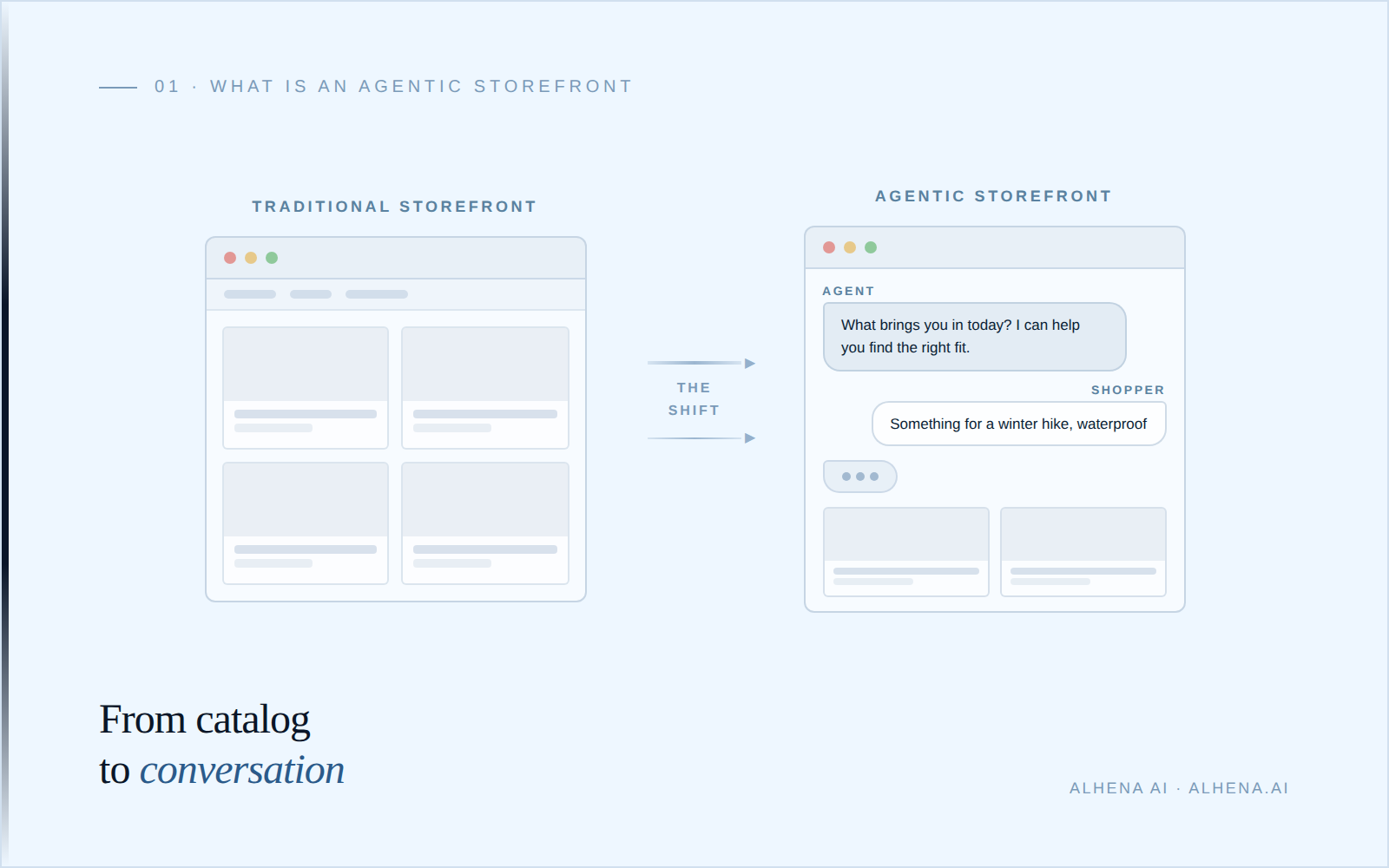
In an agentic storefront, an AI agent can step into that process at any point. It can ask what the shopper is looking for. It can surface products based on conversational context rather than keyword matches. It can check inventory in real time, explain return policies, compare two items side by side, and, in some cases, complete the purchase on the customer's behalf.
The distinction matters because it changes the role of the storefront from a catalog into a conversation. The shopping experience becomes dynamic, responsive, and personalized in a way that static page layouts and recommendation carousels simply cannot match.
Why Every Platform Is Moving in This Direction
The timing of this shift is not accidental. Several forces are converging at once.
Consumer expectations have changed. Shoppers increasingly expect instant, accurate answers without hunting through FAQs or waiting for live chat agents. The rise of conversational AI tools in everyday life has raised the bar for what people expect from digital experiences, including commerce.
Off-site shopping is growing. Consumers are starting to shop through AI assistants like ChatGPT, Google's AI features, and other conversational interfaces that bypass the traditional storefront entirely. Platforms recognize that if they do not bring agentic capabilities into the store itself, shoppers may complete their journey somewhere else.
The economics favor it. AI agents can handle a volume of interactions that would require a large human support team, at a fraction of the cost. For platforms competing for merchant loyalty, offering built-in AI capabilities is a differentiator. For merchants, it means better conversion and lower operational overhead.
Data infrastructure is ready. Real-time inventory syncing, rich product catalogs, and behavioral analytics have matured enough that AI agents can make accurate, contextual decisions rather than generic suggestions. The foundation for agentic commerce has been building for years. 2026 is when it becomes operational.
Read more about Agentic Commerce in 2026.
What This Means for Your Brand
If you sell through Shopify, Salesforce Commerce Cloud, or any other major platform, agentic features are either already available or coming soon. Here is how to think about them strategically.
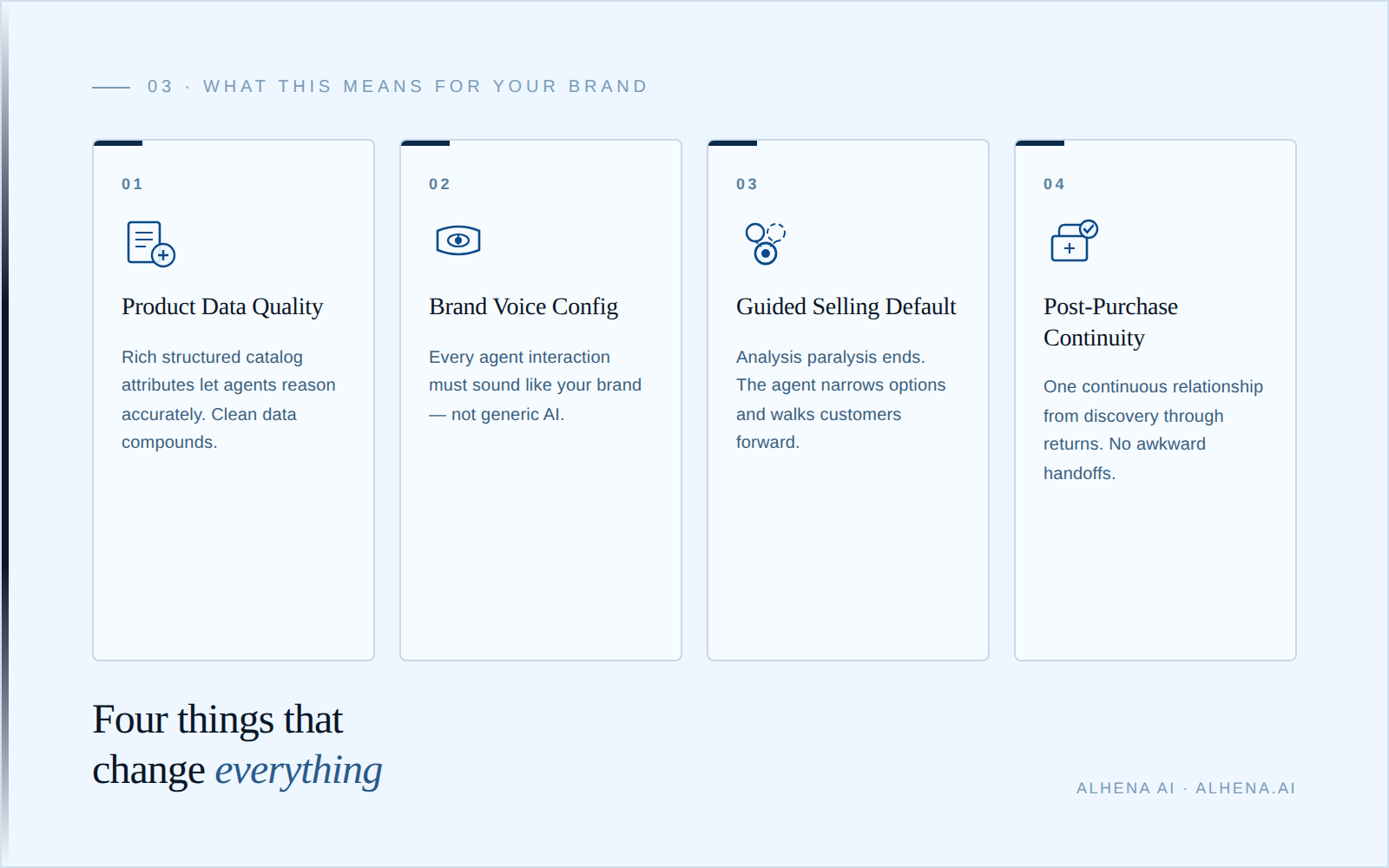
Your Product Data Becomes Even More Important
AI agents are only as good as the data they operate on. An agent that recommends a product based on incomplete attributes, outdated descriptions, or inaccurate inventory will create frustration rather than conversion. The brands that benefit most from agentic storefronts are the ones with clean, structured, comprehensive product data.
This means investing in your catalog. Not just images and titles, but detailed attributes like materials, sizing details, compatibility information, care instructions, and use cases. The richer the data, the smarter the agent.
Brand Voice Cannot Be an Afterthought
When a customer interacts with an AI agent on your store, that agent is representing your brand. The tone, the language, the personality, all of it shapes the customer's perception. A luxury brand that sounds generic through its AI agent is undermining its positioning. A casual, fun brand that sounds robotic is breaking trust.
Configuring brand voice and response guidelines is not optional in an agentic storefront. It is essential. The agent needs to know not just what to say, but how to say it in a way that feels consistent with every other touchpoint in the customer experience.
Guided Selling Becomes the Default Experience
Static product pages force customers to self-serve. They read descriptions, compare specs, and make decisions on their own. Agentic storefronts introduce guided selling as the default: the AI asks questions, narrows options, and walks the customer toward the right product.
For brands with large catalogs, complex product lines, or frequent customer confusion about sizing and fit, this is transformative. Instead of losing customers to analysis paralysis, the agent acts like the best sales associate on the floor, one who knows every product in the store, never forgets a detail, and is available around the clock.
Post-Purchase Is Part of the Storefront Now
Agentic storefronts do not stop at checkout. The same AI that guided the purchase can handle order tracking, process returns, answer warranty questions, and recommend complementary products after delivery. This continuity across the entire journey, from first click to post-purchase support, is what makes agentic commerce fundamentally different from traditional chatbot implementations.
The customer does not experience a handoff between the shopping assistant and the support bot. It is one continuous relationship.
The Difference Between Platform Agents and Purpose-Built AI
Here is something worth paying attention to. Platform-native AI agents, the ones built into Shopify or Salesforce, are designed to work broadly across all merchants. They are general purpose by design.
For many brands, particularly those with complex catalogs, specific merchandising priorities, or high-touch customer expectations, a general-purpose agent may not go deep enough. This is where purpose-built AI solutions like Alhena come in.
Alhena's AI agents are built specifically for e-commerce. They connect to your catalog, your inventory, your brand guidelines, and your customer data. They are trained on your specific product logic, not a generic model. They understand the difference between recommending a winter coat by material versus by occasion. They know when to upsell and when to simplify. And critically, they operate with hallucination-free accuracy, so your customers get answers they can trust.
Platform agents and purpose-built agents are not mutually exclusive. Many brands will use platform-level features for basic functionality while layering in specialized solutions like Alhena for the interactions that require depth, accuracy, and brand alignment.
How to Prepare Right Now
If your brand has not yet engaged with agentic commerce, here are the practical steps to start.
Audit your product data. Identify gaps in attributes, descriptions, and metadata. AI agents need structured data to reason over. Unstructured or incomplete data limits what any agent can do.
Define your brand guidelines for AI. Document the tone, language, boundaries, and priorities your AI should follow. What topics should it handle? What should it escalate? How should it speak?
Map your customer journey. Identify the moments where guided selling, instant answers, or proactive recommendations would reduce friction. These are your highest-impact deployment points.
Start with a focused use case. You do not need to automate every interaction on day one. Begin with high-volume, structured journeys like product discovery, sizing guidance, or order tracking. Expand from there.
The Bigger Picture
The storefront as we have known it, a static collection of pages that customers navigate on their own, is evolving into something more dynamic. Agentic storefronts put AI at the center of the shopping experience, not as a support tool on the margins, but as a core part of how customers discover, evaluate, and buy products.
Every major platform is betting on this direction. The brands that move early, with clean data, clear guidelines, and the right AI partner, will be the ones that turn this shift into measurable revenue growth.
The storefront is no longer just a place to browse. It is a conversation. And the brands that show up in that conversation will win. Ready to bring agentic commerce to your store? Talk to the Alhena AI team.

Frequently Asked Questions
What is an agentic storefront?
An agentic storefront is an AI-powered commerce experience where AI agents can autonomously act on behalf of shoppers, browsing products, making recommendations, and completing purchases with minimal human intervention. Unlike traditional ecommerce, an agentic storefront is designed to be discoverable and navigable by AI systems, not just human users.
What is conversational commerce, and how does it connect to agentic AI?
Conversational commerce uses natural language to facilitate shopping, but agentic AI takes it further. Instead of a human typing queries into a conversational interface, AI agents handle the conversation autonomously, interpreting shopper intent, querying the catalog, and completing transactions. The result is a frictionless, personalized shop journey driven entirely by intelligent agents.
What role does product discovery play in an agentic commerce strategy?
Product discovery is the foundation of the agentic shop journey. When an AI agent searches for a product on behalf of a shopper, it needs to efficiently surface the most relevant items from your catalog. Retailers who optimize for AI-driven product discovery, through structured data, intent signals, and intelligent catalog organization, will see higher engagement from agentic traffic.
How does an AI agent differ from a traditional chatbot or assistant?
A traditional assistant responds to prompts and provides information, but an AI agent can autonomously execute multi-step tasks: searching a catalog, comparing products, applying personalization, and completing checkout, all without step-by-step human guidance. Agentic AI systems act with intent and purpose across an entire shop journey.
How does agentic AI affect the customer journey from discovery to checkout?
Agentic AI compresses and automates the customer journey. Where a traditional shopper might spend hours researching and comparing, an AI agent can complete the full journey, product discovery, comparison, personalization, and checkout, in minutes. For retailers, this means fewer abandoned carts and higher conversion, but only if the storefront is built to support autonomous agent workflows end to end.
Is agentic commerce the same as automation?
Not exactly. While both involve reducing manual effort, agentic commerce goes further: AI agents don't just automate tasks, they act with intelligence and intent. An agentic AI system can handle dynamic, context-dependent decisions, like evaluating trade-offs between products, applying personalization, or proactively adapting to new shopper signals, in ways traditional automation cannot.
How do generative AI and agentic AI work together in commerce?
Generative AI powers the language understanding and content capabilities of agentic commerce, enabling natural product discovery conversations, dynamic catalog descriptions, and intelligent recommendation generation. Agentic AI provides the decision-making and autonomous action layer, allowing AI agents to act on generative AI outputs by executing real commerce tasks like search, selection, and checkout.