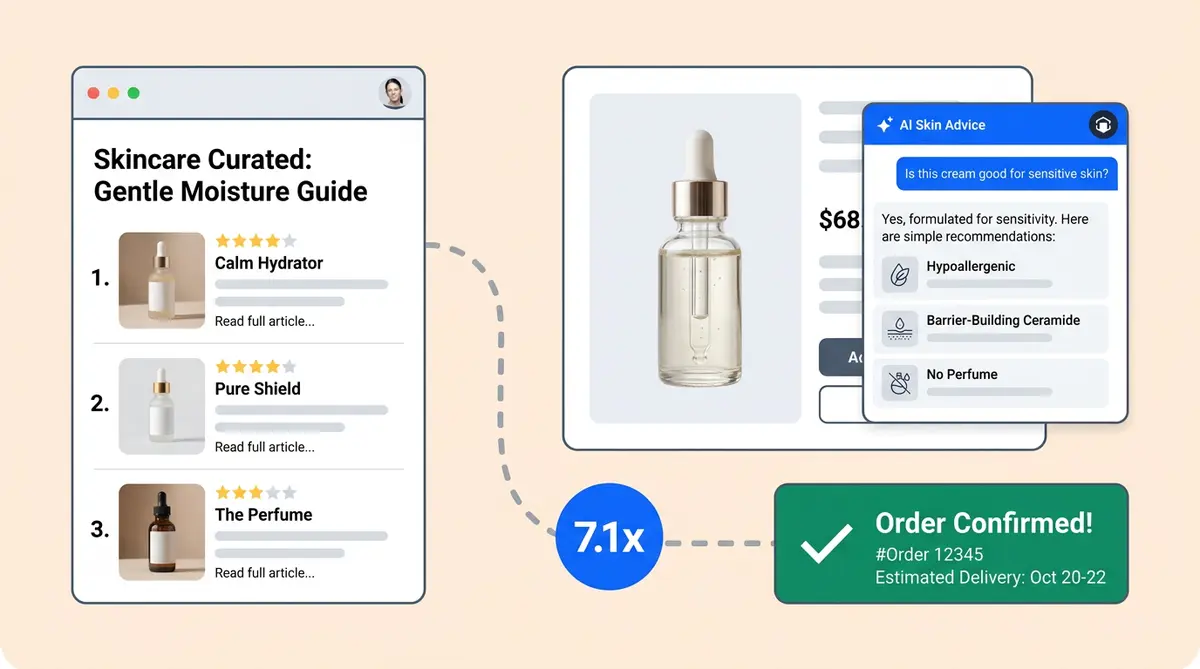
Affiliate marketing traffic converts at 3.12% without AI assistance. With on-site AI engagement, that number jumps to 22.11%, a 7.1x lift that makes affiliate the highest-converting sales channel for AI-assisted ecommerce. Not email. Not SMS. Not paid search. Not paid ads. Affiliate.
Most ecommerce businesses don't know this. They treat affiliate traffic like any other referral source, sending warm visitors who browse to static product pages with no personalization and no real-time guidance. The result is a massive gap between what affiliate traffic could deliver and what it actually does. This post breaks down why affiliate visitors respond so strongly to AI engagement, how the 7.1x lift compares to other channels, and what affiliate marketing tactics turn this data into revenue.
Why Affiliate Visitors Respond So Strongly to AI Engagement
The affiliate audience is psychologically different from every other customer and prospect on your site. They arrive pre-sold on the category and often pre-sold on the need to buy. They've already browsed a review, watched a comparison video, or read a recommendation from a creator or content creator they trust. Affiliates and content creators did the hard work of convincing them that your product category is worth their money.
But here's what affiliate content can't do: it can't tell a shopper which exact SKU, variant, size, or bundle is right for their specific situation. Beauty affiliates might recommend your moisturizer line, but customers still need to know which formula works for oily skin in humid climates. Home furnishing affiliates might feature your sofa collection, but the customer needs to confirm whether the 84-inch model fits their living room layout.
This is the critical affiliate marketing gap that AI fills perfectly. Affiliate content tells shoppers what to buy. On-site AI tells them exactly which product is right for them. It handles the last-mile decision between similar options, answers compatibility and fit questions in real time, and confirms the choice before checkout. For an audience member who already trusts the recommendation, that combines a final nudge from an AI shopping assistant is often all it takes to convert.
Study after study confirms this dynamic. Affiliate visitors who engage with AI don't just convert slightly better. They convert at 22.11%, more than seven times the 3.12% baseline. That lift isn't random. It's the direct result of matching a high-intent audience and target audience with the precise kind of help those shoppers need.
How the Affiliate AI Lift Compares to Other Channels
The 7.1x affiliate AI engagement lift isn't just impressive in isolation. It's the highest of any channel in the dataset.
- Affiliate: 3.12% baseline to 22.11% AI-assisted (7.1x lift)
- SMS: 3.92% baseline to 15.58% AI-assisted (4.0x lift)
- Email: 4.01% baseline to 15.07% AI-assisted (3.8x lift)
- Organic search: 2.14% baseline to 8.87% AI-assisted (4.1x lift)
- Direct: 2.87% baseline to 10.22% AI-assisted (3.6x lift)
Affiliate marketing outperforms email, SMS, organic, and direct on AI-assisted conversion rate by a wide margin. The reason goes back to the psychological profile: affiliate visitors arrive with stronger purchase intent and more category knowledge than shoppers from other channels. They've already done their research. AI helps close the loop.
Yet here's the untapped opportunity. Affiliate's current AI engagement rate sits at just 1.38%. The best-in-class benchmark across all channels is 3% to 4%. That means for every 100 affiliate visitors, only 1 or 2 are actually able to use AI. If businesses could push affiliate AI engagement to even 3%, the incremental revenue would be substantial, because every engaged visitor converts at that 22.11% rate.
The math is straightforward. Double the engagement rate on affiliate traffic and you roughly double the AI-attributed revenue from that channel, without spending a single additional dollar on affiliate partnerships or traffic acquisition.
Tactics for Combining Affiliate and AI Strategies
Knowing that affiliate AI engagement drives a 7.1x lift is one thing. Capturing it requires specific optimization changes to how your AI shopping assistant interacts with affiliate-referred visitors.
Deploy AI Engagement Triggers on Affiliate Landing Pages
Most businesses deploy AI chat widgets site-wide with the same passive "How can I help?" prompt. For affiliate traffic, that's a missed opportunity. Set up proactive engagement triggers that fire specifically when a visitor arrives with an affiliate UTM parameter or referral tag. The AI should initiate the conversation, not wait for the shopper to find the chat icon.
The trigger message should acknowledge the visitor's context. Something like "Looking for the right shade? I can help you match based on your skin tone" works far better than a generic greeting. Proactive, contextual engagement is what pushes the AI interaction rate from 1.38% toward the 3% to 4% benchmark where the revenue impact scales.
Customize AI Flows Based on Affiliate Source and Category
Not all affiliate traffic is the same. A visitor from a niche skincare review site has different questions than one from a niche deals aggregator. Your AI shopping assistant should adapt its conversation flow based on the referring affiliate and the shopping category the visitor lands on.
For review-driven affiliate audiences, niche audience segments, and target audience groups, the AI should focus on SKU-level recommendation intelligence: helping the shopper narrow from the category (moisturizers) to the specific product (the lightweight gel formula for combination skin). For deal-site affiliate audiences, the AI should emphasize value-driven solutions: bundle options, free shipping thresholds, and loyalty program enrollment, and promotional events that make the purchase feel like the right financial decision.
Bridge the Gap Between Broad Recommendation and Specific Match
Affiliate content creation is inherently broad, and even the best content creation cannot cover every scenario. A "Best Running Shoes 2025 blog" article might feature five options from your brand, but the reader needs to pick one. That's where AI-powered guided matching takes over. The AI asks targeted questions about the shopper's use case, preferences, and constraints, then recommends the single best option with a clear and direct explanation of why.
This isn't generic product discovery. It's guided selling that continues the content creation and recommendation journey the affiliate started. Brands like Tatcha have seen 3x conversion rates and 38% AOV uplift when AI handles this exact handoff between broad interest and specific purchase.
Measure AI Lift on Affiliate Sessions Separately
Most analytics platforms blend affiliate conversion data into a single number. To capture the 7.1x affiliate programs marketing lift, you need to segment AI-engaged affiliate sessions from non-engaged ones and track them independently. This means building a measurement framework that answers three key questions:
- What percentage of affiliate visitors are engaging with AI? (target: 3% or higher)
- What is the conversion rate of AI-engaged affiliate visitors vs. non-engaged? (expect 5x to 7x difference)
- What is the incremental revenue per AI-engaged affiliate session? (this is your true AI ROI, the clearest ROI metric for the channel)
Alhena AI's built-in revenue attribution tracks these metrics at the channel level automatically, so affiliate marketers, CX teams, and program managers can see exactly how much incremental revenue AI adds to each affiliate partner's traffic.
What This Means for Affiliate Program Strategy
Most businesses evaluate affiliate partnerships based on two key metrics: traffic volume and baseline conversion rate. The 7.1x AI lift data reveals that this evaluation framework is incomplete.
When AI engagement is not part of the equation, the true value of affiliate traffic is dramatically underestimated. An affiliate partner who sends 10,000 visitors per month at a 3% conversion rate looks like a solid performer. But if those visitors have an AI-assisted conversion rate of 22%, that same partner is actually capable of driving far more revenue than the current numbers suggest. The bottleneck isn't the affiliate's traffic quality. It's the brand's on-site experience.
Forward-thinking affiliate marketers are starting to evaluate partners based on AI-assisted conversion potential, not just raw conversion. This is the key shift in the conversation from "send us more traffic" to "send us the right audience and we'll convert it at 7x with AI." It also changes marketing strategies and commission structures. If AI engagement triples the revenue from a partner's traffic, there's a case for higher commission rates, commission structures, and commission tiers that attract top-performing affiliates and create a flywheel of quality traffic and AI-powered conversion.
The businesses that figure this out first will have a structural advantage. They'll attract the best affiliate partners by offering higher payouts funded by the extra revenue AI-driven conversion gains produce, while their competitors continue optimizing for volume on static landing pages.
How Alhena AI Unlocks the Hidden Value in Affiliate Traffic
Alhena AI is purpose-built as a complete AI solution and AI solution platform for this affiliate marketing ecommerce scenario. Unlike general-purpose AI tools, chatbot solutions, or basic FAQ tools and AI tools, Alhena's Product Expert Agent, one of two specialized AI agents, understands your full catalog at the SKU level and delivers personalized product recommendations grounded in real product data, not AI generated generic responses.
For affiliate traffic specifically, Alhena helps recognize affiliate-referred visitors through UTM parameters and referral data, then deploys tailored engagement flows that continue the recommendation journey the affiliate started. If an audience member arrives from a "Best Vitamin C Serums" article, Alhena doesn't ask "How can I help you?" It asks which skin concern matters most and recommends the specific serum variant that matches.
The platform's agentic checkout solutions handles the final friction point too. Once the AI helps a shopper choose the right product, it populates the cart and pre-fills checkout fields, cutting the steps between decision and purchase. Through this optimization, Alhena drives the 22.11% conversion rate on affiliate traffic: by handling every stage from personalized recommendation to completed transaction.
Alhena also gives affiliate program managers something they've never had before: channel-level conversion intelligence. The built-in analytics dashboard shows precisely how much incremental revenue AI adds to each affiliate partner's traffic, broken down by partner, campaign, and product category. This optimization and conversion optimization data transforms how businesses negotiate affiliate partnerships, creator partnerships, and brand partnerships, allocate co-op budgets, and prioritize which partners deserve higher commission tiers.
Victoria Beckham saw a 20% AOV increase with Alhena's AI shopping assistant. Puffy achieved 63% support automation and inquiry automation with 90% CSAT. These results come from the same core capability that drives the affiliate AI lift: meeting high-intent visitors with the right guidance at the right moment.
Alhena automates engagement and automates the full workflow and deploys in under 48 hours with no developer resources and integrates natively with Shopify, WooCommerce, and Salesforce Commerce Cloud. You can start capturing the affiliate marketing AI lift this week.
The Bottom Line
Affiliate traffic is already high-quality. AI transforms it into the highest-converting sales channel in ecommerce. The 7.1x lift from 3.12% to 22.11% isn't theoretical. It's happening right now on sites where AI shopping assistants engage affiliate-referred visitors with personalized, SKU-level guidance.
Businesses that use AI in affiliate programs without on-site AI engagement in their affiliate programs are capturing a fraction of the revenue their affiliate partners are actually capable of driving. The traffic is there. The intent is there. The only missing piece is the AI that converts it.
Ready to see what your affiliate traffic is really worth? Book a demo with Alhena AI to deploy AI tools and shopping assistance on your affiliate landing pages, or start free with 25 conversations and measure the lift yourself. Use the ROI Calculator to estimate the revenue impact before you start.
Frequently Asked Questions
Why does affiliate traffic convert 7x higher with AI shopping assistance?
Affiliate visitors arrive pre-sold on the product category after reading reviews and comparisons from trusted sources. They need more information to choose the right SKU, size, or variant for their specific situation. Alhena AI fills that last-mile decision gap with real-time, personalized product matching that converts this high-intent audience at 22.11% compared to 3.12% without AI engagement.
How do I deploy AI engagement specifically for affiliate-referred traffic?
Set up proactive AI triggers that fire when visitors arrive with affiliate UTM parameters or referral tags. Alhena AI recognizes affiliate-referred sessions automatically and deploys tailored conversation flows based on the referring source and product category. This targeted approach pushes AI engagement rates from the current 1.38% average toward the 3% to 4% benchmark where revenue impact scales significantly.
What is the AI-assisted conversion rate for affiliate traffic vs email and SMS?
Affiliate traffic leads all channels with a 22.11% AI-assisted conversion rate, compared to 15.58% for SMS and 15.07% for email. Alhena AI captures this lift by handling the SKU-level recommendation intelligence that affiliate content creation alone cannot provide, guiding each visitor from broad category interest to a specific product match.
How should affiliate program managers use AI conversion data to evaluate partners?
Evaluate affiliate partners based on AI-assisted conversion potential, not just raw traffic volume and baseline conversion rate. Alhena AI provides channel-level revenue attribution that shows incremental revenue per partner when AI engagement is active. Partners whose traffic converts at 22% with AI are worth significantly higher commissions than their baseline numbers suggest.
Can Alhena AI measure incremental revenue from AI engagement on affiliate sessions?
Yes. Alhena AI tracks AI-engaged vs non-engaged affiliate sessions separately and reports the incremental revenue, conversion rate lift, and AOV impact at the partner, campaign, campaign performance, and campaign attribution level. This gives affiliate marketers precise data on how much additional revenue AI shopping assistance adds to each affiliate relationship, broken down by product category.