Answer engines like ChatGPT and Perplexity answer shopper questions by pulling from structured FAQ content on product pages. Brands with schema-marked, conversational Q&A on their PDPs get cited. Brands without it get skipped. That's the new reality of product discovery on your website, and it applies equally to ChatGPT, Gemini, Perplexity, and other AI platforms and answer engine systems.
If your website's product pages don't have structured, conversational FAQ content, you're invisible to the fastest-growing traffic source in ecommerce, especially as zero-click searches dominate traditional results and zero-click answers replace organic listings. This guide breaks down why FAQ content is now AI engine fuel, how to build a product FAQ layer that actually gets cited, and how Alhena AI turns real shopper conversations into auto-generated, schema-ready FAQs per SKU.
Why FAQ Content Is AI Engine Fuel
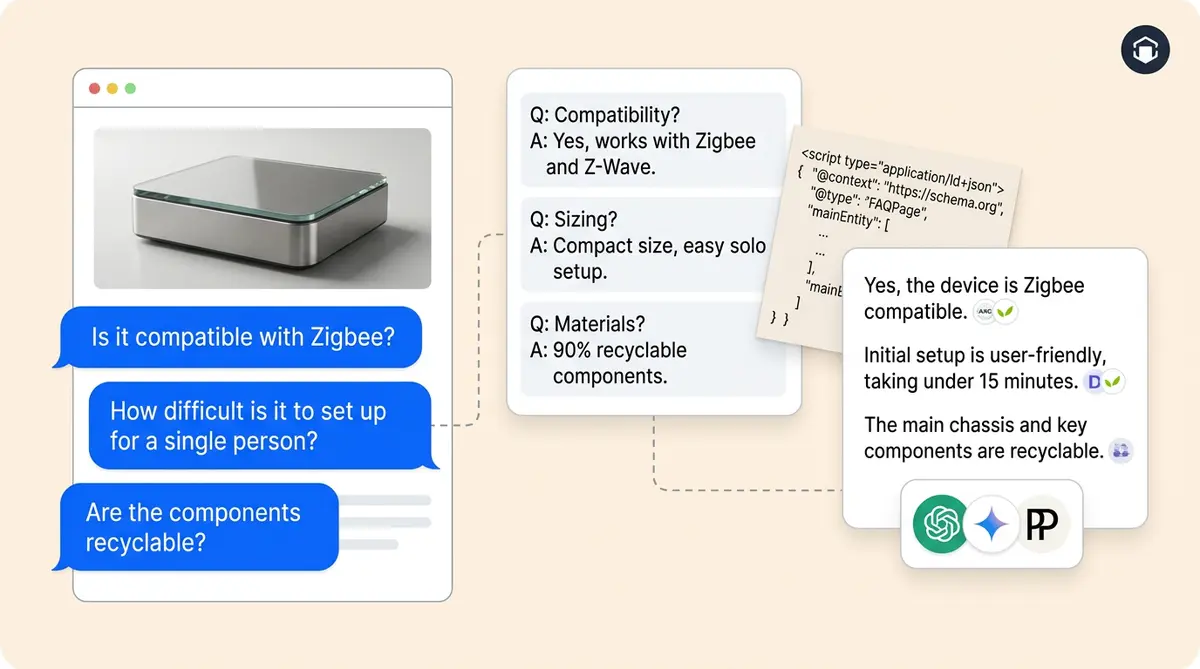
ChatGPT, Gemini, and Perplexity don't work like Google. They don't return a list of ten blue links. They synthesize a single answer, and they need concise, structured sources to do it. FAQ content gives them exactly that: a question paired with a direct answer, wrapped in machine-readable markup that AI systems understand.
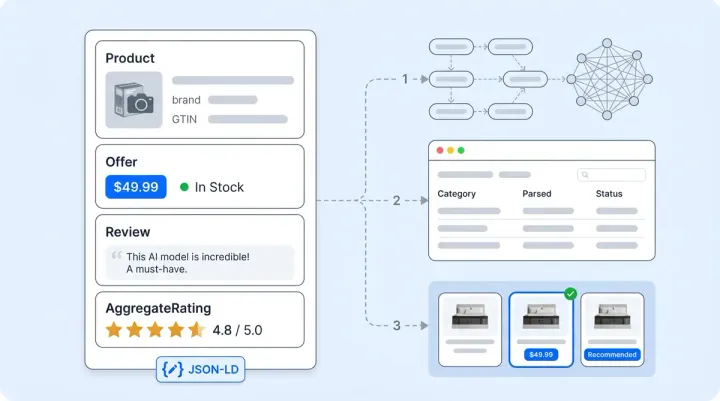
FAQPage schema is the signal that tells AI engines, "Here's a ready-made answer you can cite directly as a trusted source." Recent ecommerce studies show that pages with FAQ structured data appear significantly more often in AI Overviews and LLM-generated answers. Industry benchmarks put the advantage at roughly 3x higher visibility compared to pages without it.
There's a format advantage too. AI-generated responses use list-style and Q&A formats in the majority of their outputs. FAQ content is a structurally different match for how these platforms prefer to deliver information.
But the biggest reason FAQ content wins is alignment with how shoppers actually talk to AI. Shoppers don’t ask ChatGPT "sizing information." They ask, "Does this run true to size?" or "Will this jacket fit if I'm between a medium and a large?" Conversational Q&A on your product pages mirrors the exact queries AI engines are trying to answer. That alignment sends strong signals that get your brand cited by these platforms instead of your competitor.
How to Build a Product FAQ Layer That AI Actually Uses
Not all FAQ content gets picked up by AI engines. Three things separate FAQ sections that are getting citations from ones that get ignored.
1. Schema Markup on Every PDP
Every product page needs FAQPage FAQ schema structured data in JSON-LD format. This isn't optional. Without it, answer engines can still read your Q&A text, but they can't confirm the question-answer relationship programmatically. Schema is what sends the right signals to turn plain text into citable content. Validate each implementation with Google's Rich Results Test before shipping it.
2. Conversational Phrasing, Not Corporate FAQ Tone
The way you write the questions matters as much as the answers. Compare these two approaches:
- Bad: "What is your return policy?" (corporate, generic, not how anyone talks to AI)
- Good: "Can I return this jacket if it doesn't fit after wearing it once?" (specific, conversational, matches real AI and voice search and voice assistants queries)
- Bad: "Shipping information" (not even a question)
- Good: "How long will it take to get this delivered, and is shipping free?" (compound question, mirrors actual shopper phrasing)
Write every FAQ question as if a shopper typed it into ChatGPT. First person, full sentences, specific to the product. AI systems trust conversational phrasing more than corporate copy. If it sounds like legal copy, rewrite it.
3. Pre-Purchase Question Coverage
Most FAQ sections only cover post-purchase logistics (returns, shipping, order tracking). That misses the highest-value opportunity: answering the questions shoppers ask before they buy.
Cover these categories per product: sizing and fit, compatibility with other products, ingredients or materials, comparison with alternatives, and use-case fit ("Is this moisturizer good for sensitive skin?" or "Can I use this blender to crush ice?"). These are the questions that show up in AI search results because shoppers ask them before making a purchase decision.
One more rule: FAQ content should be unique per product, not copy-pasted store-wide boilerplate. AI engines favor specific, product-level answers over generic store policies. A FAQ about whether a specific running shoe runs narrow is more citable than a blanket sizing guide that covers your entire catalog.
From Static FAQ to Auto-Generated Intelligence
Here's where most brands hit a wall. Writing unique, conversational FAQs for every SKU takes enormous effort. If you have 500 products, that's potentially thousands of Q&A pairs to write, maintain, and keep current. Manual FAQ creation doesn't scale.
Alhena AI solves this by turning real shopper conversations into auto-generated, schema-ready FAQ pairs at the SKU level. Because Alhena's Shopping Assistant handles real customer conversations and services real shopper queries every day, it captures the actual questions shoppers ask about each product. Not guesses. Not conference-room brainstorms. Not keyword research hunches. Not hours of market research. Real questions from real buyers.
Alhena then transforms this first-party conversational data into structured FAQ content that's ready for FAQPage FAQ schema markup. Each Q&A pair reflects genuine buyer intent, phrased in the exact language your customers use, which is the same language they use when querying AI engines.
This creates a flywheel that compounds over time: shoppers ask questions through Alhena's assistant, Alhena captures those conversations, FAQs get auto-generated per SKU, answer engines cite them in search results, and more shoppers find your products. Every conversation makes your FAQ layer smarter and more complete.
The data backs this up. Across Alhena's ecommerce clients, LLM-referred traffic converts at 2.47%, with ChatGPT driving 97% of that LLM traffic. Shoppers who engage with Alhena's AI convert at 9.84%, and brands using proactive engagement see 5.5x higher interaction rates. These aren't theoretical projections. They're production numbers from live ecommerce stores.
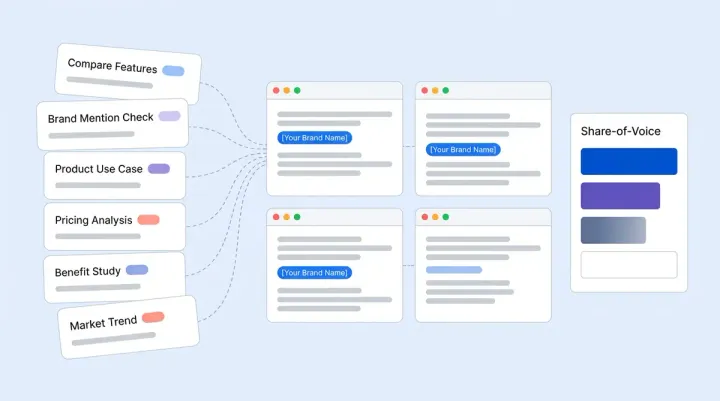
Alhena also tracks which products generate the most AI-referred traffic, monitors how your FAQ content renders across different AI platforms and systems, and provides closed-loop attribution so you can tie specific FAQ content back to revenue. You're not just creating FAQs. You're building a measurable AI search acquisition channel with clear ROI.
For a deeper look at how AEO works for ecommerce, see our complete AEO guide. And if you want to understand the conversion impact of AI-generated product FAQs on PDPs specifically, our PDP FAQ conversion analysis covers the data in detail.
Ready to turn your product questions into AI search rankings? Book a demo with Alhena AI or start for free with 25 conversations.
Frequently Asked Questions
What is AEO FAQ optimization for product pages?
Answer engine optimization for product FAQs is the practice of adding structured, conversational Q&A content with FAQPage schema markup to product detail pages so AI engines like ChatGPT, Gemini, and Perplexity can cite your products in their answers. Alhena AI auto-generates these schema-ready FAQ pairs from real shopper conversations, so each product's FAQ layer meets your needs by reflecting actual buyer intent and real questions rather than generic copy.
How does FAQPage schema help my products show up in AI search results?
FAQPage schema wraps your Q&A content in machine-readable JSON-LD that AI engines can parse, understand, and cite directly. Industry benchmarks show pages with this markup appear roughly 3x more often in AI Overviews. Alhena AI generates FAQ content that's already structured for schema deployment, so your products earn citations without manual markup work on your systems.
What ROI can I expect from adding AI-optimized FAQs to my PDPs?
Across Alhena AI's ecommerce clients, LLM-referred traffic converts at 2.47%, and shoppers who engage with AI-generated FAQ content convert at 9.84%. Alhena's closed-loop attribution tracks exactly which FAQ content drives revenue, so you can measure the return on every auto-generated Q&A pair at the SKU level.
How long does it take to implement AEO FAQ optimization with Alhena AI?
Alhena AI deploys in under 48 hours with no developer resources required. Once live, the Shopping Assistant begins capturing real shopper questions immediately. Alhena auto-generates schema-ready FAQ pairs per SKU from this first-party data, and you can start seeing AI search citations within weeks of deployment.
How is this approach different from traditional SEO for product pages?
Traditional SEO and traditional seo strategy target keyword rankings in Google's ten blue links. AEO FAQ optimization targets citations inside AI-generated answers from ChatGPT, Gemini, and Perplexity. Alhena AI covers both by generating conversational FAQ content that matches how shoppers phrase queries to AI engines, not just keyword strings that match search algorithms.
Can Alhena AI generate unique FAQs for every product SKU?
Yes. Because Alhena AI captures real customer conversations about each specific product, it generates unique FAQ pairs at the SKU level. This means AI engines favor product-specific answers they trust over generic store-wide boilerplate. Alhena's SKU-level tracking ensures every product page has distinct, citable Q&A content.
Which AI engines does AEO FAQ optimization target?
This optimization strategy targets every major AI search platform and system: ChatGPT (which drives 97% of LLM referral traffic to ecommerce), Google Gemini, and Perplexity. Alhena AI includes multi-engine monitoring and rendering analysis so you can see exactly how your FAQ content appears across each platform.
What types of product questions should AEO-optimized FAQs cover?
Focus on pre-purchase questions that shoppers ask AI before buying: sizing and fit, ingredient and material details, compatibility, use-case fit, and comparisons with alternatives. Alhena AI identifies these high-intent question patterns automatically from real shopper conversations, so your FAQ layer covers the topics that actually drive purchase decisions and buying intent.
How do auto-generated FAQs from Alhena AI stay accurate and current?
Alhena AI continuously captures new shopper questions and updates FAQ content as product details, inventory, and customer concerns change. The system uses hallucination-free AI grounded in verified product data you trust, so every auto-generated answer reflects current, accurate information. Brands using proactive engagement see 5.5x higher interaction rates, feeding more data into the FAQ flywheel.
Does this FAQ optimization approach work for stores on Shopify, WooCommerce, or Magento?
Yes. Alhena AI integrates with Shopify, WooCommerce, Magento, and Salesforce Commerce Cloud. The auto-generated FAQ pairs and schema markup work regardless of your ecommerce platform, and Alhena's SKU-level tracking ties FAQ performance back to revenue across any storefront.