The Numbers That Make WhatsApp Impossible to Ignore
WhatsApp has 2.7 billion monthly active users. Every day, 175 million people message a business on the platform. Messages hit a 98% open rate, compared to roughly 20% for email. In Brazil, India, Germany, Indonesia, Nigeria, and across the Middle East, WhatsApp is not one of many communication apps. It is the default.
For ecommerce brands selling in these markets, this is not a trend to watch. It is a business reality. A shopper in Sao Paulo or Mumbai who can't message your brand on WhatsApp will message a competitor who can. The question is not whether to be on WhatsApp. It is whether you're using it as a full sales and support channel or leaving revenue on the table.
Why WhatsApp Is Fundamentally Different
WhatsApp conversations are personal. They happen on the same app where customers message family and friends, sandwiched between those conversations. Messages need to feel conversational, fast, and human.
The thread persists indefinitely. A customer can scroll back to a product recommendation from three months ago or pull up an order confirmation without searching through email. This persistence transforms WhatsApp from a support tool into a relationship channel where trust compounds over time.
Six AI-Powered WhatsApp Use Cases That Drive Revenue
1. Product Discovery and Recommendations
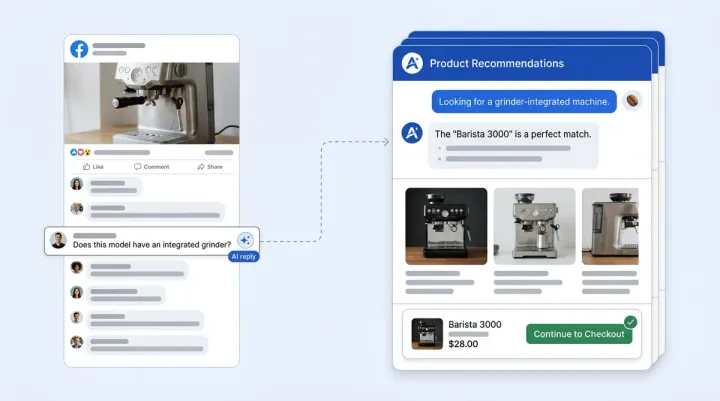
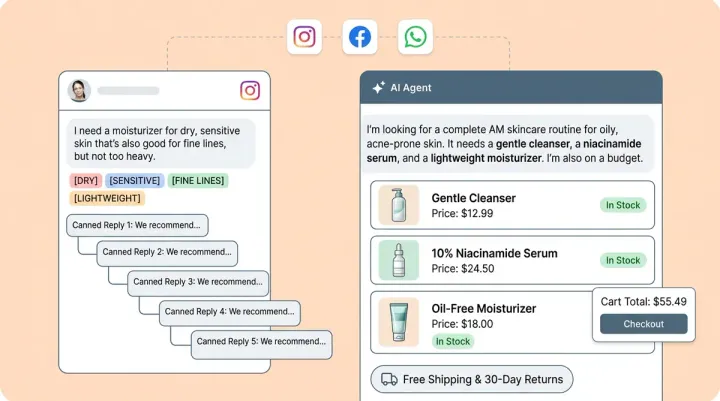
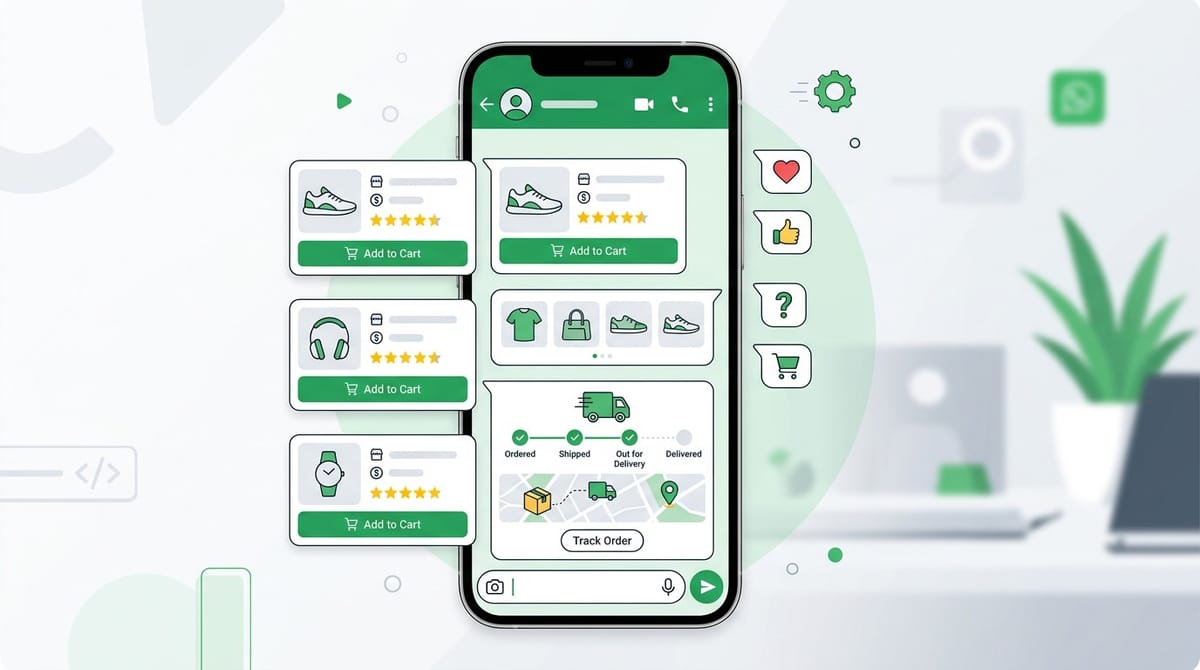
Shoppers describe what they need in natural language. The AI matches their intent against your live catalog and responds with rich product cards featuring images, pricing, and direct purchase options. No browsing required. The conversation is the storefront. This is the same AI Shopping Assistant intelligence that powers on-site product discovery, now working inside WhatsApp.
2. Order Status and Tracking
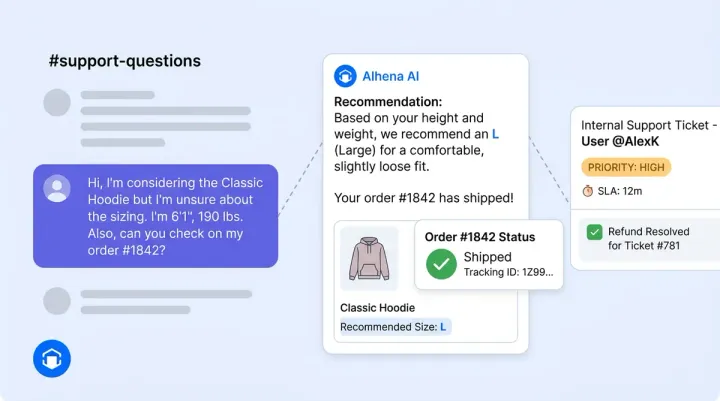
The AI pulls real-time shipping data and delivers tracking updates inside the same thread where the customer originally purchased. Customers never need to hunt for a tracking number or visit a separate portal. One thread holds the entire transaction history.
3. Returns and Exchanges
The AI processes return requests, checks eligibility against your policies, and initiates the return without routing to a human agent. Brands using Alhena AI's Support Concierge report response times dropping from 40 minutes to under 1 minute, with 80% of support interactions fully automated.
4. Size and Fit Guidance
Vertical AI agents like the Fit Analyzer deliver personalized sizing recommendations within the WhatsApp conversation. The same intelligence that powers fit guidance on your website works inside the chat thread, reducing size-related returns before they happen. Fashion and apparel brands see the highest impact from this capability.
5. Restock and Replenishment Reminders
For consumable products, the AI proactively messages customers when their purchase cycle suggests they're running low. A skincare brand can remind a customer that their 60-day moisturizer supply is nearly finished. This drives repeat purchases without requiring the customer to remember or revisit the website.
6. Post-Purchase Follow-Up
Care instructions, usage tips, and complementary product suggestions arrive in the channel the customer already trusts. A customer who bought running shoes gets a message about the right way to break them in, followed by a recommendation for performance socks two weeks later.
WhatsApp Business App vs. Business API: Know the Difference
The WhatsApp Business App is free, but it's limited to a single device. It offers no automation, no AI integration, and no ability to scale beyond one person manually typing responses. For a brand processing hundreds or thousands of conversations daily, it's not viable.
The WhatsApp Business API unlocks everything that makes AI-powered commerce possible. It enables automated AI responses, multi-agent access, rich media messages, and full integration with your ecommerce and support stack. This is the infrastructure that supports every use case above.
Alhena AI connects to the Business API through Meta's embedded signup flow. There's no need to build a custom API integration or contract with a third-party messaging provider. In the Alhena dashboard, navigate to Settings, then Integrations, then WhatsApp. Complete the Meta login, select your WhatsApp Business phone number, and the AI activates immediately. Your connected number is visible on the integration card for easy verification.
The AI uses the same training, product catalog, brand voice, and guidelines as your web chat. There's no separate WhatsApp-specific configuration to build or maintain. Brands that have already trained their AI on their website get cross-channel consistency on WhatsApp from day one. Whether you're running Shopify, WooCommerce, or Salesforce Commerce Cloud, the same product data powers every WhatsApp conversation.
The Markets Where WhatsApp Commerce Wins
WhatsApp dominance is concentrated in the fastest-growing ecommerce markets on the planet. Brazil has over 140 million WhatsApp users. India has over 500 million. Germany leads Western Europe in WhatsApp adoption. Indonesia, Nigeria, Mexico, and the UAE all rely on WhatsApp as the primary business communication tool.
For brands selling internationally, WhatsApp isn't an add-on channel. It's the front door. Brands that deploy AI on WhatsApp see 3x conversion rates compared to traditional support channels because they meet customers exactly where they already spend their time.
Compliance Rules Every Ecommerce Brand Should Know
WhatsApp Business API enforces a 24-hour messaging window for customer-initiated conversations. Within that window, brands can respond freely. Outside it, brands must use pre-approved template messages for any proactive outreach.
Opt-in requirements apply globally. Customers must consent to receiving messages from your brand. For EU brands, GDPR compliance extends to WhatsApp communications, covering data storage, consent records, and the right to deletion. Alhena AI respects these rules natively, sending only within the allowed window and using template messages for proactive outreach like restock reminders.
WhatsApp Is the Primary Channel, Not the Afterthought
The majority of the world's online shoppers already use WhatsApp every day. They don't want to download another app, navigate a website chatbot, or wait for an email reply. They want to message your brand the same way they message everyone else.
Brands that deploy AI on WhatsApp turn the world's most-used messaging app into a full-service sales and support channel. Product discovery, purchasing, order management, and post-purchase engagement all happen inside a single persistent chat thread. That's not a nice-to-have feature. For global ecommerce, it's the competitive baseline.
Ready to turn WhatsApp into your highest-converting sales channel? Book a demo to see Alhena AI in action, or start free with 25 conversations. Use the ROI Calculator to estimate the revenue impact for your brand.
Frequently Asked Questions
How does AI work on WhatsApp for ecommerce product recommendations?
When a customer messages your WhatsApp Business number, Alhena AI interprets their natural language request and matches it against your live product catalog. The AI responds with rich product cards featuring images, descriptions, and pricing, turning the chat thread into a personalized shopping experience without requiring the customer to visit your website.
What is the difference between WhatsApp Business App and Business API for AI automation?
The WhatsApp Business App is a free, single-device tool with no automation capabilities. The Business API enables AI-powered responses, multi-agent access, and integration with platforms like Alhena AI. Only the Business API supports automated product recommendations, order tracking, and return processing at scale.
Does WhatsApp AI use the same training as web chat for brand consistency?
Yes. Alhena AI applies the same training data, product catalog, brand voice, and conversation guidelines across both web chat and WhatsApp. When you connect WhatsApp through the Alhena dashboard, the AI activates with your existing configuration, so there's no separate setup or risk of inconsistent responses between channels.
How long does it take to connect WhatsApp to Alhena AI?
Connection takes minutes. In the Alhena AI dashboard, navigate to Settings, then Integrations, then WhatsApp. Complete the Meta embedded signup flow, select your WhatsApp Business phone number, and the AI begins responding to customer messages immediately using your existing training and catalog data.
Can the AI handle returns and order tracking inside WhatsApp?
Alhena AI processes return requests by checking eligibility against your store policies and initiating the return workflow directly in the chat thread. For order tracking, the AI pulls real-time shipping data and delivers updates in the same conversation where the customer originally engaged, keeping the entire transaction lifecycle in one place.
What WhatsApp compliance rules do ecommerce brands need to follow?
WhatsApp Business API enforces a 24-hour messaging window, opt-in requirements, and regional data privacy laws like GDPR for EU brands. Alhena AI handles these rules natively, sending responses within the allowed window and using pre-approved template messages for proactive outreach like restock reminders.
Which markets benefit most from WhatsApp commerce?
Markets where WhatsApp is the default communication app see the highest impact: Brazil, India, Germany, Indonesia, Nigeria, Mexico, and the UAE. Alhena AI helps brands in these regions turn WhatsApp into a full sales and support channel where product discovery, checkout, and post-purchase engagement happen in a single chat thread.