Traditional SEO Schema Isn't Built for AI Search
Google's AI Overviews now appear on 14% of shopping queries, a 5.6x increase in just four months. ChatGPT processes 2 billion queries daily. Perplexity handles over 1.2 billion monthly. These AI search engines don't read your product pages the way Google's traditional crawler does.
Traditional schema markup helped search engines display rich snippets like star ratings and price badges. But AI search engines like ChatGPT, Perplexity, and Google AI Mode synthesize answers and make purchase recommendations before a shopper visits your site. SE Ranking found that 65% of pages cited by Google AI Mode and 71% cited by ChatGPT include structured data. If your product data isn't machine-readable, AI-driven search platforms skip you entirely.
How AI Platforms Pull Structured Data Differently
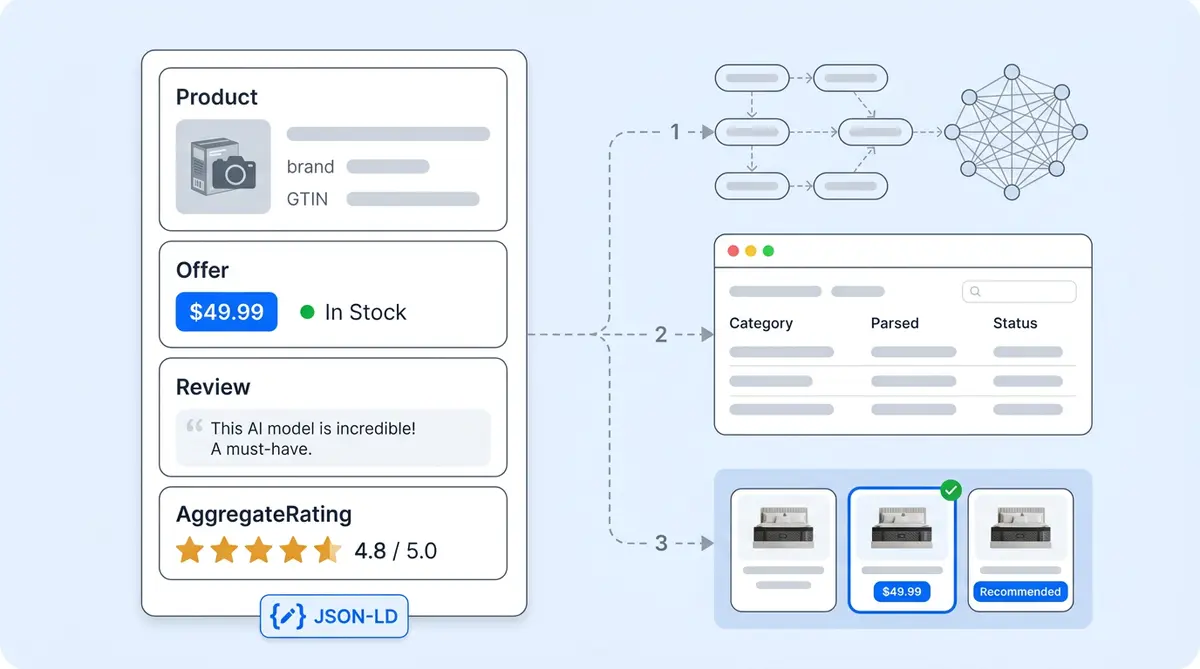
Google's traditional crawler renders your page, reads the HTML, and extracts schema for rich results. AI search platforms work on a fundamentally different model. LLMs don't parse JSON-LD in real time during a conversation. Instead, projects like Web Data Commons extract structured data separately, feeding billions of factual statements into knowledge graphs that LLMs reference when generating answers.
AI search crawlers like OAI-SearchBot and PerplexityBot process your schema at crawl time. Researchers have observed these bots "crawling JSON data more than HTML." Your JSON-LD block may be the primary data source these crawlers extract from your product pages.
The newest shift is AI shopping agents that compare products, check availability, and pre-fill carts for consumers. Already, 24% of shoppers are comfortable with AI agents buying for them (32% among Gen Z). These agents need structured, machine-readable product data to function. Without it, your products don't exist in their comparison workflows. Schema markup for AI search isn't about earning a rich snippet anymore. It's about making your product data parsable across knowledge graphs, AI crawlers, and shopping agents simultaneously.
The Four Schema Types That Matter for AI Search Visibility
Google deprecated FAQ schema in January 2026 and HowTo schema in February 2026. Four schema types remain central to AI search visibility for ecommerce.
Product schema tells AI systems what you sell: name, description, brand, SKU, GTIN, images, and materials. Pages with complete Product schema see a +74.1% CTR lift when price, rating, and availability display together.
Offer schema communicates price, currency, availability, and item condition. Real-time Offer schema reduces cart abandonment by 36.2%.
Review schema gives AI systems granular sentiment data. A product with ten detailed reviews gives AI platforms far more to work with than a single aggregate score.
AggregateRating schema provides the overall rating value and review count. For AI-generated comparisons ("best running shoes under $150"), this determines whether your product makes the shortlist.
Why JSON-LD Wins for AI Readability
JSON-LD holds 89.4% market share of structured data implementations. Microdata sits at 8.1% and falling. JSON-LD lives in a script tag, completely decoupled from the DOM, so AI crawlers extract it without parsing your entire HTML structure. It's valid JSON that any system can parse without an HTML parser.
Google's documentation notes that "Googlebot for Shopping often does not wait for JavaScript execution," making server-side rendered JSON-LD essential for ecommerce. The operational advantage matters too: JSON-LD can be updated programmatically from your product database without touching HTML templates. One data pipeline feeds both your storefront and your schema markup.
Critical Fields for AI Visibility
Research across 180 ecommerce websites found that while 57.5% have schema markup, 15-30% contain invalid markup. The gap between "technically valid" and "AI-complete" schema is where visibility is won or lost.
GTIN is the universal product identifier. AI systems use GTINs to match products against global databases. Brand connects products to entity-level knowledge graphs. Availability must be accurate and real-time. Price and priceCurrency must use ISO 4217 codes. Product attributes like color, material, size, and intended purpose match long-tail AI queries. Review metadata (ratingValue, reviewCount, author) feeds AI comparison engines. Shipping and return policies help AI agents surface purchase details at the recommendation stage.
Every empty field is an AI query your product can't match. Alhena AI's Shopping Assistant works with this same principle, using complete product data to deliver accurate recommendations across web chat, email, and social channels.
The Visibility Lift Is Measurable
A controlled experiment showed a 19.72% increase in AI Overview visibility over two months by applying entity linking to structured data. Pages with structured data are cited 3.1x more often in AI Overviews. AI search traffic converts at 14.2% vs Google's 2.8%. AI Overview citations from top-10 pages dropped from 76% to 38%, meaning lower-ranked pages with strong structured data now win citations.
For brands using AI-powered support, better structured data drives more AI visibility, sending higher-intent traffic where AI assistants convert it. Tatcha saw 3x conversion rates with Alhena AI's shopping assistant.
Your AI-Ready Schema Audit Checklist
- Fix errors first: Run Google's Rich Results Test on your top product pages. Fix content-schema mismatches.
- Add GTIN or MPN to every product for AI product matching.
- Populate brand, availability, price, priceCurrency on every Product/Offer pair.
- Add product attributes (color, material, size) for long-tail query matching.
- Include AggregateRating and Review markup with real review data.
- Add shippingDetails and hasMerchantReturnPolicy for AI agent compatibility.
- Verify robots.txt allows GPTBot, OAI-SearchBot, PerplexityBot.
- Generate JSON-LD server-side from your product database.
Schema Markup Is the Foundation of AI Discoverability
Schema markup for AI search is no longer an SEO hygiene task you delegate once a year. It's the foundation of how your products get discovered, compared, and recommended across every AI platform your customers use. AI-driven search traffic converts at 5x the rate of traditional organic, visitors spend 68% more time on site, and 38% of business decision-makers have allocated budget to AI search optimization.
Every missing field is a query you can't match. Every product without a GTIN is invisible to the comparison engines that are quickly becoming the default way consumers discover products.
Alhena AI turns structured product data into revenue by powering AI shopping assistants that sell across every channel. Ready to turn your product data into revenue? Book a demo with Alhena AI or start free with 25 conversations.

Frequently Asked Questions
How does schema markup for AI search differ from traditional SEO schema?
Traditional SEO schema targets Google rich snippets like star ratings and price badges. Schema markup for AI search feeds knowledge graphs, AI crawlers, and shopping agents that synthesize product recommendations across ChatGPT, Perplexity, and Google AI Overviews. Alhena AI uses the same structured product data principles to power accurate, hallucination-free shopping recommendations across every channel.
Which structured data fields do ChatGPT and Perplexity need to recommend my products?
At minimum, AI platforms need GTIN, brand, availability, price, priceCurrency, and AggregateRating to include your products in comparison answers. Missing any of these fields means your products are invisible to AI shopping queries. Alhena AI's Product Expert Agent pulls from the same complete product catalog data to match shoppers with the right products in real time.
Does JSON-LD actually improve AI search visibility over Microdata or RDFa?
JSON-LD holds 89.4% market share because it's parsable as standalone JSON without HTML traversal, which aligns with how AI crawlers process data. The format itself isn't a ranking signal, but it's easier to maintain at scale and server-side render for AI crawlers that don't execute JavaScript. Alhena AI recommends JSON-LD as part of any AI-ready ecommerce data strategy.
Can structured data automation help ecommerce brands scale AI visibility?
Yes. Generating JSON-LD from your product database through a single pipeline eliminates manual sync errors across thousands of pages. Brands using Alhena AI already feed their product catalog into vertical AI agents that handle recommendations, order management, and support, so the same data completeness that powers AI shopping assistants also powers AI search discoverability.
What revenue impact can ecommerce brands expect from AI-optimized schema markup?
AI search traffic converts at 14.2% compared to Google organic's 2.8%, and visitors from AI platforms spend 68% more time on site. Brands with complete structured data paired with AI shopping experiences see compounding returns. Alhena AI customers like Tatcha have achieved 3x conversion rates by combining structured product data with AI-powered shopping assistants that turn high-intent AI traffic into purchases.