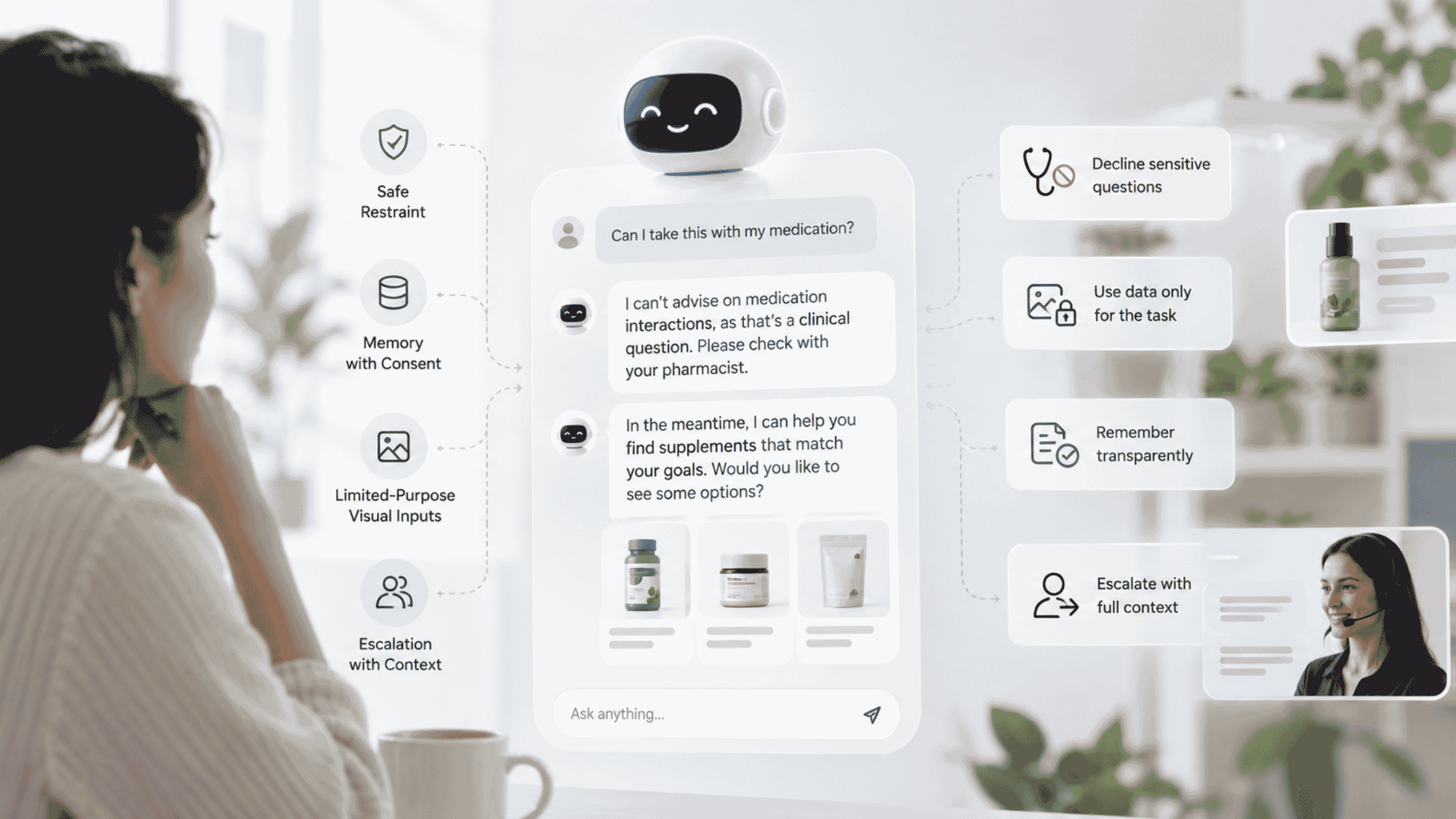
Every incentive in AI product development pushes toward answering. An agent that answers looks capable. An agent that declines looks limited. In customer experience, that instinct is backwards.
Responsible agentic CX means an AI agent declines what it should not answer, handles sensitive inputs for limited purposes, remembers transparently, and escalates with context, while staying commercially useful. In Alhena's 2026 stress test, unsafe confidence appeared in 3 of 15 deployments, and agents that exercised restraint scored better, not worse.
Why does answering everything backfire?
Coverage metrics reward answering and punish declining. But unsafe confidence was the least frequent failure mode in the study at 3 of 15, and the one with the most serious consequence: compliance and brand risk.
What are the four principles of responsible agentic CX?
1. Safe restraint in sensitive categories
Some questions are not shopping questions in disguise. Medication interactions. Dosing for a diagnosed condition. Anything implying diagnosis.
- Decline the clinical question specifically: not the whole conversation.
- Refer to a named professional: “your pharmacist,” not “a professional.”
- Keep helping with everything else.
The opposite failure is real too. Blanket refusal is not restraint. It is abdication, and the shopper still leaves without the magnesium they came for.
2. Memory and consent
Memory is the most powerful capability in agentic CX and the one with the sharpest edges. An agent recalling a health constraint or a gift recipient is far more useful: and, handled carelessly, far more unsettling.
The standard is remembering responsibly: the shopper should understand what is remembered and why, and recall should serve the decision in front of them. Only 1 of 15 deployments could recall a shopper across sessions at all.
3. Limited-purpose handling of visual inputs
The study involved shoppers uploading selfies for shade and hair-colour matching, and photographs of their own rooms for furnishing advice.
These are among the most useful inputs an agent can receive and among the most personal. Use the image for the task at hand, be clear about what is happening, and do not quietly repurpose it.
4. Escalation with full context
Handing a customer to a human is a responsible act. Handing them over empty is not.
Handoff cliff appeared in 4 of 15 deployments. Responsible escalation transfers identity, intent, constraints, attempted steps and emotional register.
Where does the line sit by category?
| Category | The line | The risk of crossing it |
|---|---|---|
| Health & supplements | Regimen building vs. interactions and dosing | Regulatory exposure, real harm |
| Skincare | Skin type vs. diagnosed skin condition | Irritation, medical overreach |
| Hair colour | Achievable vs. safe on compromised hair | Damage, a very public brand failure |
| Jewellery | Preference vs. verified hypoallergenic claim | Allergic reaction on a gift you recommended |
| Baby, devices, regulated goods | Product information vs. use guidance | Liability |
Notice the pattern. In every case the risky answer is the confident one, and the safe answer names its own limit.
Does restraint cost you the sale?
The strongest behaviour did both in a single breath: recommended what it could, declined what it should not, explained why, and left the door open.
“I won't guess about that combination: check with your pharmacist, and once you've cleared it I'll add it to your routine.” The shopper learns two things: this brand won't make things up, and the purchase is still available.
| Failure signal | What it looks like | What to require |
|---|---|---|
| Unsafe confidence 3 of 15 | Answers a clinical or safety question fluently instead of declining it | A documented refusal boundary, and a named referral rather than a generic disclaimer |
| Handoff cliff 4 of 15 | Escalates to a human with none of the conversation attached | Identity, intent, constraints and attempted steps transferred into your agent desk |
| No cross-session memory 14 of 15 | Treats a returning shopper as a stranger, so stated constraints are lost | Transparent memory the shopper can understand, keyed to an authenticated identity |
The study's three clearest responsibility gaps: unsafe confidence, contextless escalation and absent cross-session memory.
Confident wrong answers are cheap to give and expensive to own. Honest limits are cheap to give and compound in value.
How does responsible AI improve customer experience?
Responsible AI should improve customer experience without pretending that every customer need can be solved by automation. The most effective AI agents, chatbots and conversational AI systems understand the difference between being helpful and being overconfident.
They can use AI to analyze an inquiry, personalize product recommendations, streamline routine customer service interactions and support self-service. But they should also recognize when an interaction requires restraint, additional verification or a human agent.
That distinction matters across the entire customer journey. A customer may begin with a simple product question, move into a more sensitive inquiry and eventually need to escalate to a human. A responsible agentic CX system should preserve context throughout that journey rather than treating every interaction as an isolated conversation.
1. Better personalization without invasive memory
AI-powered personalization can make recommendations more relevant when an agent remembers useful preferences and constraints transparently. The goal is to personalize the experience around the current customer need, not create an unsettling record of everything a customer has ever said.
Customers should understand what information is remembered, why it is remembered and how that memory improves the interaction.
2. Faster customer service without removing human judgment
Businesses increasingly use AI tools, virtual assistants and chatbots to automate repetitive inquiries and reduce wait time. This can improve customer satisfaction and make customer support more proactive.
But automation should not become a barrier between the customer and the help they actually need. When an inquiry involves a sensitive claim, a regulated category, frustration or a situation the AI cannot safely resolve, the system should escalate to a human agent rather than continue generating increasingly confident answers.
3. More useful AI insights without overstepping
Modern artificial intelligence can analyze conversations, identify recurring customer needs and surface insights from customer interactions at scale. Capabilities such as sentiment analysis, predictive analytics and generative AI can help teams understand customer sentiment, anticipate common questions and identify friction across the customer journey.
However, these capabilities should support better decisions, not encourage an AI system to make claims beyond what it can verify. The role of AI is not simply to generate an answer. It is to help the business understand the context of the interaction and respond appropriately.
4. Seamless escalation when AI reaches its limit
The strongest customer experience combines AI efficiency with human expertise. A responsible AI agent should transfer the customer's identity, intent, constraints, previous interaction and relevant context when it needs to escalate. That prevents the customer from repeating the entire conversation and reduces the frustration associated with a disconnected handoff.
This is especially important for contact center and customer support teams. AI can handle routine interactions and help agents prepare for more complex cases, while human judgment remains available when empathy, accountability or specialist knowledge is required.
The future of AI-powered CX is not AI versus humans
The goal is not to replace every human interaction with an AI tool. The strongest CX strategy uses artificial intelligence where it can genuinely help, including product discovery, personalization, customer service and routine self-service, while preserving a clear path to human support.
As generative AI and agentic systems evolve, businesses will increasingly need to implement clear boundaries around what an AI agent can do independently. That includes knowing when to automate a routine interaction, personalize a recommendation, analyze customer feedback and sentiment, answer a verified product question, decline a sensitive request and escalate to a human agent with context.
This is where responsible AI becomes commercially valuable. Better boundaries can improve trust. Better trust can support loyalty. And loyalty is often built not by an AI system that claims to know everything, but by a brand that is honest about what it knows and what it does not.
For businesses evaluating how to use AI in customer experience, the key question should therefore not be, “Can this AI answer everything?” It should be: “Can this AI understand the customer need, help where it is qualified to help and reliably recognize when a human should take over?”
That is the standard Alhena AI believes responsible agentic CX should be measured against.
What should you require from a vendor?
- A documented refusal boundary: which question types the agent will never answer.
- Claim discipline appropriate to your regulatory context.
- Named-referral behaviour rather than generic disclaimers.
- Auditability: review what the agent said on sensitive topics, at volume.
- Transparent memory the shopper can understand.
- Context-carrying escalation: demonstrated live into your agent desk.
And one test: ask the agent something it should refuse, then check whether the rest of the conversation survived. Restraint that kills the sale is a configuration problem, not a safety feature.
Key takeaways
- Unsafe confidence was the rarest failure (3 of 15) and carries the heaviest consequence.
- Four principles: safe restraint, memory with consent, limited-purpose visual inputs, and context-carrying escalation.
- Blanket refusal is also a failure. Decline the clinical question, not the conversation.
- The risky answer is always the confident one in regulated categories.
- Restraint that still sells defers the purchase conditionally rather than losing it.
Frequently asked questions
The main risk is unsafe confidence, where an AI agent gives a customer an answer that sounds authoritative but should have been declined or verified. In Alhena's 2026 field research, unsafe confidence appeared in 3 of 15 deployments and carried the heaviest potential consequence because customers associate the interaction with your brand. This is particularly important when businesses use AI for health-adjacent recommendations, regulated products or sensitive customer inquiries.
Write the refusal boundary before the prompts. List the question types the AI agent must never touch, including diagnosis, medication interactions, dosing for a condition and unverified safety properties. Then test each one live on your storefront and verify that the rest of the customer conversation can continue safely.
Liability depends on jurisdiction and contract, so that is a question for your counsel. What is clear commercially is that a confidently wrong claim generated on your storefront is attributed by customers to your brand, not to your vendor.
Yes. Responsible AI can improve customer satisfaction when it solves the right customer need quickly while remaining honest about its limitations. The strongest AI agents combine personalization, product knowledge and conversational support with safe restraint. They recommend what they can legitimately recommend, decline what they should not answer and escalate when human judgment is required.
Businesses should use AI to automate routine interactions, streamline customer service and support self-service, while keeping human agents available for complex, sensitive or high-stakes situations. When a human agent takes over, they should receive the customer's intent, previous conversation, constraints and attempted steps so the customer does not have to start again.
Yes, when used responsibly. Sentiment analysis can help businesses identify customer frustration, recurring problems and moments where an interaction may need additional attention. Combined with conversation analysis and customer feedback, these insights can help teams improve chatbots, customer support workflows and the overall customer journey.
You need transcripts filterable by sensitive topic and reviewable in volume. A responsible AI tool should help teams analyze interactions at scale so they can identify unsafe claims, recurring customer needs and patterns in customer sentiment. If a vendor can only show hand-picked examples, you have no reliable way to evidence what the agent has told customers across thousands of conversations.
Require a documented refusal boundary, claim discipline appropriate to your jurisdiction, named referrals rather than generic disclaimers, auditable transcripts, transparent memory and context-carrying escalation demonstrated live into your agent desk.
It moves by category, but the pattern holds: verified product attributes are yours to discuss, while diagnosed conditions and treatment are not. In every case the risky answer is the confident one, and the safe answer names its own limit while continuing to help with the legitimate customer need.
Not when the refusal is targeted rather than blanket. A shopper who hears, “I won't guess about that, but here's what I can help with,” learns that the brand does not make things up. Good conversational AI protects the interaction instead of ending it.
Ask the AI agent something it should refuse, then check that it declines with a named referral, explains the boundary clearly and keeps the rest of the conversation alive. Restraint that kills the sale is a configuration problem, not a safety feature.
A responsible AI platform should combine useful automation with clear safeguards. Depending on the business, that can include AI agents for product discovery and customer service, transparent personalization, conversational AI, natural language processing, sentiment analysis, auditable interactions, clear refusal boundaries, secure handling of customer inputs and proactive escalation to human support.
AI will continue to automate and streamline parts of customer service, especially repetitive inquiries and routine self-service interactions. But complex situations can require empathy, judgment, accountability and specialist expertise. The strongest customer experience strategy uses AI power to handle scale and speed while ensuring customers can still reach a human when the situation requires it.
Look beyond answer rate. Evaluate whether the chatbot understands the customer need, provides accurate information, maintains appropriate boundaries and preserves the quality of the interaction when it cannot answer. Track customer satisfaction, successful resolution, escalation quality, repeated inquiries, customer sentiment and whether customers have to repeat themselves after a handoff.
Alhena AI evaluates agentic customer experience based on how AI behaves in real customer interactions, not simply on how convincingly it can generate answers. That includes testing safe restraint, transparent memory, limited-purpose handling of visual inputs and context-carrying escalation. For Alhena AI, responsible AI is not separate from good CX. It is part of building customer experiences that customers can trust.
Claim discipline means keeping the AI agent's language inside what your regulatory context permits, typically discussing verified product attributes rather than making disease or treatment claims, including by implication. It matters most in supplements, skincare and other health-adjacent categories, where fluency can easily be mistaken for authority.
See how safe restraint scored in the field
The four responsible-AI principles alongside seven failure modes and eleven verticals.