Product detail pages are now the primary data source AI platforms pull from when generating shopping recommendations. ChatGPT Shopping, Google AI Overviews, and Perplexity don't rely on merchant feeds or ad placements to decide which products to surface. They crawl your PDPs, extract structured data, compare attributes across competing products, and pick the one with the most complete, verifiable information. Most e-commerce pdp content is missing critical elements that directly determine PDP optimization success and whether AI surfaces your product or a competitor's. In 2026, here are 15 PDP optimization changes, ranked from highest impact to lowest, that improve your AI visibility score.
The 15-Point PDP Optimization Checklist for AI Visibility
1. Add Complete Schema.org Product Markup
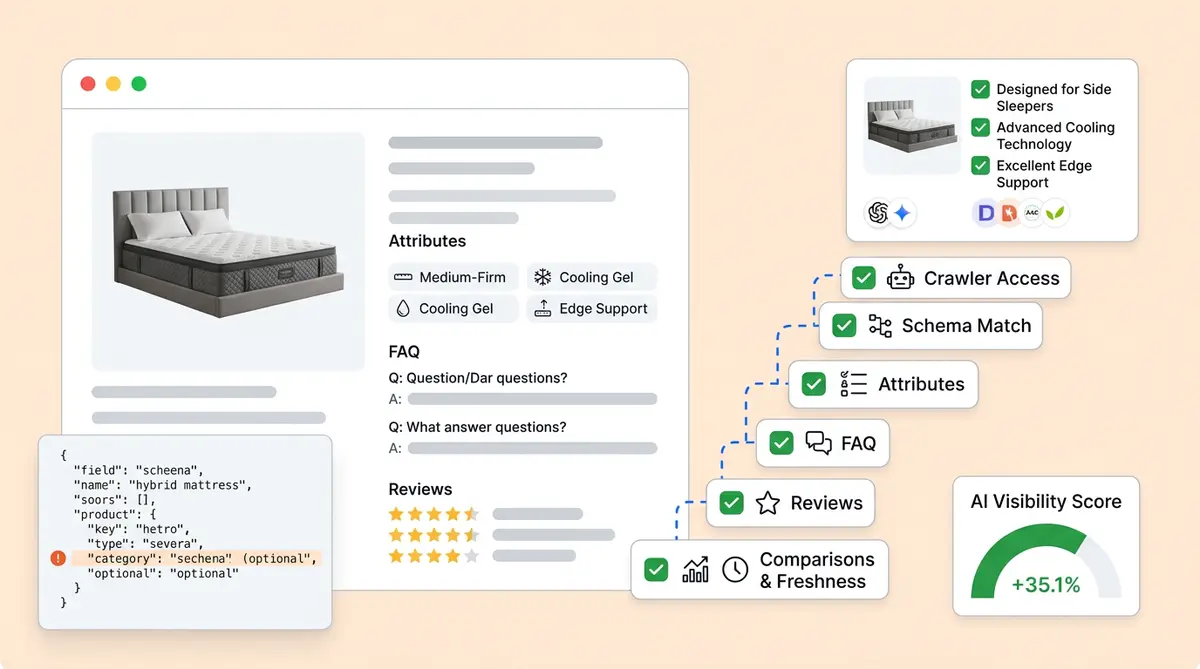
Implement JSON-LD Product schema that includes name, description, image, brand, SKU, offers (price, currency, availability), and aggregateRating. This is the foundation. AI platforms parse structured data before they read your marketing copy. Without complete Product markup, your PDP is essentially invisible to AI shopping engines, no matter how good the content looks to human visitors.
2. Include Clear Pricing with Currency and Sale Indicators
Your schema and on-page content must show the exact price, currency code, and any active sale or discount pricing. In 2026, AI platforms compare prices across products in real time. If your pricing data is missing, ambiguous, buried in static JavaScript that crawlers can't render, AI systems skip your product and recommend one with verifiable pricing instead.
3. Display Real-Time Availability Status
Mark products as InStock, OutOfStock, or PreOrder using the Offer schema's availability property. AI platforms won't recommend a product if they can't confirm it's available for purchase right now. Stale availability data, like showing "in stock" for a sold-out item, damages your trust signals across every AI surface.
4. Add GTIN and MPN Identifiers for Cross-Reference Validation
Global Trade Item Numbers and Manufacturer Part Numbers let AI platforms cross-reference your product against manufacturer databases, marketplace listings, and review aggregators. These identifiers confirm that your product listing is legitimate and matches the exact item users are asking about. Products without GTINs lose out on cross-reference matching that AI systems use to build confidence in their recommendations.
5. Implement Review Aggregation with AggregateRating Markup
Add AggregateRating schema that reflects your actual review count and average score. AI platforms treat verified, recent reviews as evidence when deciding which product to recommend for a specific use case. Brands with structured review data and fresh user feedback get significantly more mentions in AI-generated shopping responses than those without.
6. Write Descriptive Image Alt Text with Product Identifiers
Use alt text that includes the product name, color, material, and view angle. "Women's merino wool crewneck sweater in navy, front view" gives AI image models and crawlers far more context than "IMG_4827.jpg." Over half of e-commerce sites fail at informational alt text for images and videos, which means fixing this one element puts you ahead of most of your category.
7. Build Structured Attribute Tables AI Can Parse
Present product specifications in clean HTML tables with consistent column headers: attribute name and value. AI platforms extract tabular data more reliably than they extract specs from paragraph copy. A well-structured attribute table covering dimensions, weight, materials, and compatibility gives AI systems exactly the data format they need to match your product to detailed conversational queries.
8. Add FAQ Sections with Q&A Schema Matching Conversational Queries
Add an FAQ section to each PDP using real questions from customer support logs and on-site search data. Mark it up with FAQPage schema. AI platforms prioritize Q&A-formatted content because it mirrors how users actually ask questions. "Does this jacket work for hiking in light rain?" is the kind of query AI systems match directly against your FAQ answers.
9. Include Brand and Manufacturer Information in Structured Fields
Add the Brand and manufacturer properties to your Product schema. AI platforms use brand identity to disambiguate products, connect items to brand reputation signals, and match queries like "best [brand] products for [use case]." Missing brand data means your product gets excluded from brand-specific AI recommendations entirely.
10. Create Comparison-Ready Specification Tables
If users frequently compare your product to alternatives, add a comparison section that addresses "vs" queries directly on the PDP. AI platforms pull from pages that provide honest, structured comparisons. Acknowledging trade-offs actually builds trust with AI systems, because it signals that your content is informational rather than purely promotional.
11. List Ingredients or Materials for Research-Driven Categories
For beauty, skincare, supplements, food, and home goods, include a complete ingredient or material list on the PDP. AI platforms serving health-conscious or sustainability-focused shoppers look for this data to answer queries like "is this moisturizer fragrance-free?" or "does this contain organic cotton?" If the information isn't on your page, AI recommends the product that does provide it.
12. Add Size and Fit Guides with Structured Data
For fashion and apparel, include size charts and fit guidance with structured markup. AI shopping assistants increasingly handle "what size should I get?" queries by extracting measurements and fit descriptors from PDPs. A page that provides structured sizing data answers these questions directly. A page that doesn't gets passed over.
13. Show Delivery Estimates with Geographic Specificity
Include shipping timeframes and delivery estimates that specify regions or zip code ranges. AI platforms answering "can I get this by Friday?" or "does this ship to Canada?" need delivery data on the page to provide accurate answers. Without it, your product drops out of responses where delivery speed matters to the buyer.
14. State Return Policy Information Explicitly
Add return window, conditions, and process details directly on the PDP, not just in a site-wide policy page. AI platforms extract return information when users ask "can I return this?" during product research. Products with clear, accessible return policies earn more confident AI recommendations because they reduce purchase risk for the buyer.
15. Write Conversational Meta Descriptions for AI Summarization
Rewrite your meta descriptions to sound like a concise, natural answer to "what is this product and who is it for?" instead of stuffing them with keywords. AI platforms use meta descriptions as a quick summary signal when deciding how to present your product. A conversational meta description helps AI systems generate accurate, compelling product summaries in their responses.
How Alhena AI Scores Your PDPs Against This Checklist
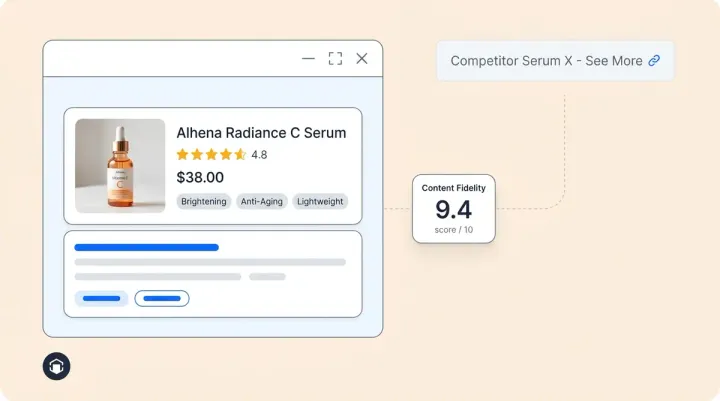
Running through this checklist manually across hundreds or thousands of SKUs isn't practical. Alhena AI scores your PDPs against these exact criteria automatically. The platform analyzes each product page, extracts every attribute, and shows you which elements are missing, which are incomplete, and how each gap impacts your AI visibility score across ChatGPT, Perplexity, and Google AI surfaces.
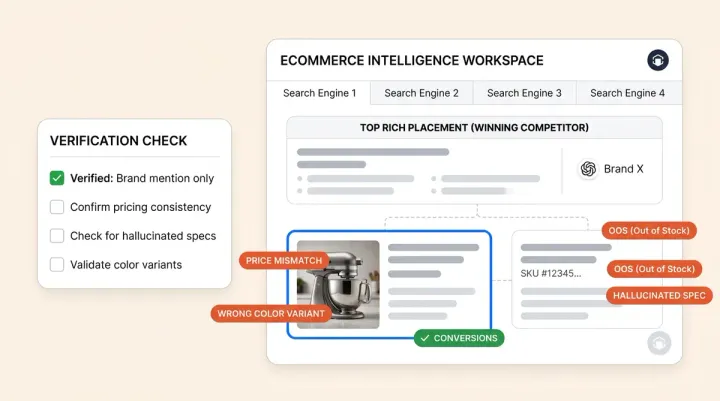
Instead of guessing which products need work, you get a prioritized list of fixes backed by data. Alhena AI's SKU-level visibility monitoring tracks whether AI platforms are actually recommending the right products with correct specs, not just whether your brand gets mentioned. In 2026, brands using Alhena AI for product data optimization have seen measurable lifts in both AI search visibility and on-site conversion rates.
Tatcha, for example, achieved a 3x conversion rate and 38% higher average order value after optimizing product data and pairing it with Alhena AI's Shopping Assistant, with 11.4% of total site revenue coming from AI-assisted conversations. Read the full case study.
Every Missing Element Is a Reason to Recommend Your Competitor
AI platforms don't penalize incomplete PDPs with lower rankings the way traditional search engines do. They simply skip your product and recommend one that provides the data they need. Every missing attribute, every absent schema field, every unstructured specification is a reason for ChatGPT, Perplexity, or Google AI to choose a competitor's product over yours.
The brands that treat PDP optimization as a revenue channel, not just an SEO task, will capture the fastest-growing product discovery channel driving AI traffic to e-commerce heading into 2026. Those that don't will keep losing recommendations they never knew they were eligible for.
Ready to see exactly where your PDPs fall short? Book a demo with Alhena AI today to get a full AI visibility audit across your product catalog, or start for free with 25 conversations.

Frequently Asked Questions
How does Alhena AI score product detail pages for AI visibility?
Alhena AI crawls each PDP, extracts structured data, product details, product attributes, schema markup, and content completeness, then scores every element against what ChatGPT, Perplexity, and Google AI surfaces require for product recommendations. You get prioritized reports showing exactly which fields are missing or incomplete and how each gap affects your pdp visibility and AI visibility score, so you fix what matters most first. These insights help e-commerce teams prioritize PDP content improvements by revenue impact.
What product data fields have the biggest impact on AI shopping recommendations?
Complete Schema.org Product markup, verified pricing with currency codes, real-time availability status, and GTIN identifiers have the highest impact. Alhena AI's PDP scoring shows that products with near-complete attribute coverage across these fields see 3-4x higher visibility in AI-generated shopping recommendations compared to products missing even one or two of them.
Can Alhena AI monitor which products AI platforms are actually recommending?
Yes. Alhena AI provides SKU-level AI visibility monitoring that tracks whether ChatGPT, Perplexity, and Google AI are recommending the right products with correct specs and pricing, not just whether your brand gets mentioned. This lets e-commerce teams catch inaccurate recommendations and missing products before they lose revenue to competitors with better-optimized PDPs.
How long does it take to see AI visibility improvements after optimizing PDPs?
Most brands see measurable changes within 2-4 weeks of implementing high-priority fixes like complete Product schema, pricing markup, and availability status. Alhena AI tracks your AI visibility score over time so you can tie specific PDP optimizations directly to increases in AI-driven product recommendations and revenue attribution.
Does PDP optimization for AI search also improve on-site shopping assistant performance?
Absolutely. The same structured product data that earns recommendations from ChatGPT and Google AI also powers on-site AI shopping assistants like Alhena AI. Tatcha saw a 3x conversion rate and 38% higher average order value after optimizing product data for both external AI search and Alhena AI's on-site Shopping Assistant, proving that one set of PDP improvements drives results across both channels.