Only 12 Shopify merchants were part of the initial ChatGPT Shopping pilot. As of late March 2026, that number has exploded: Agentic Storefronts are rolling out to all Shopify stores by default, with AI-driven traffic up 7x and AI-attributed orders up 11x since January 2025. If you run a Shopify store, your products can now surface when shoppers ask ChatGPT for recommendations, inside Google AI Mode, Gemini, and Microsoft Copilot conversations. But showing up and actually getting picked are two different things. Here is how to optimize your Shopify store for ChatGPT Shopping so AI agents actually find, recommend, and send ready-to-buy shoppers to your products.
From Instant Checkout to Discovery: How ChatGPT Shopping Evolved
In September 2025, ChatGPT launched Instant Checkout, letting users buy products directly inside the chat window. It didn't work. The feature "did not offer the level of flexibility it aspired to provide," and the company pivoted away from it by early 2026. Onboarding merchants, showing accurate product data, and supporting multi-item carts all proved too complex for an in-chat checkout experience.
The new model is discovery-first. ChatGPT now handles the browsing and recommendation layer. When a shopper is ready to buy, ChatGPT sends them to your Shopify store through an in-app browser on mobile or a new tab on desktop. You keep the customer relationship, the checkout experience, and the data. Shopify's Agentic Storefronts power this entire handoff, and the SEO implications are significant: your Shopify store needs to be optimized not just for Google, but for ChatGPT and every other AI shopping agent.
How Shopify Catalog and Agentic Storefronts Work
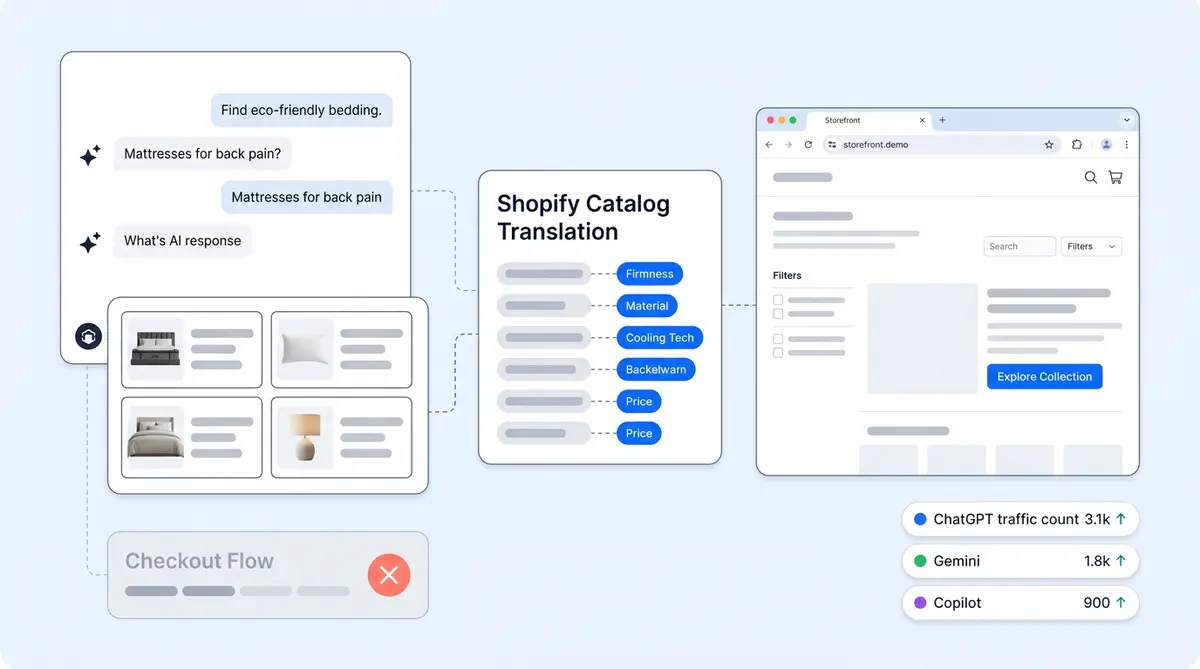
Shopify Catalog is the engine behind AI product discovery. It uses proprietary LLMs to categorize, enrich, and standardize your product data into protocol-compliant vectors that AI agents can parse. Think of it as a translation layer: your product listings go in, and structured, AI-readable data comes out, syndicated across ChatGPT, Gemini, Copilot, and Google AI Mode.
Agentic Storefronts connect your Shopify store to these AI commerce channels. They activate by default for eligible stores. No apps to install, no separate integrations, no transaction fees beyond standard processing rates. When someone asks ChatGPT for a product recommendation and your listing matches, ChatGPT can surface your product and route the shopper to your storefront. Orders appear in your Shopify admin with full channel attribution so you can track exactly which AI agent referred each sale.
Step-by-Step: How to Optimize Your Shopify Store for ChatGPT Shopping
1. Check Eligibility in Settings
Go to Settings > Sales Channels in your Shopify admin. Your Shopify store must be U.S.-based, on a Starter plan or higher, not password-protected, and have store policies published. Products need titles, images, prices above $0, and must be available for U.S. shipment. Agentic Storefronts activate by default once you meet these requirements.
2. Audit Your Product Data for AI and SEO
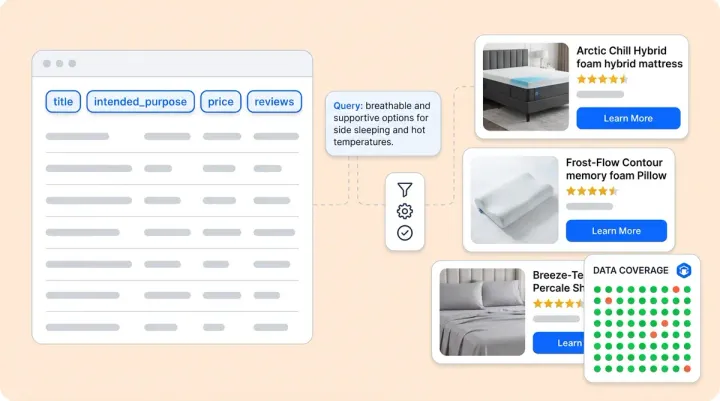
AI agents don't read marketing copy the way humans do, and neither do traditional SEO crawlers. Keep titles under 150 characters with brand name, product type, and key attributes. "Texturizing Sea Salt Hair Spray, 8oz" beats "The Dreamcatcher." Include comparison-ready specs: materials, dimensions, weight, care instructions. Shopify stores with 99%+ attribute completion see 3-4x higher AI visibility. This is the new AI SEO: structured data that both ChatGPT and search engines can parse.
3. Optimize Metafields for AI Parsing
This is where most Shopify store owners fall short. When shoppers ask ChatGPT about product specs, ChatGPT pulls from structured metafields, not HTML description blocks. Fill in material composition, weight, dimensions, care instructions, compatibility, and certifications using standardized namespaces like custom.specs and custom.materials. Products with specs buried only in free-form text are effectively invisible when someone asks ChatGPT to compare options. AI SEO for your Shopify store starts with metafields.
4. Set Up Shopify Catalog Mapping
In your admin under Shopify Catalog settings, map three core fields: product title, description, and category. Configure custom variant grouping and preview changes before saving. Monitor sync health regularly, because products that drop from the Catalog due to data issues won't surface when shoppers ask ChatGPT or any other AI agent for recommendations. Clean catalog mapping is the backbone of your ChatGPT Shopping SEO strategy.
5. Prepare Your Storefront for AI-Referred Traffic
AI-referred buyers land via in-app browser or new tab, and they are high-intent. Target sub-1000ms TTFB on mobile. Implement JSON-LD Product schema on every product page, including Offer schema with real-time price and availability. Make sure your sitemap is clean and Core Web Vitals pass. When ChatGPT sends a shopper to your Shopify store, that first page load has to be fast. This is where traditional SEO and ChatGPT Shopping optimization overlap: fast, well-structured pages rank better everywhere.
6. Track ChatGPT Referral Attribution
Every AI-driven order gets tagged with channel attribution in your Shopify admin. Set up UTM parameter tracking for AI-sourced traffic and create custom analytics segments to isolate AI-referred conversions. You can now see which products ChatGPT recommends most, which queries drive the most ChatGPT referral traffic, and how ChatGPT-referred shoppers behave compared to organic or paid visitors. This attribution data is essential for refining your AI SEO strategy.
ACP and UCP: Two Commerce Protocols You Should Know
ACP (Agentic Commerce Protocol) is the checkout language AI agents use to process payments. It uses secure, single-use payment tokens and works through REST APIs. If you already use Stripe on your Shopify store, enabling ACP can take as little as one line of code.
UCP (Universal Commerce Protocol) covers the full shopping journey from product discovery through post-purchase, backed by 60+ organizations. It uses a three-layer architecture and supports multiple transports. Merchants publish capability profiles that AI agents read to understand what your Shopify store supports.
The key difference: ACP focuses on the checkout moment. UCP covers everything. They are not mutually exclusive, and most Shopify store owners should prepare for both. Shopify handles the protocol layer for you, so your job is making sure your product data is clean enough for these protocols to work with.
The Agentic Plan: Access ChatGPT Shopping Without a Shopify Store
Not on Shopify yet? The new Agentic Plan lets brands on any ecommerce platform list products in Shopify Catalog and sell across AI commerce channels without migrating. There is no monthly fee. You upload product data once, Shopify's LLMs normalize it, and your products get syndicated to ChatGPT, Gemini, and every connected AI surface. Orders route back to your existing fulfillment systems. For brands that want ChatGPT Shopping access without rebuilding their entire store, this is the fastest path.
Why Product Data Quality Is the Real Bottleneck (and How Alhena AI Solves It)
Here is the uncomfortable truth: Agentic Storefronts are on by default as of March 2026, but most Shopify stores won't see meaningful AI traffic because their product data isn't structured for machine consumption. Metafields are empty. Descriptions are marketing fluff. Variant data is inconsistent. When someone asks ChatGPT for a product recommendation, ChatGPT can only surface what it can parse.
Alhena AI fills this gap at two critical points. First, its hallucination-free AI engine is grounded in your verified product catalog, ensuring the data AI shopping agents consume is accurate and structured. Alhena's AI Visibility product tracks exactly how ChatGPT, Gemini, and Perplexity render your product pages at the SKU level, flagging structural gaps before they cost you traffic. Think of it as an AI SEO audit that runs continuously.
Second, when high-intent AI-referred shoppers land on your Shopify store, Alhena's AI Shopping Assistant converts them. Tatcha, for example, saw 3x conversion rates and a 38% AOV uplift after deploying Alhena, with 11.4% of total site revenue attributed to AI-assisted conversations. The assistant deploys in under 48 hours on Shopify, handles guided product discovery through natural language, and populates carts with agentic checkout for the buyer.
Getting your products into ChatGPT Shopping is step one. Converting that ChatGPT-referred traffic at 3x your current rate is step two. When shoppers ask ChatGPT for a recommendation and land on your Shopify store, Alhena AI makes sure they don't bounce. Book a demo with Alhena AI to see how both work together, or start free with 25 conversations.
Frequently Asked Questions
How does Alhena AI help my Shopify store rank in ChatGPT Shopping results?
Alhena AI's AI Visibility product monitors how ChatGPT renders your product pages at the SKU level and runs a continuous AI SEO audit on your Shopify store. It flags structural data gaps, missing metafields, and formatting issues that stop ChatGPT from surfacing your products. Brands using Alhena typically see 5.5x higher engagement from ChatGPT-referred traffic.
What is the difference between Agentic Storefronts and ChatGPT Instant Checkout for Shopify stores?
ChatGPT Instant Checkout tried to complete purchases inside the ChatGPT interface, but it was abandoned in March 2026 due to poor conversion rates. Agentic Storefronts take the opposite approach: ChatGPT handles product discovery and SEO-optimized recommendations, then sends high-intent buyers to your Shopify store checkout. Alhena AI's Shopping Assistant converts those ChatGPT-referred visitors at 3x the average rate.
Can I ask ChatGPT to recommend my Shopify products, and how do I optimize for that?
You can't directly ask ChatGPT to feature your products, but you can optimize your Shopify store's product data so ChatGPT naturally surfaces your listings. Focus on structured metafields, clean SEO metadata, and complete product attributes. When shoppers ask ChatGPT for product recommendations, ChatGPT pulls from stores with the best-structured data. Alhena AI helps you audit and fix these AI SEO gaps automatically.
How long does it take to set up Alhena AI on a Shopify store for ChatGPT Shopping?
Alhena AI deploys on your Shopify store in under 48 hours with no developer resources needed. It syncs your product catalog in real time, handles guided product discovery through ChatGPT-style natural language, and starts converting AI-referred traffic from day one. The SEO and AI visibility improvements compound over time as ChatGPT learns your product catalog.
What ROI can Shopify store owners expect from optimizing for ChatGPT Shopping with Alhena AI?
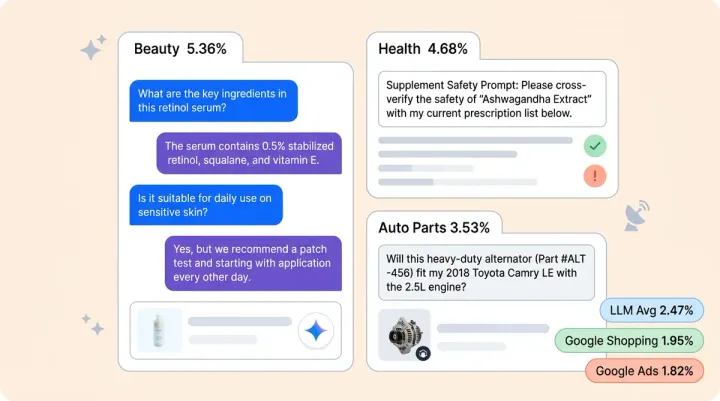
Tatcha saw 3x conversion rates, a 38% AOV uplift, and 11.4% of total Shopify store revenue attributed to Alhena AI-assisted conversations. ChatGPT-referred traffic converts at 2.47% on average, higher than paid search (1.82%) and social ads (0.52%). Alhena AI captures that high-intent ChatGPT traffic and turns it into revenue through its AI Shopping Assistant.
Do I need to choose between ACP and UCP protocols to sell on ChatGPT from my Shopify store?
No. ACP handles the checkout moment while UCP covers the full commerce journey including product discovery SEO. They coexist, and Shopify manages the protocol layer for your store. Alhena AI works on top of both, ensuring your Shopify store product data is structured correctly for whichever protocol ChatGPT or other AI agents use to discover and recommend your products.
How does AI SEO for ChatGPT Shopping differ from traditional Shopify SEO?
Traditional Shopify SEO focuses on Google rankings through keywords, backlinks, and page speed. AI SEO for ChatGPT Shopping focuses on structured product data that ChatGPT can parse: complete metafields, JSON-LD schema, and accurate variant data. When shoppers ask ChatGPT for recommendations, ChatGPT reads structured data, not marketing copy. Alhena AI bridges both by auditing your Shopify store for traditional SEO and ChatGPT-readiness simultaneously.