LLM Traffic Is Now a Top-Four Ecommerce Conversion Channel
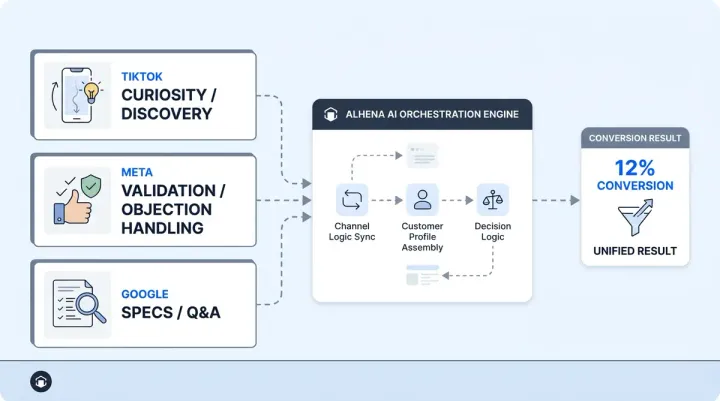
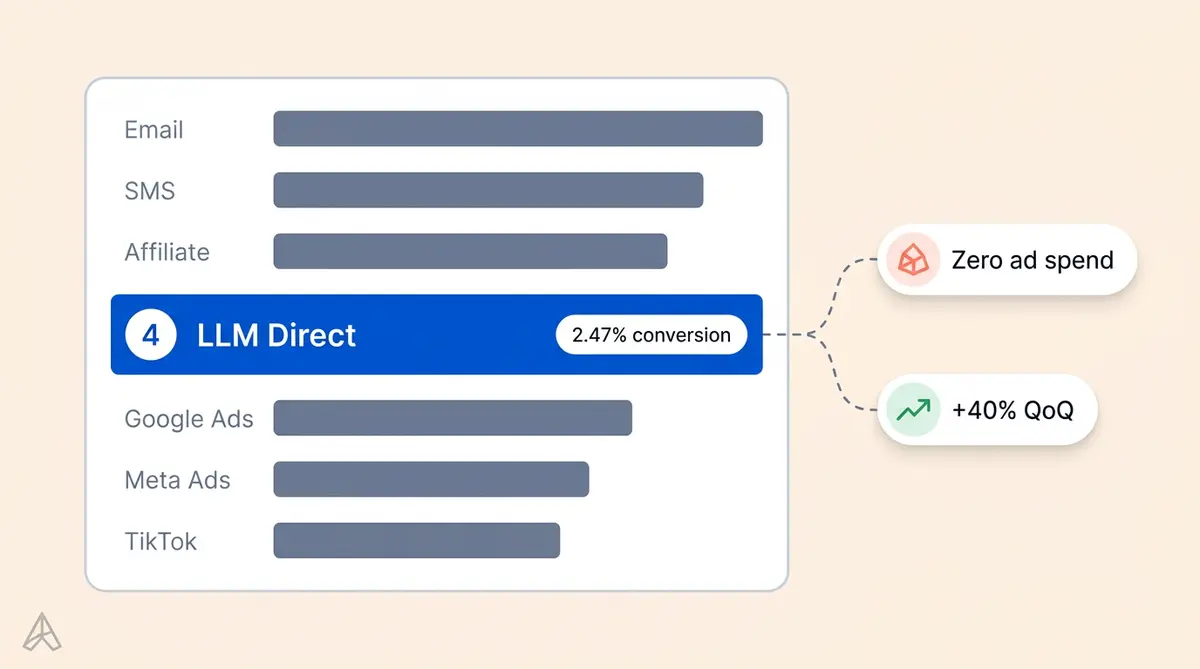
A new dataset from 329 ecommerce brands across the US and EU confirms what many marketing leaders suspected but couldn't prove: LLM traffic converts at a higher rate than Google Shopping, Google Ads, direct traffic, Meta Ads, and TikTok Ads. At 2.47%, the LLM conversion rate places it fourth overall among all measured acquisition channels, trailing only SMS at 5. For a deeper look, see how <a href="https://alhena.ai/blog/ai-conversion-lift-by-channel-tiktok-meta-google/">how AI lifts conversion rates differently across TikTok, Meta, and Google traffic</a>.49%, affiliate at 3.12%, and email at 2.92%. These conversion metrics come from Alhena's Agentic Commerce Report, which analyzed real transaction and conversion metrics data across a diverse portfolio of online sites throughout Q4 2024 and Q1 2025, with performance benchmarks extending into early 2026.
What makes this data particularly striking for online retail directors and CMOs is the economics behind it. LLM traffic is growing at 40% quarter over quarter, and every visit arrives at zero ad spend. No cost-per-click, no bid management, no creative fatigue. Unlike organic search traffic from traditional search engines, LLM referral traffic requires no keyword bidding or SEO bid management, yet it delivers comparable visibility and purchase intent. Brands that once allocated budget exclusively to paid search and social now face a channel that delivers mid-funnel purchase intent without a media line item.
The Full Channel Conversion Ranking from AI Commerce Channel Data
The complete channel ranking reveals a clear hierarchy. SMS leads at 5.49%, followed by affiliate at 3.12%, email at 2.92%, LLM at 2.47%, Google Shopping at 1.95%, Google Ads at 1.82%, direct at 0.73%, Meta Ads at 0.52%, and TikTok Ads at 0.09%. LLM traffic volume outperforms several channels that receive substantial media budgets, which forces a reconsideration of attribution models and how brands optimize acquisition dollars across search engines and AI channels.
Within LLM traffic itself, a single dominant platform, widely understood to be ChatGPT, accounts for 97% of all AI referral traffic. ChatGPT referral sessions carry higher purchase intent than typical organic search referral traffic from search engines to online stores. The secondary platform, while far smaller in volume, drives 57% higher average order value. That gap signals an audience composition difference worth monitoring as the channel matures and consumer discovery through AI assistants, rather than third party ad platforms, becomes routine shopping behavior on ecommerce sites.
Why LLM Traffic Converts at 2.47% Without Paid Media
The conversion strength of LLM-referred visitors ties directly to intent quality. Shoppers arriving from AI platforms have already described what they want in natural language, filtered through a conversational exchange, and received a recommendation before they ever land on a product page. The attribution metrics from this study show that the sequence mirrors the best-case paid search scenario, where a user types a long-tail product query, except here the AI has already pre-qualified the consumer before they ever reach a storefront. Unlike top of funnel paid ads, the consumer has already expressed specific purchase intent.
Geography plays a role, too. US-based LLM traffic converts at 3.50%, while EU traffic converts at just 0.41%. The gap isn't a weakness in the channel itself. It reflects portfolio mix: the US brands in this dataset skew toward higher-intent verticals like beauty and health, while the EU sample includes more browsing-heavy categories. As LLM adoption grows across European markets, that gap should narrow as category coverage from search engines and LLM referral sources evens out. Monitoring ChatGPT referral patterns in GA4 through 2026 shows growing consistency across both markets.
The AI Engagement Multiplier That Changes the Math
Raw LLM traffic conversion rates tell only half the story. Compared to organic search and organic traffic from SEO, the referral quality is significantly stronger. When visitors from any channel engage with Alhena AI on-site, conversion rates jump between 3x and 76x higher compared to visitors who don't interact with the AI assistant. The effect holds across every measured traffic source, not just LLM referrals.
The most dramatic number: LLM visitors who then engage with Alhena AI convert at 9.84%, nearly four times the baseline LLM rate of 2.47%. Cart-to-checkout completion tells a similar story, reaching 49.3% with AI engagement versus 26.3% without. The AI assistant doesn't just answer questions. It reduces bounce and closes the gap between product interest and purchase action by guiding shoppers through sizing, compatibility, and checkout friction in real time.
Alhena touches roughly 1% of total site visitors across these 329 brands but drives approximately 10% of total revenue. That concentration of impact explains why the engagement gap between top-performing deployers and average deployers is 5.5x. Brands that surface the AI concierge at the right moments in the shopping journey capture outsized returns from the same visitor pool.
Vertical Conversion Rates Reveal Where LLM Traffic Hits Hardest
Not all categories benefit equally from AI-referred traffic. Beauty leads at 5.36% LLM conversion, followed by health and wellness at 4.68% and auto parts at 3.53%. The conversion metrics for these verticals share a common trait: shoppers arrive in higher volume with specific needs (a skincare concern, a supplement goal, a part number) that map well to the way LLM platforms handle product queries. Categories with longer consideration cycles or heavy visual discovery, like fashion and home decor, show lower but still competitive LLM conversion rates.
For brands in these top verticals, the implication is clear. Optimizing custom data feeds for AI discovery in depth and pairing that inbound traffic with an on-site AI engagement layer like Alhena's ecommerce solution creates a compounding effect: better-qualified traffic meets a conversion engine tuned to that visitor, outperforming search engines as a discovery channel's intent.
What This Data Means for Your 2025 Budget Allocation
The LLM traffic ecommerce conversion data from this report doesn't suggest abandoning paid channels. It does suggest rebalancing. A channel converting at 2.47% with zero media cost and LLM referral volume growth at 40% per quarter, outpacing organic search and organic traffic channels, deserves a dedicated line in your acquisition strategy, not a footnote in your 2026 planning. For business leaders tracking channel performance and paid social media volume, the data is clear. Brands must invest in AI-discoverable content through AEO (answer engine optimization) and generative AI readiness, much like the early days of SEO and organic search optimization, where early movers captured disproportionate conversion rate gains, structured data for SEO and AEO, and on-site AI engagement to help commerce sites capture and convert this traffic at scale.
The full Agentic Commerce Report from Alhena breaks down these findings with segment-level detail across regions, verticals, and brand size tiers. If you're building your H2 2025 channel strategy, this dataset belongs in your planning deck.
Ready to see how your brand stacks up? Read the full Agentic Commerce Report or book a demo with Alhena AI to explore what AI-engaged conversion at a higher rate looks like for your store.
Frequently Asked Questions
How does LLM traffic compare to Google Ads and Meta Ads for ecommerce conversion rates?
Across 329 brands, LLM traffic converts at 2.47%, outperforming Google Ads at 1.82% and Meta Ads at 0.52%. Alhena AI amplifies this further: LLM visitors who engage with the AI assistant convert at 9.84%, making it one of the highest-performing channel and engagement combinations in modern ecommerce.
What is the ROI of LLM-referred traffic for ecommerce brands with no paid media spend?
LLM traffic arrives at zero cost-per-click and grows 40% quarter over quarter, giving it an effectively infinite ROAS compared to paid channels. Brands using Alhena AI to engage these visitors see cart-to-checkout rates of 49.3% versus 26.3% without, translating that free traffic into measurable revenue with minimal friction.
Which ecommerce verticals see the highest conversion rates from AI-referred shopping traffic?
Beauty leads at 5.36%, followed by health and wellness at 4.68% and auto parts at 3.53%. These categories perform well because shoppers arrive with specific, describable needs that align with how LLM platforms process product queries. Alhena AI helps brands in these verticals capture that intent and convert it on-site.
How should marketing teams adjust their 2025 channel strategy based on LLM traffic growth data?
With LLM traffic ranking fourth in conversion and growing 40% per quarter at no ad cost, ecommerce teams should allocate resources toward AI-discoverable product content and on-site AI engagement layers. Alhena AI enables this shift by converting AI-referred visitors at 3x to 76x higher rates than unassisted sessions across every traffic source.
What separates top-performing ecommerce brands from average ones when it comes to AI-driven revenue?
The engagement gap between the best and average AI deployers is 5.5x, according to the Agentic Commerce Report. Top brands surface Alhena AI at high-intent moments in the shopping journey, which is why the platform touches only 1% of visitors but drives roughly 10% of total store revenue.
Can AI shopping assistants improve conversion rates for traffic that does not come from LLM platforms?
Yes. Alhena AI lifts conversion rates across every channel, not just LLM referrals. Visitors from email, paid search, social, and direct traffic all convert between 3x and 76x higher when they engage with the AI assistant, with cart-to-checkout completion jumping from 26.3% to 49.3% site-wide.