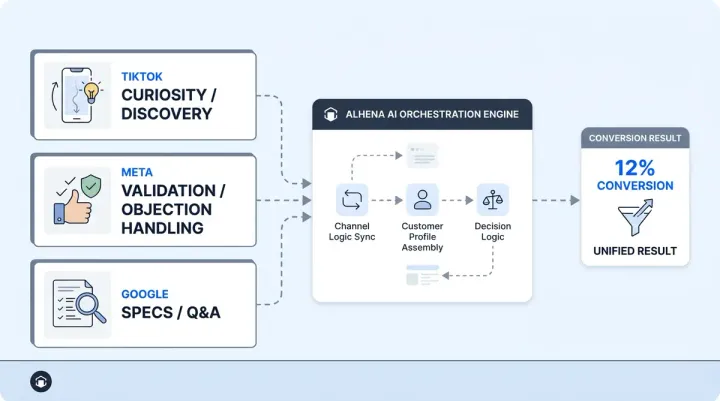
LLM-referred traffic converts at 2.47%. That's higher than Google Ads at 1.82% and more than four times Meta Ads at 0.52%, according to Alhena's Agentic Commerce Report. When a shopper asks ChatGPT "what's the best mineral sunscreen for sensitive skin" and your product shows up in the search results, that visitor is already past the awareness stage. They're ready to buy.
This is generative engine optimization (GEO): the practice of structuring your brand's digital presence so AI engines surface your products in their responses. For ecommerce brands, GEO isn't optional anymore. It's the next channel.
AI-powered shopping discovery is replacing traditional search. Three levers control whether AI recommends you or a rival: on-site data quality, off-site citation building, and review signals. Here's how each one works and what to do about it right now.
Lever 1: On-Site Data Quality
AI engines don't browse your site the way humans do. They crawl structured data, pull from schema markup, and parse text for direct answers. If your product pages read like marketing copy with no specs, no FAQs, and no structured metadata, you're invisible to every model doing retrieval.
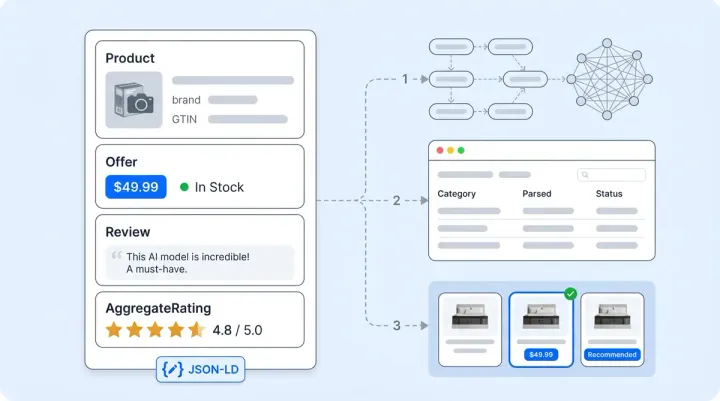
Start with schema markup. Product schema, FAQ schema, review schema, and breadcrumb schema (all implemented via JSON-LD) give AI crawlers the structured signals they need to extract and cite your products. Most ecommerce brands have basic product schema at best. Few have FAQ or review schema on individual PDPs. Adding JSON-LD markup to every product page is the single fastest technical win for GEO. JSON-LD gives generative engines clean, machine-readable data about your product attributes, pricing, and availability.
Next, rewrite product descriptions to answer questions directly. AI models favor natural language content that mirrors how people search. When shoppers type questions into search results or ask AI directly, and content structured this way gets cited more often. Instead of "our lightweight moisturizer leaves skin feeling refreshed," write "this oil-free moisturizer weighs 1.7 oz, absorbs in under 30 seconds, and works on combination and oily skin types." Specificity wins.
Complete spec sheets matter more than you think. Dimensions, ingredients, compatibility, materials, weight, country of origin. If you sell on Google, keep your Google Merchant Center feed complete and accurate, as AI overviews pull directly from Google Merchant Center structured data. Search engines and generative engines both index this feed, making it a dual-purpose asset for search engine optimization and GEO alike. Write your feed descriptions in natural language that answers how shoppers naturally ask about your products. Every missing data point is a missed opportunity for an AI to match your product to a query. The more complete your data, the more discoverable your products become across every generative engine. Discoverable products show up in AI-powered shopping answers, while incomplete products get skipped entirely. AI-powered shopping is growing fast, and every ecommerce brand needs to prepare for this shift in how people discover and buy products.
Alhena AI's Rendering Analysis shows you exactly how generative engines read your pages. It flags gaps in schema, identifies thin content that models skip over, and tells you which product pages are structured well enough to surface in LLM responses. You stop guessing what's wrong and start fixing what matters.
Lever 2: Off-Site Citation Building
On-site optimization gets your data right. Off-site citations get your brand mentioned in the sources AI models trust.
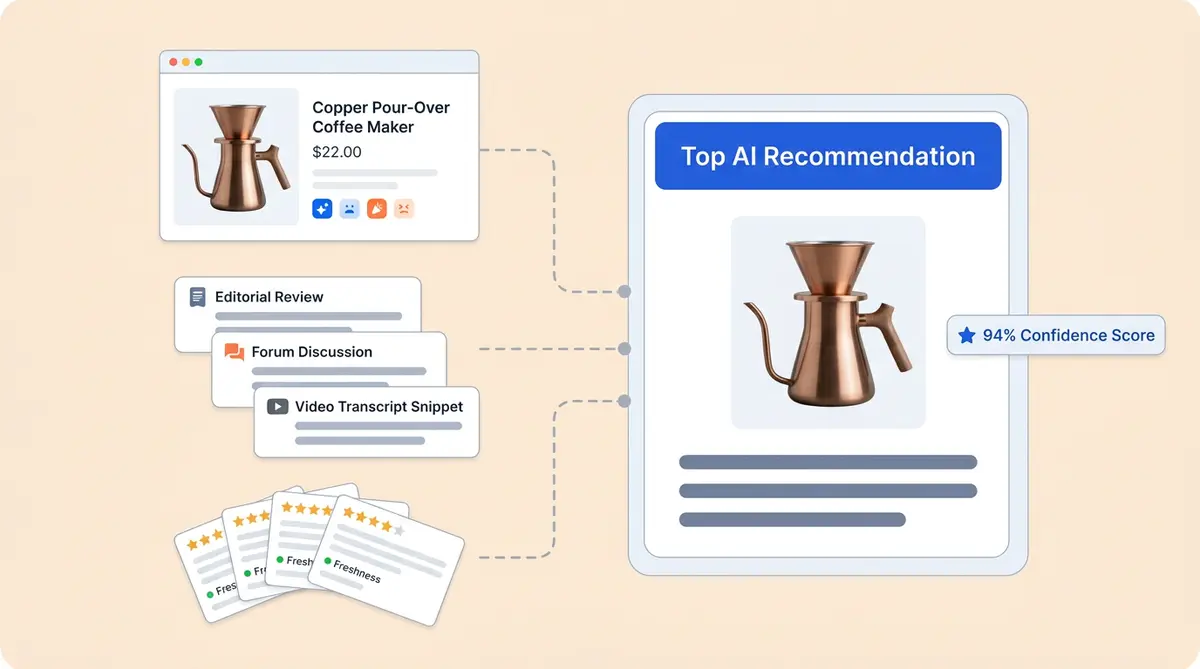
Generative engines pull from a mix of editorial content, community discussions, video transcripts, and reference sites. If your brand appears on zero third-party sources, no amount of schema markup will get you recommended by generative engines. Models weigh external validation heavily when deciding how to rank product recommendations.
Editorial placements in niche publications and buying guides carry real weight. A mention in a "best protein powders for runners" roundup on a fitness site becomes training data and retrieval fodder. Prioritize publications that cover your category with genuine editorial standards. These authoritative sources strengthen your E-E-A-T signals (experience, expertise, authoritativeness, and trustworthiness), which generative engines weigh heavily when deciding what to recommend.
Reddit and Quora presence is underrated. These platforms are core retrieval sources for ChatGPT and Perplexity. Authentic community engagement (not astroturfing) builds the kind of authoritative mentions AI models pick up on. Make sure your brand profiles link back to your site and include a clear privacy policy, as these trust indicators matter to both search engines and generative engines. When real users recommend your product in a relevant thread, that signal compounds. These organic mentions act like backlinks for generative engines, building the kind of trust that makes AI models cite you. Unlike traditional backlinks that boost your Google ranking, GEO backlinks influence what AI recommends directly in its answers.
YouTube reviews contribute through transcripts. A detailed product review from a creator with a focused audience generates text that AI engines index. Wikipedia also plays a role if your brand or category has a relevant entry. Each of these sources adds to your EEAT profile, the experience, expertise, authoritativeness, and trustworthiness signals that every generative engine evaluates.
Alhena AI Visibility's External Source Monitoring tracks what third-party sites are telling AI about your brand. You see which sources mention you, what they say, which queries trigger your brand, and where gaps exist. Instead of building citations blindly, you target the sources that actually influence AI search results and model outputs. You see which queries lead to your products and which sources help you sell products through AI recommendations.
For a practical walkthrough on tracking and attributing revenue from these AI platforms, see our measuring AI search revenue.
Lever 3: Review and UGC Signals
Reviews are one of the strongest signals AI models use when recommending products. But not all reviews carry equal weight.
Volume and recency set the baseline. A product with 12 reviews from 2022 loses to one with 340 reviews from the last six months. AI models interpret fresh, high-volume reviews as a signal of current relevance.
Review content depth matters just as much. "Love it, 5 stars" tells an AI nothing. "I've used this daily for three months on my dry, eczema-prone skin and it hasn't caused a single flare-up" gives the model a specific use-case match it can cite. Encourage detailed reviews by asking specific questions post-purchase. Reviews written in natural language about real use cases give search engines and AI models the signals they need to match your products to natural language queries.
UGC and social proof extend this further. Tagged Instagram posts, TikTok mentions, and customer photos create a broader signal footprint for AI-driven shopping recommendations. These UGC signals fuel AI-powered shopping engines. Generative engines increasingly pull from social platforms as retrieval sources.
Response patterns to reviews also factor in. Brands that respond to reviews, both positive and negative, with useful information generate additional indexable content. These responses build the EEAT trust signals that generative engines use to decide which brands deserve a recommendation.
Here's where Alhena AI's Shopping Assistant creates a unique advantage. Every conversation between a shopper and the AI assistant captures first-party intent data: what questions people ask before buying, what concerns they raise, what comparisons they make. That data feeds directly back into your GEO strategy. You learn exactly what keywords and language real buyers use, then mirror those keywords in your product content, schema markup, and review prompts. Matching real buyer keywords to your product data is the closest thing to a GEO cheat code. No survey required. No guesswork. You get a live feed of the exact keywords, phrases, and questions your buyers use before they convert.
The Numbers That Should Change Your Roadmap
ChatGPT alone drives 97% of all LLM-referred traffic to ecommerce sites. If you're thinking about GEO ecommerce as a multi-engine problem, start with ChatGPT and expand from there.
AI-engaged visitors (those who arrive via an AI-driven shopping experience) convert at 9.84%. That's not a marginal improvement over traditional channels. It's a different category of buyer intent entirely.
Brands that proactively optimize for generative engines see a 5.5x engagement lift compared to those that don't. The gap between optimized and unoptimized brands will only widen as AI-powered shopping becomes the default discovery path for ecommerce brands. If you're still building your entire acquisition strategy around paid search and social ads, you're already behind on generative engine optimization for products.
A Practical Starting Point for GEO Ecommerce
GEO for ecommerce isn't a single project. It's three parallel workstreams: fix your on-site data so AI can read it and help you sell products, build off-site citations so AI trusts you, and amplify review signals so AI recommends you.
The brands doing this now will own the AI-recommended positions in their categories. The brands waiting will spend the next two years wondering why their paid media keeps getting more expensive while conversions flatten.
You don't need to guess whether your brand shows up when a shopper asks ChatGPT, Gemini, or Perplexity for a recommendation. Alhena AI Visibility tells you exactly where you stand, what's working, and what to fix first. If you want to see how your products perform across every major AI engine, explore Alhena AI Visibility and start building your generative engine optimization strategy with real data.
For a deeper look at how agentic commerce and AI visibility work together, read our guide on AI Visibility for agentic shopping and AEO. And if you're looking to improve how your shopping assistant drives conversions, see how AI shopping assistants increase AOV.
For a practical breakdown of the off-site sources that influence AI recommendations, see our GEO citation strategy guide.

Frequently Asked Questions
How do I check if ChatGPT or Google SGE recommends my products?
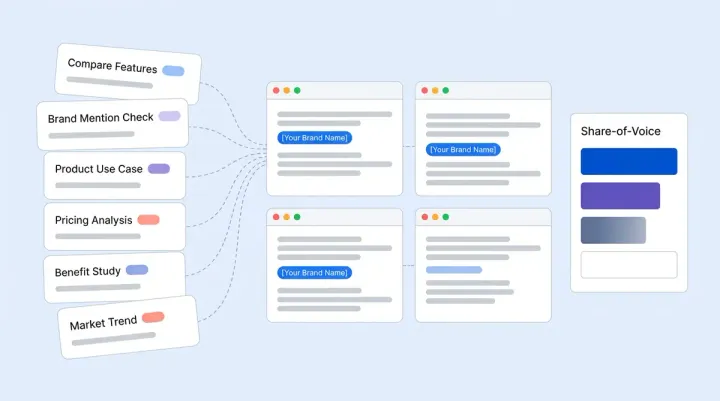
Alhena AI Visibility monitors your brand mentions across ChatGPT, Gemini, Perplexity, and Google SGE in real time. It provides SKU-level tracking so you see exactly which products surface, in response to which queries, and how your share of recommendations compares across your category.
What is generative engine optimization and how is it different from SEO?
GEO focuses on getting your products cited and recommended in AI-generated answers, while traditional SEO targets search engine results pages. SEO and GEO overlap in their technical foundations. Both share foundations like structured data and quality content, but GEO adds schema completeness, off-site citation building, and review depth. Alhena AI tracks both SEO and generative engine visibility from a single dashboard, including the EEAT signals that influence both traditional and AI-driven search results.
How long does it take for GEO changes to show up in AI recommendations?
On-site schema and content updates can influence AI outputs within weeks as models refresh retrieval indexes. Off-site citation building typically takes two to four months. Alhena AI's Rendering Analysis validates whether your changes are being picked up by AI engines, so you measure progress instead of guessing.
What's the ROI of optimizing for AI product recommendations?
LLM-referred traffic converts at 2.47%, above Google Ads (1.82%) and Meta Ads (0.52%). AI-engaged visitors convert at 9.84%. Alhena AI's closed-loop attribution connects AI-driven visits directly to revenue, letting you measure GEO ROI with the same rigor you apply to paid channels.
Can I track which AI engine sends the most qualified traffic to my store?
Yes. Alhena AI Visibility provides multi-engine monitoring across ChatGPT, Gemini, Perplexity, and Google SGE with traffic volume, conversion rates, and revenue attribution broken out by engine. Since ChatGPT drives 97% of current LLM traffic, most brands prioritize there, but tracking all engines catches shifts early.
How do product reviews influence what ChatGPT recommends?
AI models weigh review volume, recency, and content depth when deciding which products to cite. Detailed reviews with specific use cases give models more matching criteria and are cited more frequently in AI answers. Alhena AI's Shopping Assistant captures first-party shopper intent data from real conversations, revealing the exact language buyers use so you can guide review prompts accordingly.
How do I get started with GEO if I have hundreds of SKUs?
Start with your top 20 revenue-driving products. Fix their schema, rewrite descriptions to answer common questions, and audit review depth. Alhena AI's Rendering Analysis prioritizes which product pages need attention first based on how generative engines currently read them, so you focus effort where it moves the needle fastest.
Does GEO work for DTC brands on Shopify or WooCommerce?
Absolutely. GEO applies to any ecommerce platform since it targets how AI engines crawl and cite your product data. Alhena AI integrates with Shopify, WooCommerce, Magento, and Salesforce Commerce Cloud, giving you SKU-level visibility into AI recommendations regardless of your tech stack.
How is Alhena AI's approach to GEO different from general SEO tools?
Most SEO tools track Google rankings. Alhena AI Visibility focuses on AI engine citations, tracking your brand across ChatGPT, Gemini, and Perplexity with rendering analysis that shows how each model reads your product pages. The first-party data from Alhena's Shopping Assistant creates a closed loop between real shopper conversations and your optimization strategy.