AI search engines don't just read your site. They triangulate from off-site sources to decide which products to recommend. Recent publisher studies confirm that over a third of website visitors now arrive via AI-assisted pathways, and that number is climbing fast. The brands earning citations from the right external sources dominate AI recommendations. The rest are invisible.
This is why a GEO citation strategy matters more than any on-site SEO or technical SEO tweak you could make today. Generative engine optimization is about the optimization of controlling the signals that AI search engines pull from off-site sources when building product recommendations. Whether those AI-generated results come from a large language model, Google AI Overviews, or a retrieval augmented generation system, the cited sources are overwhelmingly off-site. If your brand isn't showing up in the places AI actually reads, you're not in the conversation.
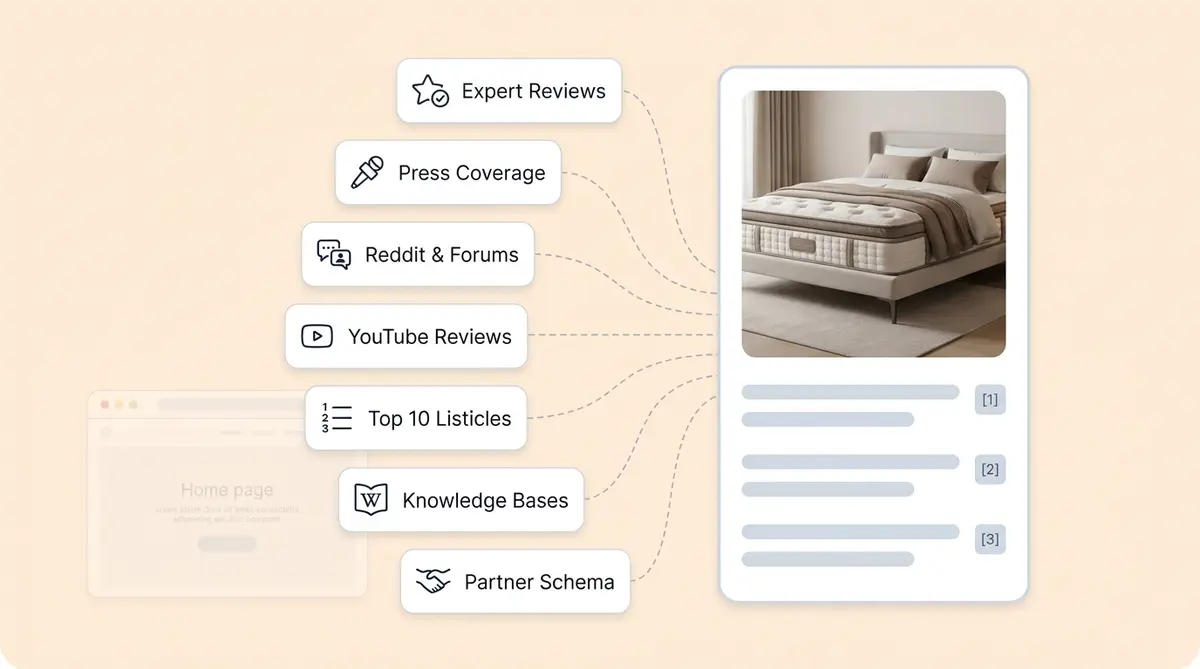
Here are the seven off-site sources that drive AI product recommendations, each with a tactical playbook you can prioritize this week.
1. Niche Editorial Reviews and Buying Guides
AI search engines treat editorial "best of" lists and expert buying guides as high-trust citation sources. The authoritativeness of these editorial sites sources. Industry benchmarks show that product recommendation content from editorial sites generates more AI citations than any other category for buying-intent queries. These aren't generic mentions. They're structured evaluations with specs, comparison tables, pros and cons, and editorial verdicts that AI engines can parse and cite directly.
Action step: Pitch category-specific publications in your vertical for expert product reviews. Provide detailed product data, comparison specs, and high-resolution assets to make their job easy.
2. Reddit Threads and Subreddit Discussions
ChatGPT and other AI search engines heavily index Reddit when building product recommendations. Authentic threads where real users compare products, share experiences, and answer buying questions carry significant citation weight in AI-generated search results. But authenticity matters. AI engines can parse genuine community engagement from astroturfing, and manufactured posts get filtered out of cited pages.
Action step: Build genuine presence in relevant product subreddits through community engagement. Answer real questions, share honest product experiences, and let your community do the talking.
3. YouTube Product Reviews
Video transcripts are fully indexed by AI search engines. A detailed product review from a credible creator gives AI systems a rich, quotable citation source covering features, performance, and real-world use cases. Industry data shows YouTube holds one of the largest citation shares in Google AI overview results, making it a high-ranking source for AI-generated product references.
Action step: Partner with credible creators in your category for detailed, data-rich product reviews. Ensure brand names, product names, and key specs are spoken clearly so transcripts produce accurate cited sources.
4. Expert Roundups and Listicles
AI search engines aggregate authority signals from multiple roundup mentions. When your brand appears across several authoritative expert roundups, AI systems interpret that as broad consensus on your product's relevance. Authoritative list mentions drive a significant share of AI-generated brand recommendations, making roundup placement one of the highest-ranking tactics in any GEO citation strategy and content strategy.
Action step: Contribute expert quotes, original data, or product insights to industry roundups. Earn placement in at least three to five relevant listicles per quarter to build your keyword-level citation footprint.
5. Comparison and Affiliate Sites
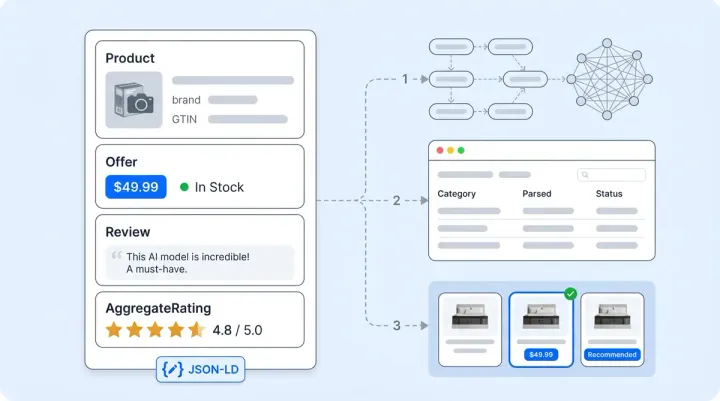
Product comparison pages with detailed spec breakdowns feed AI engines structured data and schema markup they can parse for evaluation. These sites organize product attributes, pricing, ratings, and feature matrices in formats that retrieval augmented generation systems and AI crawlers pull from when optimizing search results. If your product data on affiliate and comparison sites is outdated, AI engines will cite that outdated information.
Action step: Audit your product data on the top five comparison and affiliate sites in your domain. Update specs, pricing, schema, and feature descriptions quarterly to keep AI citations current.
6. Q&A Platforms and Niche Forums
Detailed product answers on Q&A platforms become direct cited sources for AI-generated recommendations. When someone asks a question with buying intent, AI retrieval systems scan Q&A platforms and a knowledgeable answer mentions specific products with reasoning, AI systems pull that directly into their search results. The answers that get cited are specific, experience-based, and informative. Marketing fluff gets ignored by every large language model.
Action step: Identify the top 10 buyer questions in your category across Q&A platforms and niche forums. Answer each with specifics: product names, use cases, and real performance data that AI engines can reference.
7. Wikipedia and Industry Knowledge Bases
Brand or category presence in Wikipedia and vertical databases strengthens entity recognition, which is the foundation AI search engines use to decide if your brand exists in a given category. A significant portion of AI training data comes from Wikipedia content, and Google AI systems treat these knowledge bases as authoritative references. Industry knowledge bases play a similar role, giving AI systems the structured data they need to confidently include your brand in cited pages and AI-generated recommendations.
Action step: Ensure your brand meets notability guidelines through earned media coverage, then verify your presence in relevant industry knowledge bases and vertical directories for comprehensive coverage.
Monitor Your Citation Network with Alhena AI Visibility
Knowing the seven sources is only half the equation. You also need to monitor what those sources actually tell AI about your products, because misinformation in a single Reddit thread or outdated specs on a comparison site can quietly reshape what AI recommends to thousands of shoppers.
Alhena AI Visibility's External Source Monitoring tracks what Reddit, YouTube, review sites, and forums tell AI about your products. It flags misinformation, identifies citation gaps, and shows you exactly where your brand is authoritative versus where it's missing from the conversation.
What makes this different from generic brand monitoring: Alhena connects external citation data to first-party shopping data. You see which products shoppers actually ask about in AI-assisted conversations versus which ones AI recommends from external sources. That mismatch is where revenue leaks. A product your customers love might be invisible in AI-generated search results because it lacks off-site citations, while a product with strong external presence might not match what buyers actually want.
The data backs this up. Across Alhena's platform, LLM-referred traffic converts at 2.47%, with ChatGPT driving 97% of all LLM traffic to ecommerce sites. AI-engaged shoppers convert at 9.84%, and proactive brands see 5.5x higher engagement. The brands optimizing their GEO citation strategy and monitoring their off-site citation network are getting cited and capturing this traffic. The rest are flying blind.
Ready to see what AI search engines are saying about your products? Explore Alhena AI Visibility and start monitoring your off-site citation network today.
Frequently Asked Questions
How does a GEO citation strategy differ from traditional SEO for ecommerce?
Traditional SEO focuses on on-site signals like keywords, backlinks, and page speed. A GEO citation strategy focuses on off-site sources that AI search engines use to build product recommendations. Alhena AI tracks both your external citation footprint and your on-site AI engagement, connecting the two through first-party data so you can see exactly which off-site sources drive actual conversions.
What ROI can ecommerce brands expect from investing in off-site AI citation sources?
Alhena AI data shows LLM-referred traffic converts at 2.47% and AI-engaged shoppers convert at 9.84%. Brands that proactively manage their citation network see 5.5x higher engagement rates. Alhena AI's closed-loop attribution connects each citation source to revenue, so you can measure ROI metrics by source rather than guessing which off-site efforts drive sales.
How do I know which off-site sources are actually driving AI recommendations for my products?
Alhena AI Visibility's external source monitoring tracks what Reddit threads, YouTube reviews, comparison sites, and forums say about your products across multiple AI engines. It identifies which sources AI cites most frequently and flags gaps where your products are absent from AI-generated recommendations. Multi-engine monitoring covers all major AI search platforms, not just one.
Can I track AI citations at the individual product level, not just the brand level?
Yes. Alhena AI provides SKU-level tracking that monitors how each product appears in AI-generated recommendations across off-site citation sources. This goes beyond brand-level mentions to show you exactly which products AI recommends, which ones it ignores, and which cited sources influence each recommendation.
How long does it take to implement a GEO citation strategy and see results?
Most teams can start their first off-site citation efforts within a week. Earned media placements and editorial reviews typically generate AI citations within 4 to 6 weeks. Alhena AI's rendering analysis and multi-engine monitoring let you track citation progress from day one, so you're not waiting months to measure impact.
How does Alhena AI Visibility compare to general brand monitoring tools for GEO?
General brand monitoring tools track mentions across the web but don't connect them to AI recommendation behavior. Alhena AI Visibility is built specifically for ecommerce GEO. It combines external source monitoring with first-party shopping data, showing you which products shoppers ask about versus which ones AI recommends, and closed-loop attribution ties each citation source directly to revenue.
What happens if off-site sources have outdated or incorrect information about my products?
AI search engines cite whatever information they find, accurate or not. A single outdated spec on a comparison site can quietly misdirect AI recommendations for thousands of queries. Alhena AI's external source monitoring flags misinformation and data mismatches across Reddit, YouTube, review sites, and forums so you can correct errors before they cost revenue.
How do I measure whether my GEO citation strategy is working across different AI engines?
Alhena AI provides multi-engine monitoring that tracks your citation presence across all major AI search platforms. Combined with rendering analysis that shows how each AI engine displays your products, you get a complete view of your citation effectiveness. First-party data from Alhena's shopping assistant closes the loop by connecting AI-referred traffic to actual purchases.
Which off-site citation source should ecommerce brands prioritize first?
Niche editorial reviews and buying guides consistently generate the highest citation volume for buying-intent queries. Start there, then expand to YouTube reviews and Reddit presence. Alhena AI's SKU-level tracking shows which products lack off-site citations, so you can prioritize outreach for the products with the biggest gap between customer demand and AI recommendation visibility.