Forethought has earned its place in enterprise customer service. Its Solve and Triage modules route tickets efficiently for companies like Upwork and Grammarly. But ecommerce runs on a different clock, with different problems, and Forethought wasn't built to solve most of them.
The platform requires roughly 20,000 historical tickets to train its AI. It quotes custom pricing with no public rate card. Deployment takes 30 to 90 days. And the biggest gap for online retailers: Forethought can't recommend products, recover abandoned carts, or tie a single dollar of revenue back to an AI conversation. With 89% of retailers now using AI daily or running pilots, ecommerce brands need tools built for how they actually sell. This guide breaks down seven Forethought alternatives that fit the ecommerce use case, what each does best, and how to choose between them.
Why Ecommerce Brands Are Moving Beyond Forethought
Forethought built its reputation on enterprise ticket triage. Its Solve, Triage, and Assist modules handle high-volume support queues, and its patent-pending Autoflows technology lets teams train AI agents with natural language. For SaaS companies managing thousands of IT-style tickets, it works.
Ecommerce doesn't work that way. Your customers aren't filing IT tickets. They're asking which moisturizer suits combination skin, whether their order ships to Canada, or if that sofa comes in navy. They want to buy things, and the AI sitting in your chat widget is the first point of contact.
Here's where Forethought falls short for online retail:
- No sales capabilities: Forethought can't recommend products, populate carts, or trigger checkout nudges. It deflects tickets. It doesn't sell.
- Limited ecommerce integrations: No deep Shopify order management, no WooCommerce product sync, no return processing workflows.
- High data requirements: You need roughly 20,000 historical tickets or 2,000 tickets per month for the AI to perform well. Many growing ecommerce brands don't have that volume.
- Slow deployment: 30 to 90 days with professional services, compared to under 48 hours for ecommerce-native tools.
- Opaque pricing: Custom quotes make budgeting and ROI forecasting difficult.
- No revenue attribution: You can measure deflection rates, but you can't tie AI conversations to actual sales.
Trustpilot reviewers note that Forethought's AI sometimes gets "stuck in conversational loops" without escalating to a human agent. For ecommerce, where a stuck conversation means a lost sale, that's a costly failure mode.
What to Look for in a Forethought Alternative for Ecommerce
Before comparing platforms, it helps to know which features separate ecommerce-ready AI from general-purpose support tools. These six criteria provide a comprehensive framework for every evaluation below. Match these to your specific needs.
- Ecommerce platform depth: Does the AI pull real-time product data, order history, and inventory from Shopify, WooCommerce, or Magento? Surface-level integrations that only read ticket fields won't cut it.
- Sales and support in one agent: Can the AI recommend products, recover carts, and upsell, or does it only answer questions after the sale?
- Hallucination prevention: 51% of organizations reported negative outcomes from generative AI inaccuracy in 2025. Ecommerce AI handles pricing, stock levels, and policies where a wrong answer costs real money.
- Deployment speed: Peak seasons don't wait. Tools that go live in days beat those that need months of professional services.
- Pricing transparency: Per-resolution billing can punish success. Predictable pricing makes ROI forecasting possible.
- Revenue attribution: If you can't prove AI-generated revenue, you can't justify the spend. Look for built-in analytics that tie conversations to completed purchases.
7 Best Forethought Alternatives for Ecommerce in 2026
1. Alhena AI (Best for Ecommerce both Sales & Support)
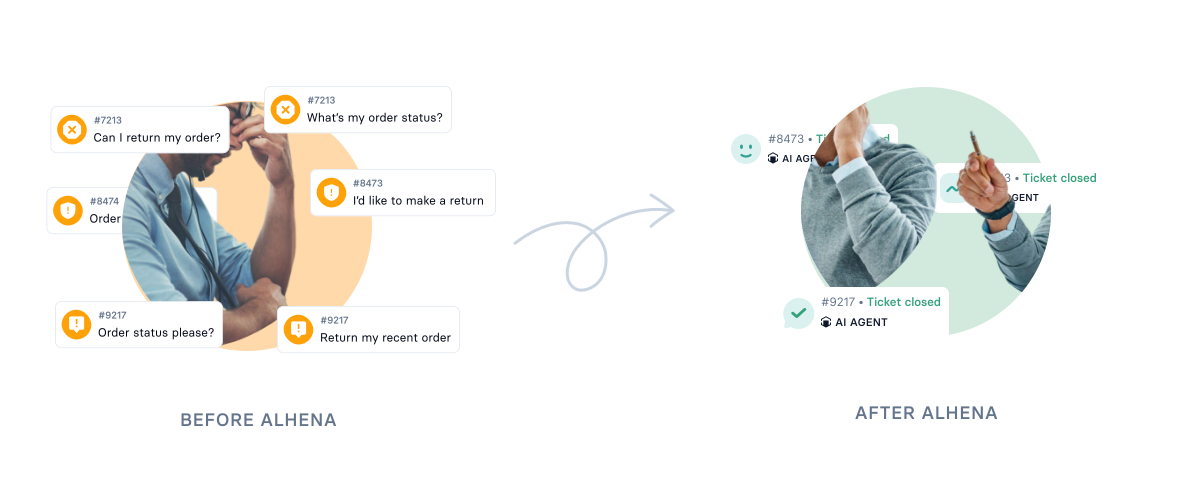
Alhena AI was built from day one as an ecommerce AI, not a support tool with commerce bolted on. It runs two specialized agents: a Product Expert Agent that handles conversational product discovery, recommendations, and guided selling, and an Order Management Agent that processes returns, tracks shipments, modifies orders, and resolves post-purchase issues autonomously.

What separates Alhena from Forethought is the sales side. The Product Expert Agent replaces traditional search filters with natural conversation. A shopper types "I need a moisturizer for dry skin under $40" and Alhena responds with matching products from your catalog, complete with variant selection and add-to-cart actions. Conversion nudges trigger when hesitation signals appear, like a shopper lingering on a product page. Timed prompts with social proof or limited-time offers push toward checkout.
Alhena's AI is grounded in verified product data, which means it doesn't hallucinate prices, ingredients, or availability. Every response pulls from your actual catalog, help center, and order system through deep integrations with Shopify, WooCommerce, Salesforce Commerce Cloud, and Magento.
On the helpdesk side, Alhena connects with Zendesk, Freshdesk, Gorgias, Intercom, and others, so it layers on top of whatever systems you already use.
Results speak clearly. Tatcha saw a 3x conversion rate, 38% average order value uplift, and 11.4% of total site revenue attributed to AI conversations. Manawa dropped response times from 40 minutes to 1 minute while cutting workload by 43%. Crocus hit an 86% deflection rate with 84% customer satisfaction.
Pricing: Starts at $239/month. Free trial available with 25 conversations. Tiered subscription, no per-resolution surcharges.
Channels: Omnichannel: web chat, email, SMS, WhatsApp, Instagram DMs, Facebook Messenger, Discord, voice.
Deployment: Live in under 48 hours. No dev resources required. Simple setup.
Best for: Ecommerce brands of any size that want AI to sell and support across every channel.
2. Gorgias Automate
Gorgias launched its AI Agent 2.0 in mid-2025, adding a Shopping Assistant mode alongside its established Support Agent. The platform understands Shopify data deeply: it reads order history, processes returns, and can edit orders directly from the conversation.
The Shopping Assistant proactively engages visitors based on browsing behavior, suggests products, applies discount codes, and nudges toward checkout. Gorgias supports 80+ languages and includes revenue attribution for AI-driven sales.
The catch? Gorgias's AI Agent only works on Shopify. If you run WooCommerce, Magento, or a multi-platform stack, the AI features aren't available. Pricing also compounds: each AI resolution costs $1.00 and counts as a helpdesk ticket, eating into your plan's ticket allotment.
Pricing: Helpdesk from $10/month (50 tickets). AI Agent at $1.00 per resolution. Overages at $0.36 to $0.40 per ticket.
Best for: Shopify-only brands with high ticket volume that want deep order management and proactive selling.
3. Zendesk AI Agents
Zendesk's AI Agents layer generative AI on top of the world's most widely used helpdesk, offering automated responses, knowledge base suggestions, and agent copilot features. If your support teams already live in Zendesk, the AI activates without migrating anything.
For ecommerce, Zendesk AI has clear limits. It can deflect common questions and suggest help articles, but it can't recommend products, populate carts, or track revenue from AI conversations. It's a support tool, not a sales tool. The ecommerce-specific gaps become obvious when a shopper asks "which running shoe is best for flat feet?" and the AI can only link to a generic FAQ page.
Pricing: Suite Team at $55/agent/month (includes 50 AI resolutions per agent). Additional resolutions at $1.50 to $2.00 each. High-volume ecommerce teams often land at $200 to $500 per agent monthly.
Best for: Enterprise teams already invested in Zendesk that primarily need support automation, not ecommerce sales.
4. Intercom Fin AI
Intercom Fin reports a 67% resolution rate across 40 million+ conversations. Its Procedures feature lets teams build multi-step workflows in natural language, and the Fin Optimize Dashboard provides granular performance debugging. Fin is genuinely strong at autonomous support resolution.
The ecommerce story is thinner. Fin connects to Shopify for basic order visibility, but it can't automate returns, trigger order-status messages in chat, or enter customer addresses during order creation. It also lacks a native Klaviyo connection, which matters for ecommerce brands running email and SMS flows. G2 reviewers consistently report that actual costs run 60 to 80% above the base seat price once per-resolution fees add up.
Pricing: Essential at $29/seat/month. Advanced at $85/seat/month. AI resolutions at $0.99 each on top of seat costs.
Best for: SaaS and tech companies already on Intercom. Ecommerce brands may find it too thin on commerce-specific workflows.
5. Tidio (Lyro AI)
Tidio combines a rule-based chatbot builder (Flows) with its Lyro AI agent. The Shopify integration is solid: Lyro can view carts, recommend products with variant selection, issue refunds, and check shipping status from within the chat widget. With a 4.6-star Shopify App Store rating, small merchants trust it.
Lyro's product recommendation engine pulls directly from your Shopify catalog, matching items by price range, complementary products, and browsing behavior. For smaller stores that want AI-powered selling without enterprise pricing, Tidio deserves a look.
The downside is complexity. Tidio's pricing stacks multiple add-ons: a base plan, a Lyro AI add-on, a Flows add-on, and conversation overages. What looks like $29/month can quickly triple. Enterprise integrations are limited, and the platform is primarily designed for Shopify and WooCommerce rather than larger commerce stacks.
Pricing: Free tier (50 conversations, 10 seats). Starter from $24/month. Lyro AI add-on from $32.50/month for 50 AI conversations.
Best for: Small to mid-sized Shopify or WooCommerce stores that want affordable AI chat with product recommendations.
6. Freshdesk Freddy AI
Freshworks packages its AI as Freddy, available across Freshdesk and Freshchat. Freddy AI Agent handles autonomous chat and email responses, while Freddy Copilot assists human agents with reply drafting, summarization, and translation. The platform includes 50+ pre-built "Vertical AI Agents" with workflows for common ecommerce scenarios like order lookups, subscription changes, and refund processing.
The limitation is ecosystem lock-in. Freddy only works within Freshworks products. You can't deploy it on Zendesk, Intercom, or Gorgias. Resolution rates vary widely in practice, ranging from 23% to 75% depending on the use case. Email automation covers only the first message in a thread, which limits its usefulness for back-and-forth order issues.
Pricing: Requires Freshdesk Pro ($49/agent/month) or Enterprise ($79/agent/month). Freddy AI Agent at $100 per 1,000 sessions. Copilot at $29 to $35/agent/month add-on.
Best for: Mid-market businesses already in the Freshworks ecosystem that want AI added to their existing helpdesk.
7. Ada CX
Ada targets large enterprises handling massive conversation volumes. Its Reasoning Engine combines NLP and LLMs with Playbooks for multi-step automation. Ada supports chat, email, voice, and social messaging with enterprise-grade security and role-based permissions. Multilingual support is strong, and the coaching system helps the AI improve continuously.
The barrier is cost. Ada starts around $30,000 per year, with enterprise contracts reportedly reaching $300,000+. Per-resolution costs range from $1 to $3.50 per ticket. For most ecommerce brands, that pricing only makes sense at 100,000+ monthly conversations. Smaller teams won't see a return.
Pricing: Starts around $30,000/year. Per-resolution at $1 to $3.50. Fully custom-quoted.
Best for: Large enterprise ecommerce operations with massive conversation volume and budget for premium AI.
Forethought Alternatives Comparison: Side by Side
Forethought Alternatives for Ecommerce: At a Glance
| Platform | Core Focus | Ecommerce Sales | Starting Price | Deploy Time |
|---|---|---|---|---|
| Alhena AI | Ecommerce sales + support | Full (recs, cart, checkout) | $239/mo (free tier) | Under 48 hours |
| Gorgias Automate | Shopify support + selling | Yes (Shopify only) | $10/mo + $1/resolution | 1 to 2 weeks |
| Zendesk AI | Enterprise support | No | $55/agent/mo | 2 to 4 weeks |
| Intercom Fin | Conversational support | Limited | $29/seat + $0.99/res | 1 to 3 weeks |
| Tidio (Lyro) | SMB chat + product recs | Yes (basic) | Free / $24/mo | Same day |
| Freshdesk Freddy | Freshworks ecosystem AI | Partial (workflows) | $49/agent + AI add-on | 1 to 2 weeks |
| Ada CX | Enterprise automation | Partial (via APIs) | ~$30,000/year | 4 to 12 weeks |
How to Choose the Right Forethought Alternative
The right platform depends on your store's setup and growth plans. Here's a quick decision framework.
If you sell on Shopify only and your primary concern is support automation, Gorgias gives you the deepest native integration. But if you also want AI that actively sells, Alhena AI covers both sides while also working across other platforms.
If you're a small store on a tight budget, Tidio's free tier gets you started with basic AI chat. The conversation add-on is affordable at low volume. Just watch the add-on stacking as you grow.
If you're locked into Zendesk or Freshdesk, you don't have to rip and replace. Alhena AI's Agent Assist layers on top of both platforms, adding ecommerce sales capabilities their native AI doesn't have. Keep your helpdesk. Gain a revenue-generating shopping assistant.
If you're enterprise-scale with 100K+ monthly conversations, Ada CX offers the security and customization large operations need, at a price tag to match. Alhena AI handles enterprise volume too, at a fraction of the cost and with ecommerce features Ada doesn't offer out of the box.
If you run a multi-platform commerce stack, Alhena AI is the only option on this list that deeply integrates with Shopify, WooCommerce, Magento, and Salesforce Commerce Cloud while connecting to every major helpdesk. Gorgias's AI is Shopify-locked. Tidio covers Shopify and WooCommerce. The rest treat ecommerce integrations as an afterthought.
The Real Cost of Support-Only AI in Ecommerce
A February 2026 Gartner survey found that 91% of customer service leaders face executive pressure to implement AI this year. But implementing AI that only handles post-purchase tickets misses the bigger opportunity.
Consider the math. AI-powered customer interactions cost roughly $0.50 on average versus $6.00 for a human agent. That 12x cost saving is table stakes. The real question is whether your AI also generates revenue.
Industry data shows AI chatbots deliver 15 to 35% revenue increases through improved conversion and upselling. Brands using Alhena AI have attributed 11.4% of total site revenue to AI conversations, with a 38% lift in average order value. That's not cost reduction. That's growth.
Forethought measures success in deflection rates. That metric tells you how many tickets humans didn't touch. It says nothing about sales the AI helped close, carts it recovered, or revenue it drove. For ecommerce, that gap between deflection and revenue is the gap between a cost center and a profit center.
Key Takeaways
- Forethought works for enterprise SaaS support but lacks the sales features, ecommerce integrations, and revenue attribution online retailers need in 2026.
- The best Forethought alternatives for ecommerce combine customer support automation with active selling: product recommendations, cart recovery, and checkout assistance.
- Alhena AI leads this list with hallucination-free responses, full ecommerce platform coverage, and proven results like 3x conversion at Tatcha and 86% deflection at Crocus.
- Gorgias is strong for Shopify-only brands but locks out WooCommerce and Magento stores from its AI features.
- Zendesk AI and Intercom Fin are excellent support tools that weren't designed to drive ecommerce revenue.
- Pricing models vary wildly. Per-resolution billing (Gorgias, Intercom, Zendesk) creates unpredictable costs. Tiered subscriptions (Alhena, Tidio) offer better budget control.
- Prioritize deployment speed measured in days, not months. Peak seasons don't wait for a 90-day implementation.
Ready to turn your customer service into a revenue channel? Book a demo with Alhena AI to see how ecommerce brands drive 3x conversions with AI, or start for free with 25 conversations. Use the ROI Calculator to estimate your return before committing.

Frequently Asked Questions
Why do ecommerce brands look for Forethought alternatives?
Forethought focuses on enterprise ticket triage and lacks ecommerce-specific features like product recommendations, cart recovery, and revenue attribution. It also requires roughly 20,000 historical tickets to train and takes 30 to 90 days to deploy, which doesn't fit the speed most online retailers need.
Which Forethought alternative is best for Shopify stores?
Alhena AI and Gorgias both offer deep Shopify integrations. Gorgias gives you strong order management but limits its AI Agent to Shopify only. Alhena AI works across Shopify, WooCommerce, Magento, and Salesforce Commerce Cloud, making it the better choice if you sell on multiple platforms or plan to expand.
Can Forethought alternatives drive ecommerce revenue, not just deflect tickets?
Yes. Platforms like Alhena AI combine support automation with active selling, including product recommendations, cart recovery nudges, and checkout assistance. Tatcha attributed 11.4% of total site revenue to Alhena AI conversations, with a 3x conversion rate and 38% average order value uplift.
How much do Forethought alternatives cost for ecommerce?
Pricing ranges from free (Tidio's starter tier) to $30,000+ per year (Ada CX). Alhena AI starts at $239/month with a free 25-conversation tier. Gorgias charges $1.00 per AI resolution. Zendesk and Intercom use per-agent plus per-resolution models that can climb quickly at high volume.
How fast can I deploy a Forethought alternative?
Deployment speed varies significantly. Alhena AI goes live in under 48 hours with no dev resources. Tidio can be set up same-day for basic chat. Gorgias and Freshdesk take 1 to 2 weeks. Ada CX and Forethought itself can take 4 to 12 weeks with professional services.
Do any Forethought alternatives work with Zendesk or Freshdesk?
Alhena AI integrates with both Zendesk and Freshdesk, layering ecommerce sales capabilities on top of your existing helpdesk. You don't need to migrate. Alhena also connects with Gorgias, Intercom, HubSpot, and other major helpdesk platforms.
What is hallucination-free AI and why does it matter for ecommerce?
Hallucination-free AI means every response is grounded in verified data, like your product catalog, order system, and help center, rather than generated from probabilities. In ecommerce, a hallucinated price, wrong ingredient list, or fabricated return policy can cost sales and erode trust and damage the customer experience. Alhena AI uses retrieval-augmented generation to prevent this.
Is Alhena AI better than Forethought for ecommerce?
For ecommerce specifically, yes. Forethought excels at enterprise SaaS ticket triage but can't recommend products, recover carts, or attribute revenue. Alhena AI was purpose-built for ecommerce with two specialized agents for selling and support, plus integrations with every major commerce and helpdesk platform. Brands like Tatcha, Manawa, and Crocus have documented measurable results.